
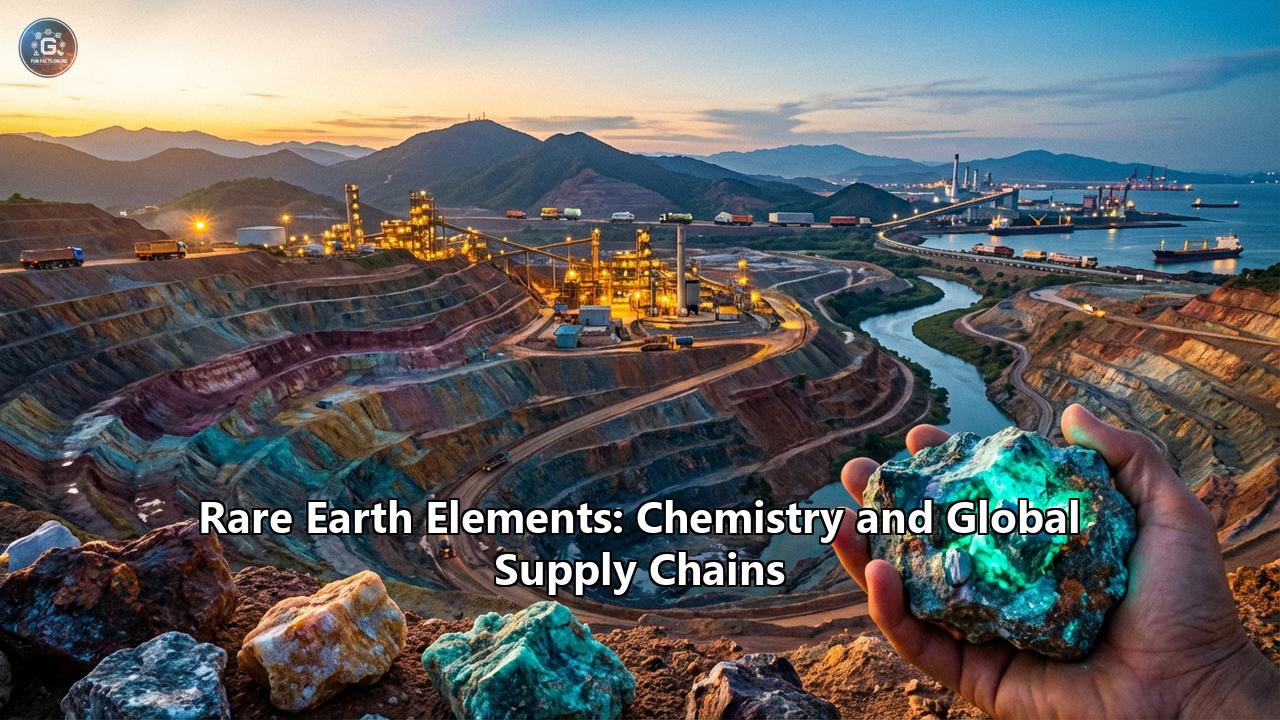
In the periodic table, there exists a row of elements often relegated to a footnote—detached, floating at the bottom like an island of misfits. To the casual observer, they are the "Lanthanides," a difficult-to-pronounce cluster of metals with tongue-twisting names like Praseodymium, Dysprosium, and Ytterbium. But to the geologist, the physicist, and the geopolitical strategist, these fifteen elements, along with their cousins Scandium and Yttrium, are the "Rare Earth Elements" (REEs). They are the invisible skeleton of the 21st century.
Without them, the digital age would cease to exist. There would be no smartphones to connect us, no electric vehicles to drive us toward a greener future, no fiber-optic cables to carry the internet across oceans, and no precision-guided missiles to define modern warfare. They are the vitamins of modern industry—required in small doses, but absolutely vital for health.
Yet, despite their name, they are not rare. Cerium is more abundant in the Earth's crust than copper or lead. Thulium, the rarest of the stable lanthanides, is more common than iodine or gold. Their "rarity" is a geologic and chemical paradox: while they are everywhere, they are almost never found in concentrated, economically viable deposits. They are chemically "promiscuous," bonding readily with other elements and scattering themselves diffuse across the planet's surface. Worse still, they are social creatures; they are almost always found mixed together, and separating them is one of the most difficult challenges in chemical engineering.
This article explores the total landscape of Rare Earth Elements—from the quantum mechanics of their electron shells that give them their superpowers, to the acid-drenched processing plants where they are refined, and finally to the boardrooms and situation rooms where nations vie for control over these "Elements of Power."
Part I: The Quantum Magic – Chemistry of the Lanthanides
To understand why a wind turbine needs Neodymium or why a missile guidance system needs Samarium, we must zoom in to the atomic level. The magic of rare earths lies in their electron configuration, specifically in the filling of the 4f orbital.
The 4f Shell and the "Buried" Electrons
In most elements, the valence electrons—the ones that do the chemical bonding and determine properties—are on the outside of the atom. When you look at carbon or iron, their chemically active electrons are exposed to the world. Rare earths are different.
As we move across the lanthanide series from Lanthanum (atomic number 57) to Lutetium (71), electrons are added to the 4f subshell. However, this 4f shell is spatially "buried" inside the atom, shielded by the filled 5s and 5p shells, and even the outer 6s electrons. This means the 4f electrons are largely protected from the surrounding environment. They don't participate strongly in chemical bonding, which is why all rare earths behave so similarly chemically—they all generally form +3 ions and look identical to a standard chemical reagent.
But physically, these 4f electrons are the source of the magic. Because they are unpaired and shielded, they retain their atomic magnetic moments even when the atom is locked in a solid crystal. In iron or cobalt, the crystal structure can quench magnetism. In Neodymium or Dysprosium, the 4f electrons act like tiny, isolated bar magnets that refuse to be bullied by their neighbors. This allows for the creation of super-strong permanent magnets.
The Lanthanide Contraction
The defining feature of rare earth chemistry, and the bane of every process engineer, is the Lanthanide Contraction.
As you move from left to right across the periodic table, you add protons to the nucleus and electrons to the shell. Usually, the extra electrons shield the outer shell from the extra positive charge of the nucleus, so atoms get slightly bigger or stay the same size. But 4f electrons are terrible at shielding. They have a diffuse shape that doesn't effectively block the pull of the nucleus.
Therefore, as we step from Lanthanum to Cerium to Praseodymium, the increasing positive charge of the nucleus pulls the outer electron shells tighter and tighter. The result is a steady, predictable shrinkage of the ionic radius across the series.
- Lanthanum (La3+): ~1.03 Angstroms
- Lutetium (Lu3+): ~0.86 Angstroms
This might seem trivial, but it is the only real difference chemists have to work with. Because their chemical reactivity is nearly identical, we cannot separate them using standard chemical reactions. We must exploit these tiny differences in size to separate them, a process that requires thousands of repetitive steps.
Part II: Geology – The Paradox of Abundance
If rare earths are everywhere, why are mines so rare? The answer lies in mineralogy. While REEs substitute easily into common rock-forming minerals, they rarely form their own concentrated minerals. When they do, they fall into two primary categories: Hard Rock deposits and Ionic Adsorption Clays.
The Hard Rock Giants: Carbonatites
The most famous rare earth mines in the world—Bayan Obo in China and Mountain Pass in California—are hosted in Carbonatites. These are bizarre igneous rocks. While most volcanoes spew silicate lava (molten glass), carbonatite volcanoes spew molten calcium carbonate—essentially washing soda and limestone.
In these strange geologic melts, rare earths are concentrated into specific minerals:
- Bastnaesite: A fluoro-carbonate mineral. It is the primary source of "Light Rare Earths" (LREEs) like Lanthanum, Cerium, and Neodymium. It is relatively easy to process but often contains radioactive Thorium.
- Monazite: A phosphate mineral. It is richer in "Heavy Rare Earths" (HREEs) but is inextricably linked with Thorium, making it radioactive and politically difficult to mine in many Western jurisdictions.
The Silent wealth: Ionic Adsorption Clays
In the sub-tropical hills of Southern China and Myanmar, a different type of deposit exists. Over millions of years, granite rocks rich in rare earths have weathered in the warm, acidic rain. The rock breaks down into clay (kaolinite), and the rare earth ions are released.
Instead of washing away, these positive ions (cations) get stuck—or "adsorbed"—onto the surface of the negatively charged clay particles, much like a magnet sticking to a fridge.
These deposits are low grade (often 0.05% to 0.2% REE), but they are incredibly valuable. Why?
- Easy Extraction: You don't need to blast rock or crush ore. You just need to wash the clay with salt water (ammonium sulfate), and the rare earths pop off.
- Heavy Earth Rich: These clays are the world's primary source of the lucrative Heavy Rare Earths (Dysprosium, Terbium) needed for high-temperature magnets.
Part III: From Ore to Element – The Processing Gauntlet
Mining is the easy part. The true bottleneck in the global supply chain is processing. Turning a chunk of ore into a pure metal oxide is a feat of chemical endurance.
Step 1: Beneficiation and Crushing
For hard rock mines like Mountain Pass, the ore is crushed to a fine powder. Using a process called Froth Flotation, specific chemicals are added to a water tank. These chemicals attach only to the rare earth minerals, making them hydrophobic (water-fearing). When air bubbles are blown through the tank, the rare earth minerals cling to the bubbles and float to the surface, forming a froth that is skimmed off. This concentrates the ore from ~8% to ~60%.
Step 2: The Acid Roast
The concentrated ore is then baked in a kiln with concentrated sulfuric acid at temperatures up to 300°C. This terrifying process cracks the mineral structure, converting the insoluble phosphates and carbonates into water-soluble sulfates. The result is a liquid soup containing all 17 rare earths, plus iron, uranium, thorium, and other impurities.
Step 3: Solvent Extraction (SX) – The Million-Stage Problem
This is the heart of the industry. We now have a liquid mix of rare earths. How do we separate Neodymium from Praseodymium when they are chemically almost identical?
We use Solvent Extraction. The technique relies on two immiscible liquids: an aqueous phase (acidic water containing the REEs) and an organic phase (kerosene containing a special extractant molecule, usually P507 or Cyanex 272).
These extractant molecules are designed to grab rare earth ions. However, because of the Lanthanide Contraction, they grab heavier, smaller rare earths slightly more tightly than lighter, larger ones. The "separation factor" between adjacent elements (like Nd and Pr) is tiny—often less than 1.5.
To get 99.9% purity, you cannot do this once. You must do it hundreds or thousands of times.
- The Mixer-Settler: The liquids are mixed (shaken) so the transfer happens, then allowed to settle so they separate. The organic layer moves one way, the aqueous layer the other.
- The Cascade: A typical separation plant looks like a sea of blue plastic boxes. A single separation line might have 1,000 mixer-settler units connected in series. The liquid moves counter-current, slowly enriching the desired element.
This process is chemical brute force. It consumes vast amounts of acid, alkali, and water. It is finicky; a slight temperature change or impurity can ruin the separation, forcing the plant to recycle the liquid and start over.
Part IV: The Elements of Power – Applications
Why go through this trouble? Because modern technology is impossible without them.
1. The Permanent Magnet (NdFeB)
This is the single most important driver of the rare earth economy, accounting for over 90% of the market's value. The Neodymium-Iron-Boron magnet is the strongest permanent magnet known to physics.
- The Mechanism: The crystalline structure of Nd2Fe14B locks the magnetic moments of the iron atoms into alignment. The Neodymium atom provides "magnetocrystalline anisotropy"—basically, it acts as an anchor. The 4f electron shell resists turning, preventing the magnet from demagnetizing even under strong opposing forces.
- The Heat Problem: Pure NdFeB loses its magnetism at high temperatures (above 80°C). This is useless for an electric vehicle motor, which runs hot.
- The Solution (Dysprosium/Terbium): By replacing some Neodymium atoms with Heavy Rare Earths like Dysprosium (Dy) or Terbium (Tb), the magnet's resistance to heat and demagnetization skyrockets. This is why HREEs are critical for EVs and wind turbines. A single offshore wind turbine can contain 2 tons of rare earth magnets.
2. Phosphors and Luminescence
If you are reading this on a screen, you are looking at rare earths.
- Europium (Eu): The only element that produces a perfect, narrow-band red light. Without Europium, there were no color CRTs, and there would be no rich red LEDs today.
- Terbium (Tb): Provides the brilliant green phosphor.
- Yttrium (Y): Acts as the host matrix (Yttrium Aluminum Garnet, or YAG) for white LEDs.
The physics here involves "f-f transitions." Because the 4f shell is shielded, the energy levels are very specific and don't blur out due to vibration. When an electron jumps between these levels, it emits a photon of an exact, pure color.
3. Catalysts and Polishing
- Cerium (Ce): The workhorse. It shuttles easily between the +3 and +4 oxidation states. This ability to grab and release oxygen makes it perfect for catalytic converters in cars (converting carbon monoxide to CO2) and for Chemical Mechanical Polishing (CMP).
- The CMP Process: Silicon wafers for microchips must be atomically flat. Ceria slurry is used to polish them. It’s not just scratching the surface; the Cerium chemically reacts with the silicon surface, softening it while mechanically wiping it away. It is a chemical-mechanical dance essential for semiconductor fabrication.
Part V: The Geopolitics of Dirt – Global Supply Chains
For most of the 20th century, the US dominated rare earths via the Mountain Pass mine. But in the 1980s and 90s, a shift occurred that would define 21st-century security.
The Rise of China
China possesses the geological lottery ticket: the Bayan Obo deposit in Inner Mongolia, the largest REE deposit on Earth. But geology was only half the story. Deng Xiaoping famously said, "The Middle East has oil; China has rare earths."
China recognized the strategic value early. They:
- Subsidized Production: Kept prices artificially low, driving Western competitors (like the original Mountain Pass operators) into bankruptcy.
- Integrated Downstream: They didn't just want to sell the oxide dust; they wanted to sell the metal, the alloy, the magnet, and eventually the electric motor.
- Invested in R&D: The State Key Laboratory of Rare Earth Resource Utilization in China graduates thousands of PhDs specialized in REE chemistry. The West faces a massive "knowledge gap" because of this.
By 2010, China controlled 97% of global production.
The Wake-Up Call: 2010
In 2010, following a maritime dispute with Japan, China unofficially blocked rare earth exports to Japan. Prices skyrocketed. Neodymium went from $15/kg to $500/kg. The world woke up to its vulnerability.
The Current State (2024-2026)
The supply chain has diversified, but China still retains a chokehold, particularly on processing.
- Mining: China produces ~60-70% of mined rock. The rest comes from the USA (MP Materials), Australia (Lynas), and Myanmar.
- Processing (Refining): China controls ~85-90%. Even ore mined in the US is often shipped to China for processing because the refining capacity doesn't exist elsewhere at scale.
- Magnet Making: China produces ~92% of the world's rare earth magnets.
The New Iron Curtain: 2025 Export Controls
In late 2025, the situation escalated. China updated its export control list to include not just the raw materials, but "parts and components" and manufacturing technology. The new rules have extraterritorial reach—meaning if a factory in Vietnam uses Chinese technology to process rare earths, China claims jurisdiction over those exports. This is a direct threat to Western efforts to build independent supply chains.
The Myanmar Black Hole
A dark secret of the industry is Myanmar. It has become the world's third-largest producer, specifically of the heavy rare earths (Dy, Tb) crucial for magnets.
The mining is concentrated in Kachin State, an area controlled largely by militias and rebel groups. The "mines" are often illegal operations using in-situ leaching without environmental controls, pumping ammonium sulfate directly into hillsides. The resulting solution is trucked across the porous border into China for refining. This "laundered" material ends up in global supply chains, posing a major ESG (Environmental, Social, and Governance) dilemma for companies like Tesla and Apple.
Part VI: The Environmental Cost
The separation of rare earths is chemically dirty.
- Radioactivity: Monazite and Bastnaesite almost always contain Thorium and Uranium. Crushing the rock liberates radioactive dust. The tailings (waste) must be managed as low-level radioactive waste. This is what shut down the original Mountain Pass operation in the 1990s (pipeline leaks) and plagues the Lynas plant in Malaysia (political battles over waste storage).
- Acid Mine Drainage: The in-situ leaching in Southern China and Myanmar destroys vegetation. Ammonium sulfate causes severe nitrogen pollution in groundwater, and the acid dissolves heavy metals like lead and cadmium, poisoning local water supplies.
- The "Black Lake": In Baotou, China, the tailings pond is a massive, toxic lake filled with the black sludge of decades of processing. It is a visceral reminder of the entropy required to create our ordered, high-tech devices.
Part VII: The Future Frontier
The world is scrambling to solve the "Rare Earth Problem."
1. The Western Supply Chain
- MP Materials (USA): Has restarted Mountain Pass and is building a "mine-to-magnet" vertical integration in Texas.
- Lynas Rare Earths (Australia): The only major non-Chinese separator, expanding capacity in the US and Australia.
- The Challenge: It's not just about building mines; it's about the "Balance Problem." Mines produce elements in fixed ratios (lots of Cerium/Lanthanum, little Nd/Pr). But the market wants Nd/Pr. Western mines struggle to be profitable because they have to sell the excess Cerium at a loss or store it, whereas Chinese producers can absorb these imbalances due to state support and broader industrial integration.
2. Recycling: The Urban Mine
Billions of phones and hard drives are sitting in drawers. They contain thousands of tons of Neodymium.
- The Hurdle: Recycling is hard. You have to disassemble the device, demagnetize the magnet, and then chemically separate the rare earths from the iron and boron.
- New Tech: Companies like Cyclic Materials and researchers are developing "Flash Joule Heating" and hydrogen decrepitation methods to shatter magnets and recover the REEs with much lower energy than primary mining. Apple has targeted using 100% recycled rare earths in its magnets.
3. Deep Sea Mining
The Clarion-Clipperton Zone in the Pacific Ocean is covered in polymetallic nodules rich in Manganese, Cobalt, and Rare Earths.
- The Status: As of 2026, the International Seabed Authority (ISA) is finalizing the "Mining Code." While technologically feasible, it faces immense opposition from environmentalists who fear the destruction of abyssal ecosystems. However, for nations lacking domestic deposits, the ocean floor is a tempting solution to Chinese dominance.
4. Substitution
Can we make a magnet without rare earths?
- Iron-Nitride: Promised to be stronger than NdFeB, but historically unstable. Recent breakthroughs suggest it might be possible.
- Tetrataenite: A meteoritic iron-nickel alloy with magnetic properties approaching rare earths. Lab synthesis is progressing.
- Tesla's Move: Tesla has announced next-gen motors using permanent magnets with zero rare earths, likely using ferrite or advanced iron alloys, though this comes with a weight/efficiency penalty.
Conclusion
Rare Earth Elements are the perfect symbol of our complex, interconnected, and fragile civilization. They are chemically fascinating, leveraging the subtle quantum mechanics of the 4f shell to bend the forces of nature—magnetism and light—to our will. They are geologically abundant yet economically elusive. And they are politically charged, sitting at the fulcrum of the trade war between the world's superpowers.
As we move deeper into the green energy transition, our hunger for these elements will only grow. The wind turbines that will cool our planet and the electric cars that will clear our air are built on a foundation of Neodymium and Dysprosium. Securing a sustainable, ethical, and diverse supply of these "industrial vitamins" is one of the defining challenges of the 21st century. We have pulled the magic dirt from the ground; now we must learn to wield it wisely.