
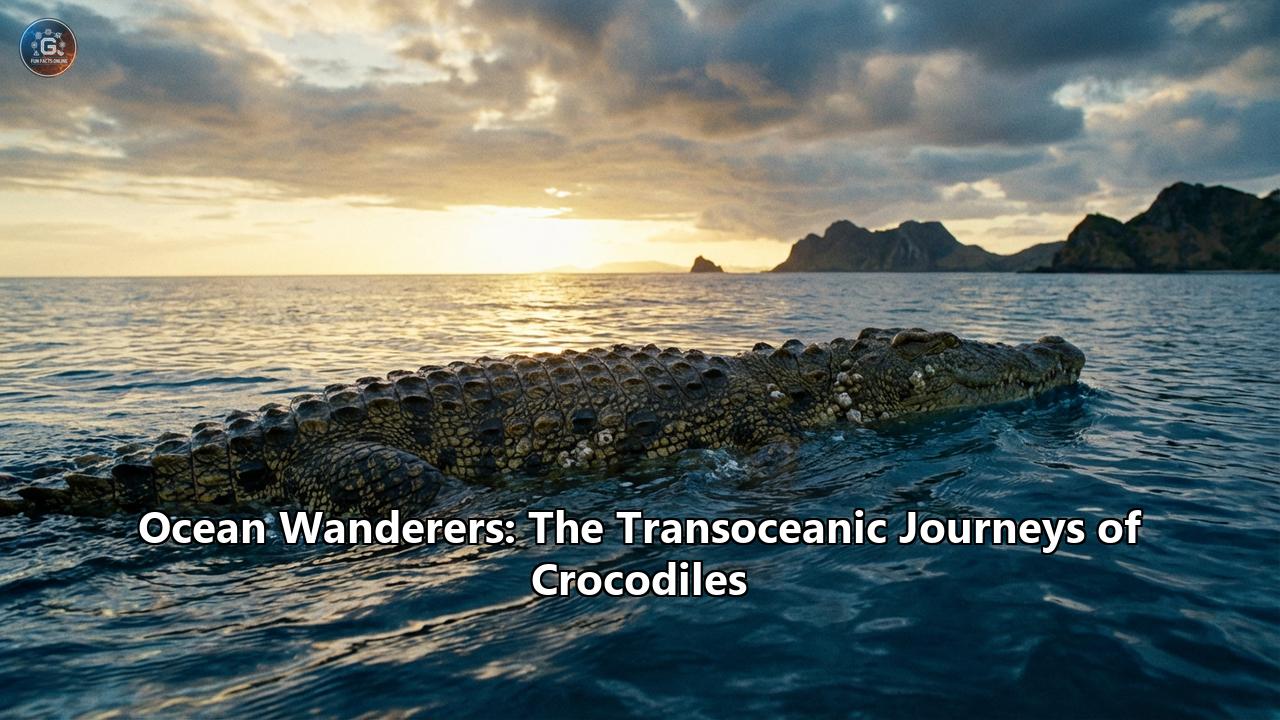
The open ocean is a realm of giants. It is the domain of the blue whale, the great white shark, and the leatherback turtle—creatures evolved over millions of years to glide through the abyss. We imagine the sea as a place where land-dwelling reptiles fear to tread, a salty barrier that strictly divides the continents. But there is a wanderer that defies this rule. It is a creature of armor and bone, a relic of the age of dinosaurs that has not only conquered the rivers but has turned the vast, blue expanse of the ocean into its personal highway. This is the story of the saltwater crocodile, the unexpected mariner of the animal kingdom, and its epic, transoceanic journeys.
For centuries, sailors and islanders whispered stories of "dragons" seen far out at sea, hundreds of miles from the nearest coastline. These accounts were often dismissed as delirium, sunstroke, or tall tales spun over grog. How could a creature so heavy, so seemingly lethargic, and so tethered to the riverbank survive the crushing solitude of the open Pacific? The answer, as science has only recently discovered, lies in a biological marvel of navigation, endurance, and an uncanny ability to "surf" the invisible rivers of the ocean.
Part I: The Paradox of the Reptile
To understand the magnitude of a crocodile’s ocean journey, one must first appreciate the biological paradox it presents. The order Crocodilia—which includes true crocodiles, alligators, caimans, and gharials—is overwhelmingly associated with freshwater. Their habitats are the murky rivers, the stagnant billabongs, and the mangrove swamps where the water is brackish but calm.
The ocean is a hostile desert for a reptile. The high salinity dehydrates body tissues, drawing precious freshwater out of cells in a deadly process of osmosis. Most reptiles, like the American alligator, are prisoners of their physiology; if placed in full-strength seawater, they would eventually succumb to salt toxicity. They lack the machinery to drink the ocean.
Yet, Crocodylus porosus, the saltwater or estuarine crocodile, stands apart. It is the largest living reptile on Earth, with males reaching lengths of over 20 feet and weights exceeding a ton. But its size is not its only superpower. Hidden within the soft tissue of its tongue are a series of modified salivary glands—lingual salt glands. These glands are the biological equivalent of a desalination plant. They actively pump excess sodium and chloride ions out of the crocodile’s bloodstream, allowing the animal to excrete concentrated salt brine.
This adaptation is shared by sea turtles and marine iguanas, but in the crocodile, it acts as a passport to the globe. It means that the saltwater crocodile is not bound by the coast. It can drink the sea, or at least survive immersion in it, for weeks or even months at a time. This physiological key unlocks 70% of the planet's surface, transforming the crocodile from a swamp-dweller into an intercontinental voyager.
Part II: The Surfer’s Secret
For decades, the mechanism of crocodile travel remained a mystery. Biologists knew that C. porosus had a massive range, stretching from the east coast of India, throughout Southeast Asia, down to northern Australia, and as far east as Fiji and the Solomon Islands. This distribution covers over 10,000 square kilometers of ocean. If crocodiles were poor swimmers—which, despite their power, they are over long distances—how did they colonize such remote specks of land?
The breakthrough came from a team of Australian ecologists led by Dr. Hamish Campbell and the late Steve Irwin. They tagged dozens of adult crocodiles with satellite transmitters and acoustic depth sounders in the remote Kennedy River of North Queensland. The data they retrieved was nothing short of revolutionary.
The researchers found that the crocodiles were not swimming in the traditional sense. They were surfing.
When a crocodile decided to undertake a long-distance journey, it would wait for the tide to turn. As the current began to flow out to sea, the crocodile would slip into the main channel, float to the surface, and let the water carry it. It was a passive form of travel, requiring almost no energy. When the tide turned against them, the crocodiles would dive to the riverbed or climb onto the bank, anchoring themselves until the flow reversed in their favor.
This "surf and stop" strategy was applied even in the open ocean. Satellite tracks showed crocodiles riding major ocean currents, like the seasonally reversing currents of the Gulf of Carpentaria and the Indonesian Throughflow. One large male, measuring nearly 4 meters, was tracked traveling 590 kilometers over 25 days. Another covered 411 kilometers in just 20 days.
By using the ocean’s own energy, these reptiles can travel thousands of kilometers without exhausting their metabolic reserves. They are the ultimate hitchhikers, reading the hydrodynamics of the sea with an instinctual precision that rivals modern oceanographic software. They treat the ocean not as a barrier, but as a conveyor belt.
Part III: The Metabolic Miracle
The ability to ride currents explains the how of movement, but not the how of survival. An ocean crossing is a starvation diet. There are no wallabies to ambush in the open Pacific, no wild pigs drinking at the water’s edge. A crocodile at sea is effectively fasting.
Here, the crocodile’s ancient lineage provides a second advantage. As ectotherms (cold-blooded animals), their metabolic requirements are minuscule compared to a mammal of similar size. A one-ton crocodile requires a fraction of the food that a lion or a great white shark would need.
During these long voyages, the crocodile enters a state of metabolic depression. Its heart rate slows, its digestion pauses, and it burns through its lipid reserves with extreme efficiency. A healthy adult crocodile can survive for a year without eating. A month-long ocean crossing is, metabolically speaking, a minor inconvenience.
Furthermore, recent research into "unihemispheric sleep" suggests that crocodiles may be able to rest half of their brain while the other half remains alert. This adaptation, also seen in dolphins and migrating birds, would allow a drifting crocodile to keep one eye open for threats—or navigational cues—while maintaining the low-energy state required for survival. It drifts like a log, a silent, armored vessel running on the faintest spark of life, waiting to make landfall.
Part IV: The Transatlantic Epic
While the journeys of the modern saltwater crocodile are impressive, they pale in comparison to the voyages of their ancestors. The story of the crocodile is written in the rocks, and the fossil record reveals a transoceanic crossing that rewrites the history of the Americas.
For years, paleontologists were puzzled by the presence of crocodiles in the Americas. The genus Crocodylus (true crocodiles) evolved in Africa and Asia. Yet, today we have the American crocodile (Crocodylus acutus), the Orinoco crocodile, the Cuban crocodile, and the Morelet’s crocodile. How did they get there? The Atlantic Ocean is a formidable barrier, thousands of miles wide.
The prevailing theory was once that the continents were connected when the ancestors of these crocodiles lived. But plate tectonics tells a different story. Africa and South America drifted apart over 100 million years ago. The ancestors of modern American crocodiles only appear in the fossil record about 7 million years ago. By that time, the Atlantic was fully formed, a vast chasm of deep water.
The only conclusion is that they swam.
Recent genetic studies have confirmed that the American species are more closely related to the Nile crocodile than to any other group. The molecular clock suggests a divergence event that matches the fossil timeline. It appears that around 7 million years ago, a population of African crocodiles—likely pregnant females carrying viable sperm—entered the sea.
Caught in the powerful westward-flowing North Equatorial Current, they were swept from the coast of Senegal or Guinea across the Atlantic. The journey would have taken weeks. It was a perilous lottery. Many would have perished, eaten by sharks or succumbing to dehydration. But enough survived to wash up on the shores of the Caribbean or South America.
This was a "founder event" of epic proportions. From those few exhausted survivors, four new species radiated, colonizing the rivers of the Amazon, the swamps of Cuba, and the mangroves of Florida. Every American crocodile alive today is the descendant of those African argonauts who braved the Atlantic.
Part V: Island Hopping and Genetic Mixing
Back in the Indo-Pacific, the saltwater crocodile’s surfing habit has had profound evolutionary consequences. In most animal groups, when a population reaches a remote island, it becomes isolated. Over time, it evolves into a new, distinct species. This is the mechanism of island biogeography that gave us Darwin’s finches and the Komodo dragon.
But Crocodylus porosus breaks this rule. A crocodile in the Solomon Islands is genetically almost identical to a crocodile in Northern Australia, thousands of kilometers away. Why?
The answer is constant movement. The ocean voyages are not rare, accidental events; they are a regular feature of the species' life history. Young males, pushed out of their river territories by larger, dominant bulls, are forced to sea. They become nomads, drifting between islands, carrying their genes with them.
This "gene flow" acts as a homogenizing force. It prevents the isolation necessary for speciation. The ocean currents act as a blender, constantly mixing the crocodile populations of the Pacific. A crocodile born in a river in Papua New Guinea might grow up to dominate a swamp in Timor. This connectivity has made the saltwater crocodile one of the most widespread and resilient predators on the planet.
However, not all crocodilians were so lucky (or unlucky, depending on your perspective). In the deep past, other lineages of crocodiles ventured into the Pacific and did become isolated. The Mekosuchines were a group of terrestrial crocodiles that colonized islands like New Caledonia, Vanuatu, and Fiji. Cut off from the mainland and the gene flow of their cousins, they evolved into bizarre forms. Some became small, land-dwelling hunters; others, like the "drop crocs," may have climbed trees. Tragically, these isolated species were driven to extinction shortly after the arrival of humans in the Pacific, likely naïve to the threat of two-legged hunters. The saltwater crocodile, with its constant reinforcements from the sea and its wariness of humans, survived.
Part VI: Legends of the Deep
The presence of a giant, man-eating reptile in the open ocean has naturally seeped into the mythology and folklore of the cultures that share its waters. To the coastal peoples of Australia, New Guinea, and Indonesia, the crocodile is not just an animal; it is a totem, a creator spirit, and a navigator.
In Arnhem Land, Australia, Aboriginal "Dreamtime" stories speak of the crocodile ancestor who traveled from the sea to carve out the rivers and shape the land. These stories reflect a deep ecological understanding of the animal's connection to both saltwater and freshwater systems. The crocodile is seen as a keeper of the waterways, a being that moves between worlds.
In Palau, a remote archipelago in the western Pacific, the crocodile features heavily in the famous "storyboards"—intricate wood carvings that depict legends and history. Palauan mythology tells of a giant crocodile that once terrorized the islands until it was outsmarted by a woman. But beyond the terror, there is respect. The Palauan people knew that their crocodiles were not land-bound. They understood that the sea was a corridor, not a wall.
Perhaps the most chilling intersection of history and crocodile migration occurred during World War II. The Battle of Ramree Island in Burma (now Myanmar) is infamous for the alleged "crocodile massacre." In 1945, British forces outmaneuvered a Japanese garrison, forcing nearly 1,000 soldiers to retreat into the mangrove swamps.
The swamps were the domain of Crocodylus porosus.
According to the accounts of British soldiers and the few Japanese survivors, the night was filled with screams and gunfire as the crocodiles attacked the retreating men. The naturalist Bruce Wright, who was present with the British forces, described it as "a cacophony of hell." While modern historians debate the scale of the massacre (it is unlikely that crocodiles ate hundreds of men in a single night), the event highlights the terrifying reality of the saltwater crocodile’s habitat. These are not stagnant ponds; they are dynamic, tidal systems connected to the sea, where armies of predators can move with the tide.
There are also the "castaway" legends—sailors from the 18th and 19th centuries who claimed to see "logs" that blinked. In the days of wooden ships, a 20-foot crocodile floating on the surface would have looked remarkably like flotsam. One can only imagine the shock of a sailor lowering a bucket to draw water, only to have the "log" erupt into a thrashing mass of teeth and tail. These encounters, likely dismissed as sea monsters, were glimpses of the ocean wanderer in its element.
Part VII: Navigation Mysteries
While we know how they move (currents) and how they survive (salt glands), the question of navigation remains the final frontier of our understanding. How does a crocodile, floating in the middle of the Timor Sea with no land in sight, know where it is?
When researchers captured "nuisance" crocodiles in Australia and relocated them hundreds of kilometers away by helicopter, the crocodiles often found their way back. One crocodile, flown across the Cape York Peninsula from the west coast to the east coast, swam around the tip of the continent to return to his home river—a journey of over 400 kilometers.
This homing ability implies a sophisticated navigation system. Scientists suspect that, like sea turtles and homing pigeons, crocodiles may be sensitive to the Earth's magnetic field. Magnetite crystals have been found in the skulls of other reptiles, and it is possible that crocodiles possess an internal compass.
In addition to magnetic cues, they likely use celestial navigation. The sun’s position, polarized light, and perhaps even star patterns could guide them. In the water, they may also use olfactory cues—"smelling" the distinct chemical signature of their home river carried on currents for miles out to sea.
The "surf" strategy itself requires navigation. The crocodile must know when the tide has turned. It must differentiate between a current that leads to the open ocean and one that leads back to the coast. This suggests a cognitive complexity that shatters the stereotype of the "mindless" reptile. The crocodile is a thinking, calculating mariner.
Part VIII: The Human Element and Future Horizons
Today, the transoceanic journeys of crocodiles present a unique challenge for conservation and management. In Northern Australia, strict protection laws have allowed crocodile populations to rebound from the brink of extinction. As the rivers fill up, large males are being pushed out, leading to more crocodiles entering the ocean.
This "spillover" effect means that crocodiles are reappearing in areas where they haven't been seen for decades. They are showing up on tourist beaches, in harbors, and on islands that were previously considered safe. In Timor-Leste, the crocodile attack rate has skyrocketed in recent years. Some locals believe these are "migrant" crocodiles from Australia, riding the currents north. While genetic studies are ongoing to confirm this, the theory is ecologically sound.
This creates a complex diplomatic and conservation issue. A crocodile born in Australia is an Australian animal, but if it swims to Timor-Leste or Indonesia and attacks a person, it becomes an international incident. Managing a predator that respects no borders requires international cooperation.
Furthermore, climate change threatens to alter the very highways the crocodiles use. As ocean temperatures rise and current systems shift, the dispersal patterns of C. porosus may change. Warmer waters could allow them to expand their range further south and north, into higher latitudes. Conversely, changes in current strength could cut off certain island populations, isolating them once again.
Conclusion: The Enduring Voyager
The image of the crocodile is often one of primeval stagnation—a living fossil that has remained unchanged because it is perfect. But the story of their ocean journeys reveals that they are dynamic, adaptable, and surprisingly mobile.
They are not just lurking in the reeds. They are out there in the deep blue, riding the currents that circulate the globe, driven by an instinct that predates the human species by millions of years. When we look at the ocean, we see a barrier. The crocodile sees a bridge.
From the fossilized skulls in the Libyan desert that point to a transatlantic crossing, to the satellite tracks of a modern giant surfing past the Great Barrier Reef, the evidence is clear: the crocodile is an ocean wanderer. It is a reminder that nature is fluid, that boundaries are often illusions, and that the world’s most formidable predator is at home everywhere—even in the middle of the sea.
In the end, the crocodile’s journey is a testament to the power of adaptation. It conquered the land, it mastered the rivers, and when the continents drifted apart, it refused to be left behind. It simply slid into the waves, tasted the salt, and swam into history.
Reference:
- https://espace.library.uq.edu.au/view/UQ:9162/Crocodylus_johns.pdf
- https://en.wikipedia.org/wiki/Saltwater_crocodile
- https://www.quora.com/How-do-crocodiles-slow-metabolisms-and-ambush-hunting-techniques-give-them-an-edge-in-survival-compared-to-other-animals
- https://www.pbslearningmedia.org/resource/migrating-saltwater-crocodiles/migrating-saltwater-crocodiles/
- https://www.youtube.com/watch?v=MZxRiRhqieU
- https://pmc.ncbi.nlm.nih.gov/articles/PMC6713319/
- https://www.pbs.org/edens/kakadu/crocs3.html