
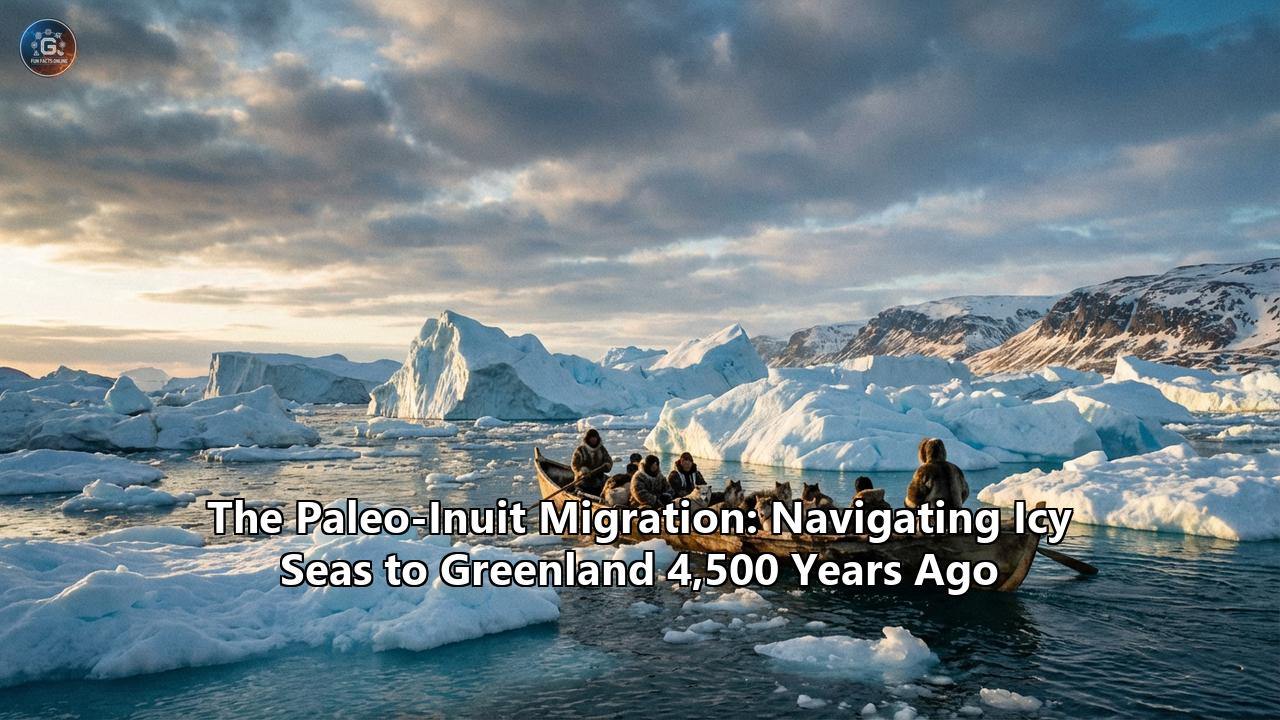
Imagine standing on the precipice of the known world, where the solid ground of the mainland fractures into a maze of shifting sea ice, lethal currents, and relentless, freezing fog. Before you lies a 50-kilometer expanse of churning, unpredictable ocean. You have no GPS, no motorized engine, and no map. Your only vessel is a meticulously crafted, kayak-like boat made of driftwood, bone, and stretched animal skins. Your destination is a speck of rock hidden in the frigid mists of the High Arctic.
To modern, well-equipped sailors, this crossing is considered a nightmare. But roughly 4,500 years ago, entire communities of ancient pioneers looked out at this forbidding seascape and paddled forward.
These were the Paleo-Inuit, the first humans to conquer the American Arctic and Greenland. For decades, archaeologists envisioned these early settlers primarily as land-bound wanderers, trudging across frozen tundras in pursuit of muskoxen and caribou. But groundbreaking archaeological discoveries published in early 2026 have radically rewritten this narrative. The Paleo-Inuit were not just survivors on the edge of the habitable world; they were master seafarers, innovators of complex maritime technology, and the architects of a seasonal migration that defies modern comprehension.
This is the epic story of the Paleo-Inuit—a distinct lineage of humanity who emerged from Siberia, thrived in absolute isolation for millennia, and braved the icy seas to settle the ultimate frontier.
The First Wave: Out of Siberia and Into the Deep Freeze
To understand the sheer magnitude of the Paleo-Inuit migration, we must rewind the clock roughly 5,000 years. During this period, the world was undergoing subtle but profound climatic shifts. In the extreme north, a unique group of people began a relentless push eastward from Chukotka in northeastern Siberia, across the Bering Strait, and into the North American Arctic.
For a long time, the genetic identity of these first Arctic inhabitants was a fiercely debated mystery. Were they the ancestors of modern Native Americans? Were they the direct forefathers of today’s Inuit? In the mid-2010s, advanced genomic sequencing of ancient DNA extracted from bits of bone and tufts of hair preserved in the permafrost finally provided the answer.
The Paleo-Inuit represented a completely distinct, independent wave of human migration.
Led by evolutionary geneticist Eske Willerslev, researchers revealed that these people crossed into the Americas thousands of years after the ancestors of Native Americans, and thousands of years before the ancestors of the modern Inuit (the Thule culture). They were a highly adapted, isolated population. In fact, the genetic record shows that after spreading across Alaska, Canada, and Greenland, the Paleo-Inuit lived in astonishing isolation for over 4,000 years. They did not significantly mix with Native American populations to the south, nor did they assimilate with later waves of migrants until much later in their history.
Instead, they carved out an existence in an environment that is almost unimaginably hostile to human life, relying entirely on their own ingenuity.
The Push Factors: Why Move North?
What drives a community to leave the relative familiarity of the Alaskan coast and venture into the high Canadian Arctic and the perilous coasts of Greenland?
The exact motivations are lost to time, as these ancient peoples left no written records. However, archaeologists and paleoclimatologists suggest that shifting climates and the pursuit of rich, untapped resources were primary drivers. The High Arctic, despite its brutality, is home to incredible bursts of life. The Paleo-Inuit followed the seasonal migrations of terrestrial mammals like caribou and muskoxen, and capitalized on the rich marine ecosystems teeming with seals, walruses, and seabirds.
As glaciers from the last Ice Age continued to retreat, new terrestrial and marine ecosystems were forming. The Paleo-Inuit didn't just passively inhabit these new lands; they were active participants in shaping them, transferring vast amounts of marine nutrients onto the barren land through their hunting and butchering practices, forever altering the Arctic biosphere.
Settling the Frozen Frontier: Independence I and Saqqaq Cultures
By about 4,500 years ago (around 2500 BC), the Paleo-Inuit had crossed the narrow, ice-choked Nares Strait from Arctic Canada and set foot in Greenland. As they spread across this massive, glaciated island, they adapted to distinct micro-climates, leading archaeologists to categorize them into early cultural groups, most notably the Independence I and Saqqaq cultures.
- Independence I (approx. 2500–1800 BC): Named after the Independence Fjord in Northeast Greenland where their remains were first discovered by archaeologist Eigil Knuth, this group pushed to the absolute northernmost extremes of the globe, settling in Peary Land. Here, in the High Arctic, they endured months of total winter darkness. Their archaeological footprint is defined by specific stone tools and the remains of their dwellings—circular tent rings with a central "mid-passage" hearth built of flat stones, designed to maximize the heat of a fire fueled by driftwood, animal fat, and bone.
- Saqqaq Culture (approx. 2400–700 BC): Further south, along the west, south, and east coasts (such as in the Disko Bay area), the Saqqaq culture thrived. The climate here was marginally more forgiving, and the Saqqaq peoples developed an incredibly diverse toolkit of specialized harpoons, lances, and cutting tools. They were heavily reliant on marine resources, hunting seals and whales from the shifting ice edges.
Because biodegradable materials like wood, skin, and bone quickly rot away in slightly warmer climates, much of what we know about these people comes from their lithic (stone) technology. But in the High Arctic, the extreme cold acts as a time capsule. Thanks to the slow soil development and freezing temperatures, ancient campsites have been preserved almost exactly as they were left millennia ago.
It is from one of these perfectly preserved sites that the most stunning revelation about the Paleo-Inuit recently emerged.
The Kitsissut Breakthrough: Redefining Arctic Navigation
For generations, the prevailing academic view was that the Paleo-Inuit were primarily terrestrial hunters who used the sea ice as a frozen bridge during winter. While it was assumed they possessed rudimentary boats, the extent of their seafaring capabilities was largely underestimated.
That changed entirely in February 2026, when an international team of researchers from the University of Calgary and the University of Greenland published a landmark study in the journal Antiquity. Led by archaeologist Matthew Walls, the team documented an astonishing archaeological landscape on the remote Kitsissut (also known as the Carey Islands).
The Nightmare Crossing
Kitsissut is a cluster of six small, rocky, cliff-edged islands representing the westernmost point of Greenland. To reach it from the nearest mainland shore of Avanersuaq, one must cross at least 53 kilometers (33 miles) of open ocean.
This is no ordinary stretch of water. It is marked by erratic, shifting crosswinds, sudden drops in visibility due to dense fog, and powerful, lethal mixing currents. Today, even experienced adventure kayakers equipped with modern GPS, weather tracking, and emergency satellite communications view this crossing as formidable.
Yet, when researchers surveyed Kitsissut, they didn't just find a stray artifact or two. They found nearly 300 archaeological features. On Isbjørne Island alone, situated directly beneath towering seabird nesting cliffs, they found a dense concentration of 15 Early Paleo-Inuit dwellings. These were clearly defined by bilobate stone tent rings with axial central hearths.
Radiocarbon dating of animal bones found in the hearths confirmed that these campsites were occupied between 3,900 and 4,475 years ago.
A Masterpiece of Prehistoric Seafaring
"It wasn't just a one-off visit by a family blown off course," Dr. Matthew Walls explained regarding the discovery. The density of the dwellings and the accumulation of butchered animal bones prove that this was a "place of return". Entire communities were intentionally and repeatedly making this treacherous journey.
How did they do it? The Paleo-Inuit utilized "skin-on-frame" watercraft. Without access to large timber, they constructed the skeletons of their boats using precious pieces of driftwood or whalebone, lashing them together with animal sinew. Over this flexible, durable frame, they stretched the hides of seals or walruses, waterproofing the seams with animal fat.
Paddling these kayak-like vessels across 53 kilometers of hostile ocean would have required 12 to 18 hours of continuous, grueling physical exertion. It required an intimate, generational knowledge of the sea. The navigators had to read the complex currents, anticipate the sudden onset of Arctic storms, and navigate by the sun, stars, and the behavior of marine life.
This discovery represents the longest open-water sea journey identified from this early period anywhere in the entire Arctic. It forces a paradigm shift: the Paleo-Inuit were not just surviving the Arctic; they were mastering it through sophisticated marine engineering and unparalleled navigational prowess.
Pikialasorsuaq: The Ecological Magnet
Why risk death in the freezing waters to reach these isolated rocks? The answer lies in a magnificent ecological phenomenon known as a polynya.
Kitsissut sits at the heart of the Pikialasorsuaq, or the North Water Polynya. A polynya is a semi-permanent area of open water that remains unfrozen year-round, even in the dead of the brutal Arctic winter, maintained by unique upwellings of warm currents and persistent winds.
In a world locked in ice, a polynya is an oasis of life. The open water allows sunlight to penetrate, triggering massive blooms of phytoplankton. This forms the base of an incredibly rich food web. Zooplankton thrive, drawing massive schools of Arctic cod, which in turn attract seals, belugas, bowhead whales, narwhals, and polar bears.
For the Paleo-Inuit, the polynya was a supermarket of unparalleled abundance. Specifically, the researchers found that the ancient seafarers were traveling to Kitsissut to harvest thick-billed murres. These resilient seabirds nest by the thousands on the sheer cliffs of the islands during the brief Arctic summer. The Paleo-Inuit positioned their tents directly below these nesting colonies, allowing them to harvest adult birds and highly nutritious eggs, which were vital for surviving the impending winter.
Rather than just a "crossroads" or a stepping stone between Canada and Greenland, Kitsissut was a destination of innovation. It was an ecological hotspot where the Paleo-Inuit perfected their maritime lifeways, exploiting the riches of the sea with astonishing bravery.
Life on the Edge: The Reality of the Paleo-Inuit Existence
To visualize the daily life of the Paleo-Inuit is to picture a masterclass in human resilience. Their world was entirely reliant on the materials around them. Nothing was wasted.
- Clothing: To survive temperatures that could easily plummet to -50°F (-45°C), they crafted highly tailored, double-layered garments from the skins of caribou, seals, and arctic foxes. Bone needles, delicate and sharp, were used to stitch the hides together with sinew, ensuring the seams were watertight and windproof.
- Tools: They were part of a "microlithic" tradition, meaning they crafted incredibly sharp, tiny stone blades. These microblades were slotted into grooved pieces of bone or antler to create specialized harpoons, lances, and butchering knives. Chert, quartz, and slate were meticulously knapped into lethal points.
- Shelter: While the stone tent rings remain today, the original dwellings were likely skin tents used during the summer months. In the winter, they may have built more substantial semi-subterranean dwellings or snow houses (igloos), utilizing the insulating properties of the snow to trap the heat of their small, fat-burning lamps.
Their communities were small, highly mobile, and deeply egalitarian out of necessity. Survival required absolute cooperation. The sharing of meat, blubber, and skins was not just a social courtesy; it was the fundamental law of survival.
The End of an Era: The Paleo-Inuit Disappearance
Despite their incredible adaptations, their mastery of the sea, and their dominance over the Arctic landscape for over 4,000 years, the Paleo-Inuit culture eventually vanished.
Around 700 to 800 years ago, a new wave of migration swept out of Alaska and moved rapidly across the Arctic. This was the Thule culture, the direct ancestors of today’s modern Inuit. The Thule were equipped with even more advanced technology: massive umiaq skin boats capable of carrying dozens of people and heavy cargo, sophisticated dog sleds for rapid winter travel, and specialized whaling gear that allowed them to hunt massive bowhead whales.
The archaeological record shows a rapid replacement of the Paleo-Inuit by the Thule. For nearly a century, historians and archaeologists debated what happened. Did the Thule violently conquer the Paleo-Inuit? Did they assimilate them? Or did the Paleo-Inuit succumb to shifting climates before the Thule even arrived?
Modern genetic studies suggest a complex, somewhat tragic narrative. Geneticist Eske Willerslev's 2014 study found no significant genetic admixture between the isolated Paleo-Inuit and the incoming Thule in Greenland. It appears that as the climate warmed during the Medieval Warm Period, the environments that the Paleo-Inuit relied upon shifted drastically. Ice edges melted, changing the migration routes of seals and the locations of vital polynyas.
Unable to adapt their highly specialized hunting strategies fast enough to the changing climate, and perhaps outcompeted by the technologically superior Thule, the Paleo-Inuit populations plummeted. They disappeared as a distinct cultural entity around 1300–1400 AD.
However, their legacy did not vanish completely. Further genetic analysis published in 2019 revealed that while the Paleo-Eskimos vanished as an isolated group in Greenland, their genetic footprint survives elsewhere. They contributed deeply to the ancestry of Na-Dene speaking peoples (such as the Athabaskans and Navajo in North America) and left a genetic mark on Yup'ik and Aleut populations in Alaska.
Furthermore, their memory lived on in the oral traditions of the modern Inuit. Inuit mythology speaks of a people called the Tunit or Sivullirmiut (the first people). Legends describe the Tunit as a gentle, incredibly strong race of giants who were easily frightened off by the newly arriving Inuit. The myths say the Tunit built the old stone tent rings, slept with their legs in the air to let the blood drain, and could haul massive walruses across the ice with their bare hands. While mythical in tone, these stories serve as a haunting, beautiful eulogy to the very real pioneers who preceded them.
A Legacy Written in Stone and Sea
The story of the Paleo-Inuit migration is one of the most remarkable chapters in human history. To categorize them merely as primitive Stone Age survivors does a massive disservice to their genius.
As the recent discoveries at Kitsissut prove, these were communities of scientists, engineers, and master mariners. They mapped the currents of the deadliest oceans on Earth using only their senses. They built seaworthy vessels out of animal skins and scavenged wood. They located invisible ecological hotspots amidst thousands of miles of crushing sea ice and established generational rhythms of life that sustained them for over four millennia.
When we look at the barren, windswept rocks of the High Arctic today, it is easy to see only desolation. But the ancient tent rings that still dot the shores of Isbjørne Island tell a different story. They are testaments to human courage. They remind us that 4,500 years ago, long before the Pyramids of Giza were fully aged, and long before the Vikings ever dreamed of the open sea, a resilient group of men, women, and children stood on the icy shores of the world, pushed their skin boats into the freezing, turbulent unknown, and conquered the Arctic.
Reference:
- https://www.zmescience.com/ecology/paleo-inuit-ancient-arctic-seafarers-kitsissut/
- https://www.livescience.com/archaeology/paleo-inuit-people-braved-icy-seas-to-reach-remote-greenland-islands-4-500-years-ago-archaeologists-discover
- https://trap.gl/en/historie/paleo-inuit/
- https://pmc.ncbi.nlm.nih.gov/articles/PMC6942545/
- https://www.smithsonianmag.com/science-nature/ancient-dna-reveals-complex-story-human-migration-between-siberia-and-north-america-180972356/
- https://www.eurekalert.org/news-releases/634187
- https://www.bas.ac.uk/media-post/expedition-to-greenland-will-piece-together-movements-of-ancient-civilisation/
- https://archaeologymag.com/2026/02/arctics-first-inhabitants-4500-years-ago/
- https://kjbritt.github.io/archaeology/2026/02/13/greenland-kitsissut.html
- https://www.ekhbary.com/news/paleo-inuit-braved-icy-seas-4500-years-ago-to-reach-remote-greenland-islands-archaeologists-discover-744-2.html
- https://archiqoo.com/news/en/paleo+inuit+communities+reached+remote+greenland+islands+4500+years+ago.php
- https://en.wikipedia.org/wiki/Genetic_history_of_the_Indigenous_peoples_of_the_Americas