
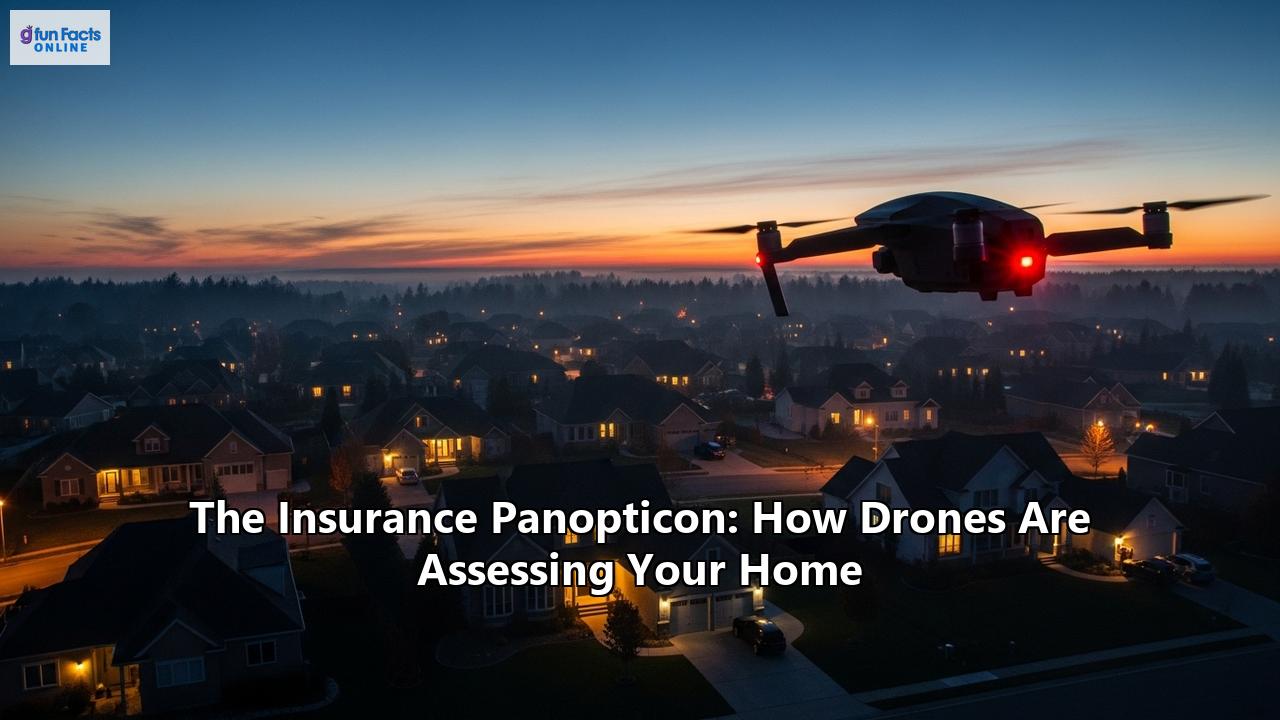
An eye in the sky is watching your home. It’s not a satellite capturing a blurry image of your neighborhood, nor is it a hobbyist’s weekend toy. This eye belongs to your insurance company. It’s a drone, flying silently overhead, armed with high-resolution cameras and sophisticated sensors, cataloging every detail of your property. Its mission: to assess risk. This is the new reality of home insurance, a technological leap that promises efficiency and accuracy but raises profound questions about privacy and power. Welcome to the Insurance Panopticon.
Imagine receiving a letter from your insurer, the company you’ve paid faithfully for years. It contains a crisp, aerial photograph of your roof, a picture you never knew was taken. The letter informs you that due to some loose shingles or overhanging tree branches identified by their "aerial inspection," your policy will not be renewed unless you undertake costly repairs within a few short weeks. This scenario is not a dystopian fantasy; it's a growing reality for homeowners across the country.
The term "Panopticon," conceived by the philosopher Jeremy Bentham, describes a prison where inmates can be observed by a single watchman without being able to tell whether they are being watched. This uncertainty was designed to compel constant good behavior. Today, a similar dynamic is emerging between insurers and policyholders. The knowledge that a drone could be inspecting your property at any time, analyzing every potential flaw, creates a new kind of pressure, fundamentally altering the relationship of trust that once underpinned the insurance industry.
This article delves deep into the world of the Insurance Panopticon. We will explore the sophisticated technology that makes it possible, the economic and environmental pressures that drove its adoption, and the significant benefits it offers to both insurers and, in some cases, homeowners. But we will also cast a critical eye on its darker side: the erosion of privacy, the potential for algorithmic bias and error, and the very real human cost of being judged from above without your knowledge or consent. This is a comprehensive look at how drones are assessing your home and what it means for the future of property ownership.
The Dawn of a New Watchfulness: Why Insurers Took to the Skies
The shift towards aerial surveillance was not born in a vacuum. It is the culmination of long-standing challenges in the insurance industry, exacerbated by a rapidly changing world. For decades, the process of inspecting a home was a decidedly earthbound affair, fraught with inefficiencies, costs, and dangers.
The Old Guard: Inspections on Foot
Traditionally, when an insurance company needed to assess a property—either for a new policy, a renewal, or after a claim—they would dispatch a human inspector or claims adjuster. This individual would travel to the property, walk the grounds, and, most perilously, climb onto the roof to check for damage or wear. The process was inherently slow and expensive, involving travel costs, labor hours, and the logistical challenges of scheduling appointments.
Furthermore, it was dangerous. Roof inspections, in particular, exposed adjusters to the risk of falls and other injuries, leading to workers' compensation claims and increased operational costs for insurers. In the aftermath of a natural disaster like a hurricane or wildfire, these dangers were magnified. Damaged structures are unstable, and entire neighborhoods can be inaccessible, delaying the claims process for homeowners at their most vulnerable moment.
A Confluence of Crises: The Impetus for Innovation
Several powerful forces converged to make the traditional inspection model untenable and push the industry toward a technological solution.
First, the increasing frequency and intensity of extreme weather events, widely linked to climate change, have unleashed a torrent of claims, putting immense financial strain on insurers. Hurricanes, wildfires, and severe hailstorms now cause widespread damage on a regular basis, making the slow, one-by-one, in-person inspection model completely inadequate for the scale of the task. After Hurricane Harvey in 2017, for instance, insurers began to see the immense value in using drones to quickly survey the devastation in the Houston area. The 2018 hurricane season further solidified the role of drones and aerial imagery, moving them from an experimental tool to an integral part of disaster response.
Second, in an effort to remain profitable amidst these mounting losses, insurers have sought to "derisk" their portfolios. This means gaining a much more granular and accurate understanding of the specific risks associated with each individual property they insure. They are no longer content with broad statistical models; they want to know the exact condition of your roof, the proximity of that old oak tree to your house, and whether you have an undeclared trampoline in the backyard. This drive for detailed data made the high-resolution, comprehensive view from a drone incredibly appealing.
The COVID-19 pandemic also served as an accelerant. With social distancing and lockdowns making in-person visits difficult or impossible, insurers who had been experimenting with virtual and aerial inspections suddenly had a powerful reason to scale up these technologies.
This confluence of rising disaster-related costs, the strategic need for better risk data, and the logistical hurdles of a global pandemic created the perfect storm for a technological revolution. Drones, once the domain of the military and hobbyists, were ready for their corporate close-up, and the insurance industry was a more than willing partner.
The Anatomy of an Aerial Inspection: Inside the Drone's Toolkit
The system insurers use to monitor your home is a sophisticated blend of advanced hardware and intelligent software. It's a process that turns raw aerial images into actionable underwriting decisions, often without any human intervention. This happens in one of two primary ways: either your insurance company directly employs or contracts a drone pilot to inspect your specific property, or, increasingly, they purchase data from third-party "insurtech" companies that are systematically photographing nearly every building in the country.
The Hardware: More Than Just a Camera
The unmanned aerial vehicles (UAVs) used for insurance inspections are far more advanced than the average consumer drone. They are commercial-grade machines designed for stability, longer flight times, and carrying specialized sensor payloads.
- High-Resolution Cameras: At the core of the operation are powerful cameras capable of capturing incredibly detailed still images and videos. These cameras can reveal subtle signs of damage, such as hail impacts on shingles, fine cracks in a chimney, or moss buildup that might indicate moisture retention.
- Thermal and Infrared Sensors: Some drones are equipped with thermal or infrared cameras. These sensors can detect variations in heat, which can be invaluable for identifying issues invisible to the naked eye. For example, a thermal camera can spot areas of heat loss from a roof, indicating poor insulation, or detect moisture trapped beneath roofing materials, a precursor to leaks and rot.
- LiDAR (Light Detection and Ranging): More advanced systems may use LiDAR, a technology that uses laser pulses to create highly accurate, three-dimensional maps of a property and its surroundings. This can be used to generate precise measurements and models of the structure.
The Data Harvest: From the Sky to the Server
The inspection process itself is meticulously planned. A licensed commercial drone pilot, operating under the FAA's Part 107 rules, will either be dispatched to a specific address or fly a pre-programmed route over a neighborhood.
In many cases, however, the insurer isn't sending a drone just for you. They are subscribing to a service. Companies that are part of the Geospatial Insurance Consortium (GIC), an industry-funded group, use manned aircraft, high-altitude balloons, and drones to build a colossal visual database, claiming to have imagery covering 99% of the U.S. population. This means a photo of your home likely already exists in a database, ready to be analyzed.
The flight path is often automated to ensure complete coverage of the property, including the roof from multiple angles, exterior walls, and the surrounding yard. The drone captures hundreds of overlapping images which can then be stitched together.
The Brains of the Operation: Artificial Intelligence at Work
The sheer volume of collected data—millions of high-resolution images—would be useless without a way to analyze it efficiently. This is where artificial intelligence (AI) and machine learning come in. The aerial images are fed into sophisticated AI models that have been trained to identify and flag potential risks.
This AI is looking for specific things:
- Roof Condition: The AI can identify missing, cracked, or curling shingles, hail damage, water pooling on flat roofs, and even discoloration that suggests the roof is nearing the end of its lifespan.
- Structural Hazards: It can spot overgrown tree limbs hanging over the house, which pose a risk in a windstorm.
- Maintenance Issues: The models are trained to find clogged gutters, debris piled up against the house, and significant moss or algae growth.
- Undeclared Liabilities: The aerial view easily reveals undeclared—and often liability-increasing—items like swimming pools, trampolines, or even an aggressive-breed dog in the yard that wasn't mentioned on the policy application.
Based on this analysis, the AI can generate a "risk score" for the property, flagging it for review by a human underwriter or, in some cases, automatically triggering a non-renewal notice or a premium increase. The images can also be used to create detailed 3D models and "digital twins" of the property, providing a permanent, measurable record of its condition at a specific point in time.
The Bright Side of the Eye: Efficiency, Safety, and Accuracy
While the idea of an all-seeing insurance drone can be unsettling, proponents argue that the technology offers significant advantages that can benefit both the insurance companies and their customers. The industry presents this evolution as a move toward a more efficient, safer, and data-driven future.
For the Insurer: A Revolution in Risk Management
For insurance companies, the benefits of drone technology are clear and substantial, touching nearly every aspect of their operations.
- Massive Cost Reduction: Drones are significantly cheaper to deploy than human inspectors. A Goldman Sachs report estimated that drone usage could lead to a 10% saving on claim adjustment expenses, amounting to billions of dollars globally. This eliminates travel expenses, reduces labor hours, and minimizes the need for specialized equipment like ladders and safety harnesses.
- Unprecedented Efficiency: A single drone can inspect multiple properties in the time it would take a human to inspect one. In the chaotic aftermath of a natural disaster, drones can survey vast, inaccessible areas in hours, allowing insurers to triage claims and allocate resources far more quickly than traditional methods would allow. This speed can slash inspection times by up to 50%.
- Vastly Improved Safety: One of the most compelling arguments for drone use is the enhancement of worker safety. By keeping adjusters on the ground, insurers eliminate the risk of falls from steep or damaged roofs, exposure to hazardous materials after a fire, or entering structurally unsound buildings.
- Superior Risk Assessment and Underwriting: Drones provide a treasure trove of high-quality, objective data. This allows underwriters to move beyond broad assumptions and price policies based on the actual, verifiable condition of a property. PwC suggests that drone usage could improve underwriting accuracy by an astounding 40-60%. A homeowner with a brand-new, well-maintained roof might be rewarded with a lower premium, a level of fairness that was harder to achieve with older, less detailed inspection methods.
- Robust Fraud Detection: Insurance fraud is a multi-billion dollar problem that drives up costs for everyone. Drones provide a powerful anti-fraud tool. By capturing detailed "before" images of a property during underwriting, insurers have a baseline. If a claim is filed later, the "after" images can be compared to the original record to verify the extent of the damage and weed out fraudulent claims, such as a homeowner claiming pre-existing wear and tear was caused by a recent storm.
For the Homeowner: The Promised Perks
Insurers argue that these operational improvements translate into direct benefits for the policyholder.
- Faster Claim Payouts: For a family displaced by a fire or storm, speed is everything. Because drones can assess damage almost immediately, the claims process can be initiated and resolved much faster. This means quicker access to the funds needed to rebuild and recover, reducing the financial and emotional toll of a disaster.
- Potential for Fairer Premiums: In theory, a more accurate risk assessment should lead to more equitable pricing. If a drone inspection confirms your home is in excellent condition and poses a low risk, you could see that reflected in a more competitive premium, as you are no longer subsidizing higher-risk properties in the same general area.
- Proactive Risk Mitigation: Drone inspections can identify potential problems before they become catastrophic failures. Discovering clogged gutters that could cause water damage or a few loose shingles that could lead to a major leak allows the homeowner to make preventive repairs, ultimately saving them from a much larger headache and a more costly claim down the road.
While these benefits are significant, they represent the idealized version of how this technology is deployed. The reality on the ground—or rather, in the air above it—is often far more complicated and fraught with conflict for the homeowner on the receiving end of the drone's gaze.
The Shadow of the Panopticon: Privacy, Power, and the Perils of Algorithmic Judgment
The efficiency and data-rich environment created by insurance drones come at a cost, and for many homeowners, that cost is a profound sense of unease and vulnerability. The "Insurance Panopticon" casts a long shadow, raising critical concerns about privacy, the balance of power, and the potentially devastating consequences of automated, and sometimes flawed, decision-making.
The "Spy in the Sky": An Invasion of Personal Space
For many, the core issue is the fundamental violation of privacy. The idea of a corporate-owned drone hovering over your property, capturing high-resolution images of your home and yard without your explicit, contemporaneous consent, feels invasive—a sentiment echoed by homeowners and privacy advocates alike. One homeowner in Massachusetts who received a cancellation threat based on drone photos of her trees described the experience as "very invasive" and "crazy."
This practice transforms the private sanctuary of a home into a subject of remote, persistent scrutiny. Insurers and their third-party data collectors often operate under the argument that they are flying in public airspace, a position supported by FAA regulations for licensed commercial pilots. However, this legal argument does little to assuage the feeling of being watched. While a drone flying at 400 feet may be in federally regulated airspace, its high-powered camera is focused squarely on your private property, capturing details of your life—the children's toys in the yard, the state of your patio furniture, the layout of your backyard. This has been described as "a bit Orwellian," creating a world where your property can be monitored daily at high resolution.
A significant part of the problem is the lack of transparency. In many cases, homeowners are not notified before an aerial inspection takes place. The inspection happens covertly, and the first time a homeowner learns of it is when they receive a non-renewal notice or a demand for repairs. This secrecy erodes trust and transforms what could be a practical inspection into something that feels unethical and deeply disrespectful.
The Tangled Web of Legality
The legality of these drone inspections exists in a gray area. While the FAA governs the skies, privacy and trespass laws are largely determined at the state level, creating a confusing patchwork of regulations. Some states have passed laws to address aerial surveillance, but many insurance contracts contain broad language where the policyholder agrees to allow the insurer to perform inspections of their property—language that insurers argue covers new technologies like drones.
Consumer advocacy groups contend that the technology is far ahead of any meaningful consumer protections, leaving homeowners with limited rights to challenge what they see as an intrusion. Even when states do have laws, such as a Florida statute requiring 48 hours' notice for an inspection, these may not always be followed, or the notice may be buried in renewal paperwork.
When the Algorithm Falters: "Computer Says No"
Perhaps the most dangerous aspect of the Insurance Panopticon is its reliance on artificial intelligence. While AI can be incredibly powerful, it is not infallible. The automated systems analyzing drone imagery can, and do, make mistakes, sometimes with devastating financial consequences for homeowners.
Consumer advocates report numerous cases of flawed analysis. A blurry image might lead the AI to misidentify a skylight or a solar panel as roof damage. Shadows cast by trees or the time of day can create optical illusions that a machine interprets as defects. A homeowner in California had her policy dropped because aerial images allegedly showed her roof was too old, a conclusion she refuted.
Furthermore, the data itself can be outdated. An insurer might use a year-old image that doesn't reflect a brand-new roof the homeowner just paid thousands to install. Because the AI models can be a "black box," it's often difficult for homeowners to understand precisely why a decision was made or to effectively challenge it. They are left fighting an automated judgment with little recourse.
The Human Toll: Dropped Policies and a Scramble for Coverage
For insurers, this technology is a tool for "derisking." For homeowners, it is often a source of immense stress and financial hardship. The use of drone surveillance has led to a dramatic increase in reports from consumers being dropped by their insurers based on an aerial image.
Insurers are using this data to aggressively cull their portfolios of any home deemed less than perfect. A few patches of moss, some yard debris, or a discolored shingle can be enough to trigger a non-renewal. Homeowners are then faced with a difficult choice: either pay for expensive repairs on a tight deadline, sometimes just to fix a cosmetic issue, or lose their insurance coverage. Losing coverage can put them in violation of their mortgage agreement and force them into a frantic search for a new, often more expensive, policy. This is happening to loyal customers with no history of claims, who feel betrayed by companies they have trusted for years.
This aggressive, data-driven culling marks a fundamental shift in the insurance contract, from a partnership in managing risk to a more adversarial relationship where homeowners are under constant probation, liable to be dropped at the first sign of imperfection as judged by a remote and unforgiving eye.
Navigating the New Reality: A Homeowner's Guide to the Drone Age
Living under the Insurance Panopticon requires a new level of awareness and proactivity from homeowners. While you may not be able to stop the drones from flying, you can take steps to protect yourself, your property, and your insurance coverage from the potential pitfalls of aerial surveillance.
1. Know Your Policy and Your Rights
The first line of defense is information. It's crucial to understand the terms of the contract you have with your insurer.
- Review Your Policy: Carefully read your homeowner's insurance policy, paying close attention to any clauses related to property inspections. Insurers argue that broad language in these clauses gives them the right to use new technologies like drones. Understanding what you've agreed to is the first step.
- Understand Local Laws: Drone privacy laws vary significantly by state and even municipality. Research the specific regulations in your area regarding aerial surveillance and privacy. While federal law governs airspace, state laws may offer you some protection against harassment or invasions of privacy. In California, for example, insurers are required to notify homeowners before a drone inspection, including when it will happen and what they're looking for.
- Advocate for Stronger Protections: Consumer groups like United Policyholders are pushing for new laws that would give homeowners more rights, such as the mandatory delivery of inspection reports and a formal process to appeal and correct inaccurate findings. Supporting these initiatives can help create a fairer system for everyone.
2. Become Your Own Inspector
In an era of remote scrutiny, the best defense is a good offense. Don't wait for a drone to find a problem.
- Conduct Regular Self-Inspections: Walk your property several times a year with a critical eye. Look for the very things an insurance drone is programmed to find: loose or damaged shingles, clogged gutters, overgrown tree limbs, and yard debris.
- Document Everything: Keep meticulous records of all maintenance, repairs, and renovations. If you replace your roof, keep the contract and receipts that detail the date, the materials used, and the contractor who performed the work. This documentation is your best evidence to refute a claim that your roof is old or in poor condition.
- Maintain Your Property: Addressing small issues before they become large ones is not just good homeownership; it's a crucial strategy for keeping your insurance. Clear debris from your roof and gutters, trim back any trees touching your home, and keep your yard tidy.
3. Challenge Inaccurate Assessments
If you receive a non-renewal notice or a premium hike based on an aerial inspection you believe is flawed, do not simply accept it.
- Demand the Evidence: You have the right to see the images that were used to make the decision. Request copies of the drone or satellite photos from your insurer.
- Identify Inaccuracies: Scrutinize the images for errors. Is the photo outdated? Did the AI misidentify a feature of your home? Are the "problems" merely cosmetic or the result of poor image quality?
- Provide Counter-Evidence: If the insurer's data is wrong, provide your own. This could include your dated receipts for a new roof, photos you've taken yourself showing the corrected issue (e.g., trimmed trees), or an inspection report from a certified professional.
- Communicate and Escalate: Start by discussing the issue with your insurance agent. If you don't get a satisfactory resolution, you may need to file a formal complaint with your state's department of insurance.
4. Secure Your Private Spaces
While you can't build a roof over your entire yard, you can take modest steps to shield some areas from the skyward gaze. If you are concerned about the privacy of your backyard, pool, or patio, consider using screens, pergolas, or foliage to create more seclusion. This may not stop an inspection, but it can help maintain a greater sense of personal space.
By being informed, proactive, and assertive, homeowners can regain a measure of control in an environment where it feels increasingly diminished.
The Future of the Insurance Panopticon: What Lies Ahead?
The drone is not a passing fad in the insurance industry; it is the vanguard of a technological transformation that is still in its early stages. The Insurance Panopticon is set to become more powerful, more pervasive, and more integrated into the fabric of our lives. The future of this technology, and our relationship with it, will be shaped by advancements in AI, the response of regulators, and a fundamental renegotiation of the trust between insurers and the insured.
Ever-Smarter, Ever-Watching Technology
The technology of aerial surveillance is advancing at a breathtaking pace. We can expect several key developments:
- The Rise of Predictive Analytics: The integration of more sophisticated AI and machine learning will move the industry beyond simple damage detection to predictive risk modeling. Insurers won't just know the current condition of your roof; their AI will analyze its material, age, and exposure to weather patterns to predict when it is likely to fail, potentially leading to pre-emptive non-renewals or mandated replacements.
- Real-Time, Persistent Monitoring: The reliance on periodic drone flights may soon be augmented by constant satellite surveillance. Some experts predict that by 2030, daily high-resolution satellite imagery of every property could become a reality. This would create a state of perpetual, real-time monitoring, where an insurer could be alerted the moment a tree branch falls on your fence or a patch of discoloration appears on your roof.
- Integration with the Internet of Things (IoT): The data from the sky will be combined with data from the ground. Insurers are already exploring the use of IoT sensors in the home—devices that can detect water leaks, temperature changes, or other potential hazards. A future insurance policy might require a holistic data stream from your home's exterior (via drones and satellites) and its interior (via sensors), creating a comprehensive, 24/7 risk profile.
The Coming Regulatory Battle
The rapid and often covert deployment of this technology has, for now, outpaced regulation. However, a backlash is brewing. As more homeowners experience the sharp end of a drone-based non-renewal, political pressure will mount for greater consumer protection.
Future legislation will likely focus on several key areas:
- Transparency and Consent: Mandating that insurers provide clear, advance notice to homeowners before any aerial inspection and obtain explicit consent rather than relying on buried policy clauses.
- Data Access and Appeals: Granting homeowners the absolute right to view all imagery and data used to make a decision about their policy, and establishing a clear, fair, and timely process to appeal and correct inaccuracies.
- Algorithmic Accountability: Placing regulations on the AI models themselves, requiring insurers to demonstrate their accuracy and fairness and to provide clear explanations for their automated decisions.
A New Social Contract for Insurance
Ultimately, the rise of the Insurance Panopticon forces a crucial question: What is the purpose of insurance? Is it a social good, a system for pooling risk to protect community members in their time of need? Or is it a purely data-driven financial instrument, designed to identify and shed all but the most perfect, risk-free customers?
The current trajectory points toward the latter. The relentless drive to "derisk" portfolios threatens to create a two-tiered system: a class of pristine, insurable homes and a growing class of "uninsurables," left to fend for themselves or pay exorbitant rates in specialty markets. This undermines the foundational principle of spreading risk.
Striking a balance will be the great challenge of the coming decade. Can the undeniable benefits of this technology—the efficiency, the safety, the potential for faster claim payments—be harnessed in a way that serves, rather than subjugates, the homeowner? Finding this equilibrium will require robust regulation, a commitment to transparency and fairness from the insurance industry, and continued vigilance from homeowners themselves.
The eye in the sky is here to stay. The task ahead is to ensure it serves as a tool for mutual understanding and protection, not as the unblinking watchman in a panopticon of our own making.
Reference:
- https://www.cbsnews.com/boston/news/iteam-insurance-company-homes-massachustts-topsfield/
- https://dronexl.co/2025/08/28/insurance-drones-secretly-inspecting-your-home/
- https://uphelp.org/us-home-insurers-are-using-drones-and-satellites-to-spy-on-customers/
- https://uphelp.org/insurers-are-using-drones-to-inspect-homes/
- https://www.rvisinsuranceagency.com/impact-of-drone-surveillance-on-home-insurance-premiums
- https://www.insurance.com/home-and-renters-insurance/how-home-insurance-companies-use-drones-to-inspect-homes/
- https://www.uavsphere.com/post/how-drones-are-revolutionizing-the-insurance-industry
- https://www.dronemediaimaging.co.uk/using-drones-for-insurance-claim-assessments/
- https://insurance.nttdata.com/post/are-drones-and-robotics-the-key-to-insurance-s-satellite-future/
- https://kraftelderlaw.com/how-insurance-companies-are-using-drones-to-inspect-property-a-look-at-the-future-of-claims-and-risk-assessment/
- https://matgardner.com/drones-for-insurance-inspections
- https://www.bfsaulinsurance.com/blog/as-insurers-use-drones-to-collect-data-on-your-home-what-can-you-expect
- https://equarium.hannover-re.com/6270-how-drones-are-helping-insurers-track-log-and-analyse-disruptive-climate-events
- https://www.insurancejournal.com/news/southeast/2019/01/24/515622.htm
- https://www.fox26houston.com/news/more-insurance-companies-using-drones-inspect-homes-evaluate-storm-damage
- https://www.insurancethoughtleadership.com/ai-machine-learning/drones-revolutionize-property-insurance-claims
- https://www.eagleview.com/product/eagleview-assess-insurance/
- https://www.cbs8.com/article/news/local/working-for-you/insurance-companies-using-drone-images-to-drop-policies/509-c5058aa0-30bd-4843-84ed-92bff45edb99
- https://farmonaut.com/usa/ai-powered-drones-revolutionize-us-land-surveys-in-2025
- https://www.dartdrones.com/faa-drone-regulations-commercial-drone-use/
- https://uphelp.org/insurance-companies-are-using-drones-to-monitor-homes-4-things-theyre-looking-for-that-could-end-up-costing-you/
- https://www.vosslawfirm.com/blog/insurance-companies-are-using-ai-and-drones-to-deny-insurance-claims.cfm
- https://completeaitraining.com/news/how-ai-and-drone-technology-are-helping-facilities-managers/
- https://www.quora.com/Why-are-insurance-companies-using-b-drones-b-and-satellite-images-to-decide-on-coverage-for-homeowners
- https://3laws.io/pages/Drones_and_the_Future_of_Insurance_Related_Activities.html
- https://www.insurancethoughtleadership.com/claims/5-ways-drones-are-changing-insurance-claims
- https://fintechos.com/blogpost/drone-insurtech-for-insurance-claims-investigation/
- https://www.dronepilotgroundschool.com/drones-private-property/
- https://www.butler.legal/if-you-invade-someones-privacy-with-a-drone-your-insurance-might-not-cover-it/
- https://nhcinsurance.com/drone-inspections-in-the-insurance-industry-what-policyholders-need-to-know/
- https://dronelaunchacademy.com/resources/how-to-fly-drones-in-a-neighborhood-legally/
- https://nhcinsurance.com/drone-inspections-what-california-homeowners-need-to-know/