
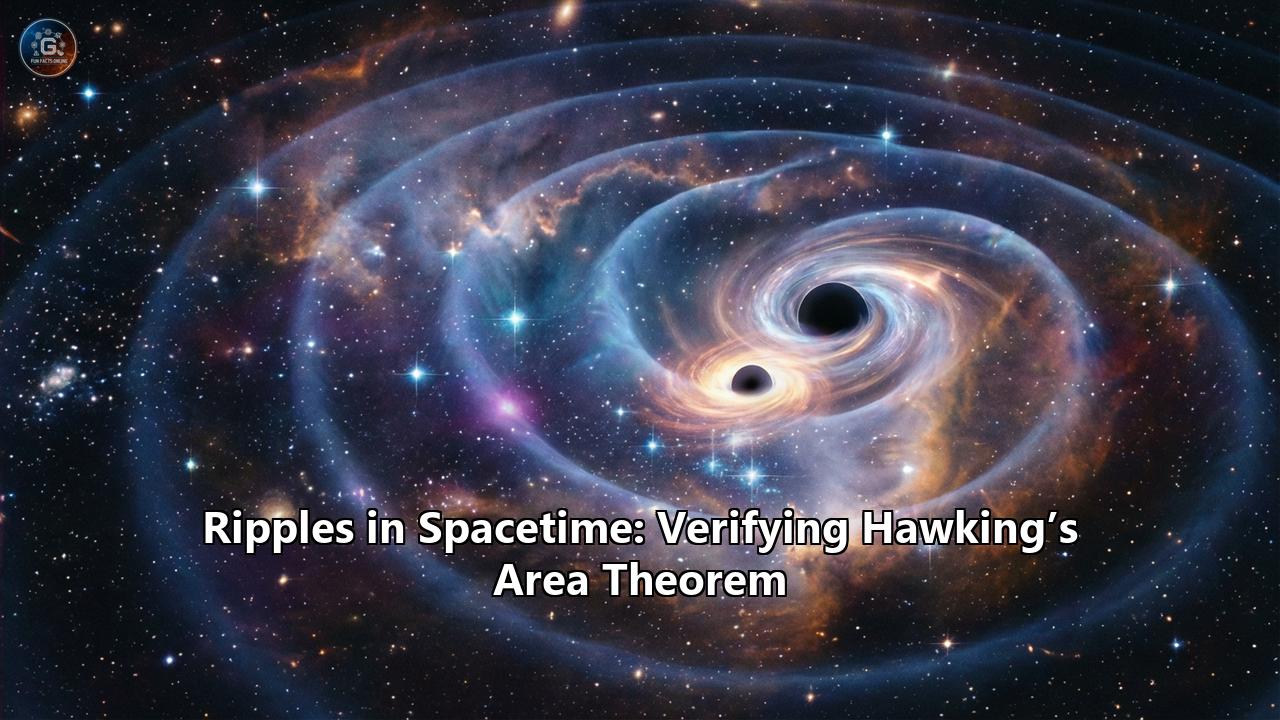
It was a prediction that sat quietly in the notebooks of theoretical physicists for more than half a century. In 1971, a young Stephen Hawking, working with the mathematics of general relativity, derived a rule that seemed as absolute as it was simple: the surface area of a black hole’s event horizon can never decrease. For decades, this "Area Theorem" was a mathematical jewel—elegant, profound, but seemingly impossible to test in the messy reality of our universe.
But the universe has a way of eventually revealing its secrets.
As we close out 2025, the physics community is still buzzing from the September announcement that has fundamentally cemented our understanding of gravity. Ten years after the first detection of gravitational waves, and following a preliminary test in 2021, the LIGO-Virgo-KAGRA collaboration has delivered the "gold standard" confirmation we have been waiting for. With the detection of the crystal-clear signal GW250114, scientists have proven Hawking right with a staggering 99.999% confidence.
This isn’t just a win for a textbook theorem. It is the observational anchor for the laws of black hole thermodynamics, a bridge to quantum gravity, and a testament to humanity’s ability to "hear" the shape of spacetime itself.
The Unshrinkable Horizon: What is Hawking’s Area Theorem?
To understand the magnitude of this verification, we must first look at the object itself. A black hole is defined by its event horizon—the invisible shell of "no return" surrounding the singularity. Once you cross this boundary, the escape velocity exceeds the speed of light.
In classical general relativity, Hawking realized that the dynamics of black holes obey a strict law. No matter what you throw into a black hole—stars, gas, or other black holes—its mass increases. Since the radius of a simple black hole is directly proportional to its mass, adding mass makes the horizon grow.
Hawking went a step further. He proved that even in the violent, chaotic collision of two black holes, the total area of the final black hole’s horizon must be greater than the sum of the areas of the two original black holes.
$$A_{final} > A_{1} + A_{2}$$
This sounds intuitive, but it wasn't guaranteed. Black hole mergers are cataclysmic events that radiate away massive amounts of energy in the form of gravitational waves. If a system loses energy, you might expect the final object to shrink. Hawking’s theorem asserts that despite this energy loss, the "balkiness" of the black hole—its area—can fundamentally only grow.
The Thermodynamic Connection
Physicists immediately noticed a striking parallel between Hawking's Area Theorem and the Second Law of Thermodynamics, which states that the entropy (disorder) of a closed system can never decrease.
This was the clue that led Jacob Bekenstein and Stephen Hawking to a radical conclusion: the area of a black hole is its entropy. This realization birthed the field of black hole thermodynamics, implying that these dark voids aren't just gravitational pits, but thermal objects that can eventually radiate energy (Hawking Radiation). Verifying the Area Theorem is, therefore, verifying the foundation of how black holes store information and energy.
The First Clues: The 2021 Breakthrough
For fifty years, the Area Theorem was untestable because we couldn't "see" black holes clearly enough to measure them. That changed in 2015 with LIGO’s historic first detection of gravitational waves, GW150914.
In 2021, a team led by physicist Maximiliano Isi at MIT revisited that first signal with a clever new technique. They split the gravitational wave signal into two distinct parts:
- The Inspiral: As the two black holes spiraled toward each other, the frequency of the waves revealed their individual masses and spins. From this, the team calculated the initial total horizon area.
- The Ringdown: After the collision, the newly formed "daughter" black hole rang like a struck bell. By analyzing the specific frequencies of this ringing (and crucially, its "overtones"), the team calculated the final mass and spin, and thus the final area.
The result? The final area was indeed larger. The confidence level was about 95%—a strong result, known in physics as "2-sigma," but not yet the "5-sigma" certainty (99.9999%) required to claim a definitive discovery. The data from 2015 was simply too noisy to be absolutely sure.
The "Golden Event": GW250114
Then came January 14, 2025.
The global network of detectors—LIGO in the US, Virgo in Italy, and KAGRA in Japan—had undergone years of "A+" upgrades, utilizing quantum squeezing technology to reduce background noise to unprecedented levels. On that cold winter day, a signal arrived from 1.3 billion light-years away that was unlike anything seen before.
Dubbed GW250114, the signal came from the merger of two massive black holes (roughly 35 and 40 solar masses). What made this event special was its Signal-to-Noise Ratio (SNR). It was loud. While the 2015 signal was a whisper buried in static, GW250114 was a shout.
Analyzing the Ringdown
The clarity of GW250114 allowed researchers to perform the "inspiral vs. ringdown" test with surgical precision.
- Before the merger: The combined horizon area of the two parents was calculated to be roughly 240,000 square kilometers (about the size of the United Kingdom).
- After the merger: The new black hole’s horizon measured approximately 400,000 square kilometers (comparable to Sweden).
The increase was unambiguous. But more importantly, the derived statistical confidence hit the celebrated 99.999% mark. This was the "smoking gun." The Area Theorem was no longer just a mathematical derivation; it was an observed law of nature.
Why This Matters: Beyond General Relativity
You might ask: If we already trusted Einstein and Hawking, why do we need to prove it?
Physics is a house of cards; if the foundation is weak, the structure collapses. Confirmation of the Area Theorem provides three crucial pillars for modern physics:
1. Ruling Out "Exotic" Compact Objects
There are alternative theories of gravity that predict objects like "boson stars" or "gravastars" which mimic black holes but lack an event horizon. If the merged object had shown a decrease in "surface area" or behaved differently during the ringdown, it would have been evidence for these exotic mimics. The strict adherence to Hawking’s law confirms that these are indeed the Kerr black holes predicted by General Relativity.
2. The Paradox of Hawking Radiation
There is a famous tension in physics. Hawking’s Area Theorem (Classical Physics) says the area can never decrease. But Hawking Radiation (Quantum Physics) says black holes slowly evaporate and shrink over billions of years.
Are they contradictory? No. The Area Theorem holds for classical processes—violent, fast events like mergers. Hawking Radiation is a slow, quantum process. Verifying the classical theorem strengthens the baseline from which we calculate quantum deviations. We have confirmed the "classical limit," which allows us to hunt for the tiny quantum signatures in the future.
3. Information and Entropy
By confirming that Area = Entropy, we validate the Bekenstein-Hawking Entropy formula. This is the only physical formula we have that combines constants from Thermodynamics ($k$), Gravity ($G$), Relativity ($c$), and Quantum Mechanics ($\hbar$).
$$S = \frac{kc^3 A}{4G\hbar}$$
Verifying the "Area" side of this equation effectively tells us we are on the right track toward a Theory of Everything.
The Future: Einstein’s Telescope and the Quantum Realm
As we look ahead to 2026 and beyond, the verification of Hawking’s Area Theorem is not an end, but a beginning. With the Einstein Telescope and the space-based LISA mission on the horizon, we will soon detect mergers of supermassive black holes and events from the dawn of time.
Physicists are now turning their attention to the "overtones" of the ringdown. The extreme precision of the GW250114 data has allowed us to hear not just the "fundamental note" of the black hole, but its "harmonics." It is in these faint harmonics that we might eventually find cracks in General Relativity—hints of the quantum structure of spacetime itself.
For now, however, the universe has spoken clearly. Fifty-four years after Stephen Hawking scribbled a derivation on a notepad, ripples in the fabric of spacetime have carried his vindication across the cosmos. The area of a black hole is an indelible record of its history, a cosmic ledger that, in the violent dance of gravity, can only grow.
Reference:
- https://www.sci.news/astronomy/stephen-hawkings-black-hole-area-law-09820.html
- https://news.mit.edu/2021/hawkings-black-hole-theorem-confirm-0701
- https://www.virgo-gw.eu/news/ten-years-after-the-discovery-gravitational-waves-verify-stephen-hawkings-black-hole-area-theorem/
- https://physics.cornell.edu/news/hawkings-black-hole-theorem-observationally-confirmed
- https://as.cornell.edu/news/hawkings-black-hole-theorem-observationally-confirmed
- https://news.northwestern.edu/stories/2025/09/gravitational-wave-detection-verifies-stephen-hawkings-theorem
- https://www.ift.uam-csic.es/en/ten-years-after-the-discovery-gravitational-waves-verify-stephen-hawkings-black-hole-area-theorem-2/
- https://www.reddit.com/r/askscience/comments/obkz5d/how_does_hawkings_area_theorem_reconcile_with/
- https://physicsworld.com/a/ligo-gravitational-wave-signal-backs-up-hawkings-area-theorem/
- https://astro.cornell.edu/news/hawkings-black-hole-theorem-observationally-confirmed
- https://www.infn.it/en/gravitational-waves-ligo-virgo-kagra-confirm-stephen-hawkings-black-hole-area-theorem/
- https://www.techexplorist.com/hawking-black-hole-theorem-confirmed-50-years/39883/
- https://arxiv.org/pdf/2307.16305
- https://www.youtube.com/watch?v=Qh8ts-SPwcI
- https://nasaspacenews.com/2025/09/black-hole-area-theorem-hawkings-area-theorem-finally-confirmed-by-new-gravitational-waves/
- https://www.youtube.com/watch?v=_fLOgS7F5Bo
- https://www.youtube.com/watch?v=ZlixdOIWFKE