
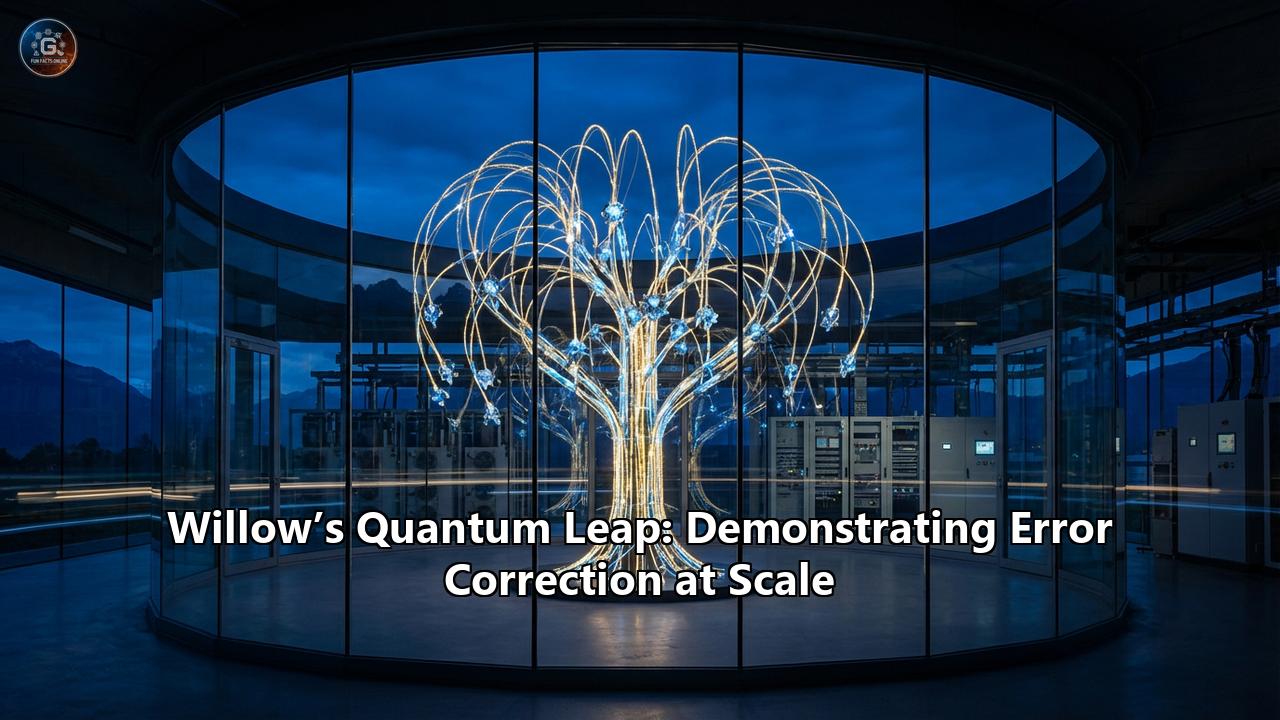
In the quiet, supercooled vacuum of a laboratory in Santa Barbara, a revolution has just taken place. It wasn’t marked by an explosion or a flash of light, but by a data plot that moved in a direction physicists have been chasing for thirty years: down.
For decades, the central tragedy of quantum computing was a paradox: to make a quantum computer powerful, you need more qubits (quantum bits). But the more qubits you add, the more noise, interference, and errors you introduce, typically causing the system to collapse into uselessness. It was a game of diminishing returns. The harder we tried to build large-scale machines, the more fragile they became.
Until now.
Google Quantum AI has officially unveiled Willow, a 105-qubit processor that has achieved what many considered the "Holy Grail" of the field: exponential error reduction at scale. For the first time in history, adding more physical qubits to a logical error-correction cluster didn't add more noise—it actually cleaned the signal.
This is not just an incremental update. This is the "Wright Brothers moment" for fault-tolerant quantum computing. Willow has crossed the rubicon from scientific curiosity to scalable engineering reality.
In this deep dive, we will explore the architecture of Willow, the physics behind its breakthrough, the staggering 10-septillion-year benchmark it crushed, and why the world of computing will never be the same again.
Part 1: The "Below Threshold" Breakthrough
The Central Problem of Quantum Mechanics
To understand why Willow is such a monumental achievement, we must first understand the enemy: decoherence.
In a classical computer, a bit is a robust switch—either a 0 or a 1. You can heat it, shake it, or leave it alone, and it stays a 0 or a 1. A qubit, however, is a delicate quantum state—a superposition of 0 and 1. It is hypersensitive to its environment. A stray photon, a fluctuation in temperature, or even the vibration of a nearby atom can cause the qubit to "decohere," losing its quantum information and introducing an error.
For years, the industry operated in the "NISQ" era (Noisy Intermediate-Scale Quantum). We built chips with 50 or 100 qubits, but they were noisy. If you ran a calculation for too long, the errors overwhelmed the answer.
The Solution: Quantum Error Correction (QEC)
The theoretical solution proposed in the 1990s by Peter Shor and others was Quantum Error Correction. The idea is to stop relying on individual, fragile "physical qubits" and instead weave them together into a collective "logical qubit."
Imagine a choir. If one singer forgets the lyrics (a physical error), the voices of the other singers drown them out, and the song continues correctly (the logical state is preserved). In a quantum processor, we arrange physical qubits in a lattice (like a checkerboard). They constantly check each other's neighbors for errors without looking at the data itself.
The Threshold Theorem
Here is where the math gets tricky. Building this "choir" of qubits is difficult. The act of checking for errors can itself introduce more errors.
The Threshold Theorem posits that there is a specific quality level for physical qubits. If your hardware is bad (above the threshold), adding more qubits to the choir just makes the noise louder. The system gets worse as it gets bigger.
But, if your hardware is good enough (below the threshold), magic happens. Adding more qubits to the choir makes the song clearer. The error rate drops exponentially.
Willow’s Historic Achievement
This is exactly what Willow has demonstrated.
In the Nature paper released alongside the chip, Google Quantum AI showed that they successfully encoded logical qubits using the surface code.
- When they used a small distance-3 code (a small grid of qubits), they achieved a certain error rate.
- When they scaled up to a distance-5 code (more qubits), the error rate dropped.
- When they scaled to a distance-7 code, the error rate dropped again—by a factor of two.
This is the first time a quantum processor has demonstrated that making the system larger makes it better. It validates the fundamental roadmap for the entire industry. We now know that if we build a big enough chip with Willow-class qubits, we can drive the error rate down to zero for all practical purposes.
Part 2: Inside the Machine — The Hardware Specs
Willow is not just a theoretical experiment; it is a marvel of engineering. Let's look under the hood of this superconducting beast.
1. The 105-Qubit Architecture
Willow features 105 superconducting transmon qubits. While this number is only double that of its predecessor, Sycamore (53 qubits), the quality of these qubits is vastly superior.
Transmon qubits are essentially artificial atoms made from circuits of niobium and aluminum, cooled to near absolute zero (around 20 millikelvin). At these temperatures, the metal becomes a superconductor, allowing electrons to flow with zero resistance, creating the quantum states necessary for computation.
2. A 5x Jump in Coherence
The defining metric of a qubit's quality is its T1 coherence time—how long it can hold information before decaying.
- Sycamore (2019): ~20 microseconds.
- Willow (2024): ~100 microseconds.
This five-fold increase in lifetime is what allowed Willow to cross the error correction threshold. It gives the control electronics enough time to spot errors and correct them before the quantum state falls apart.
3. Tunable Couplers
One of the secret weapons in Google's hardware stack is the tunable coupler. In many quantum chips, qubits are statically connected to their neighbors. This leads to "crosstalk"—when you talk to one qubit, its neighbor "hears" you and gets confused.
Willow’s couplers act like adjustable valves between qubits. They can be turned "off" completely to isolate a qubit or turned "on" to entangle it with a neighbor. This dynamic architecture allows for incredibly precise control, reducing the parasitic errors that plagued earlier generations.
4. Real-Time Decoding with AI
Error correction isn't just hardware; it's a software problem. As the chip runs, it generates a flood of "syndrome data"—measurements that hint at where errors are occurring.
To handle this, Willow is paired with a real-time decoder developed by Google DeepMind. This AI-driven system analyzes the syndrome data on the fly, identifying the "ghosts" in the machine and telling the control system how to correct them. This integration of advanced AI with quantum hardware is a preview of how these two distinct technologies will converge in the future.
Part 3: The 10 Septillion Year Benchmark
If the error correction milestone is the "scientific" breakthrough, the performance benchmark is the "raw power" flex.
To prove Willow’s capabilities, Google re-ran the Random Circuit Sampling (RCS) benchmark. This is a specific, highly complex mathematical problem designed to be easy for a quantum computer but nightmare-inducing for a classical one.
In 2019, Sycamore performed an RCS calculation in 200 seconds that Google claimed would take a supercomputer 10,000 years (a claim later disputed and refined by IBM and others).
Willow has ended the debate.Willow executed the benchmark in under 5 minutes.
Google estimates that Frontier, currently the world’s fastest supercomputer (an Exascale machine capable of a billion billion calculations per second), would take 10 septillion years to match that result.
What is 10 Septillion Years?
- It is $10^{25}$ years.
- The universe is only $13.8 \times 10^9$ years old.
- You could run the simulation for the entire age of the universe, restart it a billion times, and still not be finished.
This result, known as "Quantum Supremacy" or "Quantum Advantage," proves that we have officially moved beyond the ability of classical silicon to simulate quantum systems. The gap is no longer linear; it is exponential and unbridgeable.
Part 4: Why This Changes Everything
The announcement of Willow has sent shockwaves through the scientific and tech communities. But why does it matter to the average person or the global economy?
1. The End of Simulation, The Beginning of Discovery
Currently, when we design a new battery or a drug, we use classical computers to approximate how molecules behave. But molecules are quantum mechanical objects. Classical computers are terrible at simulating them.
With Willow-class error correction, we are on the path to Fault-Tolerant Quantum Computing. A fault-tolerant machine will be able to exactly simulate the chemical bonds in a new battery cathode or the protein folding of a virus.
- Energy: Designing room-temperature superconductors or ultra-efficient solar cells.
- Medicine: Simulating how a drug interacts with a specific protein in the human body, slashing the time for drug discovery from years to weeks.
- Materials: Creating lightweight, heat-resistant alloys for aerospace.
2. The Cryptography Clock is Ticking
Willow itself cannot break RSA encryption (the standard protecting your credit card and emails). It is still too small. Breaking RSA-2048 requires millions of physical qubits to create the thousands of logical qubits needed for Shor’s Algorithm.
However, Willow proves that the physics required to build such a machine works. The timeline for "Q-Day"—the day quantum computers break current encryption—has shifted from "maybe never" to "a matter of engineering."
Google spokespeople have stated they are still likely 10+ years away from that scale, but for governments and security agencies, the "store now, decrypt later" threat is real. This accelerates the urgent migration to Post-Quantum Cryptography (PQC) standards.
3. The New Economic Moat
The development of Willow highlights the immense barrier to entry in this field. This isn't two guys in a garage. It requires:
- A dedicated superconducting fabrication facility (like Google's in Santa Barbara).
- Dilution refrigerators colder than deep space.
- DeepMind-level AI integration.
- Capital investment in the billions.
This consolidates the power of quantum computing into the hands of a few major players (Google, IBM, Microsoft, manufacturing giants), raising important questions about access and democratization of this potent technology.
Part 5: The Road Ahead — From Willow to Maple?
What comes after Willow?
Julian Kelly, the Director of Quantum Hardware at Google, has been clear: "Error correction is the end game."
The roadmap is now focused on scaling logical qubits.
- Logical Memory: Demonstrate a logical qubit that lives effectively forever (or at least long enough for any calculation).
- Logical Operations: Performing calculations between two error-corrected logical qubits without breaking the protection.
- Scaling Up: Moving from 105 physical qubits to 1,000, then 10,000, and eventually 1,000,000.
Google has also announced a collaboration with the UK National Quantum Computing Centre (NQCC), allowing researchers to access Willow to begin developing algorithms for this new era. This is critical because writing code for a logical quantum computer is fundamentally different from the NISQ hacks used today.
The Verdict
December 2024 will be remembered in history books. Before Willow, quantum error correction was a beautiful theory, scribbled on whiteboards by physicists hoping nature would cooperate.
With Willow, the theory has become metal, silicon, and microwave pulses. We have proven that we can tame the chaos of the quantum world. The noise has not been silenced, but for the first time, we have learned to speak louder than it.
The quantum age isn't coming. It's here.
Glossary of Key Terms
- Qubit: The basic unit of quantum information. Unlike a bit (0 or 1), it can exist in superposition.
- Superposition: The ability of a quantum system to be in multiple states at once.
- Entanglement: A connection between particles where the state of one instantly influences the other, regardless of distance.
- Logical Qubit: A cluster of physical qubits working together to store one bit of information redundantly to prevent errors.
- Surface Code: A specific error-correction scheme that arranges qubits in a checkerboard pattern to detect errors.
- T1 Coherence Time: The duration a qubit can maintain its energy state before decaying.
- Quantum Supremacy: The point where a quantum computer performs a task impossible for any classical computer.
Reference:
- https://www.youtube.com/watch?v=W7ppd_RY-UE
- https://www.business-standard.com/technology/tech-news/google-announces-willow-quantum-computing-chip-all-you-need-to-know-124121000254_1.html
- https://www.techtarget.com/searchcio/definition/Google-Willow
- https://www.spinquanta.com/news-detail/meet-willow-googles-latest-breakthrough-in-quantum-chip20241219055025
- https://quantumai.google/
- https://research.google/blog/making-quantum-error-correction-work/
- https://en.wikipedia.org/wiki/Willow_processor
- https://www.sciencealert.com/googles-new-chip-could-crack-one-of-quantum-computings-biggest-problems
- https://physicsworld.com/a/quantum-processor-enters-unprecedented-territory-for-error-correction/
- https://thequantuminsider.com/2024/12/09/google-quantum-ai-new-quantum-chip-outperforms-classical-computers-and-breaks-error-correction-threshold/
- https://quantumxc.com/blog/google-willow-chip-quantum-chip/
- https://news.sky.com/story/google-unveils-astonishing-quantum-computing-chip-called-willow-13270750
- https://quantumai.google/static/site-assets/downloads/willow-spec-sheet.pdf
- https://blog.google/around-the-globe/google-europe/united-kingdom/national-quantum-computing-centre-collaboration/