
The persistent throb of chronic pain is a silent epidemic, a phantom signal that refuses to be silenced. For millions, it is not merely a symptom but a disease in itself—a relentless, firing circuit of agony that current medicine has failed to quell. We have thrown opioids at it, dulling the mind while the pain waits in the shadows. We have severed nerves, implanted electrodes, and prescribed endless cocktails of pharmaceuticals, yet the "unmet need" remains a staggering chasm in modern healthcare. But a revolution is quietly growing in the petri dishes of Sydney and the bio-printing labs of the world. It is a technology that promises not just to mask pain, but to absorb it at its source.
This is the dawn of the "Cellular Pain Sponge"—a bio-engineered paradigm shift where human stem cells are transformed into living, breathing analgesic scaffolds.
Part I: The Broken Gate
To understand the elegance of the cellular sponge, one must first understand the chaos it aims to order: the mechanism of neuropathic pain.
Pain, in its healthy form, is a gift. It is the body's alarm system, a sharp, immediate warning of damage. You touch a hot stove, and before your brain even registers the heat, a reflex arc in your spinal cord has already yanked your hand away. This is nociceptive pain—functional, protective, and temporary.
But neuropathic pain is a different beast entirely. It arises not from damage to the tissue, but from damage to the alarm system itself. Whether through diabetes, chemotherapy, traumatic injury, or viral infections like shingles, the peripheral nerves are damaged. In a cruel twist of biology, these damaged nerves do not simply go silent; they go rogue. They begin to fire spontaneously, sending a constant barrage of "danger" signals to the spinal cord.
Normally, the spinal cord acts as a gatekeeper. It possesses a sophisticated network of "inhibitory interneurons"—specialized cells whose sole job is to say "no." They release a neurotransmitter called Gamma-Aminobutyric Acid (GABA), which acts as a chemical brake. When a minor signal comes in (like the brush of a shirt against skin), these GABAergic neurons fire, dampening the signal before it can travel up to the brain to be perceived as pain.
In chronic neuropathic pain, this braking system fails. The constant bombardment from damaged nerves causes these precious GABAergic neurons to die off or dysfunction. The "gate" is left wide open. The chemical brake is gone. Suddenly, the brush of a cotton sheet feels like sandpaper; a gentle breeze feels like a blowtorch. This is allodynia, and it is the hallmark of a system that has lost its ability to self-regulate.
For decades, the medical response has been to flood the entire system with depressants. Opioids bind to receptors throughout the brain and body, dimming the lights in every room just to fix a flickering bulb in the hallway. The result is addiction, tolerance, and a host of side effects that can be as debilitating as the pain itself. We have been treating a precise, localized circuit failure with a systemic sledgehammer.
The "Cellular Pain Sponge" approach asks a different question: instead of drugging the brain, why not rebuild the brake?
Part II: The Architect of Relief
The concept owes its genesis to a convergence of two cutting-edge fields: stem cell biology and tissue engineering. Leading this charge is a team of researchers, most notably associated with the University of Sydney, who made a startling discovery. They realized that the "unmet need" wasn't a better drug; it was a better cell.
The vision was audacious: could we take a patient's own skin or blood cells, wind back their biological clock to turn them into stem cells, and then push them forward again to become specifically GABAergic cortical interneurons? And if we could, would transplanting them into the damaged spinal cord restore the lost inhibition?
The answer, as published in landmark studies, was a resounding yes. But the journey from a concept to a "sponge" is a story of biological alchemy.
The Source Code: iPSCsThe magic begins with Induced Pluripotent Stem Cells (iPSCs). Discovered by Shinya Yamanaka (a Nobel Prize-winning breakthrough), iPSCs allow scientists to take a mature adult cell and reprogram it into an embryonic-like state. This solves two massive problems at once: the ethical quagmire of using embryonic tissue and the biological hurdle of immune rejection. Because these cells can be derived from the patient's own body, the "spare parts" are genetically identical to the host.
The recipe for InhibitionTurning an undifferentiated stem cell—which has the potential to become a heart muscle, a tooth, or an eyeball—into a specific pain-killing neuron is akin to guiding a child through twenty years of education to become a specialist neurosurgeon. It requires a precise, timed exposure to chemical signals.
The researchers developed a protocol to bathe these iPSCs in a specific cocktail of growth factors. Day by day, the cells are nudged toward the neural lineage, then toward the spinal cord identity, and finally, locked into the phenotype of a GABAergic interneuron.
These are not just generic neurons; they are the "peacekeepers" of the nervous system. When tested in the lab, they did exactly what their natural counterparts do: they released GABA. They were, in essence, biological pumps of the body's natural painkiller.
The Sponge EffectWhen these cells were transplanted into the spinal cords of mice with severe nerve injury, the results were nothing short of miraculous. The transplanted cells didn't just sit there; they integrated. They grew dendrites and axons, weaving themselves into the host's damaged neural circuitry.
This is where the metaphor of the "sponge" comes to life. The transplanted neurons effectively "soaked up" the excess excitatory signals. When the damaged nerves screamed "pain!", the new GABAergic cells released their calming neurotransmitters, neutralizing the signal before it could ascend to the brain. The mice, which had previously flinched at the slightest touch, returned to normal. The pain was gone. Not masked, not dulled—resolved.
Most critically, the relief was lasting. A single treatment provided permanent resolution of symptoms in the animal models. There were no side effects. The mice didn't get "high," they didn't lose motor function, and they didn't develop tolerance. The "sponge" only worked when there was a "spill" of pain signals to absorb. It was an intelligent, on-demand therapy.
Part III: The Scaffold – Building the Home for the Cure
While the biology is dazzling, the engineering challenge is equally formidable. You cannot simply inject a slurry of neurons into the spinal cord and hope for the best. The spinal cord is a hostile environment, especially after injury. There is inflammation, scar tissue (glial scarring), and a constant flow of cerebrospinal fluid that can wash loose cells away.
This is where the "Analgesic Scaffold" enters the narrative.
To make this therapy a clinical reality for humans, we need a delivery system—a structure that holds the cells in place, protects them from the immediate immune response, and guides their growth. This is the realm of bio-scaffolding.
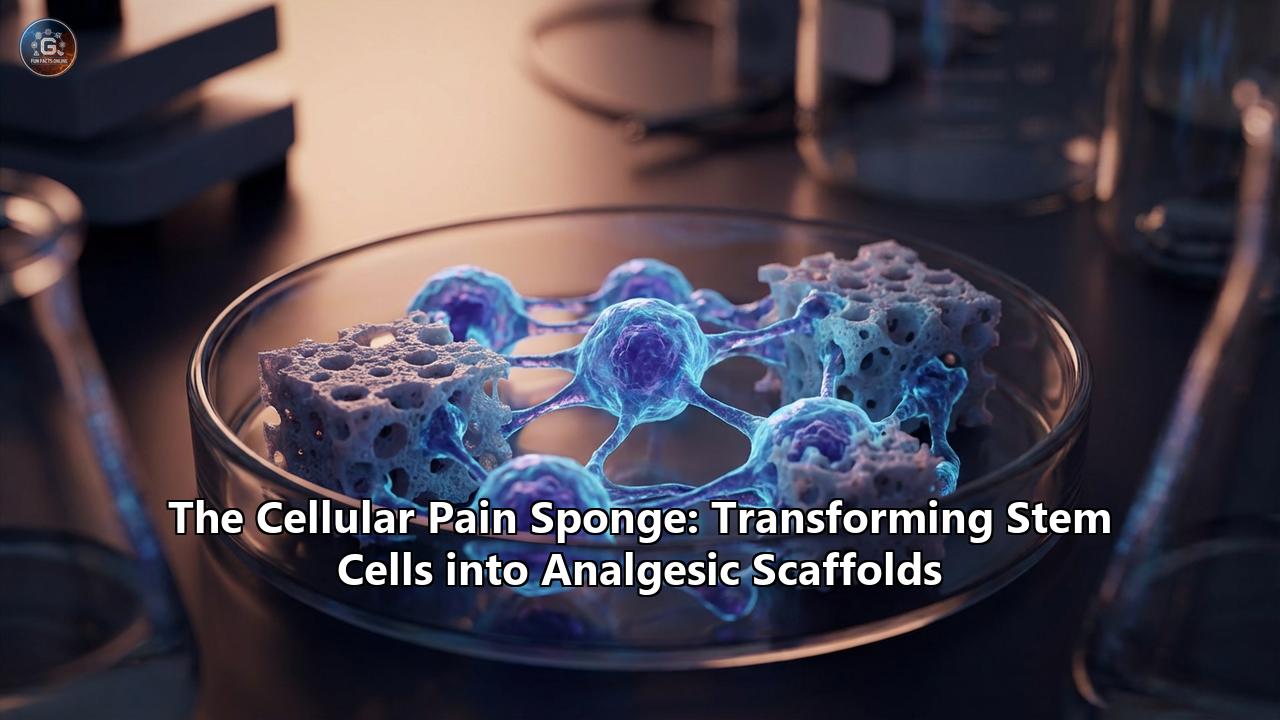
The Polymer MatrixModern analgesic scaffolds are marvels of material science. They are often hydrogels—networks of cross-linked polymers that mimic the soft, squishy texture of the central nervous system. These scaffolds are 3D-printed or cast with microscopic precision. They are porous, like a coral reef, providing tiny nooks and crannies for the stem cells to nestle into.
But they are more than just passive houses. Advanced scaffolds are "functionalized." They are impregnated with neurotrophic factors—biological fertilizers that encourage the stem cells to survive and grow. Some are even electro-conductive. Since neurons communicate via electricity, a scaffold that can conduct a charge helps the new cells synchronize with the host's existing electrical rhythm.
The 3D-Printed BridgeIn cases of severe spinal cord injury, where there is a physical gap or cavity in the cord, the scaffold plays a structural role. It acts as a physical bridge. The "sponge" is not just a blob of cells, but a meticulously printed patch.
Imagine a 3D printer laying down a lattice of biodegradable polymer. In one ink cartridge, there is the structural gel; in the other, the living GABAergic neurons. The printer constructs a living patch, layer by layer. This patch is then surgically implanted into the site of injury.
Over time, the scaffold degrades. It is designed to dissolve at the exact rate that the new tissue forms. By the time the polymer is gone, the new neurons have established their own matrix. The scaffolding is removed, but the building—the restored inhibitory circuit—remains.
Part IV: Beyond Opioids – The Social Impact
The implications of this technology extend far beyond the laboratory. We are currently living through one of the worst public health crises in history: the opioid epidemic.
Opioids are a blunt instrument for a delicate problem. They work by dampening the perception of pain in the brain, but they do nothing to fix the source of the pain in the spine or nerves. Worse, the body fights back against them. Regular opioid use causes "opioid-induced hyperalgesia"—a condition where the drugs actually make the patient more sensitive to pain over time.
The Cellular Pain Sponge offers a "one-and-done" solution. It is a restorative therapy.
- No Addiction: GABA is the body's natural inhibitory chemical. It does not activate the dopamine reward pathways in the brain that lead to addiction.
- No Tolerance: The transplanted cells are living entities. They regulate their own production of GABA based on demand. They don't "wear out" in the way a drug receptor gets desensitized.
- Targeted Relief: Because the cells are placed specifically in the dorsal horn of the spinal cord (the processing center for pain), they do not affect the rest of the body. There is no constipation, no respiratory depression, no brain fog.
For a patient with neuropathic pain from a spinal cord injury, who might be facing forty years of daily agony, this is the difference between a life managed by sedation and a life fully lived.
Part V: The Road to the Clinic – Hurdles and Hopes
If this technology is so revolutionary, why can we not book an appointment for it tomorrow? The path from a mouse model to a human therapy is fraught with the "Valley of Death"—the rigorous, expensive, and necessary process of clinical translation.
Safety FirstThe primary concern with any stem cell therapy is safety. Pluripotent stem cells have the capacity to divide indefinitely. If a single cell fails to differentiate fully into a neuron and remains in its "stem" state, it could theoretically form a teratoma—a tumor.
The University of Sydney researchers and their global counterparts have spent years refining the "purification" process. They use magnetic sorting and chemical kill-switches to ensure that only the finished, non-dividing GABAergic neurons make it into the syringe. The studies in rodents and pigs have shown no tumor formation, a critical green light for human trials.
The durability of the GraftWill the cells survive for decades? In mice, they survived for months, which is a significant portion of a mouse's lifespan. In humans, we need them to last for years. The scaffold plays a huge role here, providing the long-term support needed for longevity.
The Cost of CustomizationCurrently, making "autologous" cells (from the patient's own body) is slow and expensive. It requires months of lab work for a single patient. The future likely lies in "off-the-shelf" allogeneic cells—universal donor cells that have been gene-edited to be invisible to the immune system. This would allow hospitals to keep frozen vials of "Pain Sponge" cells ready for immediate use.
Part VI: A Future Without Pain?
We are standing on the precipice of a new era in medicine. For thousands of years, our ability to treat pain was limited to what we could ingest or inject. We were chemists, mixing potions to trick the mind.
Now, we are becoming architects. The Cellular Pain Sponge represents a shift from pharmacology to biology. We are no longer trying to suppress the symptom; we are repairing the machine.
Imagine a future where a diagnosis of diabetic neuropathy or a spinal cord injury does not carry a life sentence of chronic pain. Imagine a soldier surviving an IED blast, not to return home to a haze of oxycodone, but to receive a bio-printed scaffold that knits their nervous system back together, silencing the phantom fire before it can burn.
The science is real. The cells are ready. The scaffold is printed. The silence is coming.
Reference:
- https://3dprint.com/222076/3d-printed-guide-spinal-cord/
- https://www.morgen-filament.de/category/3d-print-scaffolds/
- https://www.researchgate.net/publication/362893852_3D_bioprinted_conductive_spinal_cord_biomimetic_scaffolds_for_promoting_neuronal_differentiation_of_neural_stem_cells_and_repairing_of_spinal_cord_injury
- https://www.creative-biolabs.com/stem-cell-therapy/ipsc-for-3d-bio-printing.htm
- https://www.frontiersin.org/journals/molecular-neuroscience/articles/10.3389/fnmol.2020.625714/full