
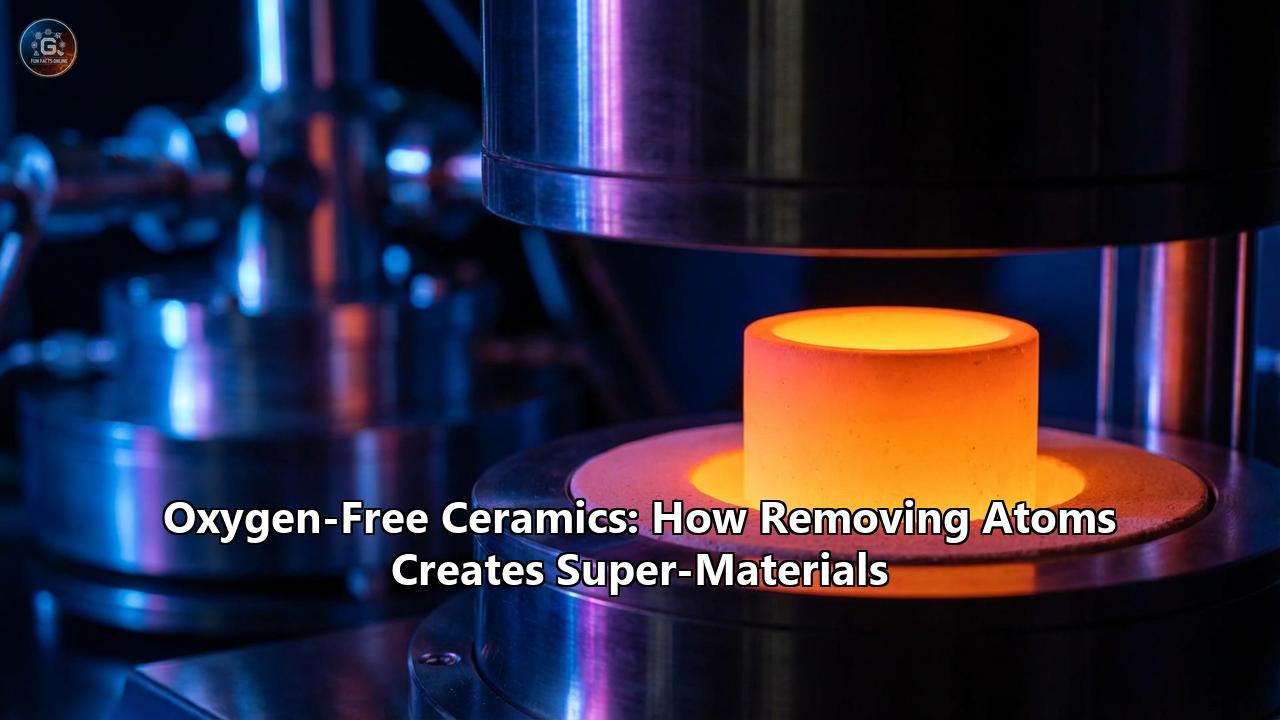
In the realm of materials science, oxygen is often the invisible shackle. For centuries, human engineering has relied on oxides—clays, silicas, and rusting metals—because oxygen is the most abundant element in the Earth's crust. It bonds aggressively, stabilizing materials into familiar, brittle forms. But to break the barriers of modern engineering, scientists have begun to ask a radical question: What happens when we take the oxygen away?
The answer lies in a class of materials that defy conventional limits: Oxygen-Free (Non-Oxide) Ceramics. By forcibly removing oxygen atoms from the crystal lattice and replacing them with carbon, nitrogen, or boron, engineers create "super-materials" with covalent bonds so strong they can survive conditions that would turn steel to liquid and traditional ceramics to dust.
But the story doesn't end with simple substitution. Recent breakthroughs have taken the concept of "removing atoms" to a quantum level. From Penn State’s thermodynamic trickery that stabilizes impossible materials by starving them of oxygen, to "defect engineering" where missing atoms create quantum sensors, the future of technology is being built on what isn't there.
This comprehensive guide explores the science, synthesis, and futuristic applications of these materials, detailing how the subtraction of atoms is leading to an addition of limitless potential.
1. The Tyranny of Oxygen: Why "Non-Oxide" Matters
To understand why oxygen-free ceramics are special, we must first understand the "oxide trap." Most traditional ceramics (like alumina, $Al_2O_3$, or silica, $SiO_2$) are held together largely by ionic bonds. Oxygen, being highly electronegative, steals electrons from metals, creating an electrostatic attraction. While strong, these bonds have weaknesses:
- Thermal Expansion: As heat rises, ionic bonds vibrate and stretch, causing the material to expand and crack under thermal shock.
- Chemical Reactivity: In extreme environments, oxygen is a "social" atom—it wants to react. This makes oxide materials vulnerable to corrosion at ultra-high temperatures.
When you remove oxygen and replace it with Nitrogen (N) or Carbon (C), the bonding nature changes. Carbon and nitrogen are less electronegative than oxygen; they prefer to share electrons rather than steal them. This forms covalent bonds—the same directed, rigid bonds that give diamond its hardness.
- Silicon + Oxygen = Silica (Sand/Glass): Brittle, melts at ~1,700°C.
- Silicon + Carbon = Silicon Carbide (SiC): Super-hard, decomposes at ~2,700°C, semiconductor.
- Silicon + Nitrogen = Silicon Nitride ($Si_3N_4$): Incredible toughness, survives thermal shock that shatters glass.
This shift from ionic to covalent bonding unlocks the "Super-Material" trifecta: Ultra-High Temperature Capability, Extreme Hardness, and Chemical Inertness.
2. The Titans of Non-Oxide Ceramics
Four specific materials dominate this oxygen-free revolution. Each represents a unique victory of chemistry over nature.
A. Silicon Carbide (SiC): The Artificial Diamond
Discovered accidentally by Edward Acheson in 1891 while trying to make artificial diamonds, SiC is the workhorse of the non-oxide world.
- The Superpower: Thermal Conductivity & Hardness. SiC conducts heat almost as well as copper but is hard enough to grind steel.
- Key Application: Electric Vehicles (EVs). The power electronics in modern EVs (like Tesla) use SiC chips instead of silicon. Because SiC can handle higher voltages and dissipate heat faster, EVs can charge faster and drive farther.
- Extreme Use: Fusion Reactors. Researchers are investigating SiC composites for the "divertor" in fusion reactors—the component that extracts heat and ash from the plasma sun—because traditional metals would melt and contaminate the reaction.
B. Silicon Nitride ($Si_3N_4$): The Toughest Ceramic
If SiC is the hard shield, Silicon Nitride is the tough muscle. Its microstructure consists of interlocking needle-like grains that stop cracks in their tracks.
- The Superpower: Fracture Toughness & Thermal Shock. You can heat a piece of $Si_3N_4$ to 1,000°C and drop it into ice water, and it won't crack.
- Key Application: Aerospace Bearings. The main engines of the Space Shuttle used $Si_3N_4$ bearings. They are 60% lighter than steel, require little lubrication, and can spin at incredibly high RPMs without seizing.
C. Boron Nitride (BN): The "White Graphite"
Boron Nitride is a chemical chameleon. In its hexagonal form, it is slippery like graphite; in its cubic form, it is second only to diamond in hardness.
- The Superpower: Lubricity & Electrical Insulation. Unlike graphite, which conducts electricity, BN is an electrical insulator but a thermal conductor.
- Key Application: Electronics Cooling. It is used in thermal pastes and substrates to draw heat away from computer processors without shorting out the circuits.
D. Aluminum Nitride (AlN): The Heat Sink
- The Superpower: Thermal Conductivity matches aluminum metal, but it's an electrical insulator.
- Key Application: 5G Towers & Lasers. High-power electronics generate massive heat. AlN substrates act as a heat highway, moving thermal energy away from sensitive chips instantly.
3. The "Removing Atoms" Breakthrough: Starving Oxygen to Create Order
While SiC and $Si_3N_4$ are established materials, a recent discovery has redefined what "removing atoms" means. In a landmark study (published in Nature Communications), researchers at Penn State University discovered a method to stabilize High-Entropy Oxides (HEOs) by strictly controlling oxygen availability.
The Thermodynamic Trick
High-Entropy materials mix 5 or more elements (e.g., Mg, Co, Ni, Cu, Zn) into a single crystal lattice. Usually, these complex mixtures fall apart because the different atoms want to oxidize at different rates (e.g., Manganese wants to be $+3$ or $+4$, while Magnesium wants to be $+2$).
The researchers found that by removing oxygen from the synthesis environment (reducing the oxygen partial pressure), they could force rebellious atoms like Manganese and Iron to adopt a specific $+2$ oxidation state.
- The Result: Seven brand-new ceramic materials were created that are thermodynamically impossible to form in regular air.
- Why It Matters: This "oxygen starvation" technique opens the door to designing materials with specific magnetic and electronic properties for next-gen energy storage, effectively using the absence of oxygen as a design tool.
4. Defect Engineering: When the "Hole" is the Hero
The concept of "removing atoms" extends to the quantum scale. In a perfect crystal, every atom is in its place. But if you intentionally kick an atom out, you create a Vacancy. In non-oxide ceramics, these vacancies are becoming the heart of the quantum revolution.
Nitrogen-Vacancy (NV) Centers
In a diamond (carbon lattice) or Silicon Carbide, if you remove two adjacent carbon atoms and replace one with a nitrogen atom, you leave a "hole" (vacancy) next to the nitrogen.
- The Quantum Magic: This NV center traps electrons that can be manipulated by light and magnetic fields. It acts as a Qubit—the basic unit of a quantum computer—but unlike other qubits that need absolute zero temperatures, NV centers in SiC and Diamond can work at room temperature.
- Applications:
Quantum Sensing: These sensors are so sensitive they can detect the magnetic field of a single neuron firing.
GPS-Free Navigation: By detecting the magnetic anomalies of the Earth's crust with extreme precision, aircraft could navigate without satellites.
5. Manufacturing the Impossible
Creating these oxygen-free super-materials is notoriously difficult. You cannot simply melt and cast them like metals because they decompose before melting. Manufacturing requires extreme conditions—another testament to their "super" nature.
- Spark Plasma Sintering (SPS): Traditional ovens take hours. SPS pulses massive electrical currents through the ceramic powder, heating it to 2,000°C in minutes while applying tons of pressure. This fuses the atoms without allowing time for grain growth, keeping the material strong.
- Polymer-Derived Ceramics (PDCs): How do you make a ceramic fiber? You start with a liquid polymer (plastic), spin it into a fiber, and then "burn" the organic parts away in an oxygen-free furnace. The carbon and silicon backbones rearrange into ceramic SiC fibers. This is how the reinforcing fibers for jet engines are made.
- 3D Printing (Additive Manufacturing): HRL Laboratories recently cracked the code on 3D printing SiOC (Silicon Oxycarbide). They print a pre-ceramic resin into complex honeycomb shapes (impossible to machine) and then pyrolyze it. The result is a lightweight, heat-resistant ceramic lattice suitable for hypersonic vehicle skins.
6. Frontiers of Application: Where Oxygen-Free Ceramics Go
The unique properties of these materials are enabling technologies that were previously science fiction.
A. Hypersonic Flight (The Mach 5 Barrier)
When a vehicle travels at Mach 5 (5 times the speed of sound), the air friction generates temperatures exceeding 2,000°C—hot enough to melt titanium.
- The Solution: Ceramic Matrix Composites (CMCs). Vehicles like the X-51A Waverider and the DARPA Falcon HTV-2 utilize Carbon/Carbon or SiC/SiC composites. These "black ceramics" do not melt; they ablate or insulate, keeping the internal electronics cool while the skin glows white-hot.
- Leading Edges: The sharp nose cones of hypersonic missiles must cut through the air without blunting. Ultra-High Temperature Ceramics (UHTCs) like Zirconium Diboride ($ZrB_2$) are used here, often reinforced with SiC to prevent cracking.
B. Fusion Energy (Taming the Sun)
In the ITER fusion reactor, the plasma reaches 150 million degrees Celsius. The walls of the reactor (the divertor) are bombarded by high-energy neutrons.
- The Problem: Metals become radioactive and brittle under neutron bombardment.
- The Ceramic Fix: SiC/SiC composites are being developed for the "breeding blankets" of future reactors (like the DEMO reactor). Silicon Carbide has "low activation"—it doesn't stay radioactive for thousands of years like steel, making fusion power cleaner and safer.
C. Space Exploration (The Mars Shield)
Radiation is the biggest killer on a trip to Mars. Traditional metal shields are too heavy.
- The Material: Boron Nitride Nanotubes (BNNTs). NASA researchers have found that Boron-10 isotopes are excellent at absorbing neutron radiation. BNNTs are light, strong (like carbon nanotubes), and can be woven into the structure of the spacecraft or even the astronauts' suits, providing a shield that is structural rather than dead weight.
D. Next-Gen Batteries
Standard Li-ion batteries use metal oxide cathodes.
- The Innovation: High-Entropy Oxides (HEOs) and non-oxide anodes (like Silicon-Carbon composites) are changing the game. High-entropy anodes, stabilized by the "oxygen removal" synthesis mentioned earlier, show exceptional cycle life because the entropy stabilizes the crystal structure against the swelling and shrinking that kills normal batteries.
Conclusion: The Era of Subtraction
The history of materials science has largely been about addition—adding carbon to iron to make steel, adding chromium to make it stainless. But the future belongs to subtraction.
- By removing oxygen, we created Silicon Carbide and Nitrides—materials that built the semiconductor and aerospace industries.
- By removing specific atoms to create vacancies, we are unlocking the Quantum Age.
- By restricting oxygen during synthesis, we are discovering entirely new phases of matter with High-Entropy Oxides.
"Oxygen-Free" is no longer just a chemical description; it is a design philosophy. By stripping away the most common element on Earth, we are revealing the extraordinary capabilities of the elements left behind, creating super-materials that will carry us to the stars, power our future, and compute at the speed of light.
Reference:
- https://crowdpulsenow.com/info.html?id=6009
- https://3dprintingindustry.com/news/u-s-air-force-advancing-hypersonic-flight-vehicles-3d-printed-ceramics-131547/
- https://www.ibtimes.co.uk/3d-printing-heat-resistant-ceramics-building-hypersonic-jets-spaceships-now-possible-1535919
- https://www.technologynetworks.com/applied-sciences/news/large-scale-screening-reveals-potential-fusion-divertor-materials-392944