
Introduction: The Paradox of the Eternal Memory
Imagine your brain as a bustling city. Every day, buildings are constructed, renovated, and torn down. The materials—the bricks, the mortar, the steel beams—are constantly weathering and being replaced. In the biological world, this is the reality of cellular life. The proteins that make up your neurons and synapses are fragile; they degrade and are recycled every few days. Yet, despite this constant molecular turnover, you can remember your first day of school, the smell of your grandmother’s kitchen, or a phone number you learned twenty years ago.
This presents one of the greatest paradoxes in neuroscience: How can memories last a lifetime when the biological machinery that stores them degrades in a matter of days?
For decades, this question has haunted scientists. If the physical substrate of memory is unstable, our recollections should fade as quickly as the proteins that hold them. But they don't. In 2024, a groundbreaking study published in Science Advances finally provided the answer. It wasn't just a single "memory molecule" as previously thought, but a dynamic partnership between an enzyme and a scaffolding protein.
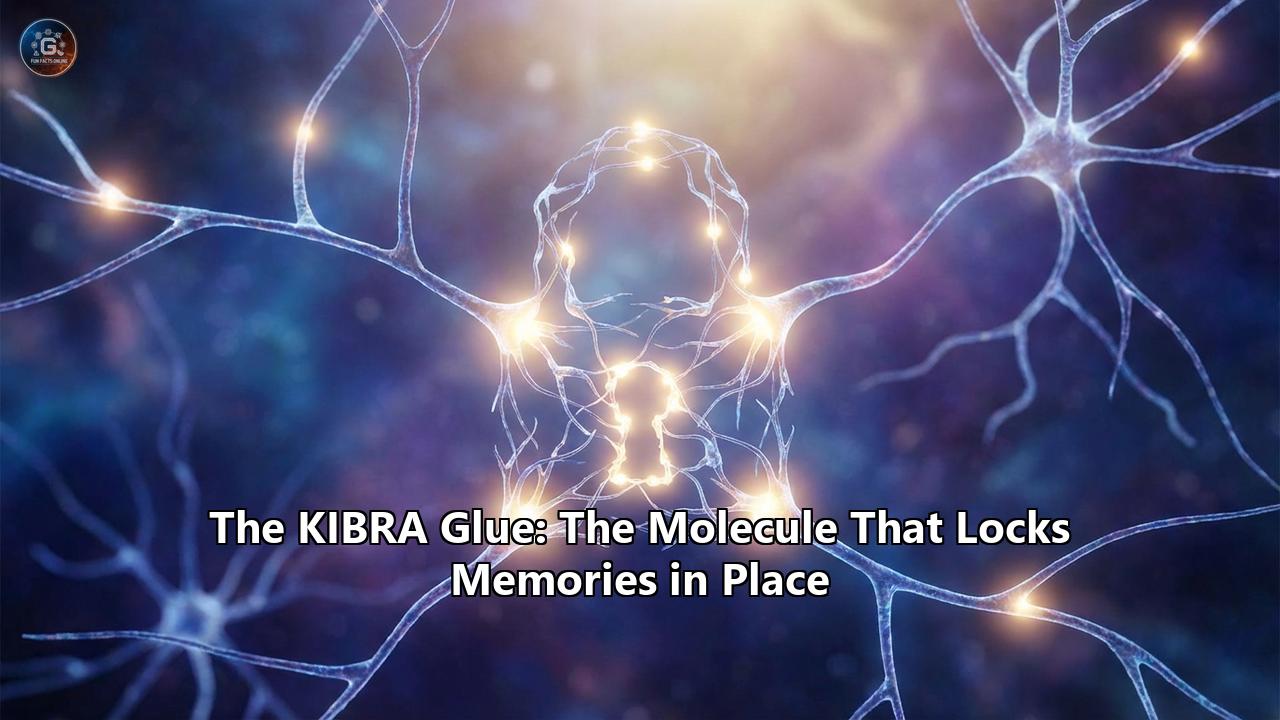
At the center of this discovery is a molecule that acts as a biological adhesive, a "glue" that secures our past against the ravages of time. Its name is KIBRA.
This article explores the fascinating journey of this discovery, the mechanics of how it locks memories in place, and the revolutionary potential it holds for treating Alzheimer’s disease, PTSD, and other disorders of the mind.
Part I: The Search for the Engram
To understand the magnitude of the KIBRA discovery, we must first look at the history of the "engram"—the physical trace of memory in the brain.
The Wax Tablet and the Hologram
Since ancient times, humans have used metaphors to explain memory. Plato compared our minds to a wax tablet: experiences stamp an impression into the wax. If the wax is soft, the impression is clear; if it hardens or wears away, the memory is lost. In the 20th century, Karl Lashley spent decades searching for the engram by lesioning rat brains, eventually concluding that memory wasn't stored in one spot but distributed, like a hologram.
The Synaptic Revolution
In the mid-20th century, the focus shifted to synapses—the tiny gaps between neurons where chemical signals are exchanged. Donald Hebb, a Canadian psychologist, proposed a famous rule: "Neurons that fire together, wire together."
When you learn something new—say, a new French word—a specific pattern of neurons fires. If you practice that word, the synapses between those neurons get stronger. This process is called Long-Term Potentiation (LTP). It is the biological basis of learning. But LTP has a problem. The strengthening of a synapse requires proteins. And as we noted, proteins die.
Francis Crick’s Prediction
In 1984, Francis Crick, the Nobel laureate who co-discovered the structure of DNA, turned his attention to this problem. He realized that for a memory to outlast the proteins that built it, there had to be a mechanism of self-perpetuation. He hypothesized the existence of a specific type of enzyme—a kinase—that could remain active indefinitely, constantly renewing the memory trace.
He predicted a "molecular switch" that, once flipped on, would stay on, even as its individual atoms were swapped out. It took forty years, but science finally proved him right.
Part II: The Key Players - PKMzeta and KIBRA
The solution to the memory paradox involves two specific molecules. One is the engine, and the other is the anchor.
1. The Engine: PKMzeta (Protein Kinase M-zeta)
For years, a molecule called PKMzeta was the prime suspect for the "memory molecule." Research led by Dr. Todd Sacktor at SUNY Downstate Health Sciences University showed that PKMzeta was abundant in strengthened synapses.
PKMzeta is a kinase, an enzyme that modifies other proteins. Unlike most kinases, which need a signal to become active, PKMzeta is "constitutively active." Once created, it runs on autopilot, constantly working to keep the synapse strong by increasing the number of receptors (AMPA receptors) on the neuron's surface. These receptors allow the neuron to "hear" signals more clearly.
However, PKMzeta has a fatal flaw: it degrades after a few days. If PKMzeta is the engine keeping the memory running, the engine should burn out, and the memory should vanish. But the memory stays. This led to a controversy in the field. Some studies even suggested that mice without PKMzeta could still form memories, leading some to dismiss it.
But the believers missed one crucial component. PKMzeta doesn't work alone.
2. The Anchor: KIBRA (Kidney and Brain Expressed Protein)
Enter KIBRA. Originally discovered in kidney cells (hence the name), this protein was later found to be genetically linked to human memory performance. People with certain variations of the KIBRA gene have naturally better memories than others.
In the landmark 2024 study, researchers found that KIBRA serves as a "scaffold" or an "adaptor" protein. It doesn't do the work of strengthening the synapse itself; rather, it hangs out at the scene of the crime.
When a memory is formed and a synapse is activated, KIBRA rushes to that specific synapse and attaches itself to the structure. It places a "tag" on the strong synapse.
Part III: The Mechanism - How the Glue Works
The interaction between KIBRA and PKMzeta is a masterclass in biological engineering. It explains how a biological system can maintain stability despite constant flux.
The Handshake
Here is the step-by-step process of how a long-term memory is locked in:
- Encoding: You experience an event. Neurons fire, and specific synapses are stimulated.
- Tagging: KIBRA molecules are deployed to these active synapses. They bind to the postsynaptic density (the receiving end of the synapse). KIBRA effectively says, "This spot right here. This is important."
- Recruitment: PKMzeta molecules float around the neuron. They have an affinity for KIBRA. They find the KIBRA tags and bind to them.
- Locking: Once bound to KIBRA, PKMzeta is stabilized. It stops degrading as quickly. More importantly, it keeps the synapse strong by maintaining high receptor sensitivity.
The "Symbiotic" Cycle
The beauty of this system is in its reciprocity.
- KIBRA saves PKMzeta: By binding to it, KIBRA prevents PKMzeta from being washed away or broken down too fast.
- PKMzeta saves KIBRA: The enzyme activity helps stabilize the KIBRA scaffold, ensuring the tag remains in place.
If you block this interaction—if you "dissolve the glue"—the PKMzeta floats away, the synapse weakens, and the memory is erased.
Part IV: The Ship of Theseus - A Philosophical Solution
The most fascinating aspect of the KIBRA discovery is how it solves the philosophical puzzle of identity.
Dr. Sacktor and his colleague Dr. André Fenton utilized the famous paradox of the Ship of Theseus to explain their findings. In Greek mythology, Theseus’s ship was preserved in the harbor of Athens for centuries. As old planks rotted, they were replaced by new ones. Eventually, not a single original piece of wood remained. Was it still the same ship?
The brain uses the exact same logic.
- The Ship: The Memory.
- The Old Planks: The degrading KIBRA and PKMzeta molecules.
- The New Planks: Newly synthesized KIBRA and PKMzeta.
The study showed that while individual KIBRA and PKMzeta molecules die off, the structure of their interaction persists. A KIBRA molecule might degrade, but before it does, it helps recruit a new KIBRA to take its place at the same location. A PKMzeta molecule might fade, but a new one snaps onto the waiting KIBRA tag.
The pattern of the bond remains, even as the matter that constitutes it changes. This is the biological secret of our continuity of self. We are not made of the same stuff we were ten years ago, but our "glue" keeps the pattern intact.
Part V: Medical Implications - The Cure and The Eraser
The discovery of the KIBRA-PKMzeta mechanism is not just academic; it provides a tangible target for pharmacology. It opens two distinct, revolutionary doors in medicine: Restoration and Erasure.
1. Treating Alzheimer's and Dementia (The Restoration)
In Alzheimer’s disease, memories aren't always "gone" immediately; often, the synaptic connections have just become too weak to be accessed, or the machinery maintaining them has failed.
The study revealed that KIBRA levels are often deficient in brains suffering from Alzheimer’s and other forms of dementia. Without the KIBRA glue, the PKMzeta engine cannot stay at the synapse. The synapse weakens, and the memory fades.
The Therapeutic Potential:Scientists are now exploring "KIBRA-mimicking" therapies. The idea is to introduce a synthetic version of the KIBRA protein or a small molecule that acts like it.
- By injecting this "extra glue" into the brain, we might be able to stabilize failing synapses.
- Even if the brain has stopped producing enough natural KIBRA, a synthetic substitute could grab onto the remaining PKMzeta and relock the fading memories.
- Early tests in mice have shown that increasing PKMzeta activity can revive "faded" memories, but only if the KIBRA tags are still there. This suggests a window of opportunity where memories are dormant but recoverable.
2. Treating PTSD and Phobias (The Erasure)
On the opposite end of the spectrum is Post-Traumatic Stress Disorder (PTSD), where memories are too strong. A traumatic event creates a memory trace that is seared into the brain, reinforced by an overabundance of synaptic strengthening.
Current treatments for PTSD often involve therapy or broad-acting drugs that dull emotion. The KIBRA discovery offers a surgical alternative: Memory Erasure.
The Mechanism of Erasure:In the study, researchers used a drug called ZIP (Zeta Inhibitory Peptide) or specific genetic blockers that disrupted the interaction between KIBRA and PKMzeta.
- When they broke the bond between the two molecules, the memory associated with that specific synapse collapsed.
- Crucially, this didn't damage the neuron itself. It just "reset" the synaptic strength to baseline.
- This suggests that in the future, we could develop treatments that disrupt the "glue" in specific neural circuits associated with trauma, effectively uncoupling the emotional intensity from the memory, or erasing the traumatic association entirely while leaving other memories intact.
Part VI: The Future of Memory Science
The identification of the KIBRA-PKMzeta axis is a watershed moment, but it is just the beginning. It shifts the paradigm of neuroscience from looking for static storage to understanding dynamic maintenance.
The "Persistent Synaptic Tag"
This discovery validates the concept of "synaptic tagging." The brain doesn't just store data; it tags data for varying levels of preservation.
- Short-term memory: Likely relies on temporary chemical changes without the KIBRA scaffold.
- Long-term memory: Requires the KIBRA scaffolding construction.
This distinction could help us understand why we forget where we put our keys (a weak tag) but remember a childhood trauma (a reinforced, KIBRA-rich tag).
Designing Better Learners
Could this lead to cognitive enhancement? Theoretically, yes. If we can manipulate the levels of KIBRA in the brain, we could potentially create a "super-learner."
- Imagine a drug taken before a study session that increases the availability of KIBRA, allowing the brain to "tag" more synapses for long-term storage than it normally would.
- This raises ethical questions. If memory becomes a choice rather than a biological process, how does that change society? Who gets access to the "smart drugs"?
The Bio-Signature of Aging
KIBRA levels naturally decline with age. This might explain "Senior Moments" or benign forgetfulness. It’s not that the neurons are dying, but that the supply of "glue" is running low. Monitoring KIBRA levels in spinal fluid or blood could become a standard diagnostic tool for predicting cognitive decline years before symptoms of Alzheimer's appear.
Conclusion: We Are What We Keep
For centuries, poets and philosophers have described memory as a library, a tape recorder, or a computer. But biology tells us it is more like a construction crew working 24/7 on a bridge, replacing every bolt and beam while traffic continues to flow across it.
The KIBRA molecule is the foreman of that crew. It is the molecular manifestation of our history. Without it, the "Ship of Theseus" that is our mind would drift apart, plank by plank, into the ocean of oblivion.
By understanding this "glue," we have taken the first step toward mastering our own minds—retaining the pasts we cherish and perhaps, one day, healing the pasts that haunt us. The discovery of KIBRA doesn't just explain how we remember; it gives us hope that we don't have to forget.
Reference:
- https://www.sciencedaily.com/releases/2024/06/240626152118.htm
- https://www.popularmechanics.com/science/health/a62011949/pkmzeta-memories-molecules/
- https://neurosciencenews.com/genetics-memory-recall-26377/
- https://www.eurekalert.org/news-releases/1049128
- https://www.techno-science.net/en/news/this-molecule-acts-as-glue-to-fix-our-memories-over-time-N25592.html
- https://www.psypost.org/scientists-discover-glue-that-holds-memory-together-in-fascinating-neuroscience-breakthrough/
- https://scitechdaily.com/new-study-reveals-molecular-secret-to-lifelong-memories/
- https://www.techexplorist.com/new-study-explains-memories-last-lifetime-biologically/85588/
- https://www.buckinstitute.org/wp-content/uploads/2024/02/NCD-BI506-Tracy.pdf
- https://www.biorxiv.org/content/10.1101/2022.02.13.480286.full
- https://scitechdaily.com/scientists-reverse-alzheimers-memory-loss-by-repairing-damaged-synapses/
- https://www.frontiersin.org/journals/aging-neuroscience/articles/10.3389/neuro.24.004.2010/full
- https://www.thetransmitter.org/memory/persistent-protein-pairing-enables-memories-to-last/
- https://pmc.ncbi.nlm.nih.gov/articles/PMC4032603/
- https://www.courthousenews.com/brain-and-kidney-protein-could-restore-memories-taken-by-alzheimers-disease/
- https://pmc.ncbi.nlm.nih.gov/articles/PMC3947452/
- https://pmc.ncbi.nlm.nih.gov/articles/PMC4023458/