
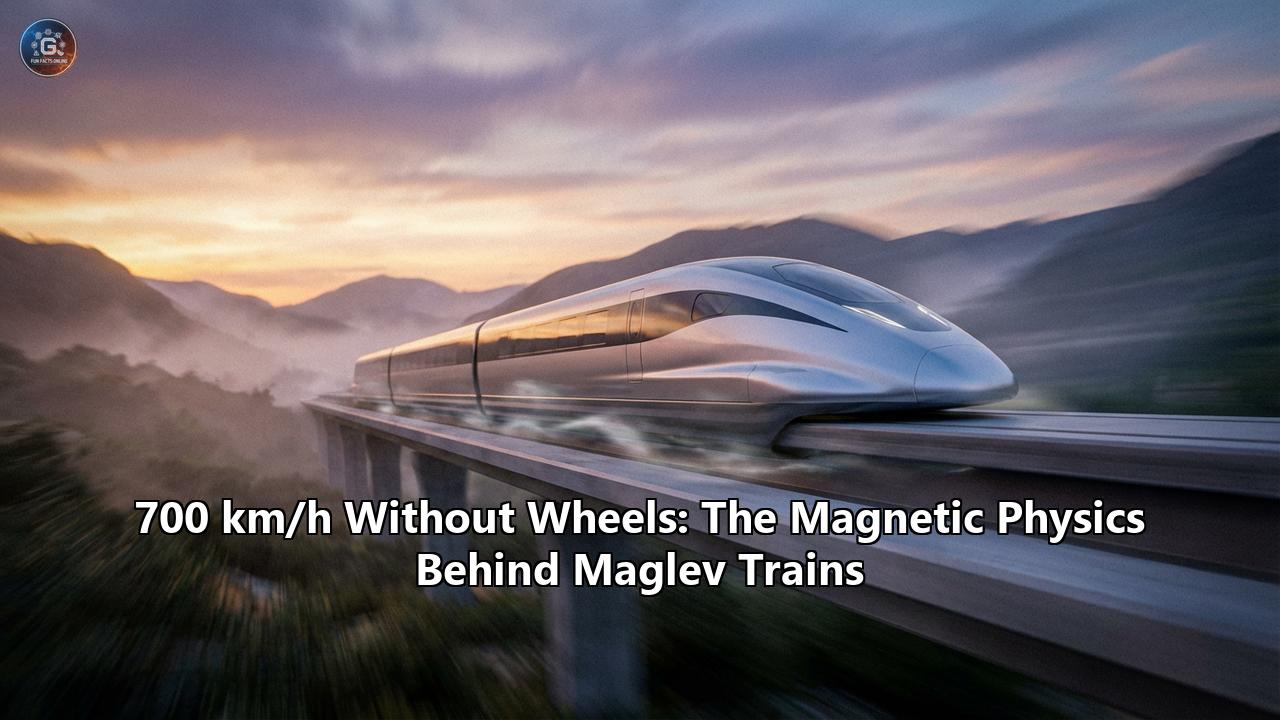
Imagine a vehicle that doesn’t just transport you—it launches you. You are sitting in a comfortable cabin, your coffee barely rippling in its cup, while outside, the landscape blurs into a streak of indistinguishable color. There are no wheels grinding against steel rails, no rhythmic clack-clack of track joints, and no roar of an internal combustion engine. There is only the soft hiss of air rushing past.
You are traveling at 700 kilometers per hour (435 mph)—nearly the cruising speed of a commercial airliner—but you are flying at an altitude of just 10 millimeters.
This is not a scene from a cyberpunk novel set in the year 2100. It is the reality of modern magnetic levitation, or maglev, technology. From the wind-swept test tracks of Yamanashi, Japan, to the high-tech laboratories of China’s National University of Defense Technology, humanity is on the brink of a new era in ground transportation. We are finally breaking the friction barrier that has limited rail travel since the days of the steam engine.
But how do you move a multi-ton train at half the speed of sound without an engine? How do you keep it stable when a single gust of wind could turn it into a projectile? And why, despite decades of promise, are we not all commuting to work at Mach 0.5 yet?
To answer these questions, we must dive deep into the invisible world of electromagnetic fields, the freezing realm of superconductors, and the brutal realities of aerodynamic engineering.
Part 1: The Friction Barrier and the Dream of Flight
For two centuries, trains have operated on a simple principle: adhesion. A steel wheel grips a steel rail. The engine turns the wheel, and friction pushes the train forward. It is a system that built the modern world, but it has a fundamental flaw.
Friction is a double-edged sword. You need it to move and to stop, but at high speeds, it becomes an enemy. Above 300 km/h, the physical stress on wheels and rails is immense. Vibrations become violent. Maintenance costs skyrocket because the metal is literally grinding itself away. There is a theoretical limit to how fast a conventional wheel-on-rail train can go before it becomes dangerously unstable or economically impossible to maintain. That limit sits roughly around 350-400 km/h.
To go faster, you have to stop touching the ground. You have to fly.
Maglev is effectively "ground-based flight." By eliminating the physical contact between the vehicle and the guideway, you remove rolling resistance entirely. The only thing left holding you back is the air itself.
Part 2: The Two Schools of Levitation
Not all maglevs are created equal. In the global race for speed, two distinct philosophies have emerged, driven by two different superpowers of engineering: Germany and Japan. Understanding the difference is key to understanding why we are now seeing speeds of 700 km/h.
1. Electromagnetic Suspension (EMS): The German Approach
If you have ever played with fridge magnets, you know that opposite poles attract. This is the principle behind EMS, the technology used by the famous German Transrapid system (which operates the commercial line in Shanghai).
In an EMS system, the train’s electromagnets are actually located below the track, wrapping around the guideway in a C-shape. These magnets look upward at the steel rail and are turned on. They are attracted to the rail, pulling the train up towards it.
The Physics of Instability:There is a catch. Magnetic attraction is inherently unstable. As the magnet gets closer to the rail, the attractive force gets stronger (inverse-square law). If you don't do anything, the magnet will snap onto the rail and clamp shut. If it gets too far away, it falls.
To make this work, EMS trains use incredibly sophisticated control systems that adjust the magnetic field thousands of times per second. They maintain a precise gap of about 8 to 10 millimeters. It is a delicate, computer-controlled balancing act, like balancing a broomstick on your fingertip.
- Pros: Works at zero speed (the train can hover while stopped). Simpler guideway construction (steel sheets).
- Cons: Requires extremely precise gap control. The gap is very small, making it vulnerable to track irregularities or debris.
2. Electrodynamic Suspension (EDS): The Japanese Approach
Japan’s Central Railway Company (JR Central) took a different path with their SCMaglev (Superconducting Maglev) project. Instead of attraction, they use repulsion.
If you try to push the north poles of two strong magnets together, they push back. EDS uses this repulsive force to lift the train. But to generate the massive magnetic fields required to lift a 50-ton carriage, ordinary electromagnets aren't enough. You need Superconductors.
The Magic of Superconductivity:When certain materials, like niobium-titanium alloys, are cooled to near absolute zero (-269°C) using liquid helium, they lose all electrical resistance. You can pump an electric current into a loop of superconducting wire, and that current will flow forever without a power source, creating a permanent, incredibly powerful magnetic field.
The SCMaglev train carries these superconducting magnets on board. The guideway (the track) is lined with simple figure-eight coils.
- The Inductive Kick: When the train is stationary, it rests on rubber tires. It cannot levitate.
- Takeoff: As the train accelerates (using tires), its moving superconducting magnets sweep past the coils in the track.
- Lenz’s Law: This movement induces a current in the track coils. According to Lenz's Law, this induced current creates a magnetic field that opposes the motion. The track coils effectively become electromagnets that repel the train's magnets.
- Flight: Once the train hits about 150 km/h (93 mph), the repulsive force is strong enough to lift the tires off the ground. The wheels retract like an airplane's landing gear, and the train levitates a massive 100 millimeters (4 inches) above the track.
- Pros: Huge air gap (10 cm vs 1 cm) makes it safer against earthquakes and debris. Inherently stable (if the train sinks, the repulsion gets stronger, pushing it back up).
- Cons: Requires expensive cooling systems (cryogenics). Does not levitate at low speeds. High magnetic fields in the cabin require shielding.
Part 3: The Invisible Engine (Linear Synchronous Motor)
So, the train is floating. How do we make it move? We don't have wheels to turn, so we can't use a standard engine.
The solution is to take a standard electric motor and unroll it.
In a normal electric motor, you have a stator (the outer ring that stays still) and a rotor (the inner part that spins).
- Imagine cutting the stator and laying it flat along the ground. That is the guideway.
- Imagine the rotor is the train.
This is the Linear Synchronous Motor (LSM).
The coils in the guideway are fed with a three-phase alternating current (AC). This creates a traveling magnetic field. Think of it like a magnetic wave moving along the track.
- The North pole in the track pulls the South pole on the train forward.
- The South pole in the track pushes the South pole on the train forward.
The train essentially "surfs" on this magnetic wave. To go faster, you simply increase the frequency of the AC current, making the wave move faster. To brake, you reverse the phase of the wave, and the magnetic fields grab the train and slow it down, regenerating electricity in the process.
This is why the 700 km/h speeds are possible. There is no friction to overcome, and the power is not limited by an onboard engine—it is pumped directly into the track from the power grid.
Part 4: The 700 km/h Record and the "Tonne-Class" Sled
In early 2024 and continuing into 2025, headlines screamed that China had built a "700 km/h Maglev." It is vital to separate the science from the hype.
The record-breaking test conducted by the National University of Defense Technology (NUDT) involved a tonne-class test vehicle, not a full-sized passenger train. This sled was launched down a relatively short track (around 400 meters to a few kilometers depending on the specific test phase).
The "2-Second" Acceleration:The report stated the vehicle accelerated to 700 km/h in just 2 seconds.
Let's do the math on that.
$a = \Delta v / t$
700 km/h is roughly 194 meters per second.
$194 / 2 = 97 m/s^2$.
That is nearly 10 Gs of force.
For reference, a fighter pilot in a G-suit can withstand 9 Gs for a short time. An average passenger on a train would pass out or be injured.
This tells us that the NUDT test was not a prototype for a passenger ride at that acceleration. It was a proof-of-concept for extreme electromagnetic propulsion. It demonstrated that their linear motor technology could handle the immense power switching and magnetic stresses required to push an object to near-supersonic speeds instantly.
Why does this matter?- Weaponry: This technology parallels "Railgun" or "Coilgun" research (launching projectiles via magnets).
- Space Launch: A "Maglev Sled" could be used to accelerate spacecraft on the ground before they ignite their rockets, saving massive amounts of fuel.
- The Limit: It proved that the propulsion system is not the bottleneck. The bottleneck for passenger trains is the human body and aerodynamics.
Part 5: The Real Contenders – The 600 km/h Passenger Trains
While the sleds are hitting 700+, the real battle for passenger transport is happening in the 600 km/h range.
China’s CRRC 600 km/h Prototype:Unveiled in Qingdao in 2021, this is a stunning blue-and-black beast. It uses high-temperature superconducting (HTS) technology and is designed to bridge the gap between high-speed rail (350 km/h) and airplanes (800 km/h).
- Aerodynamics: At 600 km/h, air becomes like soup. The nose of the train is elongated to slice through the air and prevent "micro-pressure waves" (sonic booms) when entering tunnels.
- The "Whale" Tail: The aerodynamics are so complex that the rear of the train often needs a different shape than the front to manage the turbulent wake, preventing the tail from wagging (a phenomenon called "hunting oscillation").
This train already holds the Guinness World Record for a manned vehicle: 603 km/h (375 mph), set in 2015.
The L0 series looks like a platypus. Its nose is 15 meters long and incredibly flat. This bizarre shape is purely functional. When a train enters a tunnel at high speed, it pushes a piston of air ahead of it. When that air flies out the other end, it creates a loud "boom" that can rattle windows kilometers away. The long nose spreads that air pressure out, silencing the boom.
The Current Status (2025):While the tech is ready, the dirt is not.
- Japan: The Chuo Shinkansen line (Tokyo to Nagoya) has been delayed from 2027 to 2034 or later. Why? Not physics, but water. Tunnel construction in Shizuoka Prefecture threatens the local water table, and the governor blocked construction for years.
- China: China has thousands of kilometers of High-Speed Rail (HSR). Building a new, incompatible maglev network is a massive financial risk. However, they are pushing forward with test lines in Guangdong and Shanxi.
Part 6: Into the Vacuum – The Hyperloop Connection
If you want to go faster than 700 km/h—say, 1000 km/h or more—maglev alone isn't enough. You run into the Aerodynamic Wall. Drag increases with the square of velocity. Power consumption increases with the cube of velocity. To go twice as fast, you need eight times the power.
Unless you remove the air.
This is the concept behind the Low-Vacuum Tube Maglev (often called Hyperloop, though that is a specific brand name).
China’s CASIC (China Aerospace Science and Industry Corporation) is running tests in Datong. They have combined the SCMaglev tech (magnetic levitation) with a sealed tube pumped down to low pressure (0.001 to 0.1 atm).
- The Physics: By removing most of the air, you remove the drag. The train effectively flies in space.
- The Danger: In a vacuum, you can't use air brakes. You can't open a window if the AC fails. A hull breach is catastrophic. The engineering required to keep a 50-kilometer tube vacuum-sealed while thermal expansion makes the metal stretch and shrink is a nightmare of material science.
Recent tests in Datong have pushed these pods to over 623 km/h in short bursts, aiming for a 1000 km/h target. This is the true frontier: a convergence of aerospace and railway engineering.
Part 7: Is it Worth It? The Economics of Speed
We have the physics. We have the trains. Why aren't we riding them?
- Cost: The Shanghai Maglev cost roughly $39 million per kilometer. The Chuo Shinkansen is estimated to cost $82 billion for just 286 km.
- Incompatibility: Maglevs cannot run on existing train tracks. You have to build brand new infrastructure into the hearts of dense cities.
- Energy: While efficient at cruising, levitating a massive train consumes vast amounts of electricity. The cooling systems for superconductors run 24/7.
- The "Good Enough" Problem: Traditional high-speed rail does 350 km/h. Is saving 20 minutes on a trip worth 100 billion dollars?
Conclusion: The Magnetic Horizon
The 700 km/h maglev records are more than just numbers. They are a statement of intent. They prove that we have not reached the technological ceiling of ground transport.
We are witnessing the birth of a new mode of travel. It is a mode that discards the wheel, the axle, and the engine—inventions that have served us for millennia—in favor of the silent, invisible, and terrifyingly powerful forces of electromagnetism.
Whether it is the "Platypus" nose of the Japanese L0 series or the sleek "Flux Pinning" sleds of China, the message is clear: The future doesn't roll. It floats.
Reference:
- https://www.youtube.com/watch?v=GGnzB9BqtIc
- https://www.hindustantimes.com/world-news/china-sets-record-with-worlds-fastest-maglev-train-hits-700-km-h-in-2-seconds-101766830670454.html
- https://www.financialexpress.com/world-news/us-news/what-we-know-about-chinese-train-that-hit-700-kmph-in-just-two-seconds/4090225/
- https://www.sciencefocus.com/science/how-it-works-eds-maglev-trains
- https://www.tmmotion.com/english/newsshow_182.html
- https://www.youtube.com/watch?v=NzEAr0DxEvw
- https://www.explainthatstuff.com/linearmotor.html
- https://en.wikipedia.org/wiki/Linear_motor
- https://www.indiatoday.in/world/story/china-hyperloop-maglev-train-new-world-record-superconducting-700-kmh-in-two-seconds-2842749-2025-12-27
- https://www.chinadailyasia.com/hk/article/626058
- https://en.wikipedia.org/wiki/Ch%C5%AB%C5%8D_Shinkansen
- https://www.railwaygazette.com/infrastructure/chuo-shinkansen-completion-delayed-until-2034/66398.article
- https://newsonjapan.com/article/141490.php
- https://inspenet.com/en/noticias/new-hyperloop-successfully-completes-its-first-tests-in-china/
- https://table.media/en/china/news-en/chinas-hyperloop-makes-progress
- https://www.globalconstructionreview.com/chinese-group-claims-new-hyperloop-speed-record/