
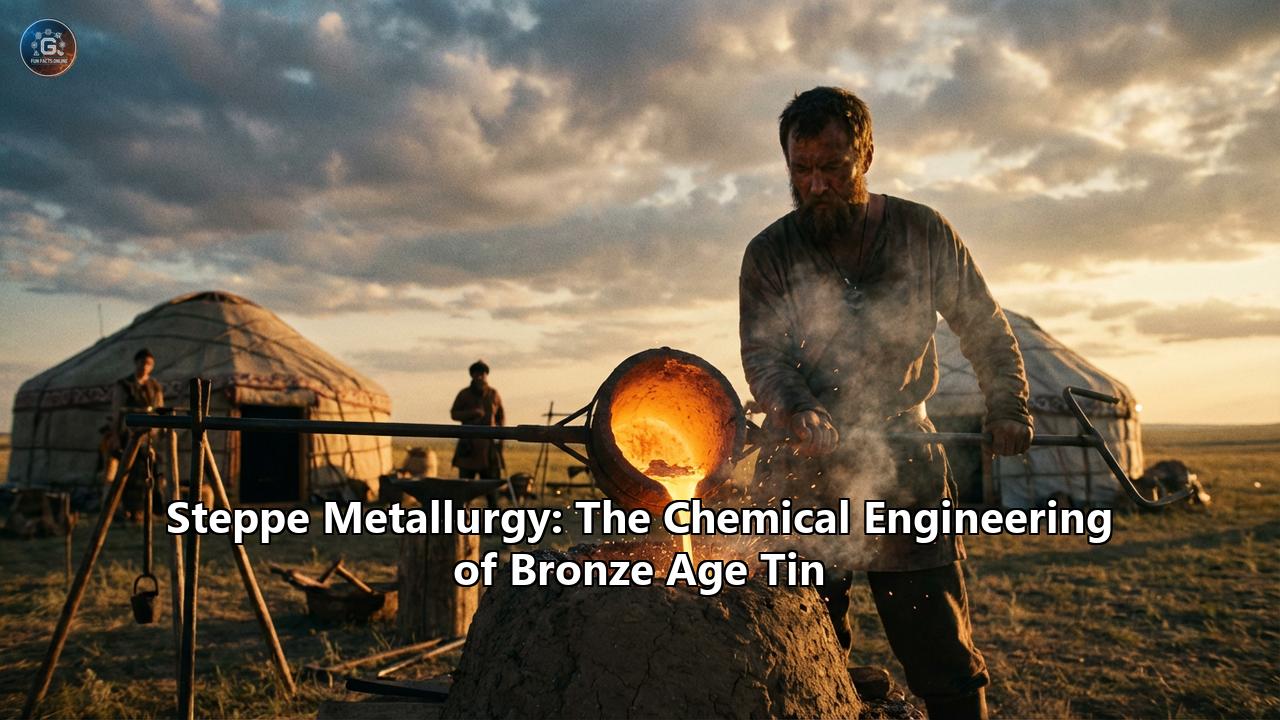
Introduction: The Invisible Empire of Metal
For centuries, the Eurasian Steppe was viewed through the lens of its eventual conquerors—a vast, empty highway for Huns, Mongols, and Turks to trample civilization under the hooves of their horses. They were seen as the "barbarians" at the gate, consumers of settled wealth rather than creators of it. But beneath the windswept grasses of Kazakhstan, Uzbekistan, and the Altai Mountains lies a different story, one written not just in blood, but in bronze.
Long before the Silk Road carried silk and spices, a "Bronze Road" carried the most strategic commodity of the ancient world: tin. This soft, silvery metal was the oil of the Bronze Age—the essential ingredient that turned soft copper into the hard, golden alloy that forged the weapons of empires, from the chariots of the Pharaohs to the daggers of Mycenae.
For decades, archaeologists faced a conundrum known as the "Tin Mystery." The great civilizations of Mesopotamia and the Mediterranean craved bronze but lacked tin. Where did it come from? The answer, increasingly illuminated by cutting-edge isotope geochemistry, points north—to the mobile pastoralists of the steppe. These were not merely herders; they were the chemical engineers of the ancient world, mastering complex redox reactions in pit furnaces and orchestrating an industrial supply chain that spanned continents.
The Chemistry of Revolution: Why Tin?
To understand the engineering prowess of the steppe metallurgists, one must first understand the chemistry of their product. Pure copper is a poor material for a warrior or a carpenter. It is malleable, dulls quickly, and bubbles when cast, releasing gases that leave the metal porous and weak.
Early smiths tried alloying copper with arsenic, creating "arsenical bronze." It was harder and cast better, but it came at a terrible cost—the toxic fumes slowly poisoned the smiths, likely giving rise to the myths of lame smith-gods like Hephaestus.
Tin was the miracle cure. Adding 10–12% tin to copper creates a true super-material:
- Lower Melting Point: It lowers copper’s melting point from 1,085°C to roughly 950°C, saving fuel and making the metal fluid enough to fill intricate molds.
- Hardness: It disrupts the crystal lattice of the copper, making the resulting alloy significantly harder than iron (though more brittle).
- Aesthetics: It turns the reddish copper into a golden, sun-like metal, highly prized for jewelry and status symbols.
The problem was geology. Copper is common; tin is exceptionally rare, found only in specific granite belts. One of the richest of these belts runs through the mountains of Central Asia—the domain of the Andronovo and Seima-Turbino cultures.
The Industrialists of the Steppe: The Andronovo and Seima-Turbino
The heroes of this story are not kings or emperors, but the mobile communities of the Andronovo cultural horizon (c. 2000–1150 BCE) and the enigmatic Seima-Turbino phenomenon (c. 2100–1900 BCE).
The Seima-Turbino Phenomenon: The Fast-Moving Engineers
The Seima-Turbino people are one of archaeology's great ghosts. They left no settlements, only graves filled with weapons of unparalleled quality. Originating in the Altai-Sayan mountains (straddling modern Russia, Mongolia, and Kazakhstan), they swept across the forest-steppe zone with breathtaking speed.
Their metallurgical signature was advanced thin-walled casting. They didn't just pour metal into stone shapes; they mastered lost-wax casting centuries before it became common in the West. This technique allowed them to create hollow, lightweight, yet incredibly strong socketed spearheads and axes. A Seima-Turbino warrior could carry more weapons with less weight, a decisive tactical advantage. Their chemical mastery allowed them to manipulate alloy compositions to ensure the liquid metal flowed perfectly into molds as thin as a few millimeters.
The Andronovo Industrial Complex
While the Seima-Turbino were the mobile innovators, the Andronovo peoples were the industrial heavyweights. In sites like Semiyarka in northeastern Kazakhstan, archaeologists have recently uncovered evidence of industrial-scale production that shatters the myth of the "primitive nomad."
At Semiyarka and the nearby Taldysai site, production wasn't a household chore; it was a specialized industry. The site spans 140 hectares and contains evidence of a "metallurgical district." Here, they built sophisticated shaft furnaces—chimney-like structures that used natural drafts or bellows to drive temperatures past 1,100°C.
Ancient Chemical Engineering: The Process
How did a semi-nomadic people manage complex chemical engineering? The evidence lies in the slag—the glassy waste product of smelting found at sites like Mushiston in Tajikistan.
1. Co-Smelting: The "Dirty" ShortcutModern metallurgy separates elements and mixes them pure. The Steppe engineers often used a more difficult but efficient technique called co-smelting. At the Mushiston mine, they mined ores that naturally contained both copper (malachite/azurite) and tin (cassiterite/stannite).
The challenge was that these ores reduce (turn to metal) at different temperatures and atmospheric conditions. The steppe smiths had to engineer a furnace atmosphere that was reducing enough (high in Carbon Monoxide) to strip the oxygen from the tin ore, but not so hot that it would volatilize the tin or freeze the copper.
- Fluxing: They understood the use of fluxes—additives like iron-rich ores or crushed bone—that lowered the melting point of the waste rock (gangue), allowing the liquid slag to separate from the metal pool.
Metallurgy is an energy war. To produce 1 kg of copper required up to 300 kg of charcoal and wood. In the treeless steppe, this was a logistical nightmare. The Andronovo solved this by managing woodlands in river valleys and, crucially, designing furnaces that maximized heat retention. The "shaft furnace" design at Taldysai acted as a thermal battery, insulating the reaction and allowing for longer, hotter burns with less fuel.
The "Tin Mystery" and the Global Trade Web
The true scale of this industry is revealed when we look thousands of miles away. In 1982, sponge divers off the coast of Turkey discovered the Uluburun shipwreck, a vessel that sank around 1320 BCE. It was carrying 10 tons of copper and 1 ton of tin ingots—enough to equip an army of 5,000 soldiers.
For decades, scholars assumed this tin came from Cornwall (Britain) or minor sources in Turkey. But a landmark study in 2022 by Wayne Powell and colleagues threw a chemical grenade into the debate. Using tin isotope analysis, they claimed that one-third of the Uluburun tin originated from the Mushiston mine in Uzbekistan/Tajikistan.
If true, this implies a supply chain of staggering complexity. Tin mined by Andronovo herders in the high Pamir mountains was:
- Smelted into ingots in steppe camps.
- Traded down the mountain corridors to the Bactria-Margiana Archaeological Complex (BMAC) cities.
- Moved overland across the Iranian plateau or through the Caspian route.
- Loaded onto ships in the Mediterranean to fuel the wars of Hittites, Mycenaeans, and Egyptians.
The theory is not without its critics. Archaeometallurgist Daniel Berger (2023) has challenged these findings, arguing that the isotope "fingerprint" of Central Asian tin overlaps with that of Cornwall. He suggests that the lead found in the ingots complicates the data, hinting that British tin might still be the primary source.
However, even the possibility of Central Asian tin in the Mediterranean changes history. It proves that the steppe was not a barrier, but a bridge. The "Bronze Road" was a conduit where the chemical genius of the north met the imperial hunger of the south.
Conclusion: The Silicon Valley of the Bronze Age
We often think of technology as the product of settled cities—universities, laboratories, and factories. Steppe metallurgy challenges this bias. It shows that high technology—complex chemical engineering, geological prospecting, and industrial mass production—can flourish in mobile societies.
The herders of the steppe didn't just ride horses; they read the rocks. They identified the rare veins of cassiterite in the granite peaks of the Altai and Pamirs. They engineered furnaces that could breathe fire hot enough to liquify rock. And they built a trade network that ensured the Pharaohs of Egypt could wield swords that gleamed like the sun.
In the chemical engineering of the Andronovo and Seima-Turbino, we see the birth of the modern world: a world connected by long supply chains, defined by the quest for strategic resources, and built on the mastery of the elements. The Bronze Age was not just an era of heroes; it was an era of engineers, and their laboratory was the open steppe.
Reference:
- https://www.frontiersin.org/journals/earth-science/articles/10.3389/feart.2023.1224873/full
- https://en.wikipedia.org/wiki/Tin_sources_and_trade_during_antiquity
- https://archaeology.org/news/2022/12/06/221207-turkey-uluburun-tin/
- https://the-past.com/news/isotope-analysis-reveals-origins-of-uluburun-shipwreck-cargo/
- https://www.sciencedaily.com/releases/2022/11/221130151458.htm
- https://www.frontiersin.org/journals/earth-science/articles/10.3389/feart.2023.1211478/full