
The universe is awash in secrets, but few are as pervasive and elusive as the neutrino. Every second, trillions of these subatomic phantoms pass through your body, traversing the empty space between your atoms without leaving a trace. They originate from the nuclear fires of the sun, the cataclysmic deaths of distant stars, and the radioactive decay within our own planet. For decades, they were mathematical curiosities—"ghost particles" predicted by theory but thought to be undetectable. Today, they are the key to unlocking the deepest mysteries of the cosmos, from the asymmetry of matter and antimatter to the ultimate fate of the universe.
In the subterranean depths of Guangdong province, China, a colossal machine has just awakened to catch these ghosts. The Jiangmen Underground Neutrino Observatory, known to the world as JUNO, is not merely a physics experiment; it is a cathedral of science, an engineering marvel built 700 meters beneath the earth to shield it from the cosmic noise of the surface. As of late 2025, JUNO has opened its thousands of electronic eyes, marking the beginning of a new "Golden Era" in particle physics. Its primary mission is as subtle as it is profound: to determine the "mass hierarchy" of neutrinos—to find out which of these tiny particles is the heaviest and which is the lightest.
This article explores the epic scale, the groundbreaking technology, and the transformative scientific potential of JUNO. It is a story of international collaboration, engineering resilience, and the relentless human drive to understand the fundamental fabric of reality.
Part I: The Ghost Particle Enigma
To understand why thousands of scientists have spent over a decade building a 20,000-ton detector underground, we must first understand the quarry they are hunting.
The Impossible Particle
The existence of the neutrino was first postulated in 1930 by Wolfgang Pauli, a desperate attempt to save the law of conservation of energy. In certain radioactive decays, energy seemed to vanish into thin air. Pauli suggested a "desperate remedy": perhaps a neutral, undetectable particle was carrying the energy away. He famously bet a case of champagne that it would never be detected. It took 26 years to prove him wrong, when Clyde Cowan and Frederick Reines finally observed neutrino interactions in 1956.
Neutrinos are fundamental particles, similar to electrons but without an electric charge. Because they are neutral, they do not feel the electromagnetic force—the force that governs almost all matter interactions we experience, from light hitting our eyes to our feet standing on the floor. Neutrinos only interact via the "weak nuclear force," which, as the name implies, is incredibly feeble and operates only at subatomic ranges. This is why a neutrino can pass through a light-year of lead without hitting anything.
The Shapeshifting Mystery
For a long time, the Standard Model of particle physics assumed neutrinos were massless. But in the late 1990s and early 2000s, experiments like Super-Kamiokande in Japan and SNO in Canada revealed a shocking truth: neutrinos oscillate. They come in three "flavors"—electron, muon, and tau. As they travel through space, they morph from one flavor to another. An electron neutrino born in the sun might arrive at Earth as a muon neutrino.
According to the laws of quantum mechanics, this shapeshifting is only possible if neutrinos have mass. This discovery won the Nobel Prize in 2015 and broke the Standard Model, forcing physicists to rewrite the textbooks. But while we know they have mass, we don’t know what that mass is, nor do we know how the masses of the three types relate to each other.
The Mass Hierarchy Problem
This brings us to the central question JUNO was built to answer: The Neutrino Mass Hierarchy (or Mass Ordering).
We know there are three mass states, let's call them 1, 2, and 3.
- We know that state 2 is heavier than state 1 (based on solar neutrino data).
- We know there is a larger gap between state 3 and the others.
However, we do not know if state 3 is the heaviest or the lightest.
- Normal Hierarchy (ordering): The two lighter neutrinos (1 and 2) are at the bottom, and the third (3) is much heavier. This mirrors the pattern we see in other particles like quarks and charged leptons.
- Inverted Hierarchy (ordering): The two "lighter" neutrinos are actually at the top, and the third one is the lightest of all.
Solving this "Normal vs. Inverted" question is not just bookkeeping. It determines whether neutrinos are their own antiparticles (Majorana particles), it influences our models of how supernovae explode, and it affects our understanding of how the universe evolved to have more matter than antimatter. JUNO is the machine designed to settle this debate once and for all.
Part II: The JUNO Facility – An Engineering Marvel
Located in Kaiping, Jiangmen, the JUNO facility is a testament to precision engineering on a gargantuan scale. The site was chosen with mathematical exactitude: it sits exactly 53 kilometers away from two major nuclear power plants, Yangjiang and Taishan.
The Strategic Baseline
Why 53 kilometers? Nuclear reactors are the most intense sources of electron antineutrinos on Earth. As these antineutrinos travel away from the reactors, they oscillate. The probability of detecting them as electron antineutrinos fluctuates in a wave-like pattern.
At a distance of 53 km, the oscillation effects driven by the two different mass splittings (the "solar" splitting and the "atmospheric" splitting) interfere with each other in a specific way. This interference creates a complex wiggle in the energy spectrum of the neutrinos. By looking at the precise shape of this energy spectrum, JUNO can distinguish between the Normal and Inverted hierarchies. If the detector were too close or too far, this delicate interference pattern would wash out.
The Abyss: 700 Meters Underground
To catch a ghost, you must first silence the noise. The surface of the Earth is bombarded by cosmic rays—high-energy particles from space. For a sensitive detector like JUNO, these cosmic rays are deafening "background noise" that would drown out the rare whisper of a neutrino interaction.
To solve this, JUNO was built 700 meters underground. The collaboration excavated a massive experimental hall, requiring the removal of hundreds of thousands of cubic meters of granite. This rock overburden reduces the cosmic ray flux by a factor of 100,000.
The Crystal Ball: The World's Largest Acrylic Sphere
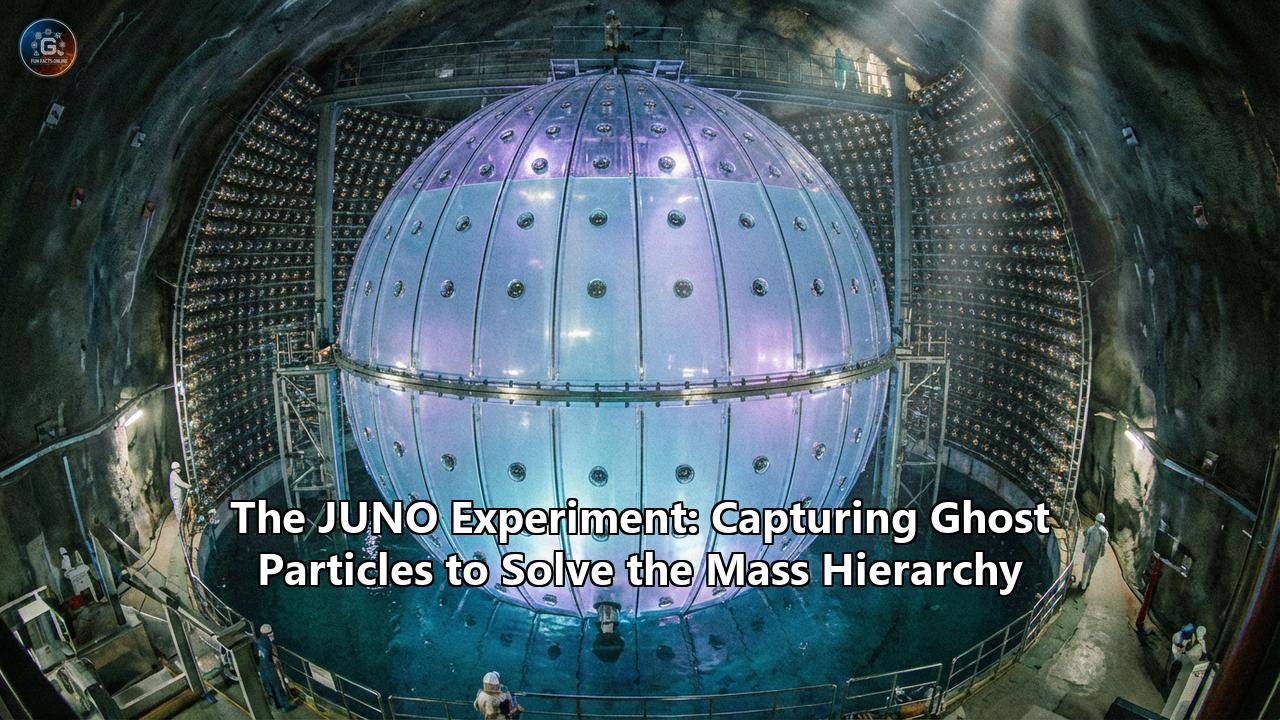
At the heart of the underground hall sits the crown jewel of the experiment: a transparent acrylic sphere with a diameter of 35.4 meters. It is the largest such structure ever built, effectively a 12-story building made of glass-like plastic.
Constructing this sphere was a nightmare of logistics and materials science. It is made of 265 separate acrylic panels, each 12 centimeters thick. These panels had to be bonded together with seamless precision to ensure optical transparency and structural integrity. The sphere holds 20,000 tons of liquid scintillator, creating immense outward pressure, while being submerged in a pool of water that exerts inward pressure. The engineering tolerances were less than a millimeter across the entire 35-meter span.
The Liquid Heart: 20,000 Tons of Scintillator
Inside the sphere lies the "blood" of the detector: Linear Alkylbenzene (LAB) doped with fluorophors. This liquid scintillator is the medium that actually detects the neutrinos.
When a reactor antineutrino crashes into a proton in the liquid, it triggers a reaction called Inverse Beta Decay (IBD). This reaction produces two flashes of light:
- A prompt flash from a positron (antimatter electron) annihilating.
- A delayed flash (about 200 microseconds later) from a neutron being captured by a nucleus.
This unique "double-flash" signature allows JUNO to pick out neutrino events from the background radiation. The scintillator at JUNO is the most transparent ever produced, with an attenuation length (the distance light can travel before fading) exceeding 20 meters. This extreme clarity is vital because the detector needs to measure the energy of the light with unprecedented accuracy.
The Eyes of JUNO: 43,000 Photomultiplier Tubes
Surrounding the acrylic sphere is a geodesic steel truss holding the "eyes" of the experiment. JUNO uses a dual-calorimetry system consisting of:
- 17,612 large 20-inch Photomultiplier Tubes (PMTs): These are the main light collectors.
- 25,600 small 3-inch PMTs: These fill the gaps between the large tubes, providing a second, independent measurement of the light to prevent saturation and improve calibration.
These PMTs are vacuum tubes that can detect a single photon of light and convert it into an electrical signal. The sheer number of sensors ensures that JUNO captures roughly 78% of the spherical surface area, a record for this type of detector.
Part III: The Science of Survival – Cracking the Code
Now that JUNO is operational (as of August 2025), how does it actually solve the mass hierarchy?
The 3% Solution
The key to JUNO's success lies in Energy Resolution. To distinguish between Normal and Inverted ordering, scientists need to see the tiny "ripples" in the neutrino energy spectrum caused by the oscillation interference.
If the detector's vision is blurry (poor energy resolution), these ripples smear together, and the hierarchy remains hidden. JUNO was designed to achieve an energy resolution of 3% at 1 MeV. This is an incredibly stringent requirement, roughly twice as precise as previous state-of-the-art detectors like KamLAND or Borexino.
Achieving this required the "three pillars" of JUNO's design:
- High Light Yield: Maximizing the number of photons generated per neutrino event (via the super-transparent scintillator).
- High Transparency: Ensuring those photons reach the edge of the detector without being absorbed.
- High Detection Efficiency: Ensuring the PMTs capture and convert those photons effectively (using high-quantum-efficiency PMTs developed specifically for this project).
The Spectrum Analysis
Every day, JUNO detects approximately 60 reactor antineutrinos. Over six years of data taking, it will collect over 100,000 signal events.
Physicists will plot the energy of these neutrinos on a graph.
- If the Normal Hierarchy is true, the oscillation ripples will appear in specific energy bands.
- If the Inverted Hierarchy is true, the ripples will be shifted (phase-shifted) in a predictable way.
By fitting the collected data to these two models, JUNO aims to rule out the incorrect hierarchy with a statistical significance of 3 to 4 sigma. When combined with data from other experiments (like IceCube or the upcoming DUNE), this will definitively solve the puzzle.
Part IV: Beyond the Hierarchy – A Multipurpose Observatory
While the mass hierarchy is the "flagship" goal, JUNO is a multipurpose observatory with a scientific scope that touches every corner of neutrino physics. In fact, its first major breakthrough in late 2025 wasn't about the mass hierarchy at all, but about solar neutrinos.
1. Precision Oscillation Parameters
The Standard Model of neutrino oscillations is governed by a set of parameters: mixing angles (how much the flavors mix) and mass splittings (the difference in masses). JUNO is an oscillation precision machine. It is expected to measure three of these parameters ($\sin^2\theta_{12}$, $\Delta m^2_{21}$, and $|\Delta m^2_{32}|$) to an accuracy of better than 0.6%. This sub-percent precision is a massive leap forward, allowing physicists to test the "unitarity" of the mixing matrix—a fancy way of checking if our current math adds up or if there are hidden, sterile neutrinos breaking the rules.
2. Solar Neutrinos: The Nov 2025 Breakthrough
In November 2025, just months after turning on, the JUNO collaboration released its first physics results. Using just 59 days of data, they measured the "solar" oscillation parameters ($\Delta m^2_{21}$) with a precision surpassing all previous experiments combined.
This was a stunning demonstration of the detector's power. It confirmed a long-standing tension between results from solar experiments (like SNO) and reactor experiments (like KamLAND). JUNO's ability to measure both solar neutrinos (directly from the sun) and reactor antineutrinos (which mimic solar parameters) in the same detector allows it to perform a unique self-consistency check on the theory of matter effects (the MSW effect).
3. Supernova Early Warning System
When a massive star collapses at the end of its life, it releases 99% of its energy as neutrinos. These neutrinos escape the dying star hours before the visible light of the explosion breaks out.
If a supernova were to occur in our galaxy, JUNO would act as an early warning system. Within seconds, it would detect roughly 5,000 to 8,000 neutrino events from a galactic core collapse. This data would provide a frame-by-frame movie of the star's death, revealing the physics of the collapse, the formation of the neutron star or black hole, and the extreme densities involved. JUNO is part of SNEWS (SuperNova Early Warning System), a global network of detectors ready to alert astronomers to point their telescopes before the light arrives.
Even without a nearby explosion, JUNO is hunting for the Diffuse Supernova Neutrino Background (DSNB)—the faint, accumulated glow of neutrinos from all the supernovae that have ever exploded in the history of the universe. Detecting this would give us a "census" of star formation and death across cosmic time.
4. Geo-neutrinos: Probing the Earth's Engine
The Earth radiates heat, about half of which comes from the radioactive decay of uranium and thorium deep in the mantle and crust. These decays emit "geo-neutrinos."
JUNO is expected to detect about 400 geo-neutrinos per year, creating the largest dataset of its kind. This will allow geophysicists to map the distribution of radioactive elements inside the Earth, settling debates about how much fuel is left in our planet's "engine" and how the Earth formed 4.5 billion years ago.
5. Exotic Physics: Proton Decay and Dark Matter
The immense size of JUNO makes it a trap for even rarer events.
- Proton Decay: Grand Unified Theories predict that the proton is not stable but decays over eons. JUNO will search for the decay of protons into kaons and neutrinos. If observed, it would prove that all forces of nature are one.
- Dark Matter: If dark matter accumulates in the sun, it might annihilate into high-energy neutrinos. JUNO will watch the sun for these energetic signatures.
Part V: The Global Race and Collaboration
Science at this scale is not a solitary endeavor. JUNO is an international collaboration involving over 750 scientists from 75 institutions in 17 countries, including China, Italy, France, Germany, Russia, and the United States.
It is one of three "titans" of the next generation of neutrino physics:
- JUNO (China): Liquid scintillator, medium baseline. Focus: Mass Hierarchy, precision parameters, low-energy astrophysics. (Operational 2025).
- Hyper-Kamiokande (Japan): Water Cherenkov. Focus: CP violation, proton decay, atmospheric neutrinos. (Expected ~2027).
- DUNE (USA): Liquid Argon Time Projection Chamber. Focus: CP violation, mass hierarchy, high-energy beam physics. (Expected ~2028-2030).
These three experiments are complementary. While DUNE and Hyper-K use particle accelerators to shoot beams of neutrinos through the earth, JUNO passively listens to reactors. DUNE is great at seeing the "tracks" of particles, while JUNO is the master of "energy resolution." Together, they form a global tripod that will support the physics of the 21st century.
Conclusion: The Golden Era Begins
As we enter 2026, the Jiangmen Underground Neutrino Observatory is fully awake. The data flowing from its 43,000 eyes is already rewriting the precision limits of our knowledge.
For decades, the neutrino was a ghost—a particle defined by what we didn't know about it. It broke our models, defied our expectations, and slipped through our nets. But with JUNO, we have built a net so fine, so vast, and so still, that the ghost can no longer escape.
Over the next six years, JUNO will likely settle the mass hierarchy question. But its legacy will extend far beyond that. It will tell us about the fire inside the Earth, the fusion inside the Sun, and the death throes of stars. It may even give us the first glimpse of physics beyond the Standard Model.
The capture of the ghost particles has begun, and the universe is about to get a lot less mysterious—and undoubtedly, a lot more interesting.
Reference:
- https://indiandefencereview.com/the-detector-that-took-17-years-to-build/
- https://www.popularmechanics.com/science/a69598613/juno-neutrino-detecto/
- https://www.jinr.ru/posts/juno-experiment-first-physics-results-obtained/
- https://indico.cern.ch/event/1439855/contributions/6461438/attachments/3045806/5381718/JUNO_EPPSU_2025_6.pdf
- https://cerncourier.com/juno-takes-aim-at-neutrino-mass-hierarchy/
- https://www.sciencedaily.com/releases/2025/08/250826005213.htm
- https://juno.ihep.cas.cn/PPjuno/202410/t20241023_692455.html
- https://icecube.wisc.edu/news/research/2019/02/an-important-step-towards-understanding-neutrino-masses/
- https://global.chinadaily.com.cn/a/202511/19/WS691d4277a310d6866eb2a494.html
- https://indico.cern.ch/event/765096/contributions/3295546/attachments/1785127/2906053/JUNO_EPPSU.pdf
- https://www.emergentmind.com/topics/juno-experiment
- https://www.infn.it/en/china-scintillator-filling-completed-juno-begins-data-taking/
- https://t2k-experiment.org/neutrinos/neutrino-detection/
- https://juno.ihep.cas.cn/ATEjuno/
- https://en.wikipedia.org/wiki/Jiangmen_Underground_Neutrino_Observatory
- https://juno.ihep.cas.cn/PPjuno/202511/t20251121_1132538.html
- https://www.youtube.com/watch?v=YvjUFjm9fTA
- https://nuclearscience.lbl.gov/research/research-programs/neutrinos/neutrinos-research/neutrino-detection-for-science-and-nonproliferation/neutrino-detection-for-science-and-nonproliferation-research/
- https://arxiv.org/abs/2207.05044