
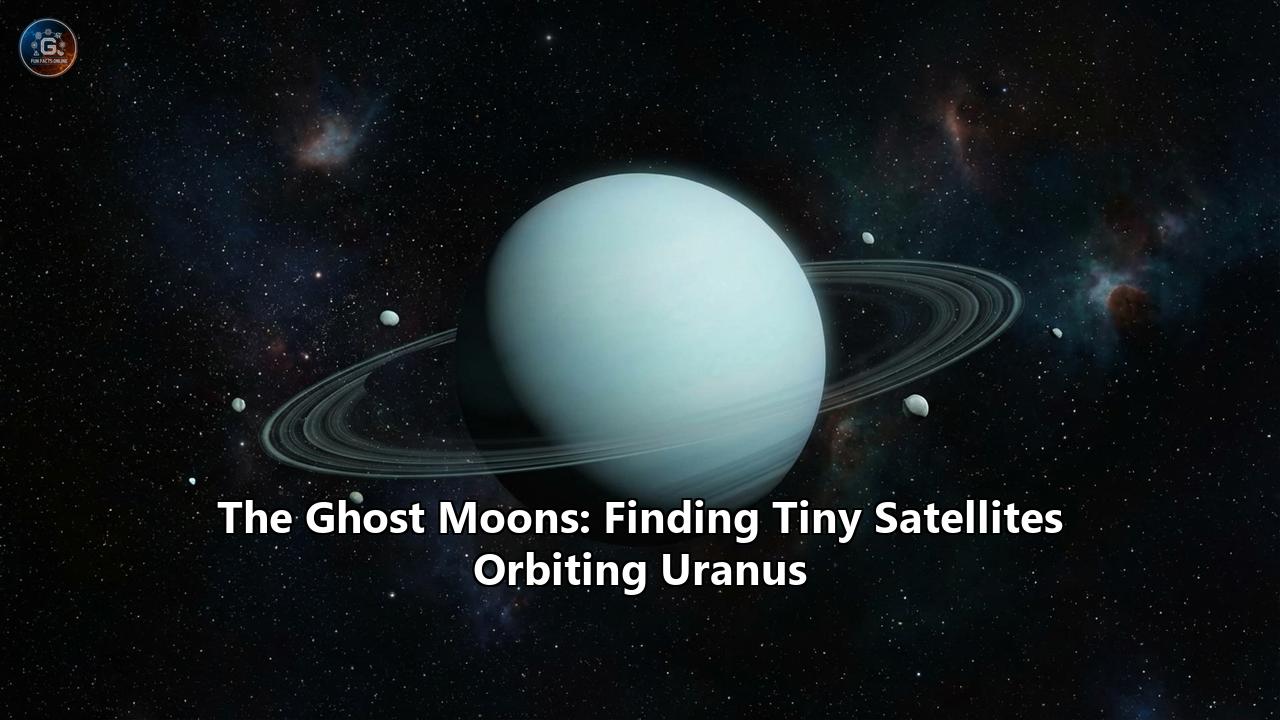
The Ice Giant has always been the odd one out—a pale, cyan marble rolling on its side through the freezing dark of the outer solar system. For decades, Uranus kept its secrets wrapped in a thick haze of indifference. When Voyager 2 sped past in 1986, it sent back snapshots of a seemingly featureless world, a "billiard ball" that stood in stark contrast to the turbulent storms of Jupiter or the ringed majesty of Saturn.
But the silence of Uranus was a lie.
Hidden within its dark, razor-thin rings and orbiting just beyond the reach of our oldest instruments, a secret population of satellites has been waiting. Astronomers call them the "Ghost Moons"—tiny, elusive worlds that have evaded detection for forty years, revealing themselves only through the faint gravitational ripples they leave in their wake.
The story of their discovery is not just about finding new rocks in space; it is a detective story that spans generations, from the grainy data tapes of the 1980s to the golden mirrors of the James Webb Space Telescope (JWST). It is a tale of re-awakening our interest in the most neglected planet in our solar neighborhood.
The Phantom Wakes of Voyager 2
To understand the Ghost Moons, we must go back to January 1986. Voyager 2, NASA’s legendary probe, was executing its flyby of Uranus. It was a brief encounter—a "blink and you'll miss it" moment in cosmic time. The probe discovered 10 new moons and two new rings, confirming that Uranus was not as lonely as it looked.
But Voyager’s cameras, cutting-edge for their time, had limits. They could spot the large icy moons like Titania and Oberon, and the mid-sized ones like Puck. However, in the chaos of the ring system—a complex network of dark dust and boulders—anything smaller than a city was lost in the noise.
For thirty years, the data sat in archives. It wasn't until 2016 that planetary scientists Rob Chancia and Matthew Hedman, from the University of Idaho, decided to take a second look. They weren't looking for moons directly; they were looking at the rings.
Rings are not solid structures; they are rivers of flowing ice and dust. And like a river, they ripple when something disturbs them. When a moon orbits near a ring, its gravity tugs on the particles, creating a pattern called a "wake"—similar to the V-shaped wake a boat leaves in water.
Chancia and Hedman noticed something strange in the Alpha and Beta rings. There were periodic variations in the ring density—wavy patterns that couldn't be explained by the known moons. The mathematics of the ripples pointed to a single conclusion: there were invisible objects, just 2 to 9 miles wide, orbiting just outside these rings.
These were the first "Ghost Moons." They were too small and dark for Voyager to see, yet their gravity was strong enough to sculpt the rings, acting as "shepherds" that kept the ring particles in line. For years, they remained theoretical—mathematical ghosts haunting the data.
The Eye of Webb: A New World Revealed
The ghosts didn't stay invisible forever. The launch of the James Webb Space Telescope ushered in a new era of clarity. With its powerful infrared vision, Webb could pierce through the glare and the gloom that had blinded previous telescopes.
In 2025, the theory became reality. Turning its golden eye toward the Seventh Planet, Webb captured a series of long-exposure images that revealed a faint, moving dot that shouldn't have been there.
Designated S/2025 U1, this new moon is a tiny world, roughly 6 miles (10 kilometers) in diameter. It is the first new moon discovered around Uranus in over two decades, and it fits the profile of the "ghosts" perfectly. It orbits within the chaotic inner zone, a region so packed with debris and moonlets that astronomers describe it as the most densely populated orbital highway in the solar system.
The discovery of S/2025 U1 was a vindication. It proved that the Uranian system is teeming with "micro-moons," objects that blur the line between a large ring particle and a small satellite. It also suggested that the Alpha and Beta ring wakes identified in 2016 are indeed caused by similar, yet-to-be-imaged bodies.
The Portia Group: A Dance of Destruction
Finding these moons has led to a darker realization: the Uranian system is violent.
Most of Uranus's small inner moons belong to a cluster known as the "Portia Group." These satellites—including Bianca, Cressida, Desdemona, and the newly found S/2025 U1—are packed together so tightly that their orbits are inherently unstable.
Gravity is a relentless master. As these moons pass each other, they exchange tiny amounts of energy. Over millions of years, these nudges accumulate, pushing their orbits into intersecting paths.
Recent simulations suggest that the ghost moon Cressida is living on borrowed time. Its orbit is slowly warping, and within the next million years—a blink of an eye in cosmic terms—it is destined to collide with the moon Desdemona.
This won't be a gentle merger. It will be a cataclysmic smash-up at thousands of miles per hour, pulverizing both moons into a cloud of ice and rock. This debris will form a new ring, which will eventually accrete into new, smaller moonlets.
This cycle of destruction and rebirth explains why Uranus has such a strange, dark ring system. The rings we see today are likely the graveyards of ancient ghost moons that smashed each other to pieces eons ago. We are watching a slow-motion demolition derby, where the contestants are entire worlds.
The Magnetic Anomaly
The mysteries of Uranus aren't limited to its moons. The "Ghost Moon" hunt has also forced scientists to re-examine the planet's bizarre magnetic field.
Voyager 2 famously observed that Uranus's magnetic field was chaotic, tilted 60 degrees away from the planet's rotation axis. For decades, this was thought to be the planet's permanent state—a "tumble and roll" magnetic mess.
But the same re-analysis of data that hinted at the ghost moons also solved this magnetic riddle. It turns out Voyager 2 had incredibly bad timing. Just days before the flyby, a massive solar wind event had smashed into Uranus, compressing its magnetosphere and distorting the data.
This means the "normal" Uranus might be much calmer than we thought, potentially allowing for subsurface oceans on its larger moons—Titania and Oberon—to remain liquid. If the magnetic environment is stable, it increases the chances that these moons could harbor life deep beneath their icy crusts. The ghost moons, orbiting closer in, would be the front-row spectators to this hidden aquatic potential.
The Call for a Return
The discovery of S/2025 U1 and the confirmation of the ring wakes have lit a fire under the planetary science community. We can no longer be content with 40-year-old data and distant telescope images.
NASA’s 2023-2032 Decadal Survey has placed a Uranus Orbiter and Probe (UOP) as the highest priority flagship mission. The plan is ambitious: send a spacecraft to orbit the ice giant for years, dropping a probe into its atmosphere to taste the ancient gases.
Such a mission would do for Uranus what Cassini did for Saturn. It would map the Ghost Moons in high resolution, turning them from pixelated dots into real places with geology, canyons, and craters. It would watch the rings ripple in real-time, perhaps even catching a moonlet in the act of forming—or dying.
Why It Matters
Why should we care about tiny rocks orbiting a planet 1.8 billion miles away?
Because Uranus is the archetype of the most common planet in the galaxy. Exoplanet surveys tell us that "Ice Giants" are everywhere. By understanding the ghost moons of Uranus—how they form, how they die, and how they shape their rings—we learn the biography of half the universe.
The Ghost Moons are reminders that even in the empty spaces of the map, something is always there, waiting to be found. They are the silent sentinels of the outer dark, and for the first time in history, we are finally seeing them step out of the shadows.
Reference:
- https://www.vice.com/en/article/nasa-found-a-tiny-hidden-moon-orbiting-uranus/
- https://scitechdaily.com/uranus-has-a-tiny-new-moon-and-its-only-six-miles-wide/
- https://scitechdaily.com/nasas-38-year-old-voyager-2-data-finally-solves-uranuss-perplexing-mysteries/
- https://www.nasa.gov/history/35-years-ago-voyager-2-explores-uranus/
- https://www.astronomy.com/science/webb-spots-a-new-tiny-moon-orbiting-uranus/
- https://science.nasa.gov/blogs/webb/2025/08/19/new-moon-discovered-orbiting-uranus-using-nasas-webb-telescope/
- https://en.wikipedia.org/wiki/Rings_of_Uranus
- https://www.sciencenews.org/article/moons-uranus-face-future-collision
- https://www.spacedaily.com/reports/Uranus_moons_could_hold_clues_to_hidden_oceans_for_future_space_missions_999.html
- https://www.jpost.com/science/article-864864
- https://www.space.com/astronomy/uranus/scientists-find-tiny-new-moon-around-uranus-with-the-james-webb-space-telescope-photos-video
- https://www.iflscience.com/two-of-uranus-moons-are-set-to-smash-into-each-other-in-1-million-years-time-43570
- https://www.jpl.nasa.gov/news/mining-old-data-from-nasas-voyager-2-solves-several-uranus-mysteries/
- https://www.youtube.com/watch?v=KqhkTneXPlg
- https://www.youtube.com/watch?v=0UdjvPuyJCU
- https://www.space.com/space-exploration/missions/the-yearning-for-uranus-a-far-out-world-with-a-tale-to-tell
- https://en.wikipedia.org/wiki/Exploration_of_Uranus