
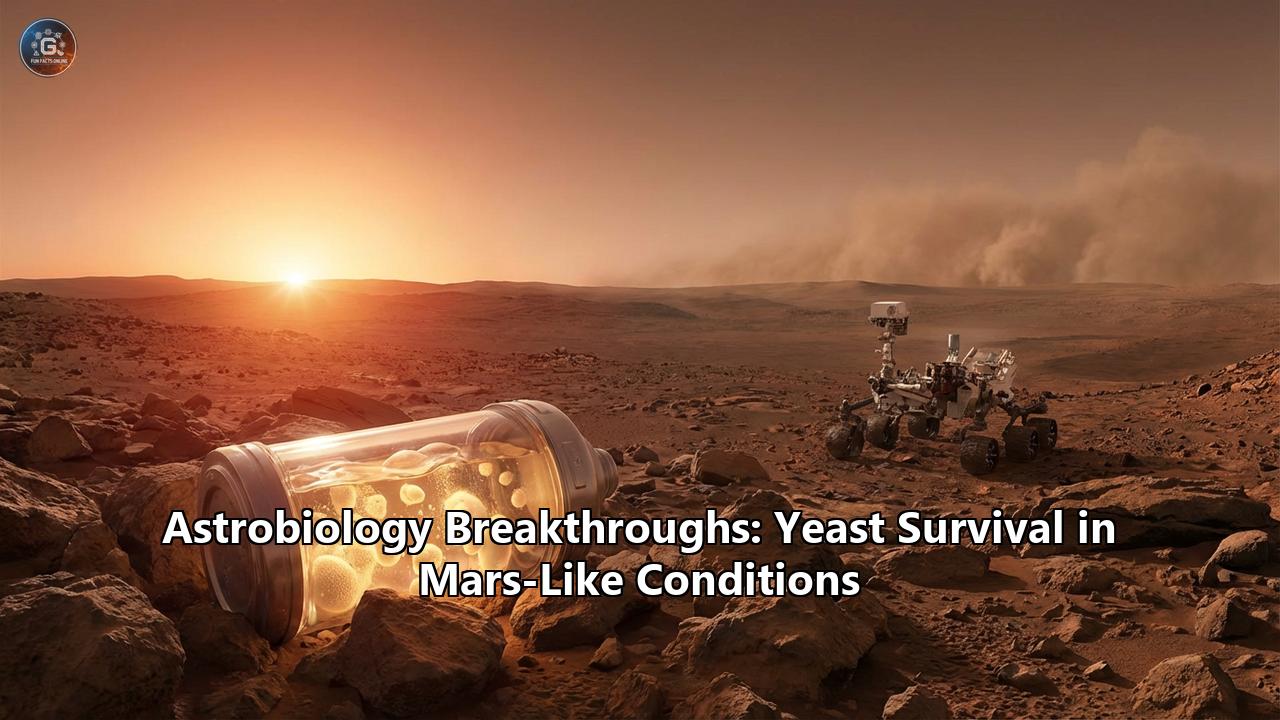
The Red Planet has long beckoned humanity, a dusty, frozen siren song echoing through the vacuum of space. For decades, our rovers have scratched at its surface, searching for signs of ancient water and the chemical precursors of life. But while we search for what was, a new frontier of astrobiology is asking a different question: what could be? In a startling breakthrough that bridges the gap between the bakery and the cosmos, scientists have discovered that the humble yeast cell—the engine of our bread and beer—possesses an innate, almost supernatural ability to survive the hellish conditions of Mars.
This is not merely a story of survival; it is a blueprint for colonization. It is a tale of biological alchemy, where the very mechanisms that rise our dough might one day raise cities on the dust of a dead world. From the shockwaves of meteor impacts to the toxic salts that bleach the Martian soil, yeast stands ready not just to endure, but to serve as the biological foundry of our future among the stars.
Part I: The Unlikely Astronaut
*The Protagonist: Saccharomyces cerevisiae---
To understand the magnitude of this breakthrough, we must first understand the unlikely hero of our story: Saccharomyces cerevisiae. To the naked eye, it is a beige powder, a dormant dust waiting for the warmth of water and sugar. Under the microscope, it reveals itself as a universe of complexity—a single-celled eukaryote that shares a surprising amount of its genetic heritage with human beings.
For millennia, this organism has been humanity's oldest companion in biotechnology. We domesticated it before we had a word for "domestication," using it to ferment grain into beer in ancient Sumeria and to leaven bread in Egypt. It is a creature of simple needs but profound resilience. But until recently, its resilience was measured against the temperature of a proofing oven or the alcohol content of a wine barrel. Few suspected that hidden within its genome lay the tools to withstand the apocalypse.
S. cerevisiae is a model organism, the "lab rat" of molecular biology. Its genome was the first eukaryotic genome to be completely sequenced. We know its genetic map better than we know our own. This deep familiarity makes the recent discoveries all the more shocking. We thought we knew everything this cell could do. We were wrong.The Martian Gauntlet: Defining the Enemy
To appreciate the yeast's survival, one must first appreciate the lethality of the environment it faced. Mars is not merely "Earth-lite"; it is a planet that actively seeks to dismantle biological machinery.
1. The Perchlorate PoisonThe Martian soil is not soil in the terrestrial sense; it is regolith, a crushed volcanic rock. But the true danger lies in its chemistry. The Martian surface is rich in perchlorates (ClO4-), salts that are highly oxidized and toxic to most terrestrial life. On Earth, perchlorates are used in rocket fuel and fireworks. On Mars, they act as chaotropic agents.
In biological systems, water is the solvent of life, organized in structured networks around proteins and DNA. Chaotropic agents disrupt this structure. They tear away the water molecules that stabilize proteins, causing them to unfold or "denature." They destabilize cell membranes, turning the distinct barrier between "self" and "environment" into a leaky sieve. For a typical cell, exposure to Martian levels of perchlorates is a death sentence—a chemical dissolution from the inside out.
2. The Shock of ImpactMars has a thin atmosphere, less than 1% the density of Earth's. This offers scant protection against cosmic debris. Meteorites that would burn up in Earth's sky strike the Martian surface with unmitigated fury. These impacts generate shock waves—supersonic pulses of pressure and temperature that ripple through the ground.
For a microorganism, a shock wave is a physical assault. It is a rapid compression that can shatter cell walls and shear DNA. The pressure spike is followed by a rarefaction wave that can boil the cytoplasm instantly. Surviving such an event requires a cellular structure that is both rigid enough to withstand the crush and flexible enough not to shatter.
3. The Radiation RainWithout a global magnetic field and a thick atmosphere, Mars is bathed in a constant drizzle of galactic cosmic rays (GCRs) and solar particle events. These high-energy particles act like subatomic bullets, shredding DNA and creating double-strand breaks—the most lethal form of genetic damage. While the IISc study focused on shock and chemical stress, the radiation context is the backdrop of all Martian biology.
Part II: The Breakthrough Experiment
In 2024 and 2025, a team of researchers from the Indian Institute of Science (IISc) and the Physical Research Laboratory (PRL) in Ahmedabad decided to put S. cerevisiae to the ultimate test. They didn't just want to see if yeast could survive in a petri dish; they wanted to simulate the violence of the Red Planet.
The High-Intensity Shock Tube (HISTA)
To simulate the impact of a meteorite, the researchers used a device that sounds like it belongs in a weapons lab: the High-Intensity Shock Tube for Astrochemistry, or HISTA. This device uses compressed gas to drive a piston, generating a shock wave that travels down a tube at hypersonic speeds.
The team exposed yeast cells to shock waves traveling at Mach 5.6. To put that in perspective, that is nearly six times the speed of sound—faster than a high-powered rifle bullet. The cells were subjected to a sudden, violent spike in pressure and temperature, mimicking the immediate aftermath of a nearby meteorite impact.
Simultaneously, they exposed the yeast to 100 mM sodium perchlorate, a concentration comparable to what has been detected by NASA's Phoenix lander and the Curiosity rover.
The Impossible Result
The expectation was death. The combination of chemical toxicity (destabilizing the proteins) and physical trauma (shattering the cell structure) should have reduced the yeast to a biological soup.
Instead, the yeast lived.
The cells didn't just survive; they adapted. While their growth rate slowed—a distinctive "lag phase" where the cells paused to assess the damage—they eventually resumed division. They had weathered a storm that would have obliterated most other organisms.
The question that rocked the scientific community was not if they survived, but how.
Part III: The Mechanism of Survival—RNP Condensates
The secret to the yeast's survival lies in a process that borders on biological magic: Phase Separation.
The Cell's Emergency Bunkers
When a cell is stressed, its most vulnerable asset is its messenger RNA (mRNA). mRNA is the set of instructions sent from the DNA to the protein-making factories (ribosomes). If these instructions are damaged or translated incorrectly during a crisis, the cell will produce toxic, malformed proteins that will clog its machinery and kill it.
The IISc researchers discovered that upon exposure to shock waves and perchlorates, the yeast cells initiated a massive reorganization of their internal cytoplasm. They formed Ribonucleoprotein (RNP) Condensates.
Think of the cell as a busy city. Under normal conditions, traffic (mRNA and proteins) flows freely. But when the air raid siren sounds (shock wave), the traffic needs to stop. The yeast cell effectively sequesters its mRNA into "safe houses." These safe houses are not membrane-bound organs like a nucleus; they are liquid droplets that form through phase separation, much like oil droplets in water.
Stress Granules and P-Bodies
The study identified two specific types of these condensates:
- Stress Granules: These are storage lockers for translation-stalled mRNA. They hold the genetic instructions in stasis, preventing them from being damaged or translated until the danger passes.
- P-Bodies (Processing Bodies): These are the recycling centers and degradation hubs. They decide which mRNA molecules are too damaged to save and which should be preserved.
Crucially, the study found a "division of labor" in the stress response:
- Shock Waves triggered the formation of both stress granules and P-bodies. The physical violence required a total lockdown of the cell's translational machinery.
- Perchlorates triggered primarily P-bodies. The chemical stress required the cell to carefully sort and degrade damaged components rather than just freezing everything in place.
The Genetic Key: Edc3 and Lsm4
To prove that these droplets were the key to survival, the researchers engineered "mutant" yeast strains that lacked specific genes—Edc3 and Lsm4. These genes code for the "scaffold" proteins that hold the P-bodies together.
When these mutant yeast cells—unable to form their protective droplets—were exposed to the Mars-like conditions, they died. They could not organize their defense. Their mRNA remained exposed to the chaos, and their cellular machinery collapsed. This confirmed that the RNP condensates were not just a side effect of stress; they were the shield itself.
Part IV: The "Black Yeast" and the Chernobyl Connection
While baker's yeast is the current star, it is not the only fungus vying for the title of Martian survivor. To fully understand the potential of fungi in space, we must look at its darker cousins: the Radiotrophic Fungi.
The Ghosts of Reactor 4
In 1991, five years after the Chernobyl nuclear disaster, a robot sent into the ruins of Reactor 4 returned with disturbing footage. The walls of the destroyed reactor, still radiating lethal levels of gamma radiation, were covered in a black slime.
Samples were retrieved, and scientists identified the slime as Cladosporium sphaerospermum and Cryptococcus neoformans. These fungi were not suffering from the radiation; they were growing towards it. They exhibited a phenomenon known as positive radiotropism.
Radiosynthesis: Feeding on Death
These "black yeasts" are rich in melanin—the same pigment that darkens human skin. But in these fungi, melanin plays a different role. It acts as a transducer. Much like chlorophyll converts sunlight into chemical energy in plants, fungal melanin appears to convert ionizing radiation into metabolic energy. This process is called radiosynthesis.
Research conducted on the International Space Station (ISS) has shown that Cladosporium can grow significantly faster in the high-radiation environment of space than on Earth. In one experiment, a layer of this fungus only 1.7 millimeters thick was able to block a significant percentage of incoming radiation.
The Synergy: Baker's Yeast + Black Yeast
The breakthrough with S. cerevisiae (baker's yeast) and the known capabilities of Cladosporium (black yeast) suggest a powerful dual-strategy for Mars:
- Baker's Yeast is the metabolic workhorse, engineered to produce food and materials, surviving inside the habitat thanks to its RNP condensate "bunkers."
- Black Yeast is the shield, grown in layers within the habitat walls to absorb cosmic radiation and generate biomass from the very energy that tries to kill the colony.
Part V: Synthetic Biology—Engineering the Martians
The survival of yeast is only the first step. The true revolution lies in what we can make that yeast do. Mars is a planet of raw elements: carbon dioxide in the air, iron in the dust, water in the ice caps. It lacks complex molecules—vitamins, plastics, drugs, fuels. Transporting these from Earth is prohibitively expensive, costing upwards of $100,000 per kilogram.
Enter Synthetic Biology. By editing the genome of S. cerevisiae, we can turn these survivors into cellular factories.
The BioNutrients Mission
NASA has already begun this work. The BioNutrients mission, launched to the ISS, tested genetically engineered yeast designed to produce beta-carotene and zeaxanthin. These are vital antioxidants. On a long-duration mission to Mars, pre-packaged vitamins would degrade within months due to radiation. Yeast, however, can be stored in a dormant, dried state for years. When the astronauts need vitamins, they simply wake the yeast with water and warmth, and within days, the cells churn out fresh nutrients.
The Martian Pharmacy
The implications extend to medicine. We cannot stock a Martian hospital with every drug humanity has invented; they would expire before they could be used. Instead, colonists will carry a "pharmacy on a chip"—a library of yeast strains engineered to produce insulin, antibiotics, pain relievers, and anti-cancer drugs on demand.
The IISc study's finding that yeast can survive perchlorates is particularly relevant here. If our "factory" cells can tolerate the local water chemistry, we don't need to purify the water to Earth standards before using it for biomanufacturing. We can run our factories on "dirty" Martian water.
Bioplastics and Building Materials
Mars has no trees for timber and no oil for plastics. Yeast can fill this gap. Metabolic engineers are currently designing strains of yeast that excrete polylactic acid (PLA), a bioplastic that can be fed into 3D printers. Imagine a colony where the furniture, the tools, and even the structural panels of the habitat are "grown" in vats of yeast, fed by the carbon dioxide exhaled by the astronauts.
Part VI: Panspermia—Did We Come from Mars?
The resilience of yeast raises a profound philosophical and scientific question. If a simple eukaryotic cell from Earth—an organism evolved for rotting fruit and warm dough—can survive the shock of a meteorite impact and the vacuum of space, could it have happened before?
Lithopanspermia
This is the hypothesis of Lithopanspermia: the idea that life can be transferred between planets aboard rocks ejected by meteorite impacts.
The IISc study proves that yeast can survive the initial launch (the shock wave). Other studies have shown that yeast spores can survive the vacuum and cold of space for extended periods. If a meteorite struck an ancient, wet Mars billions of years ago, could it have launched yeast-like microbes toward Earth?
The fact that S. cerevisiae possesses such robust, conserved mechanisms for surviving conditions not found on Earth (like perchlorate-rich regolith and Mach 5 shock waves) suggests one of two things:
- Exaptation: These traits evolved for other reasons (e.g., surviving dehydration or osmotic stress) and just happen to work for Mars.
- Ancestral Memory: Life has faced these conditions before.
While exaptation is the standard evolutionary explanation, the sheer robustness of the response—the precise orchestration of RNP condensates—adds a tantalizing layer of credibility to the idea that life is not fragile, but incredibly stubborn and portable.
Part VII: The Ethical Dilemma—Planetary Protection
With great resilience comes great responsibility. The very trait that makes yeast perfect for colonization—its inability to die—makes it a nightmare for Planetary Protection.
If we send yeast to Mars, and a seal breaks, we risk contaminating the planet. If S. cerevisiae can survive in the wild Martian regolith (as the perchlorate tolerance suggests), it could spread. It could compete with indigenous Martian life (if it exists), or it could confuse future search-for-life missions.
Imagine a rover in 2050 finding DNA in the Martian soil. Is it evidence of a second genesis, or is it the great-great-granddaughter of a yeast cell that escaped from a human habitat in 2035?
NASA and international bodies classify Mars missions by "planetary protection categories." Because yeast is a eukaryote and a potential contaminant, missions carrying it fall under strict scrutiny. We may need to engineer "kill switches" into our Martian yeast—genetic circuits that cause the cells to self-destruct if they escape the specific chemical environment of the bioreactor.
Part VIII: The Future—A Yeast-Powered Colony
Let us project forward to the year 2040. The first permanent habitation module has landed in the Arcadia Planitia region of Mars.
Inside the habitat, the air smells faintly of baking bread. This is not a coincidence. The life support system is a complex bioreactor loop.
- Air Recycling: Algae and yeast bioreactors take the CO2 exhaled by the crew and convert it into oxygen and biomass.
- Waste Management: The "black water" (sewage) is fed into fermentation tanks where yeast breaks down the waste, recovering nitrogen and phosphorus.
- Manufacturing: In the lab, a technician wakes up a vial of Strain X-29. This strain produces a high-tensile polymer. The yeast is fed a slurry of treated Martian regolith (to provide minerals) and waste sugars. Over 48 hours, the vat fills with a thick resin, which is then harvested and loaded into a 3D printer to create a replacement part for the solar array.
- Radiation Shielding: The outer shell of the habitat is double-walled. The gap between the walls is filled with water and a living culture of melanin-rich black fungi. The radiation storm raging outside is absorbed by the fungi, heating the water slightly—a biological blanket keeping the astronauts safe.
Conclusion: The Universal Cell
The breakthrough at the Indian Institute of Science is more than just a paper in a journal; it is a permission slip for the future. It confirms that life is not restricted to the delicate "Goldilocks zone" of Earth. It is tougher, stranger, and more adaptable than we dared to dream.
We used to look at Mars and see a graveyard. Now, looking through the lens of a microscope at a cluster of yeast cells forming their defensive granules, we see a frontier. The same organism that fermented the first beer for our ancestors may well ferment the fuel for our descendants.
The yeast is ready. The question remains: are we?
Deep Dive Sections
To fully explore this topic, we will now expand into specific technical domains.
A. The Physics of the Shock: Inside the HISTA Tube
The shock waves used in the IISc study were not merely "loud noises." A Mach 5.6 shock wave is a discontinuity in the medium. In the HISTA tube, a driver gas (usually Helium) is pressurized until it bursts a diaphragm. The gas expands explosively, driving a shock front down the tube.
When this front hits the yeast, the cells experience a pressure jump of dozens of atmospheres in nanoseconds. The temperature can spike by hundreds of degrees for a fraction of a second before cooling.
- Why didn't they boil? The duration is key. The heat pulse is so short that the thermal inertia of the water inside the cell prevents it from boiling instantly. However, the pressure wave travels through the cell at the speed of sound in water.
- Shear Stress: The most dangerous aspect is shear. If different parts of the cell accelerate at different rates, the cell membrane tears. The yeast cell wall, made of chitin and glucans (tough polysaccharides), acts like a roll cage. The study suggests that this cell wall is crucial—a finding that implies animal cells (which lack cell walls) would likely not survive this specific test.
B. RNP Condensates: The Physics of Phase Separation
The formation of P-bodies is an example of Liquid-Liquid Phase Separation (LLPS). This is a hot topic in modern biology. It's the same physics that keeps oil and vinegar separate in a vinaigrette.
Inside the cell, proteins with "Intrinsically Disordered Regions" (IDRs) act like the "oil." When they bind to RNA, they cross-link and drop out of the solution, forming a droplet.
- The "Velcro" Effect: The proteins Edc3 and Lsm4 act as molecular Velcro. Under stress, the cell modifies these proteins (often by phosphorylation) to make them "stickier." They grab onto mRNA and pull it into the droplet.
- The Mars Relevance: Why is this good for Mars? Because a droplet is a shield. The interior of a P-body has a different chemical environment than the rest of the cytoplasm. It can exclude harmful chemicals (like perchlorates) or maintain a different pH. It is a bunker within a bunker.
C. The History of Fungi in Space
- Apollo 16 (1972): The "Microbial Ecology Evaluation Device" (MEED) flew bacterial and fungal spores to test cosmic radiation.
- Spacelab (1983): Neurospora crassa (bread mold) was studied for circadian rhythms in space.
- BioSentinel (2022): The first deep-space biology mission in 50 years. A CubeSat sent to orbit the Sun, carrying S. cerevisiae. It used microfluidic cards to rehydrate yeast at specific intervals to measure radiation damage. While the biological payload had issues (likely due to long storage delays before launch), the mission design proved that yeast is the preferred organism for autonomous deep-space sentinels.
D. Perchlorates: The Double-Edged Sword
The IISc study showed survival, but can yeast use perchlorates?
Some bacteria on Earth (Dechloromonas aromatica) can "breathe" perchlorates—using them as an electron acceptor instead of oxygen.
- The Synthetic Biology Goal: Geneticists are now looking to transplant the perchlorate reductase genes from these bacteria into yeast.
- The Result: A yeast strain that not only survives the toxic soil but "eats" the toxin, converting it into harmless chloride and... Oxygen.
Reaction: ClO4- -> Cl- + 2O2
This is the holy grail of terraforming. A yeast that cleans the soil and produces breathable air.
Final Thoughts
The universe is vast and hostile, but life is tenacious. The discovery that Saccharomyces cerevisiae can withstand the rigors of Mars is a testament to the robustness of the eukaryotic cell. It suggests that the tools for interplanetary colonization are not just in our rocket hangars, but in our kitchen cupboards. As we look to the Red Planet, we do not go alone. We take with us the microscopic partners that have fed us, intoxicated us, and sustained us for ten thousand years. And if the experiments are right, they will be the ones to welcome us home when we finally arrive.
Reference:
- https://www.nasa.gov/ames-engineering/spaceflight-division/biosentinel/
- https://www.nasa.gov/wp-content/uploads/2024/07/biosentinel-fact-sheet-7-30-24-508.pdf?emrc=66ad3de01b224
- https://digitalcommons.usu.edu/cgi/viewcontent.cgi?article=5593&context=smallsat
- https://pmc.ncbi.nlm.nih.gov/articles/PMC10254971/
- https://pmc.ncbi.nlm.nih.gov/articles/PMC98985/
- https://osdr.nasa.gov/bio/repo/data/payloads/YEAST-B
- https://sciworthy.com/nasa-is-sending-yeast-into-deep-space/
- https://academic.oup.com/pnasnexus/article/4/10/pgaf300/8285101
- https://www.youtube.com/watch?v=an8v0JoKi-g
- https://www.zmescience.com/future/yeast-space-food-experiment/
- https://www.nasa.gov/space-synthetic-biology-synbio/
- https://pmc.ncbi.nlm.nih.gov/articles/PMC7211619/
- https://www.researchgate.net/publication/23448603_P_bodies_promote_stress_granule_assembly_in_Saccharomyces_cerevisiae
- https://pmc.ncbi.nlm.nih.gov/articles/PMC12526142/
- https://pmc.ncbi.nlm.nih.gov/articles/PMC2575786/
- https://pmc.ncbi.nlm.nih.gov/articles/PMC5087693/
- https://www.semanticscholar.org/paper/The-decapping-activator-Edc3-and-the-Q-N-rich-of-to-Huch-M%C3%BCller/d91b27b6af354df643389149b884ec4a843374ce
- https://ntrs.nasa.gov/citations/20240012789
- https://www.synbiobeta.com/read/farming-on-mars-a-future-for-synthetic-biology-off-earth
- https://synthetic.com/nasas-plans-involving-synthetic-biology/
- https://bmsis.org/settlement-of-mars-using-synthetic-biology/
- https://www.youtube.com/watch?v=ys9SjFQBGUY
- https://en.angelyeast.com/news/company/yeast-s-first-space-travel.html