
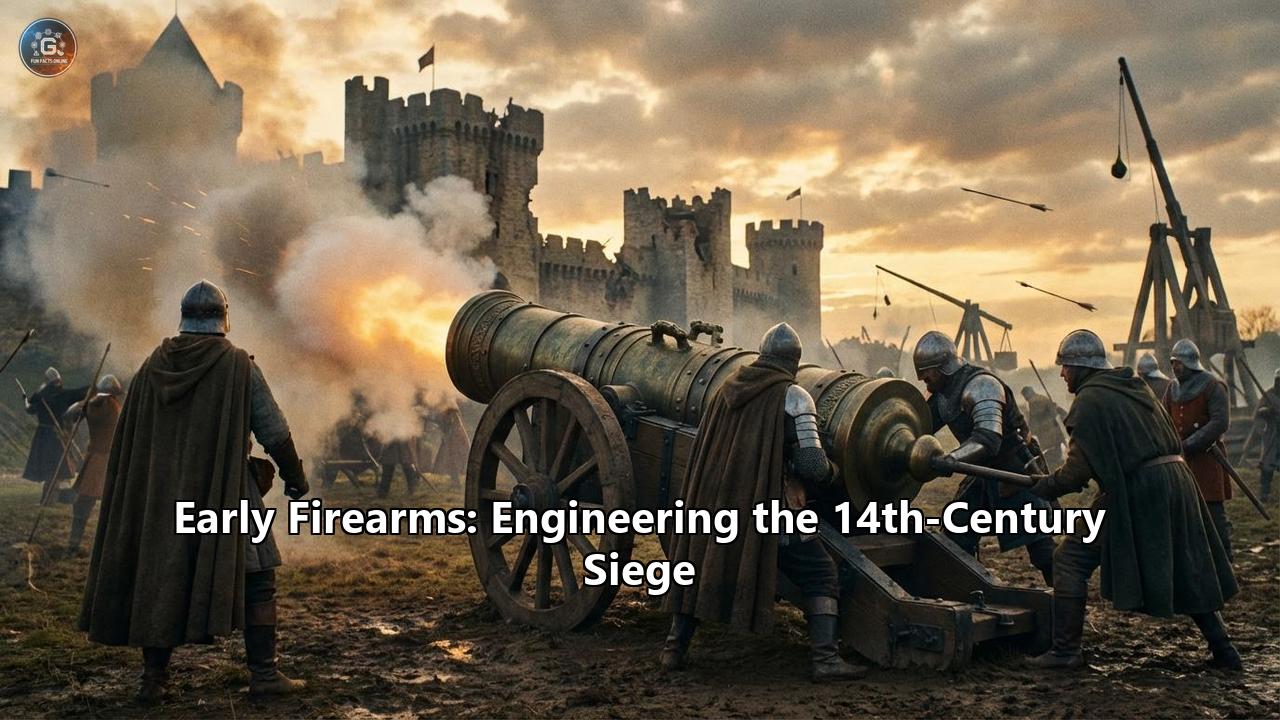
The air outside the walls of a medieval fortress in the early 14th century was typically filled with the familiar cacophony of war: the rhythmic thud of axes against timber, the creak of tensioned torsion springs, the snapping of bowstrings, and the shouts of men. But as the century progressed, a new, terrifying sound tore through the battlefield, accompanied by a foul, sulfurous smoke that clung to the damp European earth. It was a deafening roar, a sound like thunder summoned from the heavens and harnessed by mortal hands. This was the dawn of chemical warfare, the birth of the firearm, and the beginning of the end for the traditional medieval castle.
For thousands of years, siege warfare had been a matter of kinetic energy and mechanical advantage. Engineers relied on gravity, tension, and torsion to hurl projectiles. The trebuchet, the mangonel, and the ballista were the kings of the battlefield, representing the absolute pinnacle of muscle-powered and gravity-assisted artillery. But the 14th century introduced a paradigm shift so profound that it altered the trajectory of human history, warfare, and geopolitics forever. By harnessing the explosive combustion of a simple chemical mixture, engineers transitioned from the mechanical release of energy to the explosive release of chemical energy.
The story of early firearms and their integration into 14th-century siege warfare is not just a tale of weapons. It is a sweeping saga of early chemistry, groundbreaking metallurgy, logistical nightmares, and architectural evolution. It is the story of how a fragile, volatile black powder transformed the high, unscalable walls of proud fortresses into crumbling piles of masonry, and how a new breed of artisan—the master gunner—rose to prominence in the courts of European monarchs.
The Alchemy of Destruction: The Origins and Chemistry of Black Powder
To understand the 14th-century firearm, one must first understand the volatile mixture that gave it life: black powder. Long before it was known as gunpowder, this chemical compound was an alchemical curiosity. Its origins lie in 9th-century China, where Daoist alchemists, searching for an elixir of immortality, inadvertently discovered a mixture that burned with furious intensity. By the 11th century, the Song Dynasty was utilizing it in fire lances, bombs, and rudimentary rockets.
The transmission of this technology to Europe remains a subject of intense historical study, but it is generally accepted that the expanding Mongol Empire and the bustling trade networks of the Silk Road facilitated its westward journey. The first reliable European documentation of gunpowder’s recipe appears in the late 13th century in the writings of the English Franciscan friar and scholar Roger Bacon. In his 1267 work, Bacon cryptically recorded a formula that roughly equates to 41 percent saltpeter, 29.5 percent sulfur, and 29.5 percent charcoal.
Creating this powder in the 14th century was an arduous, dangerous, and highly specialized craft. The three ingredients had to be sourced, purified, and mixed with exact precision.
Saltpeter (Potassium Nitrate): The magical ingredient, the oxidizer that allows the mixture to burn rapidly in an enclosed space without external oxygen. In the 1300s, saltpeter was rare and incredibly difficult to manufacture. It was organically harvested from "nitre beds"—piles of decaying organic matter, manure, and urine left to rot for months. "Saltpeter men" would boil the resulting soil, filtering the liquid through wood ash to produce crystals. Because of its scarcity, saltpeter was the most expensive component of early gunpowder, often driving the massive cost of early artillery trains. Sulfur: Acting as the fuel and lowering the ignition temperature of the mixture, sulfur was relatively easier to acquire, often mined from volcanic regions, particularly in Italy and Iceland. It gave early firearms their signature demonic smell, prompting many medieval clerics to associate the new weapons with hellfire and dark magic. Charcoal: The secondary fuel, providing the bulk of the carbon for the reaction. Not just any wood would do. Gunpowder makers quickly realized that charcoal made from light woods like willow, alder, or hazelnut burned faster and more evenly, providing a superior explosive force.In the 14th century, gunpowder was manufactured as "serpentine powder." This meant the ingredients were ground into a fine, dry dust and mixed together. Serpentine powder was notoriously unstable and problematic. When transported over the rutted, bumpy roads of medieval Europe in wooden barrels, the vibrations caused the ingredients to separate by weight. The heavier sulfur would sink to the bottom, while the lighter charcoal floated to the top, rendering the powder useless until it was meticulously remixed by the gunner at the siege camp. Furthermore, serpentine powder absorbed moisture from the air with frustrating ease. A damp morning could ruin a siege bombardment. It was not until the development of "corned" powder later in the 15th century—where the mixture was wetted, pressed into cakes, and broken into granules—that gunpowder became stable, reliable, and exponentially more powerful. But the 14th-century gunner had to make do with his volatile, dusty serpentine mix, constantly monitoring its condition and mixing it on-site.
The First Iron Beasts: The Pot-de-Fer and the Birth of the Cannon
The transition from Chinese fire lances to true metal-barreled cannons occurred somewhere in the hazy timeline of the late 13th and early 14th centuries. By the 1320s, the concept of a closed-end metal tube using gunpowder to propel a projectile had firmly taken root in Europe.
The earliest visual evidence of a European cannon comes from an illuminated manuscript dating to 1326 or 1327, titled De Nobilitatibus, Sapientiis, et Prudentiis Regum (On the Majesty, Wisdom, and Prudence of Kings), written by Walter de Milemete, a scholar and cleric who presented the work to the young King Edward III of England. The illustration depicts a bizarre, vase-shaped weapon resting on a wooden trestle. This is the pot-de-fer (iron pot).
A knight in full armor stands behind the weapon, holding a long pole with a glowing red-hot iron tip to the touchhole at the rear of the device. Protruding from the muzzle is not a cannonball, but a massive, iron-fletched bolt or arrow, wrapped tightly in leather at the base to create a seal against the barrel. This leather wrapping, called a "sabot," was crucial. Early gunners quickly realized that if there was too much space between the projectile and the barrel (a concept known as windage), the explosive gases would simply slip past the projectile, drastically reducing its velocity and range.
The pot-de-fer was a terrifying but highly inefficient weapon. It was small, difficult to aim, and the arrows it fired, while lethal to individuals, were practically useless against the thick stone walls of a fortress. The primary effect of these early weapons was psychological. The flash, the smoke, and the thunderous boom panicked horses and terrified men who had never experienced anything like it.
However, engineers across Europe—particularly in France, England, and the Italian city-states—rapidly realized that to breach stone walls, they needed heavier projectiles, which meant larger barrels and stronger metal. By the mid-to-late 14th century, the vase shape was abandoned in favor of the straight, tubular design we recognize today. The era of the bombard had begun.
Forging the Dragons: The Metallurgy of 14th-Century Artillery
As the demand for larger guns grew, medieval craftsmen faced a monumental engineering challenge. How do you create a massive metal tube capable of containing a violent chemical explosion without bursting and killing the gun crew?
In the 14th century, there were two primary methods of manufacturing cannons, drawing heavily upon existing medieval trades: the founder (bell maker) and the blacksmith (cooper).
The Cast Bronze Method:Bell founders had centuries of experience casting massive, hollow bronze shapes. Bronze, an alloy of copper and tin, was highly desirable for cannons. It was tough, flexible enough to stretch slightly under pressure rather than shattering, and resistant to rust. The founders used a "lost-wax" or loam-molding technique. A clay core (the newel) representing the bore of the gun was suspended inside a larger clay mold. Molten bronze was poured into the gap. Once cooled, the clay was broken away, leaving a solid bronze cannon.
While bronze guns were superior, they were exorbitantly expensive. Copper and tin were costly commodities, and only the wealthiest monarchs could afford an entire siege train of cast bronze artillery. Furthermore, the technology to cast truly massive bronze guns would not be perfected until the late 14th and 15th centuries.
The Wrought Iron Stave Method:Because of the prohibitive cost of bronze, the majority of early 14th-century large siege guns (bombards) were made of wrought iron. However, medieval blast furnaces could not produce liquid iron in sufficient quantities or quality to cast large cannons. Therefore, gunsmiths turned to the techniques of the cooper—the barrel maker.
To build a wrought iron bombard, blacksmiths forged long, thick strips of iron, known as staves. These staves were arranged in a circle around a cylindrical wooden or clay core, much like the wooden planks of a wine barrel. Next, the smiths forged iron rings or hoops. These hoops were heated until they were glowing white-hot, which caused the metal to expand. The hot hoops were then driven down over the iron staves. As the hoops cooled, they contracted violently, shrinking and crushing the staves together with immense pressure, forming a tight, gas-proof seal.
This ingenious method is exactly why the main tube of a firearm is still called a "barrel" today.
These iron monsters could be scaled up to massive proportions. By the end of the 14th century, some bombards weighed thousands of pounds and were capable of firing huge stone spheres. However, wrought iron guns were inherently dangerous. The constant stress of heat and explosive pressure could weaken the forge-welded seams. If a gun was overloaded with powder, or if the projectile jammed, the weapon could burst catastrophically like a fragmentation grenade. The master gunner lived a life of high hazard, constantly inspecting his weapons for hairline fractures.
The Anatomy of the 14th-Century Siege
To appreciate the impact of these new weapons, one must visualize how a typical siege unfolded before and during the integration of gunpowder.
Prior to the cannon, a siege was primarily an exercise in starvation and brutal engineering. An attacking army would surround a castle, cut off its supply lines, and begin a slow, grinding process of attrition. Engineers would construct elaborate timber siege towers to scale the walls, massive battering rams protected by wooden sheds (called "cats" or "sows") to smash the gates, and deep networks of trenches (saps) to mine under the castle foundations. Above ground, massive counterweight trebuchets hurled rocks, dead animals, and incendiaries over the walls. A well-provisioned castle with thick, high walls could hold out for months, sometimes years, bleeding the attacking army dry through disease, exposure, and localized counter-attacks.
The introduction of the early cannon did not immediately end this paradigm, but it drastically altered the geometry of the battlefield and the psychology of the defenders.
In the mid-14th century, cannons were used alongside traditional siege engines. A typical siege train might feature a half-dozen small iron bombards positioned in heavily fortified earthworks, firing continuously alongside trebuchets. Early bombards were cumbersome and had a painfully slow rate of fire. Loading a 14th-century cannon was a delicate, multi-step process.
First, the serpentine powder was carefully ladled down the muzzle. Next, a tight-fitting wooden plug or a wad of straw and wet clay was rammed down against the powder to act as a gas seal. Then, the projectile was loaded. In the early 1300s, this was a massive iron-fletched bolt; by mid-century, gunners transitioned to perfectly carved spherical stone balls, and occasionally lead or iron shot. Another wad was rammed in to keep the ball from rolling out. Finally, the gunner filled the touchhole with fine-grained powder and applied the linstock—a stick holding a smoldering slow-match—to ignite the charge.
After firing, the barrel had to be meticulously swabbed with water and vinegar to extinguish any lingering embers; failing to do so meant the next charge of powder could detonate prematurely in the gunner's face. Because of this laborious process, and the tendency of iron barrels to overheat, a heavy bombard might only fire a handful of times a day.
Yet, despite the slow rate of fire, the impact was profound. Unlike the arcing, plunging fire of a trebuchet, a bombard fired with a flat, direct trajectory. A stone cannonball, traveling at hundreds of feet per second, struck the vertical masonry of a castle wall with shattering kinetic force. Trebuchets chipped away at walls; cannons punched through them. Continuous, pinpoint bombardment at the base of a wall could create a breach in a matter of days or weeks, allowing infantry to storm the fortification.
Flashpoints of Conflict: Early Artillery in Action
The progression of gunpowder artillery in the 14th century was heavily driven by the endless conflicts of the era, most notably the Hundred Years' War between England and France, and the bitter rivalries of the Italian city-states.
Edward III and the Weardale Campaign (1327):One of the first recorded field deployments of gunpowder weapons in Europe occurred during the Scottish campaigns of the newly crowned King Edward III of England. English accounts note the use of "crakys of war" (cracks of war)—small, early firearms that produced a terrifying noise. While they did little physical damage to the mobile Scottish forces, they marked the beginning of England’s reliance on the new technology.
The Battle of Crécy (1346):Though not a siege, the Battle of Crécy was a watershed moment for firearms. Edward III’s heavily outnumbered English army deployed a secret weapon against the charging French cavalry: small, portable cannons and "ribaudequins". The ribaudequin was an early multi-barreled volley gun, essentially several small iron barrels strapped side-by-side on a wooden cart. When fired simultaneously, they unleashed a storm of lead balls or iron bolts. The Florentine chronicler Giovanni Villani recorded the shock of the French forces: "The English guns cast iron balls by means of fire… They made a noise like thunder and caused much loss in men and horses… the whole plain was covered by men struck down by arrows and cannon balls". The loud blasts panicked the French destriers (warhorses), breaking their charges and leaving them vulnerable to the devastating volleys of English longbowmen.
The Siege of Calais (1346–1347):Following his victory at Crécy, Edward III marched to the vital French port city of Calais and laid siege. Here, the systematic use of artillery for bombardment became fully apparent. Edward brought a dedicated siege train, including bombards and a massive supply of gunpowder ingredients. The siege accounts note that the English issued daily rations of powder—often just three to four ounces per gun, highlighting the scarcity and expense of the material at the time. The bombards fired lead balls and heavy iron quarrels into the city. While starvation ultimately forced the citizens of Calais to surrender after eleven grueling months, the continuous, booming bombardment took a heavy psychological toll on the defenders, proving that the gun was now an indispensable tool of royal authority.
The War of Chioggia (1378–1381):By the late 14th century, the Italians had become masters of both the manufacture and tactical deployment of artillery. During the bitter War of Chioggia between the maritime republics of Venice and Genoa, cannons were heavily utilized in both naval engagements and amphibious sieges. The Venetians mounted heavy bombards on their galleys and deployed them against Genoese shore fortifications. The scale of the weapons had increased dramatically since Crécy. The Venetians used large stone-throwing bombards to systematically demolish the walls of the Genoese strongholds, demonstrating that the small "iron pots" of the 1320s had evolved into genuine city-killers in just fifty years.
The Master Gunner: A New Class of Warrior
The introduction of firearms completely disrupted the social hierarchy of medieval warfare. For centuries, the battlefield was dominated by the aristocratic knight, a warrior born to wealth, trained from childhood in the martial arts, and protected by expensive steel armor. The knight viewed warfare through the lens of chivalry, personal valor, and honorable combat.
The gun cared nothing for chivalry. A peasant with an hour of training and a burning match could instantly kill a nobleman who had spent his life mastering the sword. This democratization of violence deeply unsettled the medieval elite.
Because the handling of gunpowder required literacy, mathematical skill to calculate trajectories, and an understanding of rudimentary chemistry and metallurgy, a new professional class emerged: the Master Gunner. These men were rarely nobles. They were highly paid, highly sought-after artisans, mercenaries, and engineers who contracted their services to the highest bidder. A master gunner commanded a team of carpenters, blacksmiths, powder-mixers, and stone-cutters.
He was fiercely protective of his trade secrets. The exact ratio of his powder, the way he calculated elevation using a gunner's quadrant, and his methods for cooling and swabbing the barrels were closely guarded mysteries. Because of their immense value, captured gunners were rarely ransomed like noble knights; they were often either immediately employed by their captors or brutally executed as practitioners of black magic.
The Evolution of the Projectile: From Arrow to Stone to Iron
As the barrels grew larger throughout the 1300s, the projectiles underwent a rapid evolution. The initial iron bolts (carreaux) used in the pot-de-fer and early bombards were aerodynamically unstable when fired from smoothbore tubes and caused minimal structural damage to stone walls.
By the 1340s, artillerymen shifted to spherical projectiles. Smaller anti-personnel guns fired cast lead or forged iron balls, but the massive siege bombards required a different solution. Iron was too expensive to cast into massive cannonballs, so the armies turned to the earth itself. The stone cannonball became the standard siege projectile of the late 14th and 15th centuries.
This created a massive new logistical requirement: the artillery stonecutter. Shaping a perfect sphere of granite or limestone was painstaking work. If the ball was slightly too large, it would jam in the barrel, virtually guaranteeing a catastrophic explosion. If it was too small, the excessive windage would rob the shot of its power. Master stonecutters traveled with the siege trains, chipping away at local rock outcroppings to feed the hungry bombards.
Stone balls had distinct ballistic properties. They were lighter than iron, meaning they flew at high velocities but lost momentum quickly over long distances. However, when a heavy stone ball struck a rigid, vertical medieval castle wall at close range, the results were devastating. The stone ball would often shatter upon impact, transferring all its kinetic energy directly into the masonry, causing the wall's mortar to pulverize and the stones to crack. Repeated strikes in the same area would strip away the outer ashlar facing of the wall, exposing the weak rubble core and leading to a rapid collapse.
The Handgonne: Miniaturizing the Thunder
While the massive bombards battered the walls, the late 14th century also saw the miniaturization of the cannon into a weapon that could be carried and fired by a single infantryman. This was the hand cannon, known in Middle English as the "handgonne".
The handgonne was brutally simple: a short, thick iron or bronze tube attached to a wooden pole or resting on a crude stock. The weapon had no trigger mechanism. To fire it, the soldier tucked the wooden pole under his arm or rested it over his shoulder (to absorb the recoil), aimed the tube, and manually touched a glowing coal or slow-burning match cord to a touchhole drilled into the top or side of the barrel.
The recent archaeological discovery at Kletzke Castle in Brandenburg, Germany, highlights this era perfectly. In 2023, archaeologists unearthed a fragmented bronze handgun barrel near the castle dating back to a known siege in 1390. Measuring just 2 inches long in its fragmented state, this "Kletzke hand cannon" is currently considered one of the oldest physical specimens of a handheld firearm in Europe, predating the famous Tannenberg rifle of 1399. The discovery proves that by the late 1300s, handheld firearms were not just experimental novelties, but actively deployed weapons in regional European conflicts.
Tactically, the 14th-century handgonne was wildly inaccurate. With a smooth bore, a spherical lead ball, and no sights, hitting a specific target beyond thirty paces was a matter of sheer luck. However, its value lay in volley fire and armor penetration. At close range, a lead ball fired from a handgonne could punch right through the hardened steel plate armor that was becoming standard for knights of the era. Furthermore, deploying dozens of handgonners along the battlements of a besieged castle provided defenders with a terrifying, armor-piercing deterrent against scaling parties.
The Architecture of Defense: Castles in the Crosshairs
Every leap in offensive military technology forces an equal and opposite reaction in defensive architecture. For centuries, the philosophy of castle building was simple: build the walls as high and as sheer as possible to prevent escalade (climbing) and thicken the base to resist battering rams and sapping.
Gunpowder shattered this philosophy. A towering, 60-foot-tall, relatively thin curtain wall was a massive, fragile target for a battery of flat-trajectory bombards. Once the structural integrity of the base was compromised by cannon fire, the sheer weight of the high wall caused it to come crashing down into the moat, creating a perfect ramp of rubble for the attackers to swarm over.
In the late 14th century, military architects realized that the traditional castle was obsolete. They began a frantic, expensive period of adaptation. If high walls were a liability, the new walls had to be lower, thicker, and backed by massive mounds of earth. Earth is an incredible shock absorber; a stone ball that shatters masonry will simply thud into a packed earthen bank, burying itself harmlessly.
Castles began to lower their profiles. The towering keeps of the 12th century gave way to squat, massive artillery forts. But the defenders did not just passively absorb the punishment; they fought back with guns of their own. As a 2013 historical analysis notes, defensive tactics quickly shifted to prioritize overlapping fields of fire and bringing more guns to bear than the attacker. A besieged castle acting as a stable, elevated firing platform could out-range an attacker sitting in the muddy trenches below.
To accommodate defensive artillery, architects punched holes in the ancient stone walls. These early gunports often took the shape of an inverted keyhole—a circular hole at the bottom for the gun barrel, and a vertical slit above it for the gunner to sight his target. Because early cannons could not easily be pivoted left or right (traversed) without moving the heavy wooden timber beds they rested on, these keyhole ports offered a very narrow field of fire.
By the end of the century, engineers began constructing "boulevards" (from the Dutch bolwerk, bulwark)—massive earth-and-timber outer defenses designed to keep the enemy’s siege guns as far away from the main stone walls as possible. These adaptations laid the evolutionary groundwork for the complex, mathematically perfect "star forts" (trace italienne) that would dominate the landscape in the 16th and 17th centuries. But in the 1300s, it was an era of desperate, improvised transition. Castles were caught between the age of the bow and the age of the gun, bearing the architectural scars of both.
The Dawn of a New Era
As the 14th century drew to a close, the experimental, terrifying era of the early firearm had permanently altered the landscape of warfare. The days of the invincible stone fortress, dominating the countryside through sheer altitude and thickness of masonry, were rapidly fading. The pot-de-fer that had fired cumbersome iron arrows at the beginning of the century had birthed a terrifying lineage of massive, wall-smashing bombards and armor-piercing handgonnes.
The integration of gunpowder into siege warfare required more than just the invention of the gun; it required the birth of the military-industrial complex. It necessitated the establishment of international supply chains for sulfur and saltpeter, the advancement of heavy iron metallurgy, and the creation of highly paid, mathematically literate professional armies. The master gunner replaced the chivalric knight as the arbiter of sieges, and the cold, terrifying logic of chemistry and physics replaced the mechanical limits of torsion and tension.
When the smoke cleared over the battlefields and shattered walls of late 14th-century Europe, the medieval world was dying, and the modern era of warfare had announced its arrival with a thunderous, inescapable roar. The siege would never be the same again.
Reference:
- https://www.gibmuseum.gi/our-history/military-history/development-of-artillery
- https://www.historyhit.com/deadly-medieval-siege-weapons/
- https://en.wikipedia.org/wiki/Early_thermal_weapons
- https://en.wikipedia.org/wiki/Gunpowder_artillery_in_the_Middle_Ages
- https://en.wikipedia.org/wiki/History_of_cannons
- https://www.wulflund.com/tema/middle-ages/medieval-siege-warfare-ii
- https://www.scribd.com/document/470159802/A-History-of-Artillery
- https://www.youtube.com/watch?v=5BuvZQh_2YM
- https://www.reddit.com/r/AskHistorians/comments/1j9vrc/how_did_gunpowder_weapons_change_siege_tactics/
- https://military-history.fandom.com/wiki/Gunpowder_artillery_in_the_Middle_Ages
- https://www.gutenberg.org/files/56777/56777-h/56777-h.htm
- https://publications.gc.ca/site/archivee-archived.html?url=https%3A%2F%2Fpublications.gc.ca%2Fcollections%2Fcollection_2024%2Fmdn-dnd%2Fd12%2FD12-30-62-eng.pdf
- https://www.livescience.com/archaeology/europes-oldest-handgun-may-date-to-14th-century-siege-at-german-castle