
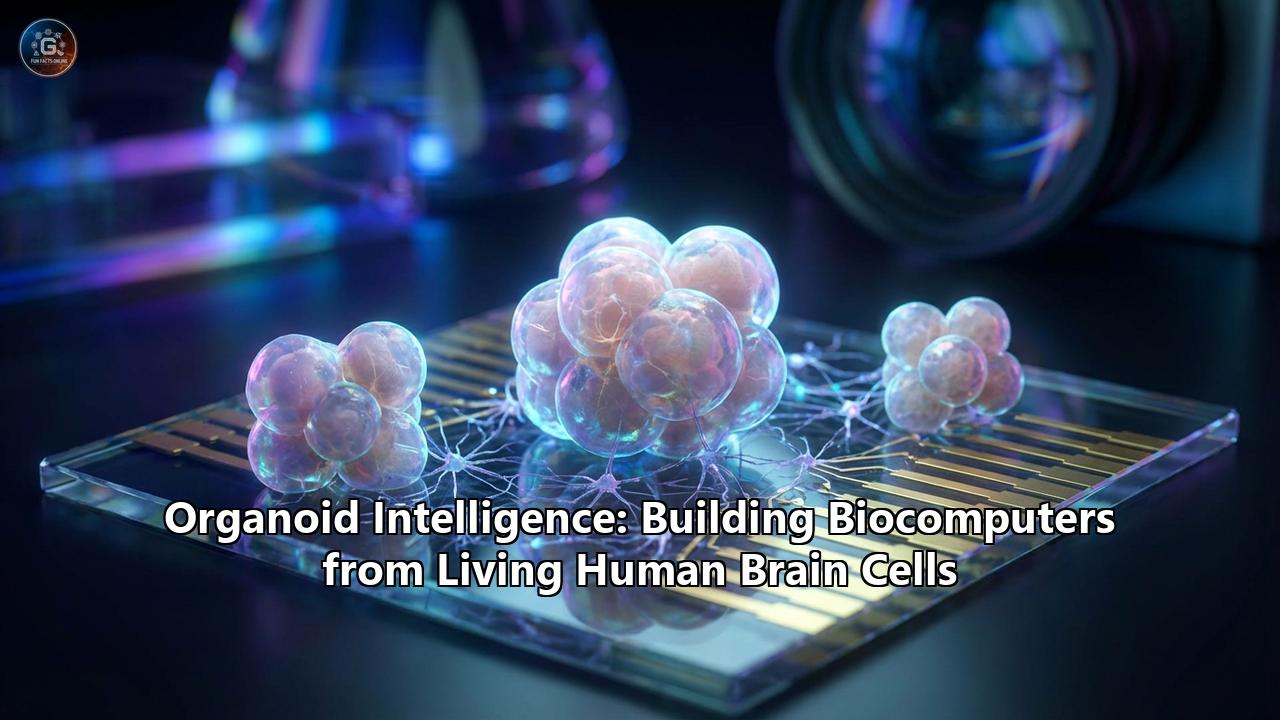
Current technological trajectories suggest we are approaching a physical limit. Silicon chips are hitting the "thermal wall," and the energy demands of training massive AI models like GPT-4 are beginning to rival the consumption of small nations. The solution may not lie in better silicon, but in a return to the most efficient computer ever known: the human brain.
The following comprehensive article explores Organoid Intelligence (OI), a revolutionary field that seeks to build "biocomputers" using living human brain cells.
The Silicon Ceiling and the Biological Renaissance
For decades, Moore’s Law—the observation that the number of transistors on a microchip doubles every two years—has been the metronome of modern progress. Yet, as transistors shrink to the atomic scale, quantum tunneling and heat dissipation are creating insurmountable physical barriers. Simultaneously, the "intelligence" we have built on this silicon substrate is voracious. Frontier, one of the world's fastest supercomputers, requires 21 megawatts of power to operate—roughly the energy consumption of a town of 20,000 people.
In stark contrast, the human brain possesses approximately 86 billion neurons and over 100 trillion synaptic connections, capable of learning, reasoning, and creativity, all while running on about 20 watts—the power of a dim light bulb.
This discrepancy has birthed the field of Organoid Intelligence (OI). Spearheaded by visionaries like Dr. Thomas Hartung at Johns Hopkins University, OI is not about mimicking the brain with code (as in Artificial Intelligence); it is about using the brain as hardware. It proposes a future where "biocomputers" built from 3D cultures of living human brain cells perform tasks that silicon struggles with, from pattern recognition to complex decision-making, at a fraction of the energy cost.
What is an Organoid?
To understand OI, one must first understand the brain organoid. Often dubbed "mini-brains" in popular media, these are not fully formed brains but rather 3D tissue cultures derived from human induced pluripotent stem cells (iPSCs).
The process begins with a simple skin sample from a donor. These skin cells are genetically reprogrammed to return to an embryonic stem cell-like state. From there, they are coaxed into becoming neural cells. Unlike traditional 2D cell cultures that sit flat in a petri dish, organoids are grown in a rotating bioreactor. This suspension allows them to self-organize into three-dimensional structures containing neurons, astrocytes, and oligodendrocytes. They develop layered architectures similar to the human cortex and, crucially, exhibit spontaneous electrical activity.
While a typical organoid is only the size of a housefly's eye (about 500 microns to 1 mm), it contains significantly more complexity and cell density than any 2D culture. It is this density that makes them a viable candidate for computational hardware.
The Hardware of the Future: How a Biocomputer Works
Building a computer from living tissue requires a fundamental rethinking of "input" and "output." You cannot plug a USB cable into a blob of cells. The interface between the biological and the digital is the crucible where OI is forged.
The Interface: High-Density Multielectrode Arrays (MEAs)
The current standard for interfacing with organoids is the Multielectrode Array (MEA). Imagine a microchip bed of thousands of microscopic needles or pads. The organoid sits atop this bed.
- Input (Writing): Specific electrodes send electrical pulses into the organoid, stimulating the neurons to fire. This is analogous to entering data or "keystrokes."
- Output (Reading): When neurons in the organoid fire (action potentials), the electrodes detect the change in voltage. This activity is decoded by a computer to interpret the organoid's "response."
Johns Hopkins researchers are currently developing "EEG caps" for organoids—flexible, shell-like microelectrode arrays that wrap around the entire sphere of cells, allowing for 3D recording and stimulation rather than just reading the bottom surface.
"Brainoware": The Reservoir Computing Model
In 2023, a team at Indiana University Bloomington achieved a major breakthrough with a system they called "Brainoware." They utilized a concept known as Reservoir Computing.
In traditional silicon computing, data is processed sequentially (step-by-step). In Reservoir Computing, the "reservoir" (the organoid) is a dynamic, chaotic system. You throw information (input signals) into this pool, and the ripples (neural activity) interact in complex, non-linear ways. A separate, simple algorithm then looks at the "ripples" on the surface (the output) to find the answer.
The Experiment: The researchers converted audio clips of eight different men speaking Japanese vowels into electrical signals and fed them into the organoid.- The Result: Initially, the organoid didn't know what to do. But using unsupervised learning, the system adapted. After training, the Brainoware could identify the specific speaker with 78% accuracy.
- Significance: This proved that a biological network could adapt and "learn" to recognize patterns without the rigid, pre-programmed architecture of a silicon neural network. Crucially, when they ran the experiment without the organoid (using just the reading software), the accuracy was zero—proving the biological tissue was doing the computing.
DishBrain: The Gamer in the Petri Dish
Perhaps the most famous example of OI in action comes from Cortical Labs in Australia. In a study published in Neuron (2022), they placed a layer of roughly 800,000 neurons (both human and mouse) onto a chip and taught it to play the vintage video game Pong.
The "Free Energy Principle"
How do you teach a blob of cells the rules of tennis? You don't. You exploit a fundamental biological drive. The team utilized the Free Energy Principle, proposed by neuroscientist Karl Friston. The principle states that biological systems strive to minimize "surprise" or unpredictability in their environment. They want their internal model of the world to match reality.
The Setup:- Stimulus: The electrodes fired on the left or right side of the dish to indicate where the "ball" was.
- The "Paddle": The neurons could fire back to move the paddle.
- The Feedback Loop:
Success (Hit the ball): The system delivered a predictable, rhythmic electrical pulse. (The neurons "like" this; it is orderly.)
Failure (Miss the ball): The system delivered chaotic, random noise / white noise. (The neurons "dislike" this; it is unpredictable.)
Remarkably, within five minutes, the neurons began to self-organize. They altered their firing patterns to move the paddle effectively, purely to avoid the chaos of the "miss" signal and receive the predictability of the "hit" signal. They weren't "playing a game" in the human sense; they were building a model of their universe to maintain order.
This demonstrated sentient behavior—defined strictly here as "responsive to sensory impressions"—in a dish. It showed that biological hardware adapts in real-time, modifying its own structure to solve problems, something silicon hardware cannot do (silicon chips do not rewire themselves physically).
The Energy Equation: Why Biology Wins
The primary driver for OI is energy efficiency. As AI models grow, their carbon footprint explodes. Training a single large language model can emit as much carbon as five cars do in their lifetimes.
The comparison is staggering:
- Biological Neuron: Consumes approx. $10^{-11}$ Joules per spike.
- Silicon Neuron: Consumes approx. $10^{-8}$ Joules per operation.
This represents a 1,000 to 10,000-fold difference in efficiency. Biological systems operate near the Landauer Limit, the theoretical minimum amount of energy required to erase one bit of information. Nature, through millions of years of evolution, has optimized computation to a degree that our best engineering cannot yet match. If we can scale OI, we could theoretically run data centers on a fraction of the current power grid, revolutionizing the economics of cloud computing.
The Roadmap and The Challenges
The Baltimore Declaration, signed by leading scientists at the first OI workshop, outlines the roadmap for this technology. However, moving from a Pong-playing layer of cells to a complex biocomputer faces Herculean challenges.
1. The Necrotic Core & Vascularization
The biggest hurdle is size. Currently, organoids can only grow to a few millimeters before the center dies. Without a blood supply (vasculature), oxygen and nutrients can only diffuse about 200-300 microns into the tissue. The center starves and becomes a "necrotic core."
- The Fix: Researchers are developing microfluidic systems ("organ-on-a-chip") that pump artificial "blood" (nutrient media) through the organoid. Others are attempting to co-culture the neurons with endothelial cells to encourage the growth of actual blood vessels within the organoid.
2. Variability and Standardization
If you buy an Intel Core i9 processor, you know exactly how it will perform. Biological systems are messy. One batch of organoids might be "smarter" or more active than another due to slight variations in the stem cell donor or the growth medium. Creating a standardized "Bio-CPU" requires rigorous manufacturing protocols that currently do not exist.
3. Output Complexity
While "DishBrain" can move a paddle up and down, extracting complex thoughts or data from an organoid is difficult. We need better decoding algorithms—likely using traditional AI—to translate the "neural code" of the organoid into binary data we can use.
Beyond Computing: Medical Applications
While "living computers" capture the imagination, the immediate term value of OI lies in medicine. OI offers a "human model" that animal testing cannot match.
- Alzheimer’s and Dementia: We can grow organoids from the skin cells of Alzheimer’s patients. These organoids develop the same plaques and tangles as the patient's brain. We can then treat the "mini-brain" with thousands of potential drugs to see which ones repair the neural network functionally (i.e., restore its ability to "learn" or process data), not just structurally.
- Autism Spectrum Disorder: By comparing "neurotypical" organoids with those derived from donors with autism, researchers can study the differences in how these networks form and process information, potentially leading to personalized therapies.
- Toxicology: Instead of testing new chemicals on rats, we can test them on human brain tissue to see if they disrupt cognitive function (learning and memory) in the dish.
The Ethical Frontier
The prospect of "thinking" tissue in a lab creates a minefield of ethical questions. The field has adopted an "embedded ethics" approach, where bioethicists are involved from day one, not as an afterthought.
- Sentience: At what point does an organoid feel pain? If "DishBrain" acts to avoid the "chaos" of a missed ball, is that a form of suffering? Current consensus is that these organoids lack the complexity and sensory input for true consciousness or suffering, but as we scale to millions of neurons, the line blurs.
- Consent: If your skin cells are used to grow a biocomputer that eventually becomes part of a military system or a corporate server, did you consent to that? The concept of "biological ownership" will need to be rewritten.
- The "Brain in a Vat" Scenario: If we eventually create an organoid capable of complex thought, do we have the right to keep it trapped in a simulation, feeding it inputs?
Conclusion
Organoid Intelligence represents a paradigm shift from artificial intelligence to augmented biological intelligence. It is a fusion of the wet and the dry, the grown and the built. While we are likely decades away from a laptop powered by brain cells, the "biocomputer" is no longer science fiction. It is a nascent reality playing video games in a petri dish, whispering the promise of a future where our technology is as efficient, adaptable, and complex as the life that created it.
Reference:
- https://www.frontiersin.org/journals/science/article-hubs/organoid-intelligence-a-new-biocomputing-frontier
- https://neurosciencenews.com/brain-cell-chips-speech-recognition-25352/
- https://www.veritasnewspaper.org/post/biocomputing-ethically-grey-energy-efficient-technology
- https://dailyai.com/2023/12/researchers-perform-ai-speech-recognition-with-human-brain-cells/
- https://www.aicoin.com/en/article/379153
- https://pmc.ncbi.nlm.nih.gov/articles/PMC10013972/
- https://www.news-medical.net/news/20231212/Brainoware-A-breakthrough-AI-approach-using-brain-organoids-for-advanced-computation.aspx
- https://decrypt.co/209387/brainoware-bioscience-ai-organoids-brain-cells
- https://www.popularmechanics.com/science/a41628165/synthetic-brain-plays-pong/
- https://www.monash.edu/medicine/news/latest/2022-articles/brain-cells-in-a-dish-learn-to-play-pong
- https://www.nano.lu.se/article/biological-computers-could-use-far-less-energy-current-technology-working-more-slowly
- https://aurelis.org/blog/artifical-intelligence/coarse-comparison-of-brain-and-silicon
- https://www.reddit.com/r/technology/comments/y2aqp5/a_dish_of_brain_cells_figured_out_how_to_play/
- https://iai.tv/articles/neurons-in-a-dish-learn-to-play-pong-auid-2058
- https://www.einpresswire.com/article/611739678/neurons-in-a-dish-learn-to-play-pong
- https://www.researchgate.net/figure/Biological-and-silicon-neurons-have-much-better-power-and-space-efficiencies-than-digital_fig1_51710519