
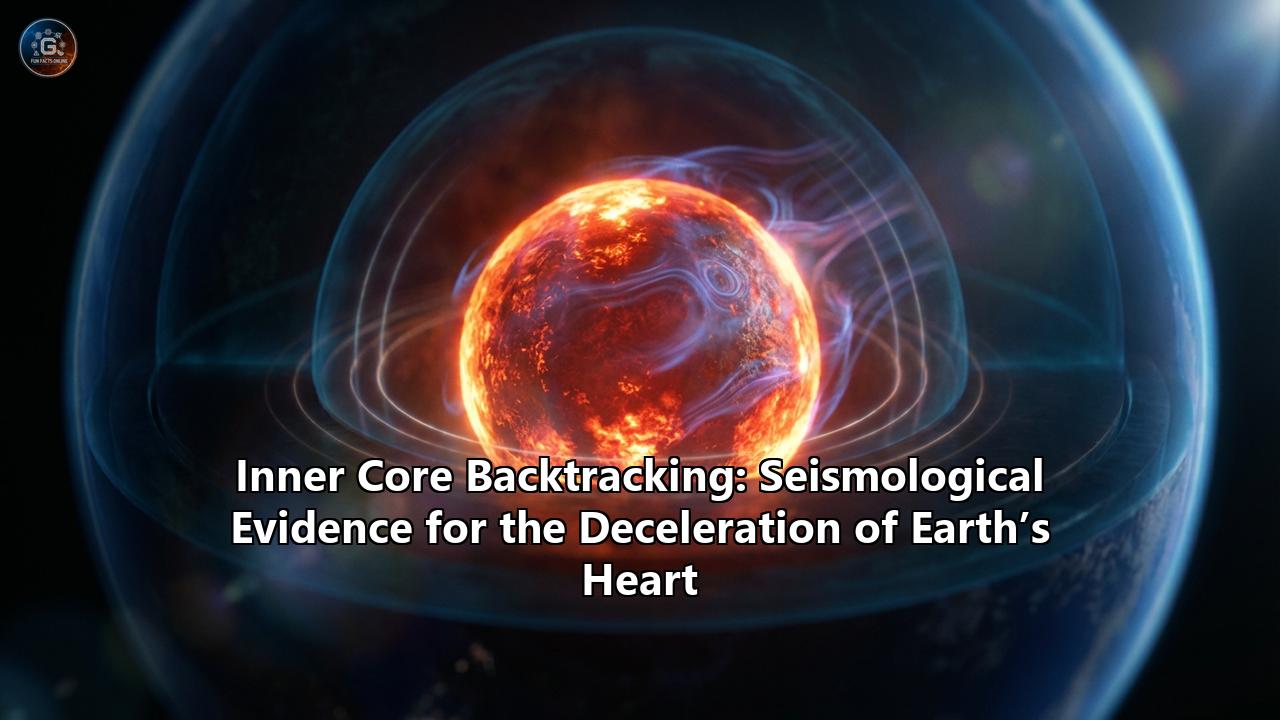
For decades, the standard model of our planet’s interior dynamics was relatively settled: beneath the shifting crust and the churning mantle, the Earth’s inner core—a Pluto-sized ball of solid iron—was thought to be spinning independently, super-rotating slightly faster than the rest of the planet. It was a “planet within a planet,” driven by magnetic torques and governed by its own distinct rhythm.
That rhythm has changed.
In a cascade of groundbreaking studies published between 2023 and 2025, seismologists have upended this long-held consensus. The inner core has not only slowed down; it has effectively paused and begun to spin in the opposite direction relative to the mantle—a phenomenon known as "backtracking" or sub-rotation. This deceleration of Earth's heart is not a catastrophic braking event but part of a massive, multi-decadal oscillation that has profound implications for the length of our days, the stability of our magnetic field, and our understanding of planetary formation.
This article explores the "Inner Core Backtracking" phenomenon in comprehensive detail, tracing the history of its discovery, the cutting-edge seismological methods used to detect it, the physics behind the core’s dance, and the very latest evidence suggesting the core’s surface itself is shapeshifting before our eyes.
Part I: The Hidden Planet – A Historical Context
To understand the significance of the "backtracking" discovery, we must first understand the elusive nature of the inner core itself. It is the most inaccessible region of our planet, buried beneath 3,000 miles of rock and molten metal.
The Lehmann Discontinuity: Finding the Solid Heart
In the early 20th century, scientists believed Earth’s core was entirely liquid. It was the Danish seismologist Inge Lehmann who, in 1936, shattered this assumption. While analyzing seismograms from an earthquake in New Zealand, she noticed faint P-waves (primary pressure waves) arriving in a "shadow zone" where no waves should have been able to penetrate if the core were purely liquid.
Lehmann proposed a radical solution: a solid inner core that was reflecting and refracting these waves. This boundary, now known as the Lehmann Discontinuity, marked the discovery of the inner core. It was established as a solid sphere of iron-nickel alloy, growing slowly over billions of years as the liquid outer core cools and crystallizes—a process that releases the latent heat driving the Earth’s magnetic dynamo.
The Discovery of Super-Rotation (1996)
For sixty years after Lehmann’s discovery, the inner core was treated mostly as a static object. Then, in 1996, geophysicists Xiaodong Song and Paul Richards published a landmark paper in Nature. By analyzing decades of seismic waves passing through the core, they observed that the travel times of these waves were changing systematically over years.
Their conclusion was startling: the inner core was rotating faster than the mantle and crust. They estimated this "super-rotation" to be about 1 degree per year. This meant that every few centuries, the inner core would make an extra full revolution compared to the surface. This "super-rotation" hypothesis became the dominant paradigm, though the estimated speed was later revised down significantly. The inner core was seen as a dynamic engine, spinning ahead of the pack.
Part II: The Great Deceleration – The 2023-2024 Breakthroughs
The consensus on super-rotation began to crack in the early 2020s. As data sets grew longer and computer modeling became more sophisticated, the "steady super-rotation" model stopped fitting the observations.
The Pause and Reversal (2023)
In January 2023, Yi Yang and Xiaodong Song (the same researcher from the 1996 discovery) published a study in Nature Geoscience that sent shockwaves through the community. They analyzed "repeating earthquakes"—seismic events that occur in the exact same location years apart—and found something strange.
In the 1990s and early 2000s, the seismic waves from these repeating quakes showed clear temporal changes, confirming the core was moving. But around 2009, these changes disappeared. The seismic waveforms from repeating quakes became identical, implying the inner core had paused its differential rotation relative to the mantle. Even more intriguingly, data from after 2010 suggested the rotation had restarted—but in the opposite direction.
The "Backtracking" Confirmation (June 2024)
While the 2023 study was highly suggestive, it wasn't definitive. Skeptics argued the data could be interpreted as local changes in the core's surface rather than global rotation. The debate was settled in June 2024, when John Vidale and Wei Wang published a definitive study in Nature titled "Inner core backtracking by seismic waveform change reversals."
Vidale and Wang utilized a highly specific dataset:
- Repeating Earthquakes (Multiplets): They focused on 121 repeating earthquakes generated in the South Sandwich Islands between 1991 and 2023.
- Nuclear Tests: They integrated precise data from Soviet, French, and American nuclear tests from 1971 to 1974.
- PKIKP Waves: They analyzed the specific seismic phase that travels through the mantle, outer core, and through the inner core (PKIKP), comparing it to waves that just grazed the surface or reflected off it.
The study provided unambiguous evidence that the inner core’s rotation relative to the mantle follows a predictable, oscillating cycle.
- 1970s - early 2000s: The inner core was super-rotating (spinning faster than the mantle).
- ~2008: The super-rotation slowed to a halt. The core became "locked" in sync with the mantle.
- 2008 - 2023: The inner core began sub-rotating (spinning slower than the mantle). Relative to an observer on Earth's surface, the inner core appears to be moving backward, or "backtracking."
Vidale stated, "The inner core had slowed down for the first time in many decades. Other scientists have recently argued for similar and different models, but our latest study provides the most convincing resolution."
Part III: The Physics of the Heartbeat – Why Does it Oscillate?
Why would a solid ball of iron the size of Pluto, suspended in a fluid metal ocean, stop and reverse direction? The answer lies in a titanic tug-of-war between two fundamental forces of planetary physics: Electromagnetism and Gravity.
1. The Electromagnetic Torque (The Accelerator)
The Earth’s outer core is a turbulent ocean of molten iron. As it churns via convection, it generates the Earth's magnetic field (the geodynamo). This magnetic field does not just radiate outward to protect us from solar wind; it also permeates the solid inner core.
Because the inner core is metallic and conductive, the magnetic field lines "grip" it. As the fluid outer core flows, it exerts a magnetic torque (a twisting force) on the inner core, attempting to spin it. This is generally the force responsible for the "super-rotation," pushing the inner core to spin faster than the mantle.
2. The Gravitational Torque (The Brake)
If the inner core were a perfect sphere and the mantle were a uniform shell, the magnetic torque would spin the core unchecked. However, neither is perfect.
- The Earth’s mantle is bumpy and has density anomalies (huge heavy blobs of rock deep underground).
- The inner core is also not perfectly uniform.
These density irregularities create a gravitational lock. The massive, dense regions of the mantle exert a gravitational pull on the dense regions of the inner core, trying to align them. This gravitational coupling acts as a restoring force. When the magnetic torque spins the inner core too far out of alignment, gravity pulls it back.
The 70-Year Oscillation
The interaction between these two forces creates a massive harmonic oscillator—essentially a planetary pendulum.
- Phase 1: The magnetic torque spins the inner core forward (Super-rotation).
- Phase 2: Gravity fights back, slowing the rotation until it stops (The Pause, c. 2008).
- Phase 3: Gravity pulls the core back toward equilibrium, causing it to spin slower than the mantle (Backtracking/Sub-rotation).
The recent data confirms this cycle takes approximately 70 years. The inner core speeds up, slows down, reverses, and speeds up again. We have just passed the peak of the "forward" spin and are now sliding down the "backward" slope of the cycle.
Part IV: The "Shapeshifting" Core – The 2025 Discovery
Just as the scientific community was digesting the confirmation of backtracking, a new study in early 2025 added a layer of complexity that borders on science fiction. Published in Nature Geoscience by Vidale, Wang, and colleagues, this research paper titled "Annual-scale variability in both the rotation rate and near surface of Earth's inner core" revealed that the inner core is not just spinning—it is deforming.
The Problem of the "Wobble"
While the 70-year oscillation model fit the long-term data well, there were still tiny, jagged irregularities in the seismic record that pure rotation couldn't explain. Some years, the data "jumped" more than physics allowed for a simple spinning object of that mass.
Viscous Deformation
The 2025 study introduced a shocking solution: the surface of the inner core is not a rigid solid like a steel ball bearing. Instead, it is soft enough to be molded by the turbulent pressures of the fluid outer core.
- Topographical Changes: The fluid outer core, swirling with hurricanes of molten iron, hammers the surface of the inner core.
- Deformation: This pressure causes the "terrain" of the inner core to shift and flow over timescales as short as a single year. Valleys and hills on the inner core's surface can grow or shrink.
This "viscous deformation" means that the inner core is shapeshifting. When seismologists see a change in a wave's travel time, it’s not just because the core moved; it’s because the core looks different than it did a year ago. This finding bridges the gap between the rotation models and the anomalous data, painting a picture of an inner core that is dynamic, soft, and constantly being sculpted by the fiery ocean surrounding it.
Part V: Seismological Forensics – How We Know
How do we measure the movement of an object 3,000 miles beneath our feet with such precision? The methodology relies on one of nature's rarest gifts to seismologists: Earthquake Doublets.
The Fingerprint of a Quake
Every earthquake sends out a unique pattern of waves—a "fingerprint" defined by its location, depth, and the rock it breaks. Occasionally, tectonic plates will snap in the exact same spot with the exact same mechanism years apart. These pairs are called doublets or multiplets.
Because the quake is identical, the seismic waves should arrive at a recording station (like those in Alaska) looking exactly the same.
- Mantle Waves: Waves that travel only through the mantle do look identical, proving the source is the same.
- Core Waves (PKIKP): Waves that dive deep, pierce the inner core, and come out the other side show differences. If the wave from earthquake A (1998) arrives 0.1 seconds faster than the wave from earthquake B (2024), it means the path through the inner core has changed.
The "Backtracking" Signal
In the 2024 study, researchers saw a specific pattern in these doublets.
- 2003-2008: The waveform differences increased steadily, indicating the core was rotating away from its previous position.
- 2008-2023: The waveform differences began to decrease and eventually matched the old patterns.
Imagine a spinning carousel. If you take a photo, wait 10 minutes, and the horse has moved forward, you know it's spinning. If you wait another 10 minutes and the horse has moved back to its original position, you know the carousel reversed. The seismograms showed the inner core "re-occupying" its old position relative to the mantle—definitive proof of backtracking.
Part VI: Implications for the Planet
The slowing and reversing of the inner core is not a sign of impending doom—the Earth is not stopping. However, this massive transfer of angular momentum has real-world effects on the surface.
1. The Length of Day (LOD)
The Earth is a closed system. According to the law of conservation of angular momentum, if the core slows down, the mantle and crust must speed up slightly to compensate, and vice versa.
- The Effect: The "backtracking" of the inner core contributes to a shortening of the Length of Day (LOD).
- The Scale: We are talking about fractions of a millisecond. However, atomic clocks are precise enough to measure this. The recent trend of the Earth rotating slightly faster (leading to discussions about a "negative leap second") correlates remarkably well with the inner core's deceleration phase that began around 2008.
2. The Magnetic Field
The inner core is the "battery" of the geodynamo. Its growth releases heat that drives the convection of the outer core, which generates the magnetic field.
- Oscillation connection: The 70-year cycle of the inner core matches known fluctuations in the strength and direction of the magnetic field.
- Geomagnetic Jerks: Sudden, sharp changes in the magnetic field (known as "jerks") often align with changes in the inner core's rotation regime. The deceleration might herald a period of shifting magnetic intensity, though a full pole reversal takes thousands of years and is not immediately triggered by this oscillation.
3. Core-Mantle Coupling
The validation of the 70-year cycle confirms that the Earth's interior is tightly coupled. The gravitational lock between the mantle and inner core is strong. This implies that the density anomalies in the mantle (the "blob" structures known as LLSVPs) are dense enough to physically yank the inner core back, influencing the planet's rotation as a whole.
Conclusion: The Pulse of the Earth
The "Inner Core Backtracking" phenomenon is a triumph of modern seismology. It transforms our view of the Earth's center from a static ball of iron into a dynamic, oscillating, shapeshifting heart that dances to a 70-year rhythm.
From Inge Lehmann’s shadow zones to Vidale and Wang’s analysis of nuclear echoes, we have peeled back the layers of the planet to reveal a mechanism of staggering complexity. The inner core is currently moving backwards relative to us, shortening our days by milliseconds and subtly altering the magnetic shield that protects our atmosphere.
As we move through the 2020s, we are witnessing the "backswing" of a planetary pendulum that began its current motion before most of us were born. It is a reminder that the solid earth beneath our feet is anything but still; it is alive with motion, governed by the deep, silent physics of the core.
Reference:
- https://timesofindia.indiatimes.com/science/earths-inner-core-unambiguously-slowing-down-could-change-days-length-study-finds/articleshow/110992726.cms
- https://news.cornell.edu/stories/2024/06/study-confirms-rotation-earths-inner-core-has-slowed
- https://en.wikipedia.org/wiki/Inge_Lehmann
- https://www2.jpgu.org/meeting/2009/program/session/pdf/D106/D106-009_e.pdf
- https://www.ldeo.columbia.edu/~richards/my_papers/Richards&Li_Encycl.pdf
- https://www.researchgate.net/publication/388852860_Annual-scale_variability_in_both_the_rotation_rate_and_near_surface_of_Earth's_inner_core
- https://www.ldeo.columbia.edu/res/pi/Monitoring/Doc/Srr_2006/GUIDE.PDF
- https://academic.oup.com/gji/article/201/3/1657/772892
- https://economictimes.indiatimes.com/news/science/day-length-set-to-change-a-new-research-says-earths-inner-core-unambiguously-slowing-down/articleshow/110992719.cms?from=mdr
- http://mpe.dimacs.rutgers.edu/2014/02/19/how-inge-lehmann-discovered-the-inner-core-of-the-earth/
- https://www.sciencedaily.com/releases/2025/02/250210132238.htm
- https://attheu.utah.edu/research/maybe-earths-inner-core-is-not-so-solid-after-all/