
On a summer day in the year 1054 CE, astronomers in China, Japan, and the Middle East looked up at the sky and witnessed something impossible: a new star, blazing so brilliantly that it was visible in broad daylight for nearly a month. They called it a "guest star," a temporary visitor in the supposedly immutable heavens. Today, we know that these ancient stargazers were witnessing the violent death throes of a massive star ending its life in a spectacular supernova explosion. The expanding shroud of stellar shrapnel left behind by this cataclysm is known to modern astronomy as the Crab Nebula.
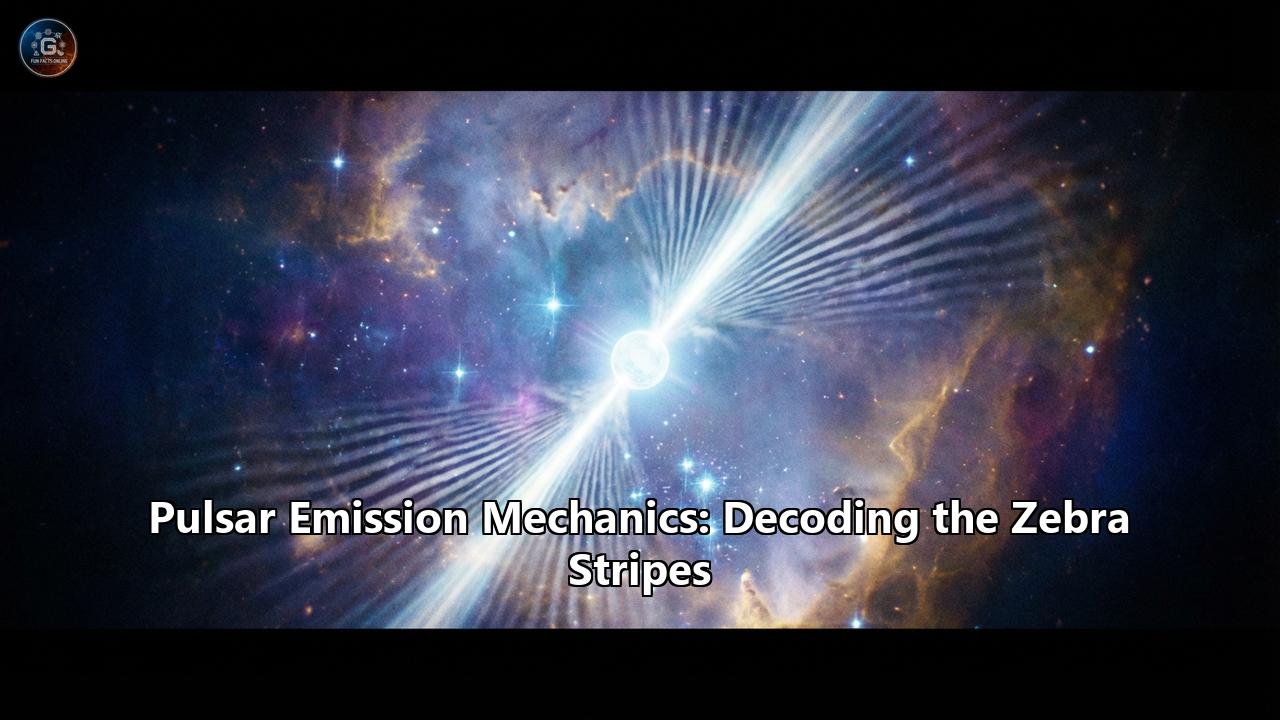
However, the most fascinating object in this celestial graveyard is not the glowing web of expanding gas, but the unimaginably dense, hyperactive corpse hidden at its very center: the Crab Pulsar. For decades, this stellar remnant has served as one of the ultimate physics laboratories in the universe, a place where matter and energy are pushed to absolute extremes. And yet, for the past twenty years, the Crab Pulsar has harbored a baffling secret. Buried within its rhythmic radio flashes is a bizarre, highly structured signal that looks exactly like the stripes of a zebra.
No other pulsar in the known universe exhibits this kind of perfectly spaced, high-contrast banded emission. For two decades, the "zebra stripes" of the Crab Pulsar defied every theoretical model thrown at them. But now, thanks to a stunning breakthrough in theoretical astrophysics, scientists have finally decoded the zebra pattern. The answer lies in a delicate, cosmic tug-of-war between two of the most powerful forces in nature: the bizarre quantum mechanics of relativistic plasma and the spacetime-warping gravity of Albert Einstein’s general relativity.
To truly understand how this stellar barcode is generated, we must take a journey into the heart of a dead star, explore the strange behavior of light in extreme environments, and unravel how a celestial double-slit experiment is currently beaming its results to telescopes on Earth.
The Heartbeat of a Monster: Anatomy of the Crab Pulsar
When a star at least eight times as massive as our Sun exhausts its nuclear fuel, its core can no longer support the crushing weight of its outer layers. The star collapses inward at a significant fraction of the speed of light, triggering a rebound explosion that rips the outer layers of the star apart—a supernova. What remains is the star's core, compressed into a sphere scarcely 20 kilometers (12 miles) across. This is a neutron star, an object so dense that a single sugar-cube-sized amount of its material would weigh over a billion tons on Earth. The extreme gravitational pressure forces electrons and protons to fuse, creating a solid sphere essentially composed of tightly packed neutrons.
But the collapse does more than just amplify density; it also hyper-amplifies the star's rotation and its magnetic field. Just as a figure skater spins faster by pulling their arms in, the collapsing star dramatically increases its spin rate. The Crab Pulsar, born from the supernova of 1054, rotates at a dizzying 30 times per second. Simultaneously, the original star's magnetic field is compressed and intensified to trillions of times the strength of Earth's magnetic field.
This rapidly spinning, hyper-magnetic environment acts as a cosmic dynamo. It tears particles from the surface of the neutron star and whips them around at velocities approaching the speed of light, creating a dense, swirling magnetosphere of electron-positron plasma. As these charged particles are funneled along the magnetic field lines, they emit intense beams of electromagnetic radiation. Because the magnetic axis of the pulsar is not perfectly aligned with its rotational axis, these beams sweep through space like the sweeping light of a lighthouse. If Earth happens to be in the path of the beam, we detect a brief, sharp "pulse" of radiation every time the star spins. Hence the name: pulsar.
Usually, the radio emissions sweeping past us from pulsars are incredibly chaotic. If you were to convert the radio frequencies of a typical pulsar into sound, it would sound like a blast of broad, unorganized static or "white noise". If you visualized it as a rainbow, the spectrum would show a continuous, smeared smear of colors. But the Crab Pulsar has never been an ordinary object, and in 2007, it proved just how strange it could be.
The Discovery of the Zebra Stripes
In 2007, astronomers Tim Hankins and Jean Eilek pointed a high-time-resolution radio telescope at the Crab Pulsar to observe its emissions in unprecedented detail. The Crab Pulsar is unique because, in addition to its Main Pulse (the primary beam of radiation), it features several other components, including a Low-Frequency Interpulse and a highly unusual High-Frequency Interpulse (HFIP). Hankins and Eilek focused their attention on the HFIP, examining the radio waves in the microwave frequency range—between 5 and 30 gigahertz (GHz), similar to the frequencies used by modern microwave ovens and advanced telecommunications.
Astronomers study these pulses using a tool called a dynamic spectrum, a visual graph that plots time on one axis and frequency on the other, with brightness indicating the intensity of the radio waves. For a standard pulsar, the dynamic spectrum of a pulse looks like a solid, featureless blob of energy spreading across all frequencies simultaneously.
When Hankins and Eilek plotted the dynamic spectrum of the Crab Pulsar's High-Frequency Interpulse, they were stunned. Instead of a solid block of static, they saw distinct, perfectly parallel bands of intense emission separated by dark, empty gaps. The emission was heavily structured, proportional, and highly polarized. The visual representation looked exactly like the stripes of a zebra.
What made these zebra stripes so incredibly baffling was the stark contrast between the bright bands and the dark gaps. It wasn't just that the signal faded slightly between the peaks; the signal vanished completely. As the researchers noted, the pattern was "bright band, then nothing, bright band, nothing". If this were a rainbow, it would be as though only a few very specific, pure colors were allowed to exist, separated by bands of absolute, pitch-black darkness.
For over 15 years, this enigma stood as one of the great unsolved mysteries of radio astronomy. Why would a chaotic, violently rotating soup of plasma emit perfectly ordered, discrete frequency bands? Some theorists proposed that the stripes were caused by a "cyclotron maser"—a process where electrons spiraling around magnetic field lines amplify specific frequencies. Others suggested the stripes were standing waves in the pulsar's plasma, or perhaps analogies to the "zebra patterns" sometimes seen in the radio bursts of our own Sun.
However, all of these traditional models eventually broke down. They either required exotic, physically impossible plasma structures that didn't fit standard models of neutron stars, or they completely failed to account for the most striking feature of the stripes: the absolute darkness between them. The high contrast of the zebra pattern demanded a mechanism that could not only generate bright bands of radio waves but also perfectly erase the radio waves at the frequencies in between.
The 2024 Paradigm Shift: Wave Optics and the Plasma Prism
The first major crack in the mystery came in 2024, courtesy of Mikhail Medvedev, a theoretical astrophysicist at the University of Kansas. Medvedev realized that previous attempts to explain the zebra stripes were approaching the problem using the wrong framework of physics. Most earlier models relied on geometrical optics—the idea that light travels in straight lines like bullets or simple rays. In geometrical optics, if an object blocks a light source, it casts a sharp, dark shadow.
But light is not just a particle; it is a wave. And when dealing with waves, geometrical optics is insufficient. You have to use wave optics.
"If you have a screen and an electromagnetic wave passes by, the wave doesn't propagate straight through," Medvedev explained regarding the nature of the phenomenon. "Waves bend around obstacles and interfere with each other, creating a sequence of bright and dim fringes due to constructive and destructive interference".
Medvedev proposed that the pulsar's own magnetosphere—the swirling cloud of electron-positron plasma surrounding the neutron star—was acting as a giant, frequency-dependent "diffraction screen". When the high-frequency radio waves are generated deep within the pulsar's magnetosphere, they don't just shoot straight out into empty space. They have to travel through the dense, highly magnetized plasma.
Because plasma interacts strongly with electromagnetic waves, different frequencies of light are bent, refracted, and diffracted by the plasma in different ways. Medvedev's 2024 mathematical models showed that this diffraction effect could indeed carve the broadband radio emission into discrete, proportional bands. His wave optics model elegantly explained the band spacing, the high polarization, and the constant position angle of the emissions—factors that had tripped up every previous theory. He even proposed that two other mysterious signals observed in the Crab Pulsar, known as High-Frequency Components 1 and 2 (HFC1 and HFC2), were simply reflections of this same diffracted signal bouncing off the magnetosphere.
It was a monumental leap forward, largely solving the fundamental mechanism of the banding. However, one crucial, nagging flaw remained. While Medvedev's 2024 plasma diffraction model could reproduce the stripes, it could not reproduce the observed contrast. The math showed dimming between the bright bands, but the real-world observations from 2007 showed absolute, complete darkness. The plasma alone was not enough to perfectly cancel out the light in the dark gaps. Something was missing from the equation.
The 2026 Breakthrough: The Cosmic Tug-of-War
In March 2026, Medvedev published a refined theory that finally placed the last piece of the puzzle into the board. The missing ingredient, it turned out, was Albert Einstein.
For decades, astronomers studying pulsar emissions had largely ignored the gravitational effects of the neutron star itself, treating the emission process purely as a problem of plasma physics and electromagnetism. But a neutron star is one of the densest objects in the universe. Its gravity is so immense that it severely warps the fabric of spacetime around it. Light traveling near a massive object doesn't travel in a straight line; its path is bent by the curvature of spacetime, a phenomenon known as gravitational lensing.
Medvedev realized that the light escaping the Crab Pulsar was subject to two wildly powerful, yet completely opposing, forces.
On one side is the pulsar's magnetospheric plasma. In the realm of optics, plasma acts as a diverging, or defocusing, lens. It forces light rays to spread outward, pushing them away from each other.
On the other side is the neutron star's extreme gravity. Gravity acts as a converging, or focusing, lens. It pulls the light rays inward, bending them toward the star.
"The combination of a defocusing magnetospheric plasma and a focusing gravity create in-phase and out-of-phase interference bands of radio-wave intensity that appear as the Crab Pulsar's zebra stripes," Medvedev concluded.
This "cosmic tug-of-war" between gravity and plasma alters the geometry of the light's escape route. Because the plasma is pushing the light out while gravity is pulling it in, the light rays are forced into taking multiple, distinct pathways through the warped spacetime to reach an observer on Earth.
"By symmetry, there are at least two such paths for the light," Medvedev explained. And it is the existence of these two nearly identical paths that finally solves the mystery of the absolute darkness between the stripes.
The Natural Interferometer: A Double-Slit Experiment on a Stellar Scale
To understand why two paths of light create high-contrast stripes, we have to look back to one of the most famous physics experiments in history: Thomas Young's double-slit experiment. If you shine a coherent beam of light at a barrier with two tiny slits in it, the light waves passing through the slits spread out and overlap on a screen behind the barrier. Where the peaks of the waves from the left slit meet the peaks of the waves from the right slit, they add together, creating a bright stripe (constructive interference). Where a peak from one slit meets a trough from the other slit, they cancel each other out completely, leaving pure darkness (destructive interference).
By forcing the radio waves to take two nearly identical paths around the neutron star, the combination of gravity and plasma effectively turns the entire Crab Pulsar into a giant, cosmic double-slit experiment.
"When two nearly identical paths bring light to the observer, they form an interferometer," Medvedev noted. "The signals combine. At some frequencies, they reinforce each other (in phase), producing bright bands. At others, they cancel (out of phase), producing darkness. That is the essence of the interference pattern".
This is why the dark gaps are so perfectly black. It is not that the pulsar stops emitting light at those specific frequencies; rather, the light traveling along Path A perfectly cancels out the light traveling along Path B by the time it reaches Earth's telescopes. Because the interference is dictated by the wavelength (frequency) of the light, the constructive and destructive zones alternate mathematically, generating the precisely spaced, highly contrasted "zebra stripes" across the dynamic spectrum.
The inclusion of General Relativity was the masterstroke. The previous plasma-only model was akin to having a single wave diffracting around an obstacle—which causes soft fading. The inclusion of gravity introduced the second distinct pathway, turning the system into a true interferometer, which results in mathematically perfect cancellation and the sharp, high-contrast blackness observed by Hankins and Eilek nearly two decades ago.
Tomography of a Dead Star: Why This Matters
The resolution of the zebra stripe mystery is much more than just tying up a loose end in observational astronomy. The synthesis of wave optics, plasma physics, and general relativity provides astrophysicists with a powerful new tool.
Because the exact spacing and contrast of the zebra stripes depend heavily on the density of the plasma and the strength of the gravitational field, scientists can effectively reverse-engineer the interference pattern to map the unseen environment around the pulsar. In medical science, tomography (like a CT scan) uses waves to map the inside of a human body. Medvedev's model enables "space-resolved tomography of the pulsar magnetosphere". By analyzing the zebra stripes, researchers have already been able to deduce the radial plasma density profile of the Crab Pulsar directly from observational data, finding that the electron density drops off proportionally to the inverse cube of the distance from the star ($n_e \propto r^{-3}$). This provides incredible confirmation for theoretical models of how pulsar magnetospheres are structured.
Furthermore, this represents the first real-world observation where gravitational lensing and plasma de-lensing are acting together in such a delicate balance. It opens a new window to investigate gravity in the "strong-field regime" directly near the surface of a neutron star. While gravitational lensing is routinely observed around supermassive black holes and massive galaxy clusters, witnessing it interact so intimately with dense quantum plasma on a stellar scale is entirely unprecedented.
The discovery also allows astrophysicists to make testable predictions. The mathematical models predict that at much higher frequencies—specifically when the separation between the light paths becomes smaller than the physical size of the pulsar itself—the zebra pattern should fundamentally change its trend. The frequency where this shift occurs is predicted to lie between 42 and 650 GHz. This is well within the observational capabilities of state-of-the-art terrestrial radio telescope arrays like the Atacama Large Millimeter/submillimeter Array (ALMA) and the Submillimeter Array (SMA). Observing this shift would serve as the ultimate confirmation of the gravity-plasma tug-of-war theory and provide precise measurements of the neutron star's physical radius, a holy grail in astrophysics that dictates the equation of state for ultra-dense matter.
Finally, solving the strange emission mechanics of the Crab Pulsar may hold the key to understanding other transient radio phenomena in the deep universe. Fast Radio Bursts (FRBs), for example, are highly energetic, millisecond-duration flashes of radio waves that originate from distant galaxies. Many theorists suspect that highly magnetized neutron stars (magnetars) are the engines behind FRBs. By understanding exactly how extreme gravity and plasma shape the radio emissions of our local Crab Pulsar, astronomers are far better equipped to decode the strange, structured signals arriving from billions of light-years away.
The Symphony of the Cosmos
Science often advances not through the discovery of entirely new forces, but by recognizing how the fundamental forces we already know interact in beautifully unexpected ways. For 20 years, the zebra stripes of the Crab Pulsar were an anomaly, a stubborn glitch in the data that refused to conform to our understanding of the universe.
Yet, by looking at the problem through the dual lenses of Einstein's macroscopic gravity and the microscopic wave mechanics of plasma, the anomaly was transformed into clarity. The absolute darkness between the bright radio bands is not a void, nor is it an absence of energy. It is the invisible signature of space and time bending around a crushed stellar core, forcing light waves to perfectly erase one another in a cosmic symphony of destructive interference.
Nearly a thousand years ago, ancient stargazers watched a star die in a brilliant flash of light. Today, from the heart of that ancient debris, the ghost of that star is still whispering to us, utilizing the very fabric of spacetime to send a perfectly striped signal across the void. And finally, we have learned how to read it.
Reference:
- https://scitechdaily.com/scientists-finally-crack-the-mystery-of-the-crab-pulsars-zebra-stripes-after-20-years/
- https://www.sciencealert.com/a-strange-signal-beamed-at-earth-from-a-dead-star-can-finally-be-explained
- https://www.researchgate.net/publication/401314964_Theory_of_striped_dynamic_spectra_of_the_Crab_pulsar_high-frequency_interpulse
- https://www.universetoday.com/articles/the-strange-pulsar-at-the-center-of-the-crab-nebula
- https://arxiv.org/abs/2410.12992
- https://arxiv.org/abs/1604.02472
- https://news.ku.edu/news/article/study-reveals-cosmic-tug-of-war-behind-the-crab-pulsars-zebra-stripes