
The wind that sweeps across the Tek Tek Mountains of southeastern Anatolia is an ancient one. It carries the dust of millennia, whispering secrets of a time before writing, before the wheel, and before the first cities rose from the Mesopotamian plains. For decades, the world looked to Göbekli Tepe as the "zero point" of history—the enigmatic temple on the hill that rewrote the textbooks. But just 46 kilometers to the east, buried beneath a layer of limestone rubble and the silence of ten thousand years, something else was waiting. Something more intimate, more human, and perhaps, more revolutionary.
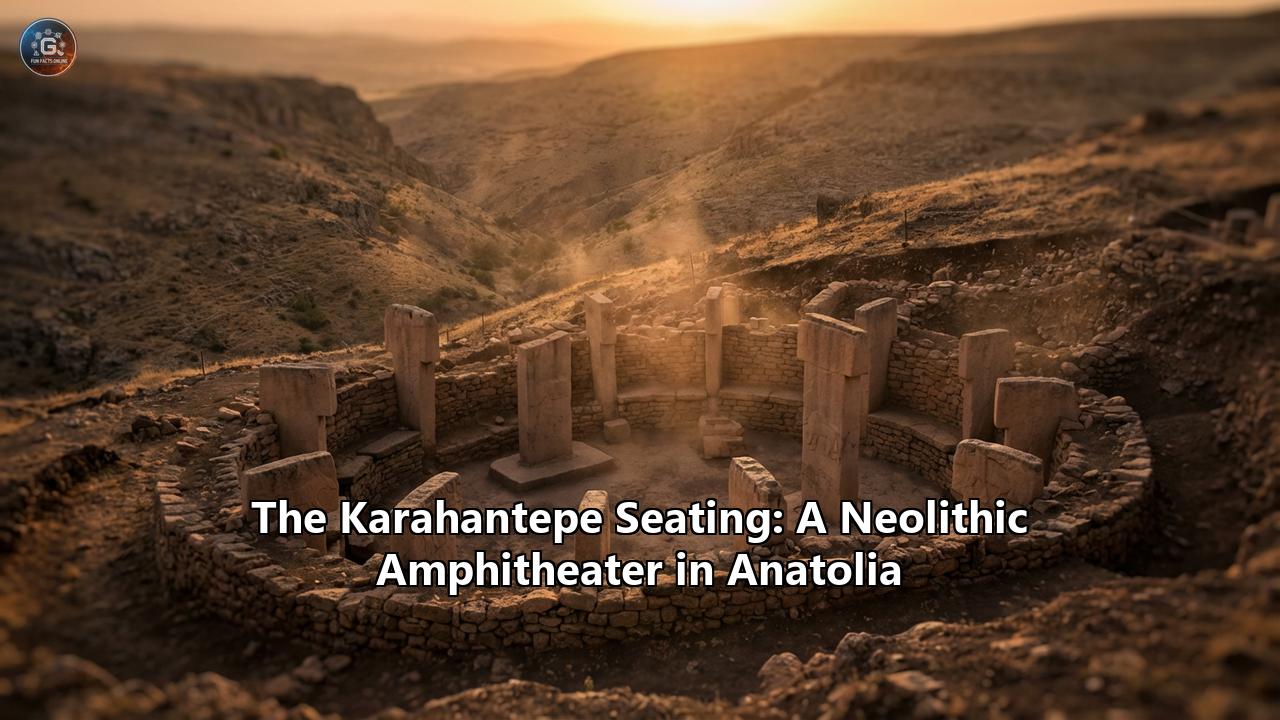
In late 2025, the archaeologists of the Taş Tepeler project, led by Professor Necmi Karul, brushed away the final layers of earth to reveal a structure that defied the established logic of the Neolithic world. It was not just a temple. It was not a house. It was a gathering place—a 17-meter-wide circular enclosure carved directly into the living bedrock, ringed by three tiers of wide, stone benches. It was, in every recognizable sense, an amphitheater.
This is the story of the Karahantepe Seating—a discovery that has shifted our gaze from the gods of the sky to the community of men and women who first sat together in the dark, watching the dawn of a new era.
Part I: The Theater of the Stone Age
The Impossible Structure
To understand the magnitude of the "Amphitheater" discovery, one must first unlearn the image of the "primitive" Stone Age. The people who built Karahantepe lived around 9400 BCE, in the Pre-Pottery Neolithic B (PPNB) period. They were hunter-gatherers, teetering on the brink of domestication but not yet fully farmers. Their tools were flint and obsidian; their clothes were hides and furs. And yet, their architectural vision was monumental.
The newly uncovered structure, designated by the excavation team as the "Public Building" or "Amphitheater," is a marvel of subtraction. Unlike the pyramids or Stonehenge, which were built up, Karahantepe was built down. The builders identified a limestone plateau and, with nothing but stone tools, hacked away the bedrock to create a negative space.
The structure measures approximately 17 meters in diameter. Its most striking feature—the one that earned it its nickname—is the seating. On one side of the circular enclosure, the bedrock has been carved into three wide, tiered benches. These are not rough ledges; they are deliberate, uniform platforms, capable of seating dozens, perhaps hundreds, of people.
Standing in the center of the floor, looking up at those empty stone bleachers, the modern observer is struck by a chilling realization: this space was designed for an audience.
Acoustics of the Ancients
The design of the amphitheater implies function. In the classical world, theaters were built for projection—to carry the voice of an actor or the note of a lyre to the furthest row. At Karahantepe, the physics are similar. The sunken nature of the structure, carved deep into the rock, creates a natural acoustic container.
Archaeologists have speculated that this space was not merely for passive observation but for active participation. The tiers suggest hierarchy or perhaps just organized community. Elders, initiates, or specific clans may have had designated spots. The focal point, opposite the seating, likely held a speaker, a shaman, or a central totem.
This architectural choice—to fix a group of people in place, facing a common center—is a profound social technology. It turns a "crowd" into an "assembly." It transforms scattered individuals into a unified "public." In the flickering torchlight of the Neolithic night, the people sitting on those benches were not just watching a ritual; they were being forged into a society.
The Focal Point
What were they watching? Opposite the tiered benches, the bedrock floor is not empty. Excavations have revealed sockets for standing pillars and, most startlingly, statues. Unlike the animal-dominated imagery of Göbekli Tepe, the focal points here are undeniably human.
In the center of the amphitheater-like space, evidence suggests the presence of a prominent sculpture or a "master" pillar. While many pillars were ritually decapitated—their T-shaped heads knocked off and buried—the arrangement remains clear. The gaze of the audience was directed toward a specific point, orchestrating a shared visual experience. This was a stage, managed and curated to convey a specific message to the tribe.
Part II: The Human Turn
Beyond the Zoo
For years, the "Göbekli Tepe Culture" was defined by its menagerie. The T-shaped pillars of the older site are crawling with scorpions, vultures, boars, foxes, and lions. It is a world of beast-totems, where humans are abstract, faceless T-shapes, small and insignificant against the power of nature.
Karahantepe flips this script. Professor Karul has termed this the "Human Turn."
As you walk from the older layers of the region to the strata of Karahantepe, the animals recede, and the human face emerges. The walls of the amphitheater and the surrounding structures are embedded with stone heads—portraits of men with distinct features, strong jaws, and deep-set eyes. They are not stylized masks; they are individuals.
The Ribbed Man
The most spectacular example of this human-centric focus was found near the amphitheater: the "Ribbed Man" (or "Seated Man"). Uncovered in 2023 and fully analyzed in the years following, this statue is a masterpiece of Neolithic art. Standing—or rather, sitting—2.3 meters tall, the figure is carved from a single block of limestone.
He sits on a stone bench, much like the ones in the amphitheater. His hands are clasped in his lap, holding his phallus—a gesture that likely symbolizes lineage, potency, or life-force rather than mere sexuality. His ribs are carved with startling anatomical precision, a "living corpse" aesthetic that haunts many of the site's depictions.
But it is his face that captivates. He has a mouth, eyes, and a nose. He is looking at us. For the first time in monumental history, the gods (or ancestors) are not distant spirits or terrifying beasts; they are us. The people sitting in the amphitheater were looking at a mirror image of themselves, elevated to stone immortality.
The Leopard Carrier
Another key figure in this "Human Turn" is the "Leopard Carrier." This statue depicts a standing human figure with a live leopard draped across their shoulders. The animal is not attacking; it is being carried, perhaps as a pet, a sacrifice, or a totem. The human is in control.
This signifies a massive psychological shift. At Göbekli Tepe, the human is surrounded by threatening nature. At Karahantepe, the human has dominated nature. The leopard is a burden, a heavy cloak worn by the man. This imagery aligns perfectly with the transition to a sedentary lifestyle. We were no longer just running from the wild; we were beginning to tame it.
Part III: The Daily Life of the Builders
The Honeycomb Village
One of the most persistent myths about the Taş Tepeler sites was that they were purely "temples"—pilgrimage sites with no resident population. The 2024-2025 excavations at Karahantepe shattered this illusion.
Surrounding the monumental ritual areas, archaeologists unearthed a sprawling neighborhood. It is a "honeycomb" of subterranean dwellings. More than 30 of these huts have been identified, carved into the bedrock in a dense, organic cluster.
These homes were small, typically 3 to 6 meters in diameter. They were not grand. They were functional, intimate spaces. Descent was likely through the roof, a ladder leading down into a cool, rock-cut chamber.
Living in the Rock
Inside these huts, the ghosts of daily life linger. The floors are smoothed limestone. Hearths—blackened by the fires of 11,000 years ago—mark the center of domestic activity. Small alcoves carved into the walls served as cupboards for stone tools, dried herbs, or sacred tokens.
The proximity of these houses to the amphitheater is telling. The separation between "church" and "state," or "sacred" and "profane," did not exist here. You slept in a hole in the rock, and you walked fifty meters to sit on a bench in a larger hole in the rock to commune with your ancestors. The ritual was woven into the fabric of the everyday.
The Menu of the Pre-Pottery Neolithic
What did the builders of the amphitheater eat before they took their seats? The flotation samples—soil washed in water to separate organic material—have given us a menu.
They were hunters, certainly. Gazelle bones are ubiquitous, cracked for marrow. But they were also processing plants on an industrial scale. Grinding stones found in the huts show wear patterns from wild barley, wheat, and legumes. They had not yet fully domesticated these crops, but they were managing them—harvesting them in the wild and bringing them back to the village to process.
We can imagine the smell of roasting gazelle and the rhythmic sound of stone-on-stone grinding echoing through the honeycomb village as the sun set and the torches were lit for the gathering in the amphitheater.
Part IV: The Pillar Shrine and the Solstice
Structure AB: The Pillar Pool
Adjacent to the great central complex lies one of the most enigmatic and disturbing structures in the ancient world: Structure AB, often called the "Pillar Shrine" or "Pillar Pool."
This is a smaller, rectangular chamber, about 7 by 6 meters. It is accessible by a winding, rock-cut staircase. But the floor is not for walking. It is carved with eleven phallus-shaped pillars, protruding from the bedrock like stalagmites. They are smooth, varying in height, and arranged in a way that makes movement through the room difficult.
Overlooking this "pool" of pillars is a single, disembodied head. Carved into the rock wall, a human face with a serpentine neck stares out into the room. It is a guardian, a witness, or perhaps a deity of the underworld.
The Fluid Ritual
A serpentine channel carved into the bedrock leads into this chamber, suggesting that liquid was a key part of the ritual. Was it water? Blood? A fermented brew?
The "pool" may have been literally filled. Archaeologists theorize that this room was used for initiation or fertility rituals. The experience of descending the stairs, wading through liquid among the stone phalluses, under the gaze of the stone head, would have been a visceral, sensory overload—a "rebirth" from the womb of the earth.
The Winter Solstice Alignment
In December 2023 and confirmed in subsequent years, researchers Hugh Newman and JJ Ainsworth, working with the excavation team, documented a stunning astronomical alignment in this chamber.
On the morning of the Winter Solstice—the shortest day of the year, the turning point of the sun—a beam of sunlight pierces through a "porthole" stone and strikes the carved human head on the wall. For a few fleeting minutes, the face is illuminated in the darkness, "awakened" by the returning sun.
This alignment connects the Karahantepe community to the cosmos. It proves that the "Amphitheater" builders were not just gazing at each other; they were tracking the stars. The assembly likely gathered to witness this moment—the assurance that the sun would return, that life would continue.
Part V: The Earliest Storytelling
The 3D Narrative
If the amphitheater provided the stage, we now have evidence of the scripts. In 2025, a discovery was announced that Archaeology Magazine hailed as the "Earliest 3D Story."
Found within a domestic structure, it was a collection of small stone figures: a fox, a vulture, and a wild boar. But they were not scattered toys. They were found arranged on a stone plate, set within a larger vessel, sealed with a lid.
The intentionality is undeniable. The fox, the vulture, and the boar were characters in a scene. The Neolithic person who placed them there was freezing a myth in stone. Was it a fable about the trickster fox and the scavenger vulture? A clan totem story? We don't know the plot, but we know the medium. This was a tableau—a physical representation of an oral tradition, perhaps the very stories that were told to the audience sitting on the amphitheater benches.
Part VI: The Stone Hills Network
Taş Tepeler: The 12 Hills
Karahantepe is not alone. It is the crown jewel of the Taş Tepeler (Stone Hills) project, a massive archaeological undertaking covering 12 distinct sites in the Şanlıurfa region.
- Göbekli Tepe: The elder sibling, the great cathedral of animal spirits.
- Sayburç: A site discovered under a modern village, featuring a stunning relief of a man holding his phallus while flanked by leopards—a scene of narrative violence and power.
- Sefertepe: A smaller site yielding beads and jewelry, suggesting trade and craft specialization.
- Harbetsuvan: A fortress-like hill with similar T-pillars.
This was not a lonely outpost. This was a network. A civilization. The "Amphitheater" at Karahantepe may have been the "parliament" or the "regional capital" where these scattered groups converged. The seating capacity suggests a gathering larger than a single village. Did the clans of Göbekli Tepe and Sayburç travel here for the solstice? Did they sit on the tiered benches to resolve disputes or arrange marriages?
Part VII: Why They Buried It
The Great Backfill
Perhaps the most haunting mystery of Karahantepe is its end. Around 8000 BCE, after using these structures for over a millennium, the people did something baffling. They didn't just walk away. They buried them.
The amphitheater, the pillar pool, the honeycomb huts—they were all deliberately filled with rubble, soil, and stone chips. This was not an act of destruction; the statues were not smashed (mostly). It was an act of preservation, or perhaps a ritual closure.
To fill the Amphitheater would have taken immense labor. Thousands of baskets of earth, carried by hand, dumped into the sacred space until the benches were covered, the statues drowned in dirt, and the bedrock floor sealed.
Why?
Some theories suggest a change in belief systems. As agriculture took hold, the old "cult of the hunt" and the subterranean rituals became obsolete. Others suggest a desire to protect the sacred from desecration. Or perhaps, the act of burying was the final ritual itself—a way to return the stone to the earth from which it was carved.
Because of this burial, the Karahantepe Seating was preserved in pristine condition, waiting for us to uncover it.
Conclusion: The First Assembly
The discovery of the Karahantepe Amphitheater forces us to rewrite the story of civilization. We used to think that cities came first, then temples, then complex society. Karahantepe proves that community came first.
Before they had harvested the first wheat field, before they had built the first city wall, human beings felt the need to gather. They felt the need to carve a space out of the hard rock where they could sit, shoulder to shoulder, and look at the same thing together.
They built a theater for their beliefs. They built a stage for their stories. And in the face of the "Ribbed Man" and the carved heads of the amphitheater, we see the moment humanity stopped looking at the animals and started looking at itself.
As you stand on the rim of the excavation today, looking down at those empty benches, you can almost hear the echo of that first audience. They are gone, but the seat they carved for us remains. The show, it seems, has only just begun.
Reference:
- https://www.ancient-origins.net/news-history-archaeology/neolithic-amphitheater-karahantepe-00102343
- https://www.youtube.com/watch?app=desktop&v=hkxafdxRdD0
- https://www.anatolianarchaeology.net/an-amphitheater-like-neolithic-structure-has-been-uncovered-at-karahantepe-in-southeastern-turkiye/
- https://arkeonews.net/a-11000-year-old-neolithic-amphitheater-discovered-at-karahantepe/
- https://en.wikipedia.org/wiki/G%C3%B6bekli_Tepe
- https://bianet.org/haber/neolithic-amphitheater-uncovered-at-karahantepe-archaeological-site-313926
- https://www.hurriyetdailynews.com/amphitheater-like-neolithic-structure-unearthed-at-karahantepe-216221
- https://arkeonews.net/archaeologists-unearth-30-neolithic-homes-at-karahantepe-revealing-daily-life-and-diet-of-early-settlers/
- https://www.anatolianarchaeology.net/daily-life-unearthed-at-karahantepe-over-30-neolithic-dwellings-discovered-in-southeastern-turkiye/
- https://www.hurriyetdailynews.com/karahantepe-project-probes-neolithic-eating-habits-214718
- https://www.thearchaeologist.org/blog/stone-beasts-reveal-prehistoric-storytelling-at-karahantepe
- https://en.wikipedia.org/wiki/Karahan_Tepe
- https://ccrs.ku.dk/calendar/2024/karahantepe-a-new-pre-pottery-neolithic-site-in-anlurfa-turkey/