
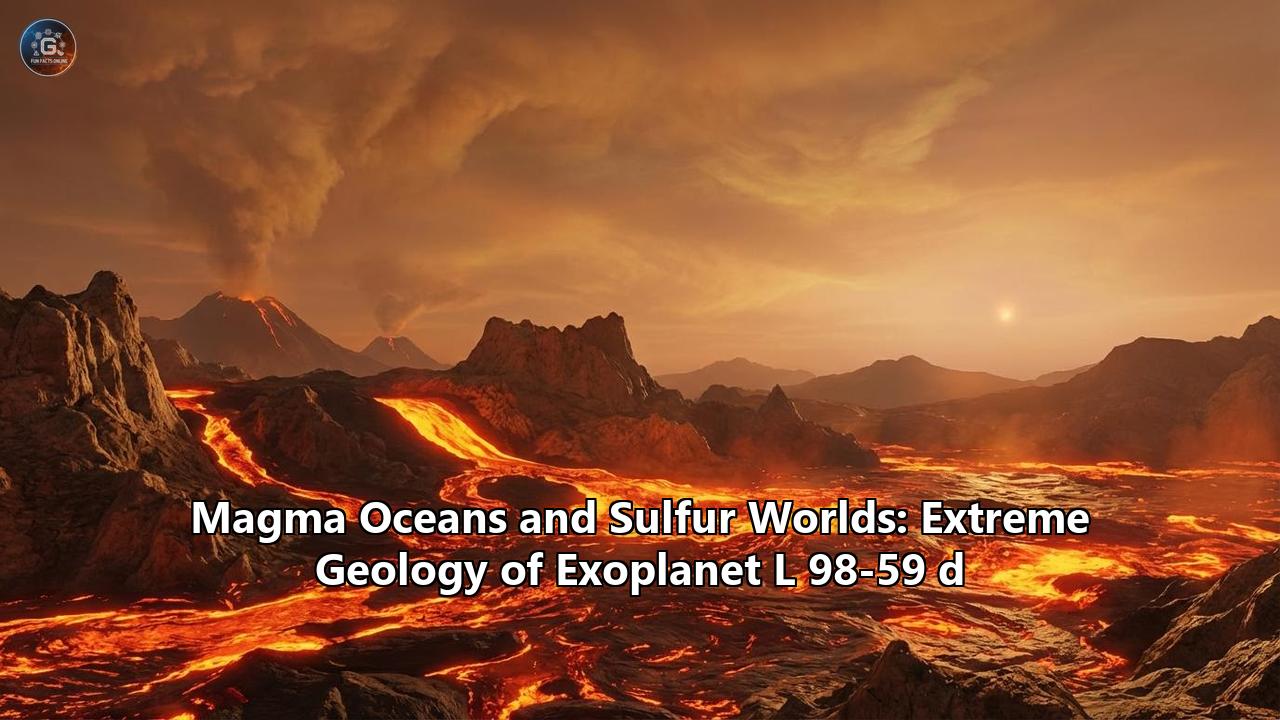
Imagine standing on the precipice of a world where the ground beneath your feet is not solid rock, but a churning, glowing expanse of molten silicate. Above you, a thick, hazy atmosphere hangs heavy, painted in sickly hues of yellow and brown, completely saturated with the pungent, unmistakable stench of rotten eggs. The sky is dominated by the looming presence of a crimson sun, casting a relentless, bloody glare across a landscape of endless lava.
This is not a vision of a mythological underworld, nor is it a scene from a science fiction novel. It is a very real, newly characterized exoplanet located 34.5 light-years away in the southern constellation of Volans. Its name is L 98-59 d, and its recent observations have completely upended our understanding of planetary science, forcing astronomers to rewrite the rulebooks on how small worlds form and evolve.
For decades, the planetary bodies we have discovered outside our solar system—exoplanets—have largely been forced into a handful of neat, predefined categories. But the universe, in its infinite creativity, rarely conforms to human expectations. Through the combined power of the James Webb Space Telescope (JWST), advanced ground-based observatories, and cutting-edge computer simulations, a multinational team of scientists led by the University of Oxford has revealed that L 98-59 d fits none of our established molds. Instead, it is the founding member of an entirely new class of extraterrestrial world: the volatile-rich, molten super-Earth.
This comprehensive exploration will take you on a journey to L 98-59 d. We will dive deep into its scorching, thousands-of-kilometers-deep magma oceans, decode the complex photochemistry of its sulfur-choked atmosphere, trace its five-billion-year evolutionary history, and discover why this extreme, hellish world is one of the most important astronomical discoveries of the decade.
The L 98-59 System: A Cosmic Family Portrait
To understand the bizarre nature of L 98-59 d, we must first look at the neighborhood in which it resides. The planetary system is anchored by the host star, L 98-59 (also known in astronomical catalogs as TOI-175 and TIC 307210830). This star is an M-dwarf—a red dwarf star that is significantly smaller, cooler, and dimmer than our own Sun, possessing roughly one-third of the Sun's mass. Red dwarfs are the most common type of star in the Milky Way, making the planetary systems they host incredibly important for understanding the general population of planets in our galaxy.
Discovered initially by NASA’s Transiting Exoplanet Survey Satellite (TESS) in 2019, the L 98-59 system is a marvel of compact orbital architecture. It is the second-closest transiting multi-planet system to our Sun, making it a prime target for follow-up observations. The system boasts at least five known planets, each with its own unique characteristics:
- L 98-59 b: The innermost planet, completing an orbit in a blistering 2.25 days. It is a tiny, rocky world, measuring about 0.83 times the radius of Earth. Because of its tight, slightly eccentric orbit, astronomers predict it experiences immense tidal heating—similar to Jupiter's moon Io—potentially driving rampant volcanic activity across its surface.
- L 98-59 c: A slightly larger world, about 1.33 times Earth's radius, orbiting every 3.69 days.
- L 98-59 d: The star of our show. It is a super-Earth with a radius approximately 1.58 to 1.63 times that of Earth, orbiting every 7.45 days. Because of its proximity to the star, it is blasted with roughly four times the radiant energy that Earth receives from the Sun.
- L 98-59 e: An outer, non-transiting planet confirmed by radial velocity measurements, taking 12.83 days to orbit the star.
- L 98-59 f: A fascinating non-transiting super-Earth orbiting in 23.06 days, placing it squarely within the star's habitable zone, where liquid water could theoretically exist on a planetary surface.
While the prospect of a habitable zone planet in this system is tantalizing, it is the extreme, hostile environment of the third planet, L 98-59 d, that has captured the undivided attention of the global astronomical community.
The Identity Crisis of Super-Earths
Before the revelation of L 98-59 d's true nature, astronomers faced a persistent mystery regarding planets of its size. In the study of exoplanets, there is a well-documented phenomenon known as the "radius valley" or "Fulton gap." This is a drop-off in the occurrence of planets that are between 1.5 and 2 times the size of Earth. Planets tend to be either smaller, dense, and rocky (like Earth and Venus), or larger, gaseous, and enshrouded in thick atmospheres (like Neptune, hence the term "sub-Neptunes").
Super-Earths sitting right on the boundary, like L 98-59 d, have always presented an identity crisis. When astronomers calculated the mass and radius of L 98-59 d, they found that it possessed a surprisingly low density for a planet of its size. Historically, a low-density super-Earth would be forced into one of two prevailing theoretical categories:
- The Gas-Dwarf: A rocky core surrounded by a massive, puffy, primordial envelope of light gases like hydrogen and helium.
- The Water-World (or Hycean World): A planet composed of a vast amount of water, either in the form of deep, planet-wide liquid oceans or high-pressure exotic ice phases, sitting beneath a steam or hydrogen atmosphere.
For years, scientists debated which of these two models fit L 98-59 d. A gas-dwarf model struggled to explain how the planet could hold onto a primordial hydrogen envelope for billions of years while being constantly bombarded by intense X-ray and ultraviolet (UV) radiation from its host red dwarf. Red dwarfs are notorious for their violent stellar flares, which excel at stripping the atmospheres off closely orbiting planets. Conversely, the water-world model didn't quite match the spectral data beginning to trickle in from advanced telescopes.
The mystery required a technological leap to solve. It required the sharpest eyes humanity has ever built.
Peering Through the Cosmos: The Spectroscopic Revolution
To truly understand what L 98-59 d is made of, astronomers had to look far beyond simple images. They had to capture the planet's chemical fingerprint through a technique known as transmission spectroscopy.
When L 98-59 d transits—or passes directly in front of—its host star from our point of view, a tiny fraction of the star's light filters through the planet's atmosphere before traveling 34.5 light-years to reach our telescopes. Different chemical molecules in the planet's atmosphere absorb specific wavelengths of this starlight. By analyzing the spectrum of the light that makes it to Earth, scientists can look for the "missing" wavelengths—dark bands in the spectrum that serve as incontrovertible proof of specific gases.
The JWST and Ground-Based Triumphs
The James Webb Space Telescope (JWST), utilizing its NIRSpec (Near-Infrared Spectrograph) instrument, was pointed at L 98-59 d. The data returned was shocking. Instead of the flat spectrum expected of a water-logged world, or the simple hydrogen signature of a gas dwarf, JWST detected large absorption features spanning between 2.8 and 5.1 microns.
These features indicated a high mean molecular weight atmosphere, heavily enriched with sulfur-bearing compounds—specifically sulfur dioxide (SO2) and hydrogen sulfide (H2S). Hydrogen sulfide is the exact chemical responsible for the pungent odor of rotten eggs and volcanic sulfur vents on Earth.
Furthermore, this space-based observation was masterfully complemented by high-resolution, ground-based astronomy. Using the IGRINS spectrograph on the 8-meter Gemini-South telescope in Chile, astronomers achieved a monumental milestone: the first ground-based inference of a molecular species (hydrogen sulfide) in the atmosphere of a super-Earth. By utilizing high-resolution cross-correlation techniques, they were able to separate the incredibly faint planetary signal from the overpowering glare of the host star and the interference of Earth's own atmosphere.
The data was undeniable. L 98-59 d was not a water-world. It was not a simple gas-dwarf. It was a world choking on sulfur. But where was all this sulfur coming from, and how was the planet holding onto it? The answer lay not in the sky, but deep underground.
A Journey to the Center: The Physics of a Global Magma Ocean
In a landmark study published in Nature Astronomy in March 2026, a research team led by Dr. Harrison Nicholls of the University of Oxford, alongside colleagues from the University of Groningen, the University of Leeds, and ETH Zurich, finally cracked the code of L 98-59 d.
By feeding the telescopic data into highly advanced computer simulations, the team reconstructed the interior physics of the planet. They discovered that L 98-59 d harbors a permanent, global magma ocean.
On Earth, magma is generally confined to localized pockets within the crust and upper mantle, occasionally bursting to the surface through volcanic eruptions. But on L 98-59 d, the reality is far more extreme. The entire mantle of the planet consists of molten silicate—a churning, liquid rock reservoir that extends thousands of kilometers deep into the planet's interior.
Why is it molten?
The permanent molten state of L 98-59 d is driven by its birth conditions and its current environment. During planetary formation, the immense kinetic energy of accreting material and the decay of radioactive isotopes generate enough heat to melt a young planet completely. Earth itself went through a "magma ocean" phase billions of years ago before cooling down and forming a solid crust.
However, L 98-59 d never cooled down. Orbiting closely to its star, it is subjected to intense stellar irradiation (four times what Earth receives) and potentially immense internal pressures and tidal forces. The thick atmosphere acts as an ultimate thermal blanket, trapping the primordial and radiogenic heat inside, preventing the silicate mantle from ever solidifying into rock.
This creates a world where the "surface" is a fluid, incandescent boundary between a crushing, sulfurous atmosphere and a bottomless sea of liquid lava.
The Great Volatile Vault: Solving the Atmospheric Mystery
The discovery of the global magma ocean was the missing puzzle piece needed to explain the planet's bizarre atmosphere and its surprisingly low density.
Magma is an incredible solvent. Just as water can dissolve salt, molten silicate can dissolve immense quantities of gases—known as volatiles. The computer models run by Dr. Nicholls and his team revealed that this thousands-of-kilometers-deep ocean of lava acts as a gigantic planetary sponge.
For a planet sitting so close to an M-dwarf star, atmospheric loss is a constant threat. The relentless bombardment of X-rays and extreme ultraviolet radiation from the star should, over billions of years, strip away any primordial hydrogen atmosphere, leaving behind a barren, high-density rocky core. This is a fate that has likely befallen many of the small, dense exoplanets we have discovered.
But L 98-59 d survived this cosmic erosion. How? Through the buffering power of its magma ocean.
As the host star stripped away the outer layers of the planet's atmosphere over geologic time scales, the magma ocean responded by outgassing. The immense reserves of hydrogen and heavy sulfur trapped deep within the molten interior slowly bubbled up to the surface, continuously replenishing the atmosphere. This dynamic chemical exchange between the molten interior and the atmosphere allowed L 98-59 d to maintain a thick, hydrogen-rich envelope laden with sulfur compounds for nearly five billion years.
Without the magma ocean, the sulfur and hydrogen would have been lost to the void of space long ago. Instead, the planet's deep interior effectively armed it with a massive, internal reservoir of volatile gases, continuously feeding the atmosphere and giving the planet its unusually low bulk density today.
An Atmosphere of Hellfire: The Chemistry of the Skies
If you could survive the crushing pressures, the searing heat, and the lack of oxygen, taking a breath on L 98-59 d would be a profoundly unpleasant experience. The atmosphere is an alien chemical laboratory driven by the violent radiation of its star.
The primary background of the atmosphere is likely composed of hydrogen, making it chemically reducing. But it is the trace gases that define the planet's unique signature. The magma ocean outgasses immense amounts of sulfur into the sky.
Once in the upper atmosphere, these sulfur compounds are subjected to intense ultraviolet (UV) light from the red dwarf host. This UV radiation acts as a catalyst, breaking molecular bonds and triggering a cascade of complex photochemical reactions.
- Hydrogen Sulfide (H2S): As confirmed by both JWST and the Gemini-South telescope, H2S is highly prevalent. This molecule is produced in a state of chemical disequilibrium, constantly replenished by the volcanic outgassing from the molten surface below.
- Sulfur Dioxide (SO2): The JWST observations also hint at the strong presence of SO2, generated through in-situ photochemical production. As UV light breaks apart other molecules, free atoms interact with sulfur to create this heavy, toxic gas.
The presence of these heavy sulfur molecules in a hydrogen background creates a high-molar-mass atmosphere. This dense, smoggy sky likely forms thick hazes that scatter light, painting the planet in bizarre, murky colors and contributing to the greenhouse effect that keeps the ocean of lava below from freezing.
Reconstructing 5 Billion Years of History
One of the most remarkable aspects of the research published in Nature Astronomy is the temporal scope of the study. Dr. Nicholls and his team did not just take a snapshot of L 98-59 d as it exists today; they built a time machine.
Using their coupled atmosphere-interior modeling framework, they traced the evolutionary pathway of the planet back to its birth. They found that for the planet to look the way it does today, it must have formed with a massive initial volatile budget. Specifically, early in its life, the planet's mass had to consist of more than 1.8% sulfur and hydrogen by weight.
To put that into perspective, the Earth is relatively depleted in volatiles. Our oceans, which seem so vast to us, make up only about 0.02% of the Earth's total mass. L 98-59 d was born with a staggering abundance of these light elements and volatile compounds.
Over five billion years, the planet underwent a violent but sustained evolution. It survived the chaotic, highly active youth of its red dwarf star. While other planets may have had their atmospheres completely blown away (crossing what astronomers call the "cosmic shoreline" of atmospheric retention), L 98-59 d held on. The models explicitly proved that a large initial volatile budget, locked away safely in a molten mantle, is the ultimate determinant of a planet's ability to retain its atmosphere over stellar lifespans.
Breaking the Mold: A New Taxonomy of Exoplanets
"This discovery suggests that the categories astronomers currently use to describe small planets may be too simple," stated Dr. Harrison Nicholls. "While this molten planet is unlikely to support life, it reflects the wide diversity of the worlds which exist beyond the Solar System."
For years, the scientific community relied on the gas-dwarf vs. water-world dichotomy to explain low-density super-Earths. L 98-59 d shatters this binary thinking. It proves the existence of a third path: the volatile-rich molten world.
This finding has massive implications for exoplanet demographics. L 98-59 d is likely not a freak anomaly, but rather the first recognized member of a much broader population of gas-rich, sulfurous exoplanets that sustain long-lived magma oceans. When we look out at the galaxy and see thousands of low-density super-Earths discovered by the Kepler and TESS missions, we must now ask ourselves: how many of them are actually hellish, glowing worlds of liquid rock and rotten-egg skies?
This paradigm shift invites a much more nuanced taxonomy of small exoplanets. It forces researchers to consider the interior state of the planet—specifically whether its mantle is solid or molten—as a primary driver of its observable atmospheric characteristics.
The Search for Habitability and the "Cosmic Shoreline"
When discussing exoplanets, the inevitable question always arises: Could it host life?
In the case of L 98-59 d, the answer is an unequivocal no. A planet with no solid surface, an ocean of lava thousands of kilometers deep, scorching temperatures, and an atmosphere composed of toxic sulfur dioxide and hydrogen sulfide is fundamentally incompatible with biology as we know it.
However, L 98-59 d is paradoxically one of the most important planets for the study of habitability.
In astrobiology, there is a concept known as the "cosmic shoreline." It is a statistical boundary that separates planets capable of retaining an atmosphere from those that have been stripped bare into dead, airless rocks. Understanding exactly where this shoreline lies, and what physical mechanisms allow a planet to stay on the "safe" side of it, is crucial for predicting which planets in the galaxy might actually be habitable.
By demonstrating that a magma ocean can act as a long-term reservoir that protects and buffers an atmosphere against stellar erosion, L 98-59 d provides a masterclass in atmospheric retention. It teaches us the complex interplay between a planet's deep interior and its outer envelope.
Furthermore, within the very same planetary system, we have L 98-59 f, orbiting comfortably in the habitable zone. By studying how the inner planets like b, c, and d have evolved and interacted with the star's radiation, scientists can build highly accurate models to predict the environment of planet f. If L 98-59 d can hold onto an atmosphere in the face of blistering heat and radiation, it bolsters the hope that the temperate planet f might also have retained a stable, potentially life-supporting atmosphere.
The Future of Exoplanet Exploration
The story of L 98-59 d is a testament to the golden age of astronomy we are currently living in. The synergy between space-based observatories like TESS and JWST, and ground-based titans like the Gemini Observatory and the HARPS/ESPRESSO spectrographs, has allowed us to turn points of light into vividly realized geological worlds.
But this is only the beginning. The confirmation of this new class of molten, sulfurous worlds opens the floodgates for future exploration.
- Further JWST Cycles: As JWST continues its mission, more observation time will inevitably be dedicated to the L 98-59 system. Deeper spectroscopic sweeps could map the atmospheric hazes, pinpoint the exact temperature gradient of the skies, and search for even rarer isotopic signatures.
- The Ariel Mission: The European Space Agency's (ESA) upcoming Ariel mission, dedicated purely to the chemical census of exoplanet atmospheres, will be perfectly positioned to search for other sulfur-rich magma worlds. By surveying hundreds of targets, Ariel will determine just how common planets like L 98-59 d truly are.
- PLATO: Another upcoming ESA mission, PLATO (Planetary Transits and Oscillations of stars), will hunt for rocky exoplanets and characterize their host stars with unprecedented precision, helping us find more compact multi-planet systems that might harbor molten oddities.
The discovery of L 98-59 d proves that our galaxy is far more creative than our theoretical models. Every time we build a larger mirror, a more sensitive spectrograph, or a faster supercomputer, the universe rewards us with something wonderfully unexpected.
In the grand tapestry of the cosmos, L 98-59 d stands as a glowing, sulfurous jewel. It is a hostile, terrifying place, reeking of rotten eggs and awash in a sea of liquid fire. Yet, in its extreme nature, it has gifted humanity a profound new understanding of planetary physics. It reminds us that to truly understand the heavens, we must be willing to abandon our preconceived notions and let the data guide us into the unknown. The categories of the past are no longer sufficient. We have crossed the threshold into a universe of boundless, terrifying, and beautiful diversity. And as we gaze out at the stars, guided by the sulfurous light of L 98-59 d, we are left to wonder, alongside the astronomers who discovered its true nature: what other impossible worlds are waiting in the dark to be uncovered?
Reference:
- https://www.sci.news/astronomy/sulfur-rich-magma-super-earth-14624.html
- https://en.meteorologiaenred.com/They-discover-a-new-type-of-planet-with-oceans-of-magma-and-sulfur.html
- https://www.space.com/astronomy/exoplanets/astronomers-discover-a-new-type-of-planet-that-probably-smells-like-rotten-eggs
- https://www.physics.ox.ac.uk/news/scientists-reveal-new-class-molten-planet
- https://arxiv.org/abs/2507.02656
- https://www.sciencedaily.com/releases/2026/03/260317190802.htm
- https://astrobiology.com/2025/07/detailed-architecture-of-the-l-98-59-system-and-confirmation-of-a-fifth-planet-in-the-habitable-zone.html
- https://www.researchgate.net/publication/383495228_Hints_of_a_sulfur-rich_atmosphere_around_the_16_R_oplus_Super-Earth_L98-59_d_from_JWST_NIRSpec_G395H_transmission_spectroscopy
- https://arxiv.org/pdf/2603.02209
- https://astrobiology.com/2026/03/ground-based-atmospheric-characterization-of-super-earth-l-98-59-d-at-high-spectral-resolution.html