
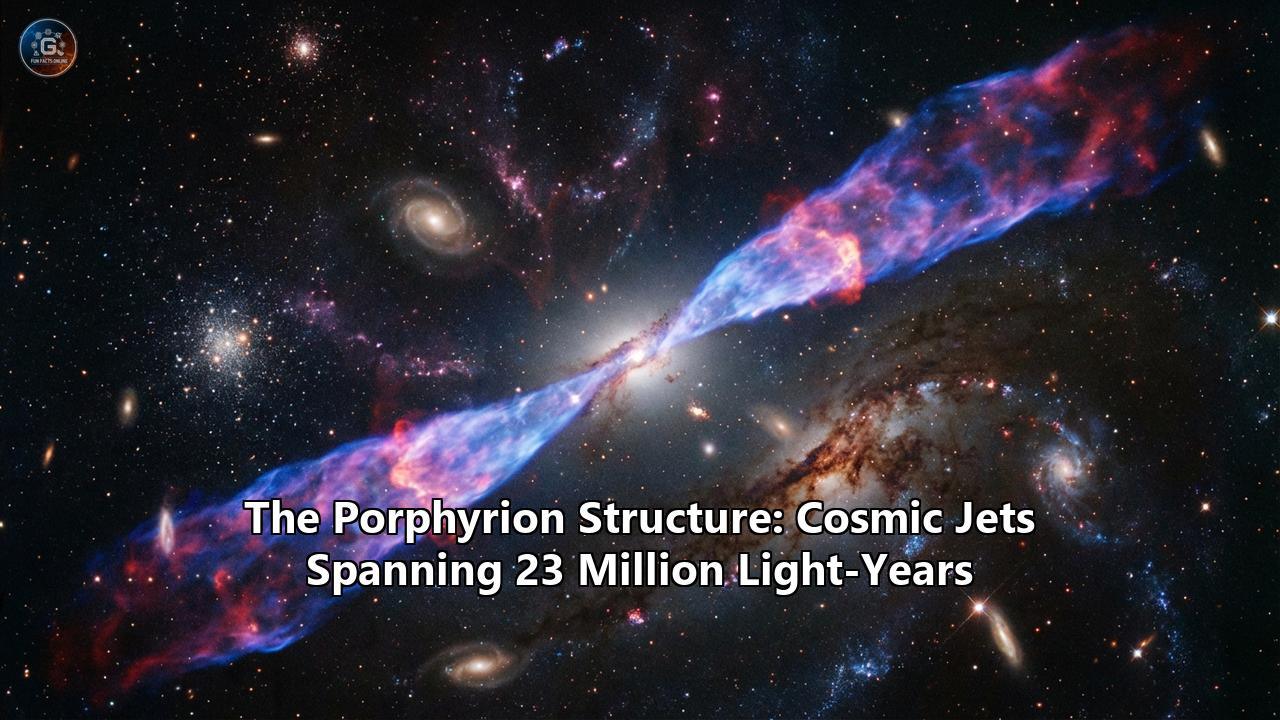
In the vast, silent theater of the cosmos, where galaxies drift like islands of light in an infinite ocean of darkness, astronomers have stumbled upon a leviathan that defies all previous scales of imagination. It is a structure so immense that it makes our entire Milky Way look like a mere speck of dust. It is a testament to the violent, creative, and destructive power of the universe’s most enigmatic engines: supermassive black holes.
They call it Porphyrion.
Named after the king of the giants in Greek mythology who dared to wage war against the gods, this cosmic megastructure is a pair of bipolar jets blasting out from a distant black hole, spanning an unfathomable 23 million light-years. To put this into perspective, if you were to line up 140 Milky Way galaxies side-by-side, they would arguably just barely span the length of this colossal eruption. It is the largest structure of galactic origin ever discovered, a finding that has shattered our understanding of how black holes influence the universe and rewritten the history of cosmic evolution.
The Discovery: hunting Giants in the Radio Sky
The unveiling of Porphyrion was not a moment of serendipitous luck, but the result of a relentless, high-tech treasure hunt across the radio spectrum. The discovery was made using the LOFAR (Low Frequency Array) telescope, a revolutionary instrument that does not look like a traditional telescope at all. Instead of a giant glass mirror pointing at the stars, LOFAR consists of a vast network of tens of thousands of small radio antennas spread across Europe, with a concentration in the Netherlands.
These antennas operate in unison to scan the sky for radio waves—the low-frequency whispers of the universe that are invisible to the human eye. These waves are often the signature of high-energy events, such as the acceleration of electrons spiraling around magnetic fields, a process known as synchrotron radiation.
An international team of astronomers, led by Martijn Oei of Caltech and Leiden University, was combing through LOFAR data as part of a massive survey to map the northern sky. Their goal was to find "giant radio galaxies"—rare beasts where the jets ejected by a central black hole have punched through the halo of their host galaxy and expanded into the intergalactic medium.
The search was akin to finding a specific needle in a stack of needles. The team utilized a combination of advanced machine learning algorithms to scan images for jet-like patterns and the eagle eyes of citizen scientists who manually inspected data to flag anomalies. Amidst thousands of candidates, one faint, fuzzy line stood out. It was a streak of radio emission that seemed to go on forever.
When the team realized what they were looking at, the scale was hard to comprehend. They weren't just looking at a big jet; they were looking at a monster. Follow-up observations with the Giant Metrewave Radio Telescope (GMRT) in India and the W. M. Keck Observatory in Hawaii confirmed the distance and the host. The light from Porphyrion had traveled for 7.5 billion years to reach us. This meant the structure existed when the universe was less than half its current age, making its sheer size even more baffling.
Anatomy of a Leviathan
To understand Porphyrion, one must first understand the engine that drives it. At the heart of this structure lies a massive galaxy, roughly ten times the mass of our Milky Way. And at the core of that galaxy sits a supermassive black hole, a gravitational singularity gluttonously feeding on infalling matter.
Usually, when a black hole feeds, it forms an accretion disk—a swirling, superheated disk of gas and dust. As material spirals inward, magnetic fields twist and snap, launching a fraction of that particle soup outward at near-light speeds. These are the cosmic jets.
Most jets sustain themselves for a few million years before fizzling out or being disrupted by the dense gas of their host galaxy. But Porphyrion is different. Its jets have remained stable and active for hundreds of millions of years, piercing through the galaxy, escaping its gravitational halo, and drilling into the deep void of intergalactic space.
The structure consists of two opposing lobes of plasma, shooting out from the black hole in opposite directions. Together, they span a linear distance of 7 megaparsecs (23 million light-years).
The energy required to inflate such a structure is mind-boggling. The power output of the Porphyrion system is equivalent to the energy of trillions of suns. Yet, perhaps the most surprising revelation was the type of black hole powering it.
Astronomers classify active black holes into two main modes:
- Jet-mode (radio-mode): Efficient engines that convert infalling matter directly into powerful jets. These are usually associated with older, massive elliptical galaxies.
- Radiative-mode (quasar-mode): violently bright black holes that blast out radiation (light and heat) rather than organized jets. These are common in the young universe.
Porphyrion’s black hole was found to be in radiative-mode. Until now, wisdom held that radiative-mode black holes couldn't produce such stable, gigantic jets because the intense radiation would destabilize the accretion flow. Porphyrion proves this wrong. It shows that even the most violently radiating black holes in the early universe could launch jets that spanned the cosmos, suggesting that these giants might have been far more common in the ancient universe than we ever dared to dream.
The Cosmic Web Connection
The true significance of Porphyrion lies not just in its size, but in where it lives. The universe is not a uniform scattering of galaxies. It is structured like a vast, three-dimensional spider web. This Cosmic Web consists of filaments of dark matter and gas that stretch across the universe, connecting clusters of galaxies. Between these filaments lie the Cosmic Voids—immense, empty regions of nothingness.
Porphyrion is so large that it doesn't just sit inside a filament; it likely pierces through it and extends deep into the voids.
“Up until now, these giant jet systems appeared to be a phenomenon of the recent universe,” Martijn Oei explained upon the discovery. “If distant jets like these can reach the scale of the cosmic web, then every place in the universe may have been affected by black hole activity at some point in cosmic time.”
This changes everything. It means that black holes are not just local gardeners, pruning the star formation in their own galaxies. They are cosmic engineers.
By injecting energy, heat, and magnetic fields into the intergalactic medium, structures like Porphyrion could have magnetized the universe. We know the cosmos is permeated by magnetic fields, but their origin has been a mystery. Porphyrion suggests that giant jets act as sowers, spreading magnetic fields and heavy elements synthesized in stars across millions of light-years, enriching the pristine gas of the voids.
Comparing the Titans: Porphyrion vs. Alcyoneus
Before Porphyrion, the title of "largest radio galaxy" belonged to Alcyoneus, another giant discovered by the same team in 2022. Alcyoneus spans about 16 million light-years. At the time, Alcyoneus was considered a shocking anomaly.
Porphyrion dwarfs Alcyoneus by a margin of 7 million light-years.
To visualize this:
- The Milky Way: 100,000 light-years across.
- Distance to Andromeda (our neighbor): 2.5 million light-years.
- Alcyoneus: 16 million light-years.
- Porphyrion: 23 million light-years.
If Porphyrion were placed at the distance of the Andromeda galaxy, its jets would cover a massive portion of our night sky, appearing larger than the full moon, glowing with the ghostly light of radio waves.
The existence of Alcyoneus was a hint; the discovery of Porphyrion is a confirmation. These aren't freaks of nature. They are likely the tip of an iceberg, a population of giants that dominated the epoch of the early universe, whose fossils we are only just beginning to unearth.
A Universe Denser and More Violent
One crucial factor in Porphyrion's growth is the epoch in which it lived. 7.5 billion years ago, the universe was physically smaller. The expansion of the universe means that in the past, the filaments of the cosmic web were closer together.
This makes Porphyrion's feat even more impressive. It had to push against a denser intergalactic medium. The fact that the jets remained straight and stable for 23 million light-years suggests an incredibly persistent engine and perhaps a protective magnetic sheath that kept the plasma focused, preventing it from fraying or dispersing into the surrounding gas.
The Future of the Past
The discovery of Porphyrion is a "ground-breaking" moment for cosmology. It challenges our simulations of how galaxies evolve. Standard models suggest that jets deposit energy into their surroundings, stopping gas from cooling and collapsing to form new stars. If jets can reach as far as Porphyrion's, they could be shutting down star formation in galaxies millions of light-years away from the host black hole. This implies a form of "action at a distance" where a single black hole influences the fate of an entire corner of the universe.
This is just the beginning. With LOFAR continuing its survey and the upcoming Square Kilometre Array (SKA)—which will be the largest radio telescope ever built—astronomers expect to find thousands more of these giants.
We are entering a new golden age of radio astronomy. We are learning that the universe is more interconnected than we thought. Through the invisible threads of radio waves, we see that the chaotic, destructive power of a black hole can create structures of elegant, terrifying symmetry that span the voids between the stars.
Porphyrion stands as a silent monument to this power—a 23-million-light-year scar across the face of the deep, reminding us that in the cosmos, size is just a matter of time and energy, and even the voids are not safe from the reach of a giant.
Reference:
- https://www.futuretimeline.net/blog/2024/09/23-largest-black-hole-jets-ever-seen-are-23-million-light-years-in-length.htm
- https://www.youtube.com/watch?v=1QsG9v_QHF8
- https://en.wikipedia.org/wiki/Porphyrion_(radio_galaxy))
- https://www.theguardian.com/science/2024/sep/18/huge-plasma-jets-spotted-gigantic-black-hole-porphyrion
- https://www.caltech.edu/about/news/gargantuan-black-hole-jets-are-biggest-seen-yet
- https://scitechdaily.com/astronomers-stunned-by-discovery-of-colossal-black-hole-jets-spanning-23-million-light-years/
- https://www.sciencenews.org/article/universe-largest-black-hole-jets
- https://www.smithsonianmag.com/smart-news/astronomers-discover-record-breaking-jets-escaping-a-black-hole-the-longest-ever-seen-180985111/
- https://keckobservatory.org/porphyrion/
- https://www.republicworld.com/science/space/porphyrion-the-23-million-light-year-black-hole-jet-redefining-cosmic-evolution
- https://thecrusadernews.ca/2024/11/16/porphyrion-where-size-meets-cosmic-mystery/
- https://www.space.com/black-hole-jets-longest-23-million-light-years