
The year is 2025, and the windswept heath of Sutton Hoo has once again yielded a secret that forces us to rewrite the history of the so-called "Dark Ages." For decades, the Bromeswell Bucket—a battered, enigmatic vessel found in the shadow of the famous royal burial mounds—was treated as a beautiful curiosity. But recent micro-excavations and a breakthrough analysis of its newly discovered base have shattered that perception. We now know this was not merely a souvenir; it was a cremation urn, holding the calcined bones of a high-status individual, a horse, and an antler comb, burying a man who may have called himself a "Count" in the Greek tongue of the distant Byzantine Empire.
This discovery is not just about a bucket. It is a smoking gun for a vibrant, dangerous, and incredibly complex network of trade that stretched from the sun-drenched markets of Antioch and Alexandria to the cold, grey waters of the North Sea.
The Object: A Souvenir from the End of the World
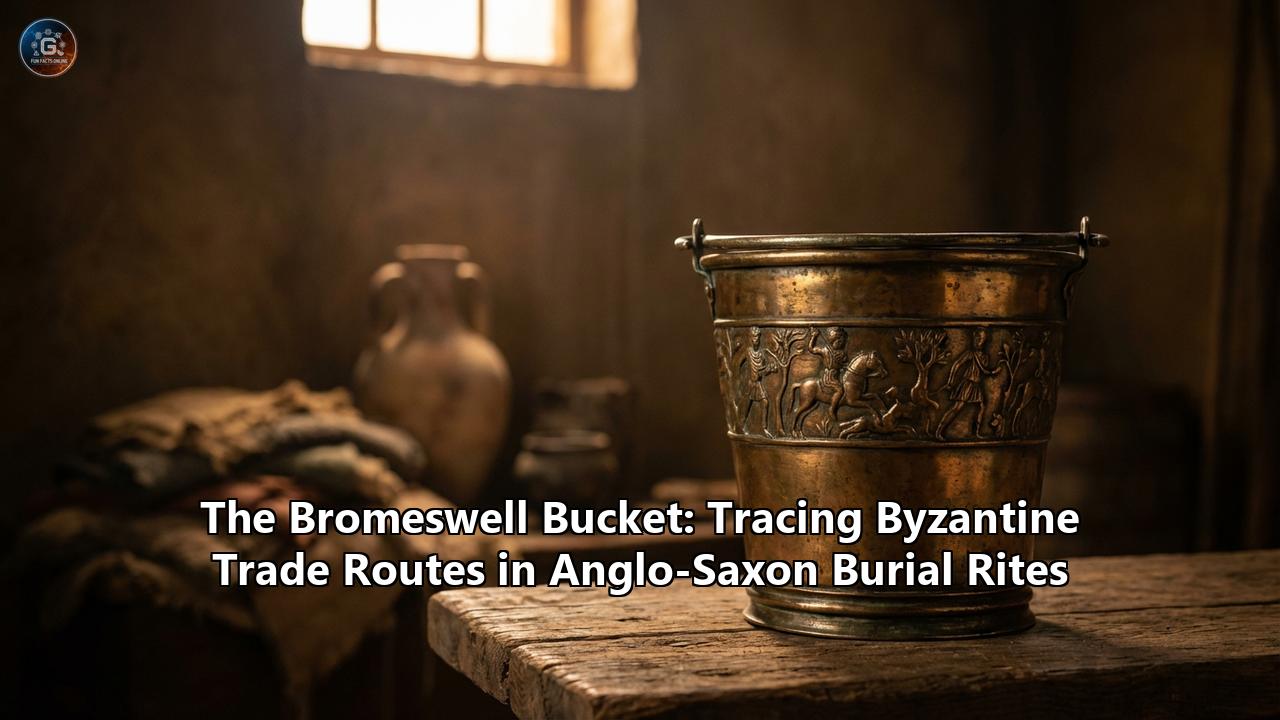
To understand the magnitude of this find, one must look closely at the object itself. The Bromeswell Bucket is a vessel of cast copper alloy, dating to the 6th century—predating the famous Ship Burial (Mound 1) by nearly a hundred years.
It is not Anglo-Saxon work. It is undeniably, unapologetically Byzantine.
- The Frieze: Hammered into its surface is a frieze of startling exoticism for a Suffolk field: naked warriors battling leaping lions and leopards. This is a North African hunting scene, a motif popular in the late antique Mediterranean, reflecting the wild beast hunts of the Roman amphitheater.
- The Inscription: Most tantalizing is the inscription running around the rim in Greek:
> "Use this in good health, Master Count, for many happy years."
(Hygiainon chro, kyrie komi, polla ta ete)
This was a generic, high-class greeting, similar to "Bon Appétit" or "Cheers," often found on silver tableware in the East. But to find the title "Comes" (Count)—a specific Roman military and administrative rank—buried in the soil of East Anglia raises spine-tingling questions. Was the occupant a Germanic mercenary who served in the armies of Justinian? A local chieftain adopting Roman affectations? Or was this a diplomatic gift from an Emperor trying to buy influence at the edge of the known world?
The 2025 Revelation: A Warrior's Ashes
Until recently, the bucket was incomplete. The 2025 investigation by the National Trust and archaeological teams recovered the missing base and its solidified contents.
- The Contents: Inside were the cremated remains of a human male and a horse. This is a classic Germanic rite—the "horseman's burn"—but performed using a Christian/Roman vessel.
- The Paradox: The bucket was designed for washing or mixing wine at a civilized banquet in Syria or Egypt. In Suffolk, it became a tomb. This repurposing signifies a "hybrid" culture: an Anglo-Saxon elite who signaled their status not just by owning Roman things, but by consuming them in their own pagan rituals.
Tracing the Route: The "Atlantic System"
How did a bucket made in Antioch (modern Turkey/Syria) end up in a hole in Suffolk? This is where the Bromeswell Bucket lights up the map of 6th-century trade.
For years, historians debated two routes:
- The Rhine Route: Goods traveling up from Italy, across the Alps, and down the Rhine. This was the traditional "backdoor" into Europe.
- The Atlantic Route: A daring sea voyage from the Mediterranean, through the Pillars of Hercules (Gibraltar), up the coasts of Portugal and France, to the tin-rich cliffs of Cornwall.
The Bromeswell Bucket, along with other recent finds, heavily favors the Atlantic Route.
The Tintagel Connection
The key lies in Tintagel, the legendary Cornish fortress. Excavations there have uncovered thousands of sherds of Byzantine pottery—amphorae that once held wine from Gaza, olive oil from Tunisia, and fine "African Red Slip" tableware. Tintagel was a major redistribution hub.
- Ships from Constantinople didn't just stop at Cornwall. They were part of a network that likely "cabotaged" (hopped along the coast) or moved goods overland.
- The Bromeswell Bucket likely arrived in a cargo hold alongside jars of Gaza wine. It may have been traded to the East Anglian Wuffingas dynasty in exchange for slaves, amber, or wool—or perhaps given as a diplomatic sweetener to ensure safe passage for merchants.
A Globalized "Dark Age"
The Bromeswell Bucket forces us to abandon the idea of isolated, muddy Anglo-Saxon villages. The man buried in this bucket lived in a world where:
- The Plague of Justinian (which ravaged Europe in the 540s) was spreading along these exact same trade routes.
- Elites were Cosmpolitan: A warlord in Suffolk could wash his hands in a Syrian basin, drink wine from a Palestinian jar, and wear garnets mined in India (Sri Lanka) and arguably polished in the Black Sea workshops.
The "Master Count" of Suffolk
Who was the "Master Count"? The Greek inscription offers a final, poetic twist. The title Comes suggests a man of authority. In the 6th century, the Byzantine Empire was actively recruiting "barbarians" to fight its wars in Italy and North Africa.
- The Mercenary Theory: It is entirely possible the deceased was a high-ranking Anglo-Saxon warrior who traveled to the Mediterranean, served the Emperor (perhaps in the reconquest of North Africa, explaining the hunting motif), and returned home with his "service medal"—this bucket—only to be buried in the pagan style of his ancestors.
The Bromeswell Bucket is more than metal; it is a memory. It remembers the heat of the Syrian sun, the roar of the amphitheater, the salt spray of the Atlantic, and the fire of a Suffolk funeral pyre. It stands as a testament to an age that was not dark, but glittering with the gold of commerce and the bronze of distant empires.
Reference:
- https://www.wikiwand.com/en/articles/Sutton_Hoo
- https://esotericbasics.co.uk/esotericism-part-4-sec-07/
- https://eprints.oxfordarchaeology.com/7272/10/9_TTT3PX_Chapter07.pdf
- https://en.wikipedia.org/wiki/Sutton_Hoo
- https://esotericbasics.co.uk/esotericism-part1/
- https://dlab.epfl.ch/wikispeedia/wpcd/wp/s/Sutton_Hoo.htm