
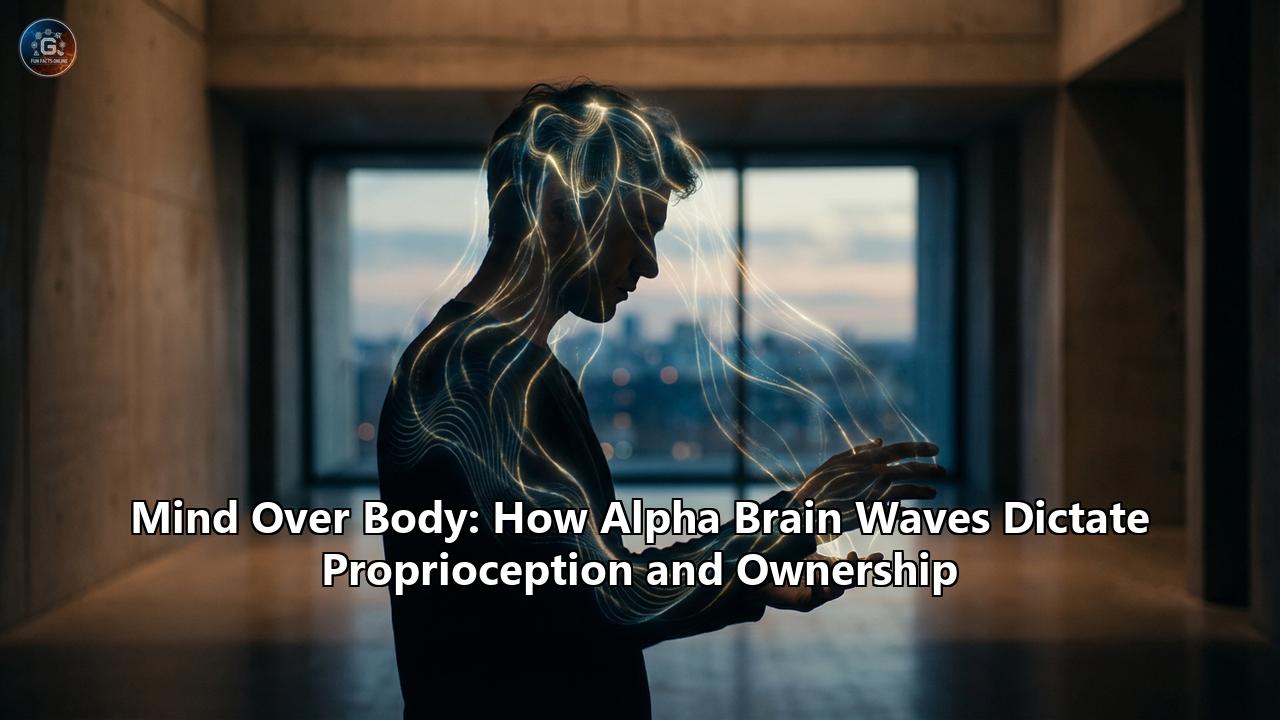
The feeling that your hand belongs to you seems like the most fundamental, unshakeable fact of your existence. You do not have to deduce it; you do not have to calculate it. You simply know. But neuroscience reveals that this feeling of "mine-ness"—or body ownership—is not a solid fact, but a fragile construction. It is a neurological magic trick performed by the parietal cortex, and the magician’s wand is a rhythmic pulse of electricity firing roughly ten times per second: the alpha brain wave.
Recent breakthroughs in neurophysiology have identified that the precise frequency of these alpha oscillations (8–12 Hz) dictates the "temporal resolution" of your reality. It determines the width of the temporal window in which your brain merges sights, sounds, and touches into a single event. This internal clock speed decides whether you perceive a rubber hand as your own, whether you feel distinct from the chair you sit on, and—in extreme cases—whether you feel you exist at all.
This article explores the profound science of "Mind Over Body," tracing how alpha waves generate the self, how they fail in psychiatric disorders, how they are being hijacked to engineer futuristic prosthetics and virtual reality experiences, and how ancient meditation practices may have intuitively hacked this system millennia ago to dissolve the ego entirely.
Part I: The Illusion of ownership
The Rubber Hand and the Ghost in the Machine
To understand how the brain constructs the self, we must first look at how easily that construction can be dismantled. In 1998, psychiatrists Matthew Botvinick and Jonathan Cohen published a landmark study on an experiment that would become famous as the "Rubber Hand Illusion" (RHI).
In this setup, a participant sits with their arm hidden behind a screen. A realistic rubber hand is placed in front of them in full view. The experimenter then takes two paintbrushes and simultaneously strokes the participant’s hidden real hand and the visible rubber hand. The strokes are perfectly synchronized in time.
Within seconds, a strange sensation washes over the participant. They stop feeling the brush on their hidden hand and start feeling it on the rubber hand. If the experimenter suddenly smashes the rubber hand with a hammer, the participant will flinch in genuine fear. Their brain has "adopted" the plastic limb, remapping its proprioceptive map (the internal sense of body positioning) to include this foreign object.
For decades, scientists knew that this happened, but they struggled to explain why some people succumbed to the illusion instantly while others remained immune. The answer, it turns out, lies in the invisible rhythm of the brain’s alpha waves.
The Alpha Rhythm: The Brain’s Frame Rate
The brain does not perceive the world continuously like an analog stream of water; it samples the world in discrete snapshots, much like a movie camera capturing frames on a reel. This sampling rate is governed largely by alpha oscillations, rhythmic electrical pulses originating in the thalamus and the parietal cortex.
A standard alpha wave cycles at about 10 Hertz (10 times per second). This means one "perceptual frame" lasts roughly 100 milliseconds.
- Integration: Any sensory inputs that arrive within the same 100ms cycle are fused together by the brain as a single, simultaneous event.
- Segregation: Inputs that land in different cycles are perceived as separate events.
This is the "Temporal Binding Window" (TBW).
In the Rubber Hand Illusion, the visual signal (seeing the brush move) and the tactile signal (feeling the brush stroke) must arrive within the same Temporal Binding Window for the brain to say, "These are the same event. Therefore, that hand is mine."
Recent studies from the Karolinska Institutet have shown a direct correlation: Individuals with faster alpha frequencies (e.g., 11-12 Hz) have narrower temporal binding windows. Their brains take more snapshots per second. This high "frame rate" allows them to detect tiny discrepancies between the visual stroke and the tactile sensation. If the brush strokes are even slightly out of sync—by just a few milliseconds—a person with fast alpha waves will notice the lag. Their brain will reject the illusion, maintaining a strong boundary between "self" and "object."
Conversely, individuals with slower alpha frequencies (e.g., 8-9 Hz) have wider binding windows. Their "perceptual frames" are longer. Even if the visual and tactile signals are slightly asynchronous, they still fall within the same long alpha cycle. The brain merges them, concludes "this is happening to me," and the rubber hand becomes part of the body.
The Gatekeeper of the Parietal Cortex
The parietal cortex involves the somatosensory cortex, which processes touch, and the intraparietal sulcus, which integrates vision and touch. This region acts as the "Gatekeeper of the Self."
When alpha power is high in this region, it acts as an inhibitory filter. It suppresses irrelevant sensory noise. This is a "top-down" prediction mechanism. The brain predicts what the body should feel. When the alpha rhythm is strong and fast, the Gatekeeper is vigilant. It says, "The visual input of that rubber hand does not match the proprioceptive prediction of my real hand’s location. Reject."
But when the alpha rhythm slows or its power drops, the Gatekeeper becomes drowsy. The "bottom-up" sensory data (the sight of the brush) overwhelms the internal prediction. The brain prioritizes the visual information over the proprioceptive truth, and the self-boundary dissolves.
Part II: When the Boundary Breaks
Schizophrenia and the "Leaky" Self
If alpha waves define the boundary of the self, what happens when that rhythm is chronically disrupted? The answer may lie in the tragic phenomenology of schizophrenia.
A hallmark symptom of schizophrenia is "passivity phenomena"—the feeling that one’s thoughts or movements are not their own. A patient might reach for a cup but feel as if an external force moved their arm. This is a failure of agency attribution, a collapse of the "mine-ness" mechanism.
Research indicates that patients with schizophrenia often exhibit slower peak alpha frequency (IAF) and, more critically, "phase discontinuities" in their alpha rhythms. Their internal clock is not just slow; it is stuttering.
Because their Temporal Binding Window is pathologically wide or erratic, they may integrate sensory inputs that should be kept separate. For example, if they speak (motor action) and hear their own voice (auditory input), a healthy brain binds these instantly: "I am speaking." But if the timing mechanism is flawed, the auditory input might be processed in a different "frame" than the motor command. The brain concludes: "I heard a voice, but I didn't feel myself speaking." The result is the hallucination of hearing voices.
This "leaky" boundary means the distinction between internal thought and external reality becomes porous. The alpha wave, which should act as a shield defining "this is me," fails to hold the line.
Depersonalization: The Ghost in the Mirror
On the other end of the spectrum lies Depersonalization/Derealization Disorder (DPDR). Sufferers often describe feeling like a robot, or as if they are watching a movie of their life. They look at their hands and know, intellectually, "these are my hands," but they feel no ownership over them.
While schizophrenia involves a disintegration of boundaries, DPDR often involves an over-stabilization or "locking down" of the system. EEG studies have found frontal alpha wave overactivation in DPDR patients.
The brain is inhibiting too much. The alpha rhythm is suppressing the emotional and somatosensory richness of experience. It is a defense mechanism gone wrong, often triggered by trauma. The brain says, "The reality of this trauma is too overwhelming. I will increase alpha inhibition to block the somatosensory emotional feedback." The result is a numb, purely visual existence. The "me" is protected, but at the cost of being exiled from the body.
Part III: Engineering the Self (Prosthetics & VR)
The Challenge of the Bionic Limb
For an amputee, a prosthetic limb is often just a tool—a sophisticated hammer or pair of pliers attached to the body. It rarely feels embodied. This lack of ownership is a primary reason for prosthetic abandonment. The limb feels "heavy," "dead," and mentally exhausting to use because the brain has to consciously drive it rather than intuitively inhabiting it.
The science of alpha waves is changing this.
Researchers at ETH Zurich and other institutions are developing "Neuro-Haptic" feedback systems. By placing sensors on the prosthetic sole and knee, they convert pressure and motion into electrical pulses sent to the nerves in the user's thigh.
But the secret sauce isn't just the signal; it's the timing.
To create embodiment, the artificial feedback must hit the brain within the user’s specific Temporal Binding Window. If the signal is delayed by Bluetooth latency or processing time, it falls outside the alpha cycle, and the illusion breaks.
"Alpha-Tuning" Therapy:We are moving toward a future of "Alpha-Tuned Prosthetics." Before fitting a limb, a clinician might measure a patient’s Individual Alpha Frequency (IAF).
- Patient A (12 Hz Alpha): Has a tight 80ms window. The prosthetic needs ultra-low latency processors to ensure the tactile signal matches the visual movement instantly.
- Patient B (8 Hz Alpha): Has a lenient 125ms window. They might tolerate a slower, more processing-heavy limb.
Furthermore, Neurofeedback Training (NFT) is being used to help amputees "hack" their own ownership. By training patients to modulate their parietal alpha activity (via visual feedback on a screen), they can temporarily widen their binding window during rehabilitation sessions. This makes their brain more plastic, more willing to accept the mechanical stranger as a biological friend. Once the connection is made, the "weight" of the prosthetic drops. The brain stops treating it as dead weight to be carried and starts treating it as a limb to be lived in.
Virtual Reality: The Ultimate Dissociation Machine
Virtual Reality (VR) is essentially a "Rubber Hand Illusion" for the entire body. When you look down in a headset and see a digital avatar moving as you move, you are relying on alpha-mediated temporal binding to accept this new body.
However, VR does something unique: it potentiates alpha and beta oscillations. The immersion of VR—the blocking out of the physical world—hijacks the brain’s top-down prediction mechanisms.
Virtual Embodiment Training (VET) is now being tested for chronic pain. In conditions like Complex Regional Pain Syndrome (CRPS), the brain has a "corrupted file" for the painful limb. It perceives the arm as swollen, painful, or alien.In VET, patients wear a VR headset where they see a healthy, pain-free digital arm in place of their own. By synchronizing the movements perfectly, the therapy tricks the parietal alpha rhythm into accepting the digital limb as the "true" self. The brain then overwrites the "painful arm" prediction with the "healthy avatar" prediction. Because the alpha rhythm dictates the flow of top-down predictions, capturing this rhythm allows therapists to rewrite the body schema, effectively "deleting" the pain.
Part IV: Dissolving the Boundary (The Meditation Link)
The Neuroscience of Nirvana
If the self is constructed by 10Hz parietal oscillations, can we deconstruct it by altering the rhythm?
For millennia, Eastern traditions have spoken of "Non-Dual Awareness"—a state where the distinction between observer and observed, subject and object, self and world, collapses. Meditators describe this as a feeling of infinite spaciousness, where "I" am not looking at the tree; "I" am the looking.
Neuroscience offers a fascinating parallel here.
- Alpha Synchronization: In deep meditative states (particularly Samatha or focused attention), there is often a massive increase in alpha power and synchronization across the cortex.
- The Flattened Hierarchy: Some theories suggest that in non-dual states, the brain stops "predicting" the self. The top-down alpha inhibition relaxes in a specific way—it stops filtering "self" vs. "other."
- The Infinite Window: If the alpha cycle is the "frame" that separates events, what happens if the frame dissolves? Or if the synchronization becomes so global that everything falls into one giant simultaneous cycle?
In the "flow state" or deep absorption, the parietal alpha rhythms that usually define the spatial boundaries of the body ("my hand ends here, the table starts there") quiet down. This is why a jazz musician feels "one with the instrument" or a surfer feels "one with the wave." It is not a poetic metaphor; it is a literal neurophysiological event. The parietal boundary mechanism has gone offline. The temporal binding window has expanded to include the tool or the environment within the definition of "self."
The Alpha Paradox
There is a paradox here.
- High, Fast Alpha = Sharp definition, strong ego boundary, precision (The "Pilot" mode).
- Slow/Broad Alpha = Blurry boundary, potential for illusions or psychosis (The "Dream" mode).
- Coherent/Global Alpha = The "Flow" or "Non-Dual" mode.
The difference between a psychotic break and a mystical experience may lie in the control and coherence of these rhythms. The schizophrenic patient suffers from a fragmented, erratic clock that mis-binds reality. The meditator cultivates a smooth, coherent, and volitional modulation of the clock, allowing them to dissolve the boundary at will without losing the ability to function.
Part V: The Future of Proprioception
Resonant Architecture and Haptic Internet
As we move into an era of spatial computing and the "Metaverse," the role of alpha waves will become central to design.
Imagine "Resonant Architecture": Virtual or physical spaces designed to entrain your brain waves to specific frequencies.
- A workspace designed with 14Hz (Beta) flicker/audio cues to sharpen your temporal binding window, making you feel distinct, agentic, and hyper-focused.
- A relaxation pod designed with 8Hz (Slow Alpha/Theta) entrainment to widen your window, encouraging a feeling of merging with the surroundings, dissolving stress and ego defense.
We may also see the rise of The Haptic Internet, where we can "feel" distant objects or people. The success of this technology will depend entirely on latency management—not just for the sake of speed, but for the sake of ownership. If the internet lags, you don't just lose the connection; you lose the self.
Conclusion: The Rhythm of Being
We tend to think of our bodies as biological hardware—bones, skin, and nerves that define who we are. But the science of alpha oscillations suggests we are more like software running on a loop. We are a song, a rhythm of electrical pulses that frantically stitches together the chaotic sensory soup of the universe into a coherent story of "Me."
This rhythm is powerful, capable of granting us agency and precision. Yet it is also fragile, susceptible to disruption by disease, trauma, or simple confusion. And perhaps most importantly, it is flexible. Through technology like VR and prosthetics, or through practices like meditation, we can change the tempo. We can expand the window. We can rewrite the boundaries of what it means to be human.
In the end, you are not the hand. You are the wave that claims it.
Deep Dive: The Mechanisms of Mind Over Body
To fully grasp the implications of these findings, we must descend into the granular details of the neuroscience. How exactly does a rhythmic pulse of electricity "bind" reality?
1. The Temporal Binding Window (TBW)
The TBW is the brain's "margin of error" for simultaneity. Light travels faster than sound, and nerve impulses from the toe take longer to reach the brain than impulses from the nose. If the brain demanded perfect, atomic-clock synchronization, we would perceive the world as a disjointed mess. You would see a person's lips move, and then hear the sound a fraction of a second later. You would stub your toe, and feel the pain after you saw the impact.
To solve this, the brain creates a "window of now."
- Visual-Auditory Binding: Usually around 100-200ms.
- Visual-Tactile Binding: Critical for body ownership. Usually narrower, around 80-120ms.
- Phasic Integration: Neural firing is often "phase-locked" to the alpha cycle. Neurons are more excitable at the "peak" of the wave and inhibited at the "trough."
- The Gating Hypothesis: Sensory information that arrives during the inhibitory "trough" of the alpha wave is either suppressed or delayed until the next "peak."
- The Result: Two stimuli (vision + touch) that arrive within the same excitatory peak are treated as one event. If the alpha wave is slow (long cycle), the peak is wider, and the brain is more forgiving of delays. If the alpha wave is fast (short cycle), the peak is narrow, and the brain is strict.
This explains why fast-alpha individuals are harder to fool with the Rubber Hand Illusion. Their brains are "strict editors," rejecting the fake hand because the brush strokes aren't perfectly synchronized. Slow-alpha individuals are "lenient editors," accepting the "close enough" timing and adopting the hand.
2. Top-Down vs. Bottom-Up Processing
The brain is a prediction machine (Predictive Coding Theory). It is constantly generating a model of the world and the body.
- Top-Down (Prediction): "I am sitting in a chair. My hands are on my lap." (Carried largely by Alpha/Beta waves).
- Bottom-Up (Sensory Error): "Hey! I see a hand on the table being stroked!" (Carried largely by Gamma waves).
High alpha power in the parietal cortex represents a strong "prior" or prediction. It inhibits the bottom-up "prediction errors."
- Strong Alpha: The brain ignores the visual input of the rubber hand because it conflicts with the strong internal model. "That's just a dummy hand. Ignore it."
- Weak/Suppressed Alpha: The top-down inhibition fails. The bottom-up visual data rushes in, overwriting the internal model. The brain updates its map: "Oh, I guess my hand IS on the table now."
This mechanism is crucial for VR Embodiment. To make a user feel like they are an avatar, the VR system must overwhelm the user's top-down predictions with high-fidelity, synchronized bottom-up data, forcing the alpha rhythm to yield and update the body schema.
3. The Thalamocortical Loop
Where do these waves come from? The thalamus acts as the central pacemaker. It engages in a rhythmic dialogue with the cortex (the thalamocortical loop).
- Burst Mode: In deep sleep or disconnection, thalamic neurons fire in bursts, creating slow rhythms (Delta/Theta).
- Tonic Mode: In awake, focused states, they fire more continuously, supporting faster Gamma processing.
- Alpha Mode: This is the "idling" or "ready" state. It is a specific resonance between the thalamus and cortex that gates information flow.
In Depersonalization, this loop may be "jammed." The thalamus creates a hyper-stable alpha rhythm that refuses to let somatosensory richness pass through to the conscious cortex. The person sees the world but cannot "feel" it.
In Schizophrenia, the loop is unstable. The "switch" between internal thought and external sensation flickers. The alpha rhythm cannot reliably distinguish between "stimulus I generated" (my voice) and "stimulus from outside" (your voice).
Clinical Frontiers: Healing the Broken Self
The realization that body ownership is a frequency opens up radical new avenues for medicine.
1. Treating Schizophrenia with tACS
Transcranial Alternating Current Stimulation (tACS) involves applying weak electrical currents to the scalp to "entrain" brain waves.
- The Hypothesis: If we can use tACS to force a schizophrenia patient's brain into a stable, coherent 10Hz alpha rhythm, can we "tighten" their Temporal Binding Window?
- Early Results: Pilot studies suggest that stabilizing alpha oscillations can reduce auditory hallucinations. By helping the brain time-stamp events correctly, the patient stops misattributing their own inner voice to an external source.
2. Rehabilitation for Stroke and Neglect
After a stroke in the right parietal lobe, patients often suffer from Hemispatial Neglect. They simply stop acknowledging the left side of their body or the world. They might shave only the right side of their face or eat only from the right side of the plate.
- The Alpha Connection: This is often linked to a pathological imbalance of alpha waves. The unaffected hemisphere becomes hyper-active (too much alpha inhibition) toward the affected side.
- Therapy: "Alpha-Balancing" neurofeedback. Patients play video games using their brain waves, rewarded only when they lower the pathological alpha activity in the healthy hemisphere and boost it in the damaged one. This re-opens the "gate" to the neglected side of the world.
3. Pain Management via Body Swapping
Complex Regional Pain Syndrome (CRPS) is one of the most excruciating conditions known to medicine. The pain is often maintained by a cortical error—the brain map of the limb has become "smudged" or associated with threat.- The VR Cure: By using VR to give the patient a "virtual body swap," therapists can induce a "safe" alpha state. The patient sees a healthy limb where their painful one is. They see it being touched without pain.
- Mechanism: This visual-tactile synchronization (locking into the alpha window) forces the brain to update its priors. "I see the limb is fine. I feel the limb is fine (via vibration). Therefore, the pain prediction is wrong." The alpha rhythm permits the overwrite, and the pain signals drop.
The Philosophical Implication: The Mutable Self
The most jarring implication of this research is not medical, but existential. We grow up believing that our "self" is a noun—a thing. A soul, a mind, a center.
But the neuroscience of alpha oscillations suggests the self is a verb. It is an action the brain performs. It is the act of binding time. It is the act of predicting ownership.
When the rhythm changes—due to drugs, illness, meditation, or technology—the self changes.
- It can expand to include a hammer, a violin, or a virtual avatar.
- It can contract to exclude a paralyzed limb or a traumatic memory.
- It can fragment into voices and ghosts.
- It can dissolve into the universe.
This suggests that the "Self" is not a prison we are locked in, but a frequency we are tuned to. And as our understanding of alpha waves deepens, we are slowly gaining the ability to turn the dial.
We are entering the age of frequency-based identity. Whether through the silence of a meditation hall or the circuitry of a neural interface, the command is the same: Change the wave, change the you.
Reference:
- https://pmc.ncbi.nlm.nih.gov/articles/PMC12104197/
- https://pmc.ncbi.nlm.nih.gov/articles/PMC4341313/
- https://en.wikipedia.org/wiki/Depersonalization-derealization_disorder
- https://www.ovid.com/journals/nebior/abstract/10.1016/j.neubiorev.2020.08.011~symptoms-of-depersonalisationderealisation-disorder-as?redirectionsource=fulltextview
- https://nhahealth.com/neurofeedback-news-helping-prostheses-feel-lighter/
- https://www.frontiersin.org/journals/human-neuroscience/articles/10.3389/fnhum.2025.1537463/full
- https://pmc.ncbi.nlm.nih.gov/articles/PMC6867560/
- https://www.youtube.com/watch?v=Tt_zQcNbpg8
- https://www.sciencedaily.com/releases/2026/01/260114080325.htm