
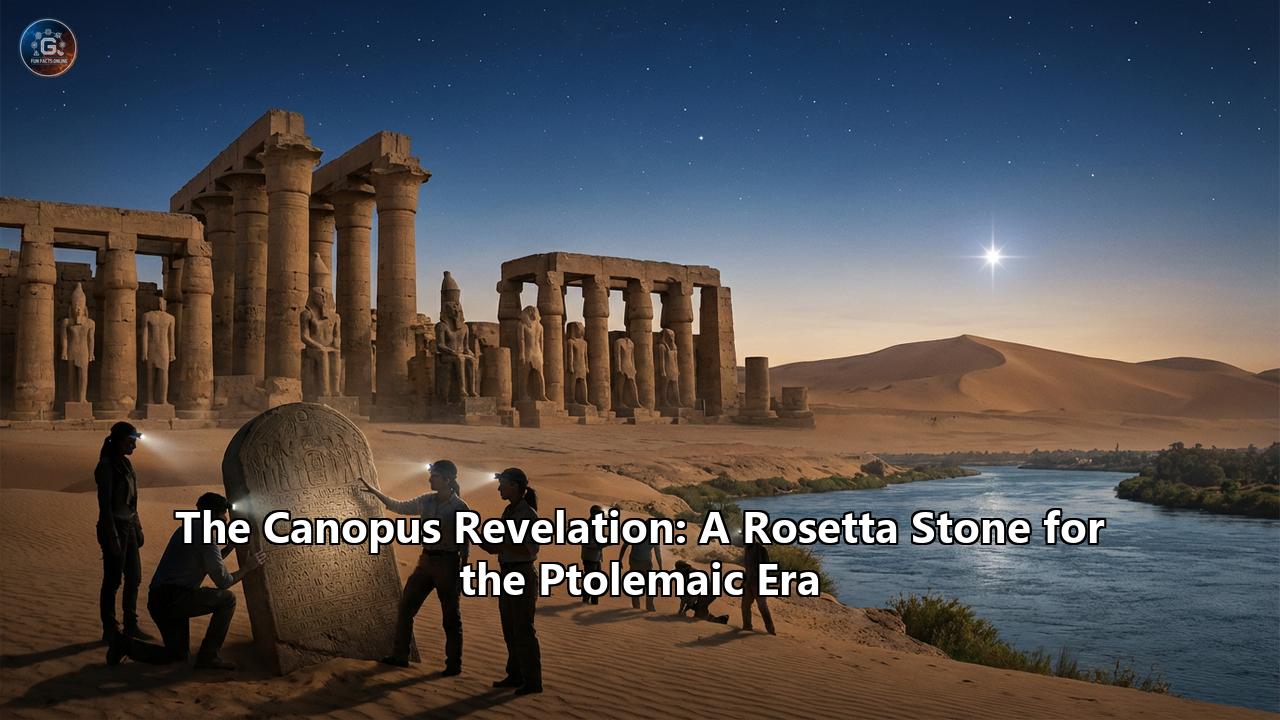
The sands of the Nile Delta have spoken once more, and their voice is not a whisper, but a thunderclap that echoes across twenty-three centuries. For generations, the Rosetta Stone has reigned as the supreme icon of Egyptology—the black basalt key that unlocked the silent library of the pharaohs. But in the grand detective story of deciphering the ancient world, the Rosetta Stone has a sibling—older, wiser, and arguably more profound. This is the story of the Decree of Canopus, a document that did not just translate a language, but attempted to tame time itself.
And now, in the light of the monumental discovery at Tell El-Fara'in in late 2025, the "Canopus Revelation" has entered a startling new chapter. The unearthing of a pristine, complete copy of this decree—inscribed solely in the sacred hieroglyphs of the priesthood—has shattered over a century of silence. It compels us to rewrite the history of the Ptolemaic era, offering a "Rosetta Stone" not for the novice, but for the master.
Chapter 1: The New Revelation at the Hill of the Pharaohs
The date was September 2025. The location: the dusty, sun-baked mounds of Tell El-Fara'in, known in antiquity as Imet, and later as Buto, the primordial seat of the cobra goddess Wadjet. For decades, this site in the Sharqia Governorate had yielded steady but modest finds. But as the Egyptian mission from the Supreme Council of Antiquities cleared the sand from a Ptolemaic-era foundation, they struck something that would send shockwaves through the global archaeological community.
It was a stela. Standing over four feet tall, carved from golden sandstone, it was vibrant and miraculously intact. Its rounded lunette featured the winged sun disk of Behedet, flanked by the protective uraei—the royal cobras wearing the White and Red Crowns of Upper and Lower Egypt. Between them, the hieroglyphs whispered the eternal promise: Di Ankh—"He who gives life."
But it was the text below that stopped the excavators in their tracks. It was the Decree of Canopus.
Archaeologists had known of this decree since 1866, when the German savant Karl Richard Lepsius found a copy at Tanis. That version, like the Rosetta Stone, was trilingual—hieroglyphic, Demotic, and Greek. It had been the final proof that Jean-François Champollion’s decipherment of hieroglyphs was correct. But the 2025 stela was different. It was monolingual. It carried the decree solely in hieroglyphs—the "Words of God."
This was the "Canopus Revelation." For the first time, scholars possessed a copy of this pivotal state document intended purely for the eyes of the Egyptian high priesthood and their gods, stripped of the Greek translation that was mandated for the administrative class. It was a window into the internal mind of the Egyptian clergy, a "pure" text that promised to resolve lingering debates about Ptolemaic grammar, theology, and the delicate power balance between the Macedonian pharaohs and the native priests.
To understand why this stone matters, and why the "Canopus Revelation" is the Rosetta Stone of our era, we must travel back to the vibrant, dangerous world of 238 BC.
Chapter 2: The Benefactor and the Crisis
The year is 238 BC. The place is Canopus, a bustling coastal city just east of the rising metropolis of Alexandria. The air is thick with the scent of incense and the salt of the Mediterranean. Egypt is ruled by Ptolemy III Euergetes, the third pharaoh of the Greek dynasty founded by Alexander the Great’s general.
Ptolemy III was at the height of his power. He was a warrior-king who had just returned from a dazzling campaign in the Near East, the "Third Syrian War," where he had marched as far as Babylon. He had brought back the sacred statues of Egyptian gods that had been stolen by the Persians centuries earlier. For this act of piety, the Egyptian populace adored him, bestowing upon him the title Euergetes—"The Benefactor."
But beneath the surface of this golden age, a crisis was brewing. The Nile, the lifeblood of Egypt, had failed. The annual inundation, which deposited the fertile black silt needed for farming, was disastrously low. Famine stalked the land. In a country where the Pharaoh was responsible for Ma’at (cosmic order), a failure of the river was a failure of the king.
Ptolemy III and his formidable wife, Queen Berenice II, faced a potential revolt. They needed to solidify their alliance with the only power bloc that mattered: the Egyptian priesthood. These priests controlled the temples, the grain reserves, and the hearts of the people.
And so, a great synod was called. High priests, prophets, and "stolistai" (those who dressed the gods) from all over Egypt gathered at the Temple of the Benefactor Gods in Canopus. Their goal: to issue a decree that would cement the bond between the House of Ptolemy and the temples of Egypt.
The result was the Decree of Canopus—a masterclass in political propaganda and religious innovation. But it would also contain a scientific revelation that was two thousand years ahead of its time.
Chapter 3: The Gift of Bread and the Stolen Statues
The text of the decree, now revitalized by the 2025 discovery, opens with a grand eulogy. It is a transactional document of the highest order. The priests recount the King’s beneficence in exquisite detail, painting a portrait of a ruler who cares for both the bodies and souls of his subjects.
"They have conferred many benefits on the temples of Egypt and on all those who are included in them," the hieroglyphs proclaim. The decree details how Ptolemy III used his own wealth to import grain from Syria, Phoenicia, and Cyprus to feed the population when the Nile failed. This was a radical act of state welfare, explicitly recorded to bind the people’s gratitude to the crown.But the "Canopus Revelation" goes deeper into the theological legitimacy of the Greek king. The text emphasizes the recovery of the sacred statues from the Persians. This was a psychological victory of immense proportions. The Persians were the hated archetypal invaders who had disrespected the gods. By returning the statues, Ptolemy III was not just a Greek king; he was the avenger of Egyptian honor, a true Pharaoh in the mold of the great Ramessides.
In return for this "bread and honor," the priests granted the royal couple unprecedented privileges. They established a new class of priests—the "Priests of the Benefactor Gods"—to serve the royal cult. This was a shrewd political move. It integrated the worship of the Ptolemies directly into the daily rituals of every major temple in Egypt. The Greek king was no longer an overlord; he was a resident god, fed and clothed alongside Amun, Ptah, and Osiris.
Chapter 4: The Tragedy of the Princess
The Decree of Canopus is not merely a political contract; it is also a testament to parental grief. During the synod, tragedy struck the royal house. The young Princess Berenice, daughter of Ptolemy and Berenice, died suddenly.
The death of a royal child was a delicate matter. In the "Canopus Revelation," we see the priests transforming this tragedy into a unifying religious event. They deified the young princess immediately. She was given the title Berenice Anasse—"Berenice, Mistress of Virgins."
The decree outlines, with touching specificity, the rituals to honor her. A gold statue of the princess, inlaid with precious stones, was to be placed in the holy of holies of the temples. The priests described a special crown for her statue, consisting of two ears of corn (symbolizing the fertility she failed to inherit?) and the ureaus.
Most poignant was the creation of a special bread-cake, the bread of Berenice, which was to be distributed during her festivals. The text even dictated that the daughters of the priests would sing hymns to her, mirroring the grief of the royal parents. This section of the decree humanized the distant Greek rulers, binding their personal sorrow to the ritual life of the native clergy.
Chapter 5: The Timekeeper’s Revolution
If the Decree of Canopus had stopped there, it would be an interesting historical footnote. But it didn't. Buried in the middle of the text is a paragraph that qualifies as one of the greatest "what ifs" in the history of science.
The Ancient Egyptians were the masters of time. They had invented the 365-day solar calendar millennia earlier. Their civil year was simple and rational: 12 months of 30 days, followed by 5 "epagomenal" days (days added upon the year).
But there was a flaw. The true solar year is not 365 days; it is approximately 365.2425 days. Those extra quarter-days, ignored by the civil calendar, accumulated. Every four years, the calendar slipped back by one day against the seasons. Over centuries, this "wandering year" meant that the summer festivals would eventually drift into winter. The rising of Sirius (Sothis)—the star that heralded the Nile flood—would slowly disconnect from the New Year’s Day (1 Thoth) it was supposed to mark.
The priests at Canopus, the greatest astronomers of their day, knew this. And in the Decree of Canopus, they proposed a solution that was breathtaking in its simplicity and accuracy.
The decree reads:
"In order that the seasons may correspond to the established order of the world... and that it may not occur that some of the national festivals kept in winter may come to be kept in summer, the sun changing one day in every four years... from now on, one day, a feast of the Benefactor Gods, shall be added every four years to the five additional days." This was the invention of the Leap Year.In 238 BC, two centuries before Julius Caesar and the Romans "invented" the Julian Calendar, the Egyptians had solved the problem. They legislated a 365.25-day year. This section of the decree is the "Canopus Revelation" in its purest scientific form. It was a moment of supreme intellectual clarity.
However, history is cruel. The reform failed. The Egyptian populace and the conservative factions of the priesthood resisted the change. The rhythm of the "wandering year" was too deeply embedded in tradition to be altered by a royal decree. The Leap Year was abandoned, only to be resurrected by Augustus Caesar in 26 BC (as the Alexandrian Calendar), which survives today as the Coptic liturgical calendar.
But the Canopus Decree remains the smoking gun: the proof that the leap year was an Egyptian invention, not a Roman one.
Chapter 6: The Rosetta’s Older Brother
For most of the modern era, the Rosetta Stone has hogged the limelight. Discovered by Napoleon’s troops in 1799, it provided the first real foothold for decipherment. But the Rosetta Stone, created in 196 BC (under Ptolemy V), is actually a "sequel" to the Canopus Decree. It mimics the Canopus formula: a synod of priests, honors for the king, and a trilingual inscription.
In many ways, the Rosetta Stone is an inferior copy. The workmanship is rougher, and the stone itself is a broken fragment. The Canopus Decree, particularly the "Tanis Stone" discovered in 1866 and the new "Tell El-Fara'in Stela" of 2025, are superior in almost every way.
When Karl Richard Lepsius discovered the Tanis copy of the Canopus Decree in 1866, the world of Egyptology was in a precarious state. Champollion had died decades earlier, and while his system was generally accepted, there were still loud detractors who claimed his readings were fantasy.
The Canopus Decree silenced them forever. Because it was much longer and more perfectly preserved than the Rosetta Stone, it allowed scholars to cross-check Champollion’s alphabet with absolute precision. If the Rosetta Stone was the key, the Canopus Decree was the door. It offered a wider vocabulary, more complex grammar, and a clearer Greek translation.
The 2025 discovery at Tell El-Fara'in takes this comparison to a new level. The new stela is inscribed only in hieroglyphs. This is highly significant. In the trilingual versions, there was always a suspicion that the hieroglyphic text might be a clumsy translation of the Greek original—a "Greek thought in Egyptian dress."
But a monolingual hieroglyphic version suggests a text composed in Egyptian, for Egyptians. It offers linguists a control sample to study the evolution of the Egyptian language in the Ptolemaic period without the interference of translationese. It is a "pure" sample of the priestly mind.
Chapter 7: The "New" Stela – A Description
Let us look closer at the artifact that has redefined the "Canopus Revelation" for the 21st century. The 2025 Tell El-Fara'in stela is a masterpiece of the late Egyptian style.
Unlike the grey-pink granite of the Tanis stela, this new find is carved from a warm, luminous sandstone, likely quarried from Gebel el-Silsila in the south. The preservation is startling; the hieroglyphs retain traces of their original blue pigment, a color symbolizing the heavens and the Nile.
The text is arranged in vertical columns, a traditional format that harkens back to the Old Kingdom, lending the decree an air of archaic authority. The carver was a master. The birds and human figures in the hieroglyphs are detailed to the point of miniature art.
One detail has captivated scholars: the determinatives (silent symbols at the end of words) used for Ptolemy and Berenice. In this version, they are given divine determinatives usually reserved for major deities like Osiris or Isis, not just deified mortals. This suggests that in the specific temple at Imet where this stela stood, the cult of the Ptolemies had achieved a level of integration that was far deeper than previously thought.
The location of the find is also telling. Tell El-Fara'in (Imet) was a major administrative center. Finding a high-quality copy here confirms that the decree was indeed "published" effectively across the Delta, not just in the major hubs of Memphis or Tanis. It shows the reach of the Ptolemaic propaganda machine.
Chapter 8: The Legacy of the Revelation
Why does the "Canopus Revelation" matter today? Why should we care about the political maneuvering of a long-dead Greek king and a calendar reform that failed?
First, it is a lesson in the continuity of knowledge. The leap year we use today—the extra day in February that keeps our seasons aligned—is a direct descendant of the intellectual labor of the priests at Canopus. Every time you check the date, you are living in the world they designed.
Second, it is a testament to the complexity of multicultural societies. Ptolemaic Egypt was a place where Greek kings and Egyptian priests danced a dangerous tango of power. The Decree of Canopus shows us how they maintained peace: through mutual respect, religious syncretism, and the exchange of "bread for honors." It is a model of political compromise that resonates in our own fractured world.
And finally, the 2025 discovery is a reminder that the book of history is never closed. For 150 years, we thought we had "solved" the Canopus Decree. We had the Tanis Stone; we had the translations. We became complacent. Then, the earth shifted at Tell El-Fara'in, and a new chapter opened.
The "Canopus Revelation" is not just about a stone. It is about the endurance of human thought. It is about a King who wanted to be a God, a Princess who became a star, and a Priesthood that tried to capture the sun. As we stand before the new stela, reading the fresh, blue-painted glyphs of the Benefactor Gods, we realize that in Egypt, the past is never truly past. It is merely waiting to be revealed.
Reference:
- https://arkeonews.net/archaeologists-discover-unique-hieroglyphic-version-of-ptolemy-iiis-canopus-decree/
- https://www.egypttoday.com/Article/4/142220/Egypt-Uncovers-a-New-and-Complete-Version-of-the-Canopus
- https://english.ahram.org.eg/News/552903.aspx
- https://archaeologymag.com/2025/09/complete-copy-of-the-canopus-decree/
- https://allthathistory.com/archaeology-discoveries/canopus-decree-egypt-discovery/3481/
- https://news.artnet.com/art-world/archaeologists-find-new-version-decree-of-canopus-hieroglyphics-2687455
- https://archaeology.org/news/2025/09/12/new-complete-copy-of-canopus-decree-recovered/
- https://egyptianchronicles.blogspot.com/2025/09/days-at-egyptian-museum-of-cairo.html
- https://en.wikipedia.org/wiki/Decree_of_Canopus
- https://egyptianmuseumcairo.eg/artefacts/stela-with-canope-decree/
- https://www.britannica.com/topic/Decree-of-Canopus
- https://www.discovermagazine.com/besides-the-rosetta-stone-other-stone-texts-have-interpreted-ancient-44258
- https://api.pageplace.de/preview/DT0400.9781317654919_A23894342/preview-9781317654919_A23894342.pdf
- https://grokipedia.com/page/Decree_of_Canopus
- https://www.nationalgeographic.com/premium/article/leap-day-year-canopus-decree-egypt-tanis-stele
- https://www.labrujulaverde.com/en/2025/09/stele-with-a-complete-monolingual-version-of-the-canopus-decree-issued-by-pharaoh-ptolemy-iii-in-238-bc-discovered/
- https://archive.spectator.co.uk/article/27th-may-1871/21/the-decree-of-canopus-the-author-of-this-little-pu
- https://en.wikipedia.org/wiki/Leap_year
- https://www.instonebrewer.com/TyndaleSites/Egypt/ptolemies/chron/egyptian/chron_lnk_canopus.htm
- https://www.youtube.com/watch?v=46A5dRHdMXg
- https://www.youtube.com/watch?v=bQ2hm00yXIU
- https://www.lavanguardia.com/mediterranean/20240926/9973709/discovery-tanis-overlooked-capital-ancient-egypt-ramses-exodus-avaris-archaeology-ruin-pharaoh-biblos-dynasty-thebes-mediterranean.html
- https://www.youtube.com/watch?v=VDrDnxAhY_o