
The Unseen Tapestry of Light: An Exploration into Optical Knots
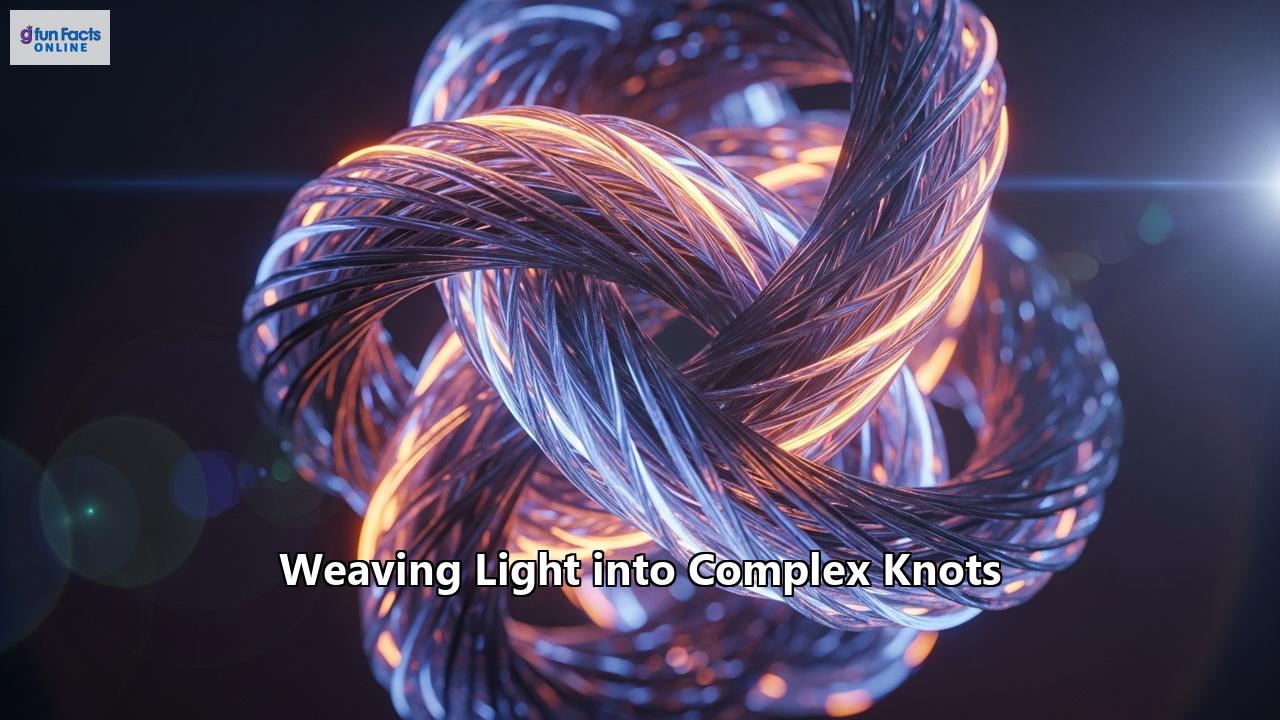
Imagine holding a beam of light in your hands, not as a straight, unwavering line, but as a pliable thread. Now, imagine skillfully weaving this thread into an intricate, three-dimensional knot, a structure as complex and beautiful as a Celtic design or a sailor's hitch. This is not a flight of fancy from the realm of science fiction; it is a stunning reality at the forefront of modern physics. Scientists are now able to tie light into knots, creating complex, stable structures of darkness and phase within a luminous field. These are not knots of a physical, tangible string, but rather of the very fabric of light itself—an achievement that is unlocking revolutionary possibilities across technology and science.
These "optical knots" are a testament to our growing mastery over the properties of light. They are born from the precise sculpting of laser beams, twisting their wave fronts into helical patterns that carry orbital angular momentum. Where these carefully crafted beams interfere, they can forge lines of pure darkness, called optical vortices or phase singularities. By expertly braiding these dark filaments, physicists can construct intricate and enduring topological structures—knots of nothingness suspended in a cage of light.
The true power of these light knots lies in their topology. Just as a physical knot in a rope retains its knottedness no matter how you stretch or bend it (as long as you don't cut it), an optical knot is robust. Its fundamental structure is protected by the mathematical laws of topology. This inherent stability makes knotted light a tantalizing candidate for a new generation of technologies, from ultra-secure communication channels and microscopic tractor beams to the very architecture of future quantum computers. This article will unravel the story of weaving light, tracing its journey from a curious 19th-century atomic theory to the cutting-edge laboratories of the 21st century, where the once-unimaginable is becoming routine. We will explore the fundamental physics that makes these structures possible, the ingenious methods used to create them, and the vast frontier of applications they promise to unlock.
A Tangled History: From Ether to Electromagnetism
The idea of knotted fields is surprisingly old, predating our modern understanding of light by decades. Its origins lie in the Victorian fascination with a hypothetical, all-pervading medium known as the luminiferous ether.
Lord Kelvin's Visionary, Albeit Incorrect, TheoryIn 1867, the brilliant physicist William Thomson, later known as Lord Kelvin, was captivated by a demonstration of smoke rings by his colleague Peter Guthrie Tait. He observed their remarkable stability and the way they could vibrate and interact without breaking. This sparked a visionary idea: what if atoms themselves were simply knotted vortices in the ether? Kelvin hypothesized that the different chemical elements corresponded to different types of knots. A simple, unknotted vortex ring could be a hydrogen atom, while a more complex trefoil knot might represent carbon. The sheer variety of possible knots seemed sufficient to explain the diversity of the elements known at the time.
Inspired by this powerful vision, Tait embarked on a decade-long project to classify and tabulate different types of knots, inadvertently giving birth to the mathematical field of knot theory. For about two decades, the vortex atom theory was a popular and compelling model among British physicists. It offered a framework that explained the permanence of atoms and their vibrational properties, which were just beginning to be observed in the form of spectral lines.
Ultimately, Kelvin's theory was proven incorrect. The discovery of the electron at the end of the 19th century and the failure to detect the ether in the famous Michelson-Morley experiment led the scientific community to abandon the vortex atom. However, the legacy of Kelvin's idea was profound. It had launched the formal mathematical study of knots, a field that would lie dormant in physics for nearly a century before re-emerging as the essential language for describing the very structures Kelvin had imagined.
The Maxwell Connection: A Modern RebirthThe modern understanding of optical knots is not based on a mythical ether, but on the solid foundation of James Clerk Maxwell's equations of electromagnetism. These four elegant equations, formulated in the 1860s, govern the behavior of electric and magnetic fields, and thus, of light itself. It turns out that knotted structures are mathematically permitted solutions to these very equations.
These are not knots of a physical medium, but rather stable, propagating configurations of the electromagnetic field. The field lines of electricity and magnetism can be woven into closed loops that are linked and knotted together, and these topological features can remain intact as the light beam travels through space. It wasn't until the late 20th and early 21st centuries that physicists began to fully appreciate this and develop the theoretical and experimental tools to create these solutions in the lab, breathing new life into Kelvin's century-old dream.
The Physics of Woven Light: Anatomy of an Optical Knot
To understand how a beam of light can be tied in a knot, one must first appreciate that a light beam is more than just a ray traveling in a straight line. It is a complex, three-dimensional field with properties like phase, polarization, and momentum that can be sculpted with incredible precision. The key building blocks of optical knots are peculiar features known as optical vortices.
Optical Vortices and Phase Singularities: The Threads of DarknessAn optical vortex is a point in a light field where the intensity is zero and the phase is undefined. Think of it as the calm eye of a hurricane made of light. Around this dark core, the phase of the light wave twists in a helical or corkscrew pattern as it propagates. This twisting wavefront is the defining characteristic of a vortex.
This twisting is not arbitrary; it is quantized. The "amount" of twist in a single wavelength is described by an integer called the topological charge. A charge of +1 means the phase spirals one full cycle (360 degrees) clockwise around the vortex, while -1 signifies a counter-clockwise spiral. Higher integer charges correspond to more rapid twists. The dark, null-intensity line that traces the center of the vortex as it propagates through space is known as a phase singularity. It is these lines of darkness that physicists have learned to braid and weave into knots.
The Role of Momentum and PolarizationThe helical wavefront of an optical vortex endows the light beam with a special property: Orbital Angular Momentum (OAM). This is a form of angular momentum that is distinct from the more familiar spin angular momentum, which is associated with the light's polarization (circularly polarized light has spin). OAM arises from the spatial distribution and rotation of the beam's phase structure. This momentum is not just a theoretical curiosity; it can be transferred to matter, allowing a vortex beam to exert a physical torque on microscopic particles and set them spinning—turning optical tweezers into "optical spanners." It is the ability to precisely control the OAM of light beams that provides the leverage needed to twist them into knotted configurations.
While many optical knots are created by structuring the phase of light (scalar knots), it is also possible to create knots in its polarization. The polarization of light describes the orientation of the electric field's oscillation. By creating beams where the polarization state varies in a complex, three-dimensional pattern, researchers can create knotted lines of a specific polarization state, for example, lines of pure circular polarization (C-lines). These are known as vector or polarization knots and offer another degree of freedom for encoding information.
The Language of Topology: What Makes a Knot a KnotThe robustness of optical knots comes from the mathematical field of topology, which studies properties of shapes that are preserved under continuous deformation.
- Knot Theory and Classification: In mathematics, a knot is a closed loop embedded in three-dimensional space that does not intersect itself. Knots are classified by their crossing number, which is the minimum number of crossings in any 2D projection of the knot. The simplest knot is the unknot (a simple circle, 0 crossings). The next simplest is the trefoil knot (3 crossings), followed by the figure-eight knot (4 crossings), and so on. Optical physicists have successfully created light beams containing knots of these types and even more complex ones, like torus knots, which can be drawn on the surface of a torus (a donut shape). When multiple, separate knotted loops are intertwined, they form a link.
- Topological Invariants: The power of knot theory comes from the existence of topological invariants—quantities or properties that are identical for two equivalent knots. These invariants, which can be numbers or even polynomials (like the famous Jones polynomial), do not change even if the knot is stretched or deformed. For an optical knot, this means its fundamental knottedness is protected. For instance, the number of vortex lines and how they are linked is a topological invariant. While external factors like atmospheric turbulence can distort the knot's shape, its underlying topology—the very thing that makes it a trefoil knot, for instance—can remain intact under certain conditions.
- The Hopf Fibration: On a deeper theoretical level, one of the elegant mathematical structures underpinning some knotted light fields is the Hopf fibration. First described by Heinz Hopf in 1931, it's a way of mapping a 3-sphere (a sphere in four dimensions) onto a standard 2-sphere. In this mapping, every point on the 2-sphere corresponds to a unique circle on the 3-sphere, and all these circles are linked together. Physicists have found that this structure can be used to construct exact solutions to Maxwell's equations where all the electric and magnetic field lines are closed, linked loops, forming a fundamental basis for creating knotted electromagnetic fields.
- Seifert Surfaces: Every knot can be thought of as the boundary of a special, orientable surface called a Seifert surface. Imagine dipping a wire knot into a soap solution; the soap film that spans the knot is analogous to a Seifert surface. This surface holds crucial information about the knot's properties, like its genus (the number of "holes" it has). In optics, the spaces between the knotted vortex lines can be described by Seifert surfaces, and analyzing these surfaces provides another powerful tool for characterizing the topology of the knotted light.
The Digital Loom: How to Create Knots of Light
Creating a knot of light is an act of extreme precision, requiring a combination of sophisticated theory and cutting-edge optical technology. The process is akin to digital weaving, where a computer-designed pattern is imprinted onto a beam of light to guide it into a knotted form.
The ToolkitThe primary components of a modern optical knot-tying setup include:
- Lasers: The process begins with a coherent light source, typically a laser. For generating more complex structures, specific types of laser beams are often used as a starting point. Laguerre-Gaussian (LG) beams, for example, are a class of laser modes that naturally possess a donut-shaped intensity profile and carry orbital angular momentum, making them ideal building blocks for vortex-based structures.
- Spatial Light Modulators (SLMs): The heart of the operation is the SLM, which acts as a "digital loom" for light. An SLM is essentially a high-resolution liquid crystal display that can be controlled by a computer. Instead of producing an image, it manipulates the properties of light passing through it or reflecting off it. Each pixel on the SLM can be individually addressed to impart a specific phase delay to the light at that point. This allows scientists to precisely sculpt the wavefront of a laser beam into almost any conceivable shape.
- Holography: The principle behind sculpting the light is holography. A computer is used to calculate a complex hologram—a specific phase pattern—which, when imprinted onto the light beam by the SLM, will cause the light to interfere with itself downstream in a highly controlled manner, creating the desired three-dimensional knot.
The journey from a simple laser beam to a complex optical knot generally follows these steps:
- Mathematical Design: The process starts on a computer. A physicist first chooses the desired knot topology, such as a trefoil knot (T(2,3)) or a figure-eight knot. Using mathematical formalisms, like those based on Milnor polynomials or other knot theory constructs, they derive the complex field of light—with its specific amplitude and phase variations—that represents this knot.
- Calculating the Hologram: The next step is to calculate the hologram that will produce this target field. This involves computing the specific, two-dimensional phase pattern that must be displayed on the SLM. This pattern is designed to transform the simple, flat wavefront of the incoming laser beam into the complex, twisted wavefront of the knotted beam after it propagates a certain distance.
- Programming the SLM: The calculated phase pattern is then loaded onto the SLM. A laser beam is expanded to cover the active area of the SLM. As the light reflects off (or passes through) the SLM, each part of the beam's wavefront is shifted in phase according to the pattern on the screen.
- The Optical Setup: The now-modulated beam propagates through a series of lenses. A common configuration is a 4f system, which essentially performs a Fourier transform on the light, translating the encoded pattern from the SLM into the desired knot structure at a specific point in space—the focal plane.
Since the knot itself is made of lines of complete darkness, it cannot be seen directly. Scientists must use clever techniques to verify its existence and map its structure:
- Interferometry: A powerful method is to interfere the knotted beam with a simple, undisturbed plane wave of light (a reference beam). The resulting interference pattern reveals the phase structure of the knot. A simple optical vortex shows up as a fork-like dislocation in the interference fringes; a knot produces a much more complex and characteristic set of branching and merging "forks" that can be used to trace the path of the dark vortex lines.
- Tomographic Reconstruction: To get a full 3D picture, researchers can scan a camera through the beam's volume, taking 2D slices of the intensity or interference pattern at different positions along the propagation axis. By stacking these slices and identifying the dark vortex cores in each one, they can computationally reconstruct the entire three-dimensional trajectory of the knotted vortex lines, confirming that the desired topology was successfully created.
Applications: The Power of a Topological Twist
The ability to weave light into complex, robust structures is more than just a scientific curiosity. It opens the door to a host of revolutionary applications that leverage the unique properties of these topological fields.
Optical Communication and CryptographyThe topological nature of optical knots makes them an exciting new platform for encoding information. Since a trefoil knot is topologically distinct from a figure-eight knot or an unknot, these different knot types can be used to represent different units of data (bits or bytes). The key advantage is robustness: because the knot's topology is resistant to minor perturbations, information encoded in this way could be transmitted through noisy environments, like turbulent air or water, with a much lower error rate than conventional methods.
Researchers have taken this a step further by creating framed knots. A framed knot can be visualized not just as a knotted line, but as a ribbon that is knotted. This "framing," which can be implemented by structuring the light's polarization field around the knot, provides an additional degree of freedom—the amount of twist in the ribbon. This twist can be used to encode information, and researchers at the University of Ottawa have proposed a security protocol where these framed knots are used to distribute secret cryptographic keys for secure communication.
Microscopic Manipulation: Optical Tweezers and SpannersStandard optical tweezers use a tightly focused laser beam to trap and hold microscopic particles like cells, colloids, or nanoparticles. Knotted light fields offer the potential for much more sophisticated three-dimensional manipulation. The intricate 3D structure of the light intensity and phase gradients in a knotted field can create complex potential energy landscapes, allowing multiple particles to be held and moved along prescribed three-dimensional paths. These could act as microscopic "tractor beams" or assembly lines for building micro-scale structures.
Furthermore, the orbital angular momentum inherent in the twisted structure of these beams can be used to create optical spanners. When a particle is trapped within a rotating light field, the OAM is transferred to the particle, causing it to spin. This allows for precise rotational control of microscopic objects, a feat with significant implications for biology, microfluidics, and the assembly of micromachines.
Sensing and MetrologyWhile the topology of an optical knot is robust, its geometric shape can still be distorted by the medium through which it travels. This apparent weakness can be turned into a powerful strength for sensing applications. Researchers at Duke University, led by Professor Natalia Litchinitser, have shown that by sending an optical knot through atmospheric turbulence, they can measure the strength of that turbulence by analyzing the degree to which the knot's structure is deformed or even broken. If the turbulence is strong enough, it can cause the vortex lines to break and reconnect, changing a trefoil knot into a simpler link or even an unknot. By quantifying these changes, the knot acts as a highly sensitive, 3D probe of the turbulent environment.
Probing Fundamental PhysicsOptical knots serve as a highly controllable tabletop platform for studying topological phenomena that are relevant in many other areas of physics. The mathematics that describes knotted vortices in light is analogous to that used for vortices in superfluids, Bose-Einstein condensates, and plasmas. By creating and manipulating knots of light in the lab, physicists can gain insights into the behavior of these more complex and difficult-to-access systems. For instance, firing a knotted light beam into a plasma could induce a similar knotted structure within the plasma itself, providing a new way to study and potentially control these high-energy states of matter.
The Cutting Edge and Future Frontiers
The field of knotted light is advancing at a breathtaking pace, moving beyond single, static knots into realms that sound like pure science fiction. Researchers are now exploring how to arrange these topological structures in space and time and how to harness their properties for the ultimate computational prize: a quantum computer.
Spacetime Crystals of LightRecent breakthroughs have shown that it's possible to create not just a single knot, but a repeating, crystalline lattice of them. An international research group has developed a blueprint for weaving hopfions—a type of knotted vortex in the light's polarization—into repeating crystals that extend through both space and time. By using two laser beams of different colors (bichromatic light), they can create a beating pattern where a chain of hopfions appears and reappears periodically in time. They have further outlined how arrays of tiny emitters could generate a full three-dimensional lattice of these light knots. These "spacetime hopfion crystals" could form the basis for incredibly dense and robust methods of processing and storing information in all-optical systems.
Quantum Knots and Topological ComputingPerhaps the most profound future application of knotted light lies in the quantum world. The topological protection that makes optical knots robust against classical noise also makes them an ideal candidate for building topologically protected qubits.
The goal of topological quantum computing is to encode quantum information not in the fragile state of a single particle, but in the global, topological properties of a system. The logic gates in such a computer would be performed by braiding the world lines of special quasiparticles called anyons. Because the outcome of the computation depends only on the topology of the braid, it is immune to small, local errors that plague current quantum computers.
Knotted light fields offer a potential pathway to realizing these ideas. Researchers are exploring how the topological features of light can be used to entangle photons in a robust way. The idea is that the shared topological properties of entangled particles could be preserved even when the entanglement itself decays, offering a new, resilient way to encode quantum information. While still in its infancy, the use of topological light to build the architecture for fault-tolerant quantum computers represents a holy grail for the field.
Challenges and the Road AheadDespite the incredible progress, significant challenges remain.
- The Stability Problem: As demonstrated by studies of knots in turbulence, their topological protection is not absolute. In strongly perturbative environments, the knots can break apart and lose their defining structure. A major area of ongoing research is the development of optimization algorithms to design more resilient knots, for instance, by maximizing the distance between the vortex lines to make them harder to disrupt.
- Scalability and Control: Creating simple knots like the trefoil is now well-established, but generating and controlling much more complex knots and links with high fidelity remains experimentally challenging.
- New Materials and Interactions: A largely unexplored frontier is how these intricately structured light fields will interact with novel materials. Could a knotted light beam be used to "tie" polymer chains or to catalyze chemical reactions in a specific, three-dimensional pattern?
Conclusion: A Glimpse of a Twisted Future
The journey of knotted light is a remarkable tale of scientific resurrection and innovation. An idea born from a flawed 19th-century vision of the atom has, through the lens of modern physics, blossomed into one of the most exciting and visually stunning frontiers in optics. By learning to weave the very fabric of light, we have moved beyond thinking of it as a mere carrier of energy and information and have begun to treat it as a building material.
The central insight is the power of topology. By encoding properties in the robust, global structure of a knot rather than in the fragile, local state of a wave, we open a new paradigm for controlling light and, through it, the world. The applications are no longer theoretical. From unbreakable cryptographic keys and microscopic tractor beams to sensitive environmental probes and the potential scaffolding for quantum computers, the power of a topological twist is poised to reshape technology.
We stand at the beginning of this new chapter. As our control over these complex light structures becomes ever more refined, we will undoubtedly discover new phenomena and applications we can currently only imagine. The unseen tapestry of light, with its intricate knots and links, is slowly being revealed, promising a future that is anything but straight and narrow.
Reference:
- https://arxiv.org/html/2406.06096v1
- https://www.sciencedaily.com/
- https://medium.com/swlh/topological-quantum-computing-5b7bdc93d93f
- https://webhomes.maths.ed.ac.uk/~v1ranick/papers/alex.pdf
- https://physicsworld.com/a/physicists-tie-light-into-knots/
- https://www.sciencedaily.com/releases/2025/08/250827010722.htm
- https://arxiv.org/abs/2406.06096
- https://validate.perfdrive.com/?ssa=42f20f6d-721d-0538-79de-2ca91a417ddc&ssb=62779286850&ssc=https%3A%2F%2Fopg.optica.org&ssi=741ee2c8-d3hy-67c2-6dd4-41360cdf56ae&ssk=botmanager_support@radware.com&ssm=77128957478533713109387925815500&ssn=97926b6d4179929a5c6596636c3cba7b1ee5bc0e1cb0-3606-1b4e-eb0cc8&sso=833b84e-e1fd-8a09788a60f6aadaa6234c9dff8d4b0c71b1dcac98ff5a9c&ssp=38237598341756381337175633306526612&ssq=52539860228280058951502282548814330868590&ssr=MTI0LjIxNy4xODkuMTMx&sst=python-requests%2F2.32.3&ssv=&ssw=
- https://dr.ntu.edu.sg/server/api/core/bitstreams/2b1c4e00-40e4-4f47-85b8-978b4693148c/content
- https://pmc.ncbi.nlm.nih.gov/articles/PMC11950510/
- https://www.physics.utoronto.ca/apl/knot/knots.pdf
- https://ncatlab.org/nlab/show/topological+quantum+computation
- https://medium.com/intuition/knots-in-quantum-computing-f91bc611dc88
- http://math.uchicago.edu/~may/REU2015/REUPapers/Adkisson.pdf
- https://en.wikipedia.org/wiki/Knot_invariant
- https://www.researchgate.net/publication/233385143_Discovery_of_an_Organic_Trefoil_Knot
- https://arxiv.org/pdf/2401.12306
- https://pubs.acs.org/doi/10.1021/jacs.4c05953
- https://en.wikipedia.org/wiki/Seifert_surface
- https://math.mit.edu/research/highschool/primes/circle/documents/2024/Carlos.pdf
- https://arxiv.org/abs/2407.18855
- https://www.researchgate.net/figure/Topological-characterization-and-seifertometry-of-an-optical-figure-eight-knot-a-d_fig3_326691152
- https://arxiv.org/abs/1101.3564
- https://www.techexplorist.com/quantum-entanglement-topology-inextricably-linked/79543/
- https://www.ucf.edu/news/ucf-researchers-advance-understanding-of-quantum-light-and-turn-loss-into-robustness/
- https://www.researchgate.net/figure/Experimental-generation-of-optical-framed-knots-a-Experimental-apparatus-used-to-generate_fig4_345997462
- https://www.sciencedaily.com/releases/2021/03/210330081254.htm
- https://mathcurve.com/surfaces.gb/seifert/seifert.shtml
- https://www.researchgate.net/publication/394830177_Space-Time_Optical_Hopfion_Crystals
- https://en.wikipedia.org/wiki/Topological_quantum_computer