
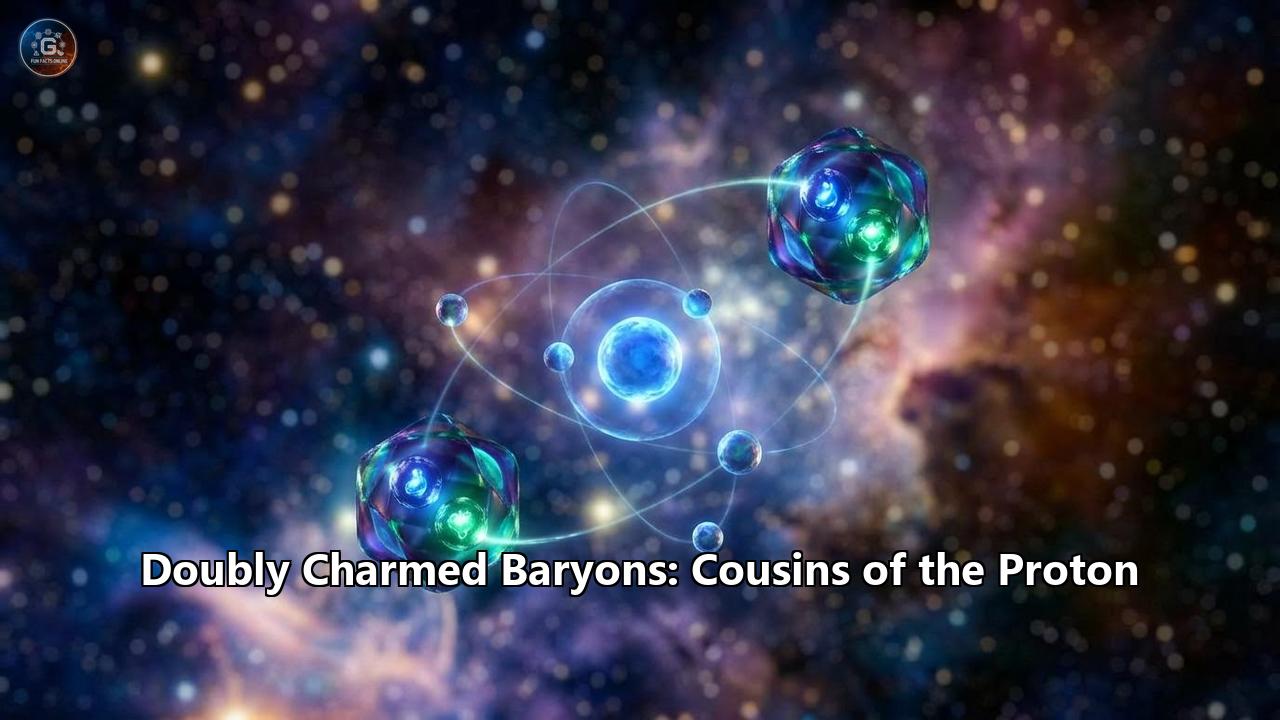
If you were to take a microscope to the universe, zooming past the cellular machinery of biology, past the crystalline lattices of molecules, and deep into the heart of the atom itself, you would eventually find yourself staring into a chaotic, subatomic cauldron. Here, inside the nucleus, the familiar protons and neutrons that make up the periodic table are not fundamental solid spheres, but rather buzzing metropolises of activity. They are made of even smaller entities known as quarks, bound together by the strongest force in the universe. For nearly a century, our understanding of this microscopic realm has been defined by a relatively small cast of characters. But the subatomic family tree is vastly larger and far more exotic than the protons and neutrons that construct our everyday reality.
Deep within the multi-billion-dollar subterranean particle smashers of the 21st century, physicists have been coaxing a hidden universe into brief, spectacular existence. Among the most fascinating of these newly materialized entities are the doubly charmed baryons—heavy, unstable, and exquisitely complex cousins of the familiar proton. These particles, containing not one, but two heavy "charm" quarks, offer a profound window into the quantum rules that govern the universe. Unlike the proton, whose internal quarks perform an elaborate, fluid dance, the doubly charmed baryon acts like a microscopic planetary system, complete with a binary star core and an orbiting planet.
The story of the doubly charmed baryon is a triumph of modern theoretical prediction, experimental ingenuity, and sheer perseverance. Spanning decades of false starts, immense technological upgrades, and mind-bending quantum mechanics, the successful identification and subsequent study of these heavy cousins of the proton represents a masterclass in modern particle physics.
To truly appreciate the majesty of the doubly charmed baryon, we must first embark on a journey through the architectural blueprints of reality: the Standard Model of Particle Physics.
The Standard Model is the crowning achievement of 20th-century physics, an intricately woven mathematical tapestry that describes all known fundamental particles and three of the four fundamental forces of nature (excluding gravity). According to this model, the visible universe is constructed from two primary classes of particles: fermions, which make up matter, and bosons, which act as the carriers of forces.
Fermions are further divided into leptons (such as the electron and the ghostly neutrino) and quarks. Quarks are the sociable introverts of the particle world; they are never found in isolation. Due to a phenomenon known as "color confinement," quarks are perpetually bound together in groups. These composite particles are collectively known as hadrons. When quarks pair up as a quark and an antiquark, they form short-lived particles called mesons. When three quarks bind together, they form a baryon.
The proton and the neutron—the building blocks of all the atoms in your body, the Earth, and the stars—are baryons. But the Standard Model tells us that the quarks making up protons and neutrons are just the tip of the iceberg.
Quarks come in six distinct "flavors," arranged into three generations of increasing mass.
The first generation consists of the up and down quarks. These are the lightest and most stable. A proton is composed of two up quarks and one down quark (uud), while a neutron is composed of one up quark and two down quarks (udd).
The second generation introduces the charm and strange quarks. These are significantly heavier and are typically only produced in high-energy environments, such as cosmic ray collisions or particle accelerators.
The third generation contains the top and bottom (or beauty) quarks. These are the heavyweights of the subatomic world. The top quark alone is roughly as massive as an entire atom of gold.
Because there are six flavors of quarks, the mathematical combinations of taking any three to form a baryon are vast. The universe, it seems, has a recipe book with hundreds of potential composite particles. If you swap out one of the light up or down quarks in a proton for a heavier quark, you create a "hyperon" or a heavy baryon. For decades, physicists observed singly heavy baryons—particles containing one charm or one bottom quark alongside two light quarks.
But the Standard Model's mathematics boldly predicted something even more extraordinary: the existence of baryons containing two heavy quarks and one light quark. These are the doubly heavy baryons, and among them, the doubly charmed baryons hold a special place in the hearts of physicists.
Imagine trying to build a solar system. If you take three celestial bodies of roughly equal mass, their gravitational interaction will result in a complex, chaotic, and highly intricate orbital waltz. This is analogous to the interior of a proton. The up and down quarks have very similar, very light masses. Bound together by the strong nuclear force—mediated by particles aptly named gluons—they move at relativistic speeds, zipping around one another in an elaborate, highly symmetric quantum dance. The strong force is so dominant here that the sheer kinetic energy of this dance generates nearly 99% of the proton's mass; the resting mass of the quarks themselves contributes almost nothing.
Now, change the parameters of your solar system. Introduce two supermassive black holes and one small, Earth-like planet. The dynamics change entirely. The two supermassive bodies will immediately lock into a tight, rapid binary orbit around their common center of mass. The tiny planet, meanwhile, will be cast into a wide orbit, circling the binary pair as if they were a single, central gravitational point.
This is exactly what happens inside a doubly charmed baryon. The charm quark is incredibly massive compared to the up and down quarks—weighing about 570 times more than an up quark. When two charm quarks and one light quark are bound together, the system undergoes a radical geometric shift. The two heavy charm quarks sink to the center, mutually attracting one another to form a tightly bound, heavy "diquark" core. This core acts like a binary star system. The remaining light quark—be it an up, down, or strange quark—orbits this central binary pair at a much greater distance, acting as the lone planet in this microscopic solar system.
This planetary analogy, frequently invoked by leading physicists, is not just a poetic metaphor; it is the physical reality dictated by Quantum Chromodynamics (QCD). QCD is the branch of theoretical physics that governs the strong nuclear force. It is notoriously one of the most mathematically excruciating theories in science. At high energies, the strong force becomes weak, allowing quarks to behave almost like free particles—a phenomenon called asymptotic freedom. But at low energies, such as the distances inside a proton, the strong force becomes incredibly powerful, leading to infinite complexities that render traditional mathematical tools, like perturbation theory, useless.
The doubly charmed baryon acts as the ultimate Rosetta Stone for deciphering QCD. Because of its unique structure, physicists can use mathematical approximations that are impossible to apply to the proton. They can treat the heavy binary core as a single, static point of color charge, using a framework known as Heavy Quark Effective Theory (HQET). By studying how the light quark orbits this core, and how the heavy quarks interact with each other, scientists can test the predictive power of QCD with unprecedented precision. If our theoretical models can accurately predict the mass, lifetime, and decay patterns of the doubly charmed baryon, then we know our fundamental understanding of the strong force is correct. If the predictions fail, it signals a crack in the Standard Model, potentially pointing the way to new, uncharted physics.
Knowing these particles should exist on paper is one thing; conjuring them into reality is a completely different endeavor. Doubly charmed baryons do not simply float around in nature. They existed in abundance during the first fraction of a second after the Big Bang, when the universe was an unimaginably hot, dense soup of fundamental particles. But as the universe expanded and cooled, these heavy particles instantly decayed into the lighter, stable matter that makes up our world today.
To recreate them, physicists must recreate the conditions of the Big Bang. This requires sheer, unadulterated energy.
The stage for this cosmic recreation is the Large Hadron Collider (LHC), a 27-kilometer ring of superconducting magnets buried 100 meters beneath the border of France and Switzerland. Operated by CERN (the European Organization for Nuclear Research), the LHC accelerates two beams of protons in opposite directions to 99.9999991% the speed of light. When these proton beams cross paths, they collide with cataclysmic energy, shattering the protons and converting their kinetic energy into raw mass, strictly following Einstein's iconic equation, $E = mc^2$.
Out of this microscopic fireball, hundreds of new particles condense into existence. But producing a doubly charmed baryon is an exceedingly rare and statistically improbable event. When the protons collide, the energy must materialize into two separate charm-anticharm quark pairs. Then, by sheer luck of quantum mechanics, two charm quarks must find themselves close enough together, moving in the same direction, with the correct quantum numbers, to bind together. Finally, they must capture a light quark from the surrounding debris to form the three-quark baryon. It is the subatomic equivalent of throwing two disassembled Swiss watches into a tornado and having them land fully assembled and perfectly synchronized.
To catch these fleeting phantoms, CERN utilizes the LHCb (Large Hadron Collider beauty) experiment. While general-purpose detectors like ATLAS and CMS are designed to look for heavy, slow-moving particles like the Higgs boson in all directions, LHCb is a specialized, forward-looking detector. It is designed specifically to capture particles containing heavy quarks (beauty and charm).
Because the incoming protons at the LHC collide head-on, particles containing heavy quarks are typically thrown heavily forward, along the line of the particle beam. The LHCb detector is built as a series of sub-detectors stretching out like a series of increasingly wide funnels. The most crucial component for finding doubly charmed baryons is the VELO (Vertex Locator).
The doubly charmed baryon is unstable. The moment it is born, the weak nuclear force begins tearing it apart. In a fraction of a picosecond, one of the heavy charm quarks undergoes a weak decay, transforming into a lighter quark and emitting a cascade of other particles. The baryon travels perhaps a few millimeters through the detector before it disintegrates. The VELO sits mere millimeters from the collision point, tracking the trajectories of the decay products with microscopic precision. By extrapolating these tracks backward, computers can find the exact point in space—the "displaced vertex"—where the doubly charmed baryon decayed.
But tracing the tracks is not enough. The detector must also identify exactly what particles were produced in the decay. For this, LHCb utilizes Ring Imaging Cherenkov (RICH) detectors. When a charged particle travels through a medium faster than the local speed of light, it emits a cone of bluish light, akin to a sonic boom. This is Cherenkov radiation. By measuring the angle of this cone, the RICH detectors can determine the velocity of the particle. Combined with momentum data from the magnetic trackers, physicists can definitively identify whether a decay product is a proton, a kaon, or a pion.
With the theoretical foundations laid and the experimental apparatus built, the hunt for the doubly charmed baryon began. But the road to discovery was fraught with controversy and confusion.
In the early 2000s, the SELEX (Segmented Large-X baryon spectrometer) experiment at Fermilab in the United States made a startling announcement. By firing a beam of high-energy hyperons (baryons containing strange quarks) into a fixed target, they claimed to have discovered the first doubly charmed baryon: the $\Xi_{cc}^{+}$ (a particle with two charm quarks and one down quark).
They reported a mass of 3519 MeV. The physics community was immediately polarized. While the discovery was groundbreaking if true, the reported mass was significantly lower than what theoretical models of QCD had predicted. Furthermore, the rate at which SELEX claimed to produce these particles was staggeringly high, defying theoretical expectations.
The ultimate test in science is reproducibility. A host of other formidable particle physics experiments took up the mantle to confirm the SELEX anomaly. The FOCUS experiment at Fermilab, the BaBar experiment at the Stanford Linear Accelerator Center, and the Belle experiment in Japan all combed through massive datasets of particle collisions. None of them found any trace of the particle at 3519 MeV.
When the LHC turned on, the LHCb experiment, with its unprecedented capability to produce and detect charm quarks, also searched for the SELEX particle. Again, the result was a definitive null. The phantom $\Xi_{cc}^{+}$ at 3519 MeV faded into the annals of experimental anomalies, a stark reminder of the incredibly difficult nature of high-energy data analysis, where statistical fluctuations can occasionally mimic the signal of a new particle.
The true breakthrough required patience, an immense amount of data, and the unparalleled power of the Large Hadron Collider.
In 2017, the landscape of particle physics was forever altered. On July 6, at the European Physical Society Conference on High Energy Physics in Venice, the LHCb collaboration formally announced the unequivocal discovery of the $\Xi_{cc}^{++}$ (pronounced Xi-cc-plus-plus).
This particle was the up-quark sibling in the doubly charmed family, containing two heavy charm quarks and one light up quark ($ccu$). The inclusion of the up quark gave the particle a double positive electrical charge, hence the "++" in its name.
The researchers found the $\Xi_{cc}^{++}$ by sifting through petabytes of data from proton collisions during both the 7 TeV and 13 TeV runs of the LHC. Because the particle decays almost instantly, it cannot be seen directly. Instead, physicists had to look for its specific decay signature. The $\Xi_{cc}^{++}$ was identified through a specific and highly complex decay chain: it decayed into a $\Lambda_c^+$ baryon (a singly charmed baryon containing an up, down, and charm quark) and three lighter mesons: a negative kaon ($K^-$) and two positive pions ($\pi^+$).
Finding this specific combination of four particles, all originating from a single displaced vertex a few millimeters away from the main proton collision, was like finding a specific grain of sand in a desert. But LHCb found over 300 of these events. The statistical significance of the discovery was completely unassailable. In particle physics, a discovery is formally recognized when it reaches a statistical significance of 5 sigma—meaning there is less than a 1 in 3.5 million chance that the result is a random background fluctuation. The LHCb measurement for the $\Xi_{cc}^{++}$ was far in excess of 5 sigma. It was a monumental, ironclad discovery.
The mass of the newly discovered $\Xi_{cc}^{++}$ was measured at approximately 3621 MeV. This is almost exactly four times the mass of a normal proton, roughly equivalent to the mass of an entire Helium-3 nucleus. Crucially, unlike the SELEX anomaly, this mass was in perfect alignment with the predictions made by Lattice QCD and other rigorous theoretical frameworks. The universe was behaving exactly as the Standard Model predicted it should.
Giovanni Passaleva, then-spokesperson for the LHCb collaboration, noted the profound impact of the discovery: "Finding a doubly heavy-quark baryon is of great interest as it will provide a unique tool to further probe QCD. Such particles will thus help us improve the predictive power of our theories".
Guy Wilkinson, former spokesperson for the collaboration, elegantly popularized the "planetary system" analogy during the announcement, cementing the particle's unique status in the public and scientific imagination.
The discovery of the $\Xi_{cc}^{++}$ was an enormous victory, but it was only the opening chapter. In science, discovering a particle is just the beginning; measuring its properties is where the true physics lies. Less than a year later, in May 2018, the LHCb collaboration announced another critical milestone at the CHARM 2018 international workshop in Novosibirsk, Russia: they had successfully measured the lifetime of the $\Xi_{cc}^{++}$.
By analyzing the microscopic distance the particle traveled before decaying, physicists determined that the $\Xi_{cc}^{++}$ lives for 0.256 picoseconds. A picosecond is one trillionth of a second (0.000000000001 seconds). To the human mind, this is an unimaginably short duration. But in the tempestuous realm of subatomic physics, this is actually considered "long-lived".
The particle's lifetime is a critical parameter because it is governed by the weak nuclear force, which dictates how the charm quarks decay into lighter quarks. The measured value of 0.256 picoseconds fell precisely within the range of 0.20 to 1.05 picoseconds predicted by theoretical physicists. This measurement confirmed that the fundamental mechanisms of quark decay, including complex quantum phenomena like "Pauli interference" (where the presence of an identical quark in the final state suppresses the decay rate), were functioning as expected in this new heavy environment.
But the Standard Model is a family affair. The discovery of the $ccu$ state immediately begged the question: where were its siblings? According to the mathematics, the $\Xi_{cc}^{++}$ ($ccu$) must have a partner containing a down quark instead of an up quark: the $\Xi_{cc}^{+}$ ($ccd$), with a single positive charge. There should also be a sibling containing a strange quark: the $\Omega_{cc}^{+}$ ($ccs$).
For years following the 2017 discovery, the LHCb and other experiments scoured their data for the $\Xi_{cc}^{+}$ ($ccd$). Theoretical calculations suggested that finding the down-quark sibling would be significantly harder. Although its mass would be nearly identical to the $\Xi_{cc}^{++}$, its lifetime was predicted to be drastically shorter—perhaps up to six times shorter. This rapid decay is due to a quantum mechanical process called W-exchange. In the $ccd$ baryon, a charm quark and the down quark can exchange a W boson, causing them to instantly annihilate into an up and strange quark, vastly accelerating the particle's destruction. Because it decays so quickly, it travels an even shorter distance from the collision point, making it incredibly difficult for the VELO detector to distinguish its decay from the background chaos of the primary collision.
The quest required more data and better technology. From 2019 to 2022, the Large Hadron Collider underwent a massive period of upgrades, transitioning into "Run 3." The LHCb detector was essentially completely rebuilt. The old tracking systems were replaced with state-of-the-art silicon pixel detectors, capable of reading out data at an astonishing 30 million times per second. The entire software trigger system was overhauled, allowing the experiment to run entirely on cutting-edge GPU architecture, analyzing collisions in real-time with unprecedented artificial intelligence algorithms.
The upgrades paid off spectacularly. In early 2026, at the prestigious Moriond conference—a traditional venue for groundbreaking physics announcements—the LHCb collaboration presented a historic finding. Analyzing the vast new datasets collected during the LHC's third run, physicists had finally cornered the elusive $\Xi_{cc}^{+}$.
The new particle, composed of two charm quarks and one down quark, was confirmed with a statistical significance of 7 sigma—far beyond the threshold for formal discovery. As theoretically anticipated, it was roughly four times heavier than the proton and exhibited a strikingly short lifespan, decaying much faster than its up-quark cousin. This provided definitive proof of the complex W-exchange mechanisms and the profound impact that a subtle difference in light quark flavor (up vs. down) can have on the overarching quantum stability of a heavy baryon. Vincenzo Vagnoni, LHCb Spokesperson, highlighted the monumental nature of the event, noting that it was the first new particle identified following the comprehensive 2023 detector upgrades, and only the second time a baryon with two heavy quarks had ever been observed.
The identification of both the $\Xi_{cc}^{++}$ and the $\Xi_{cc}^{+}$ solidifies the existence of the doubly charmed baryon family, but the hunt is far from over. The strange-quark sibling, the $\Omega_{cc}^{+}$ ($ccs$), remains an active target for researchers. Containing a strange quark, this particle bridges the gap between the charm sector and the strange sector of the Standard Model, promising further insights into the hierarchical mass structure of the universe.
Beyond that, the physics community's eyes are set on the ultimate heavy baryon: the triply charmed baryon, $\Omega_{ccc}^{++}$, composed of three heavy charm quarks. If a doubly charmed baryon is a binary star system with a planet, a triply charmed baryon would be a trinary star system of supermassive black holes. The theoretical implications for QCD in such a system are staggering. While its production rate is expected to be incredibly low, the continuous accumulation of data at the LHC and future planned facilities makes its eventual discovery a mathematical inevitability.
Furthermore, the techniques developed to find doubly charmed baryons have blown the doors wide open for the study of exotic hadrons. The traditional rules state that quarks bind in twos (mesons) or threes (baryons). But QCD does not strictly forbid larger aggregates. In recent years, physicists have discovered tetraquarks (four quarks) and pentaquarks (five quarks). Many of these exotics contain heavy charm quarks.
One of the most profound connections between doubly charmed baryons and exotic matter is the doubly charmed tetraquark, $T_{cc}^+$, discovered by LHCb in 2021. This particle contains two charm quarks, an anti-up quark, and an anti-down quark. The internal dynamics of the $T_{cc}^+$ are incredibly similar to the $\Xi_{cc}^{++}$. Both feature the tight, heavy charm-charm diquark core. By comparing the properties of the doubly charmed baryon (where the core interacts with one light quark) to the doubly charmed tetraquark (where the core interacts with two light antiquarks), physicists can isolate and map the exact mechanics of the strong force with unparalleled resolution.
The study of these heavy, microscopic planetary systems also has vast cosmic implications. While doubly charmed baryons decay instantly in our current epoch, understanding their internal pressures, energy states, and strong-force interactions helps astrophysicists understand the behavior of matter under extreme conditions. Deep in the core of neutron stars, matter is compressed to densities far exceeding that of an atomic nucleus. Some theories suggest that at the very center of the most massive neutron stars, the boundaries between individual protons and neutrons dissolve, creating a macroscopic fluid of free quarks—a quark star. The mathematical tools refined by studying the heavy diquark cores of doubly charmed baryons (like HQET and Lattice QCD) are the exact same tools needed to model the equations of state for this ultra-dense cosmic matter. What happens in the microscopic core of a particle at CERN echoes in the colossal gravitational collapse of dying stars across the universe.
As we look toward the future, the exploration of heavy quarks will continue to drive technological and theoretical innovation. The High-Luminosity Large Hadron Collider (HL-LHC), slated to begin operations in the 2030s, will increase the collision rate by a factor of ten, producing a veritable factory of doubly and possibly triply charmed baryons. Looking even further ahead, proposed colliders like the Future Circular Collider (FCC) in Europe or the Circular Electron Positron Collider (CEPC) in China aim to push the energy and precision frontiers to regimes where the heavy quark physics of today becomes the standard background of tomorrow.
The discovery and ongoing study of the doubly charmed baryons—from the pioneering detection of the $\Xi_{cc}^{++}$ in 2017 to the triumphant unveiling of the $\Xi_{cc}^{+}$ in 2026—stand as a testament to humanity's relentless curiosity. We are not content with merely observing the surface of reality. We have built machines of unprecedented scale and complexity to tear open the fabric of the universe, peer into the fleeting, high-energy echoes of the Big Bang, and reconstruct the mathematical symphony that orchestrates existence.
In these heavy cousins of the proton, we find a beautiful, microscopic reflection of the macroscopic cosmos. The binary dance of heavy quarks and their orbiting light companions remind us that the laws of nature are scalable, elegant, and profoundly deeply interconnected. Every new particle found is not just a stamp in a collection, but a newly illuminated word in the fundamental poetry of nature, bringing us one step closer to understanding the grand, unified architecture of everything.
Reference:
- https://physicsworld.com/a/first-doubly-charmed-baryon-spotted-by-lhcb/
- https://www.iflscience.com/lhcb-experiment-discovers-a-particle-with-two-heavy-quarks-42610
- https://scoap3-prod-backend.s3.cern.ch/media/files/67440/10.1088/1674-1137/abec68.pdf
- https://www.researchgate.net/publication/281076978_Search_for_Doubly_Charmed_Baryons_Xi_cc_and_Xi_cc_in_BABAR
- https://www.sci.news/physics/doubly-charmed-baryons-05019.html
- https://case.ntu.edu.tw/blog/?p=28609
- https://news.liverpool.ac.uk/2017/07/06/cern-experiment-discovers-a-new-very-charming-particle/
- https://quantumzeitgeist.com/lhcb-experiment-cerns-particle/
- https://www.researchgate.net/publication/401488864_Potential_of_discovering_X_c_c_in_L_decays
- https://home.cern/news/news/physics/long-live-doubly-charmed-particle
- https://oamonitor.ireland.openaire.eu/national/search/publication?pid=29219384
- https://www.reddit.com/r/Physics/comments/6ll40o/lhcb_observes_a_doublycharmed_baryon/
- https://longbridge.com/en/news/280024655
- https://www.researchgate.net/publication/399003495_Doubly_heavy_hadron_production_in_ultraperipheral_collision
- https://www.researchgate.net/publication/371823896_Tetraquarks_and_Pentaquarks_from_Quark_Model_Perspective