
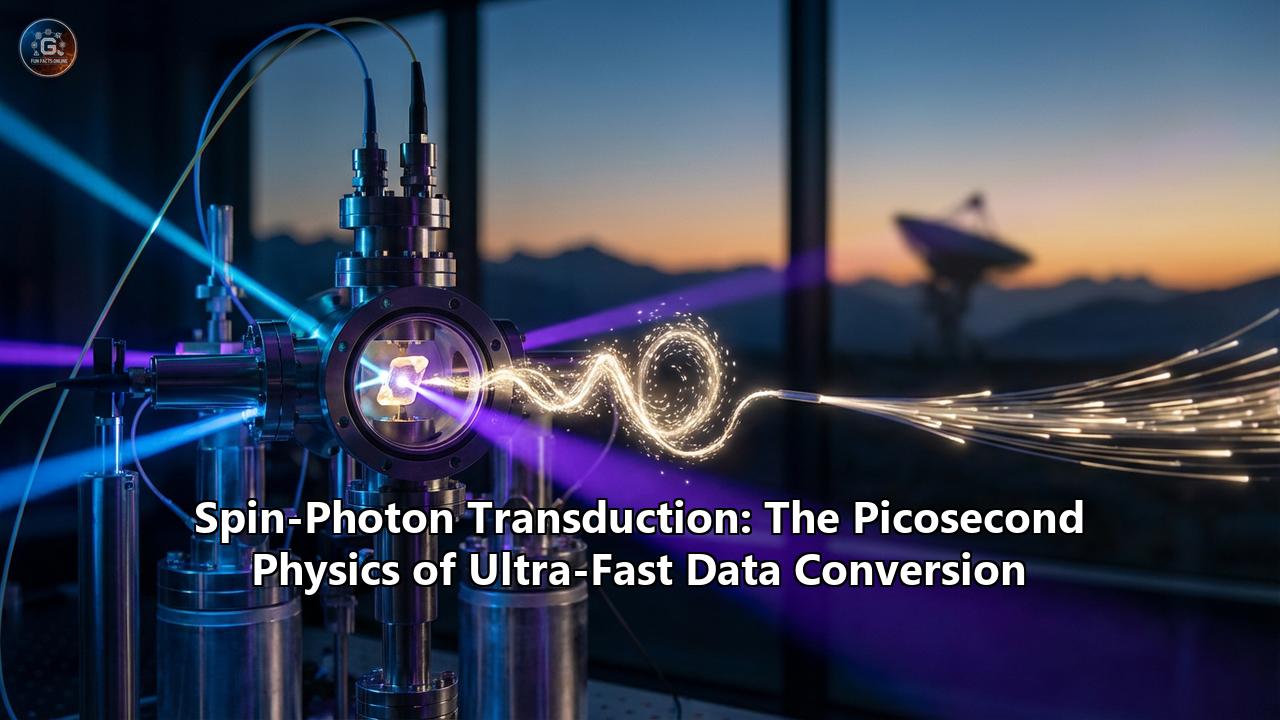
Introduction: The Speed Limit of the Electronic Age
For decades, the digital world has been governed by the rhythmic ticking of the electron. From the vacuum tubes of the 1940s to the 3-nanometer silicon transistors of today, the fundamental unit of computation has been the flow of electrical charge. But as we race toward the era of Exascale computing and Artificial Intelligence (AI) models with trillions of parameters, the electron is hitting a wall. That wall is thermal and temporal. Moving electrons through copper wires generates heat, and switching them on and off has a speed limit imposed by resistance and capacitance. We are approaching the "interconnect bottleneck," where processors are fast enough to solve the world's hardest problems, but they spend most of their time waiting for data to arrive.
Enter Spin-Photon Transduction. This is not merely an incremental improvement; it is a paradigm shift in physics. It replaces the shuffling of charge with the flipping of spin—the intrinsic angular momentum of particles—and links it directly to the fastest carrier of information in the universe: the photon.
By converting the quantum state of a spinning electron directly into a flying photon (and vice versa) on picosecond timescales (10⁻¹² seconds), we are unlocking a new regime of data conversion. This technology promises to merge the non-volatile, high-density memory of spintronics with the speed and bandwidth of photonics, creating a hybrid architecture that could power everything from next-generation AI data centers to the Quantum Internet.
Chapter 1: The Physics of "Spin" and "Light"
To understand why spin-photon transduction is revolutionary, we must first understand the physical chasm it bridges.
1.1 The Great Divide
In classical computing, information is stored as magnetic orientation (hard drives) or electric charge (DRAM/Flash). In optical communication, information is encoded in the phase, polarization, or intensity of light.
- Electrons are heavy, charged, and interact strongly with each other (which is good for processing but bad for transmission due to resistance).
- Photons are massless, neutral, and barely interact (which is perfect for transmission but terrible for processing/storage).
Traditionally, converting between these two worlds involves a clumsy, energy-intensive process: an electron hits a sensor, creates a cascade of charge, which is amplified electronically, processed, and then used to drive a laser to create a new photon. This "O-E-O" (Optical-Electronic-Optical) conversion introduces latency (nanoseconds to microseconds) and burns massive amounts of power (joules per bit).
1.2 The Picosecond Shortcut
Spin-photon transduction skips the "charge" step entirely. Instead of moving electrons, it flips their spin.
- Spin-Up ($\uparrow$): Represents a "1".
- Spin-Down ($\downarrow$): Represents a "0".
Through phenomena like the Optical Stark Effect and Spin-Orbit Interaction, a photon can directly impart its angular momentum to an electron, flipping its spin in mere picoseconds. Conversely, a relaxing electron spin can emit a photon with a specific polarization that encodes its state.
Why Picoseconds?The timescale is dictated by the strength of the interaction. In systems like TDK’s newly announced Spin Photo Detector, the mechanism relies on electron heating. When a photon hits a ferromagnetic material, its energy is transferred to the electron system in femtoseconds ($10^{-15}$ s). The electron system heats up, changing its magnetic properties (demagnetization) long before the atomic lattice has time to vibrate (which takes picoseconds). This decoupling of the "electron temperature" from the "lattice temperature" allows for switching speeds that are fundamentally impossible in semiconductor devices, which are limited by carrier drift velocities.
Chapter 2: The Materials Revolution
Achieving this subtle quantum handshake requires materials that exhibit strong "Light-Matter Coupling." Silicon, the workhorse of the 20th century, is notoriously bad at this because it has an "indirect bandgap"—it effectively refuses to emit light. The search for the perfect spin-photon interface has led physicists to exotic new material platforms.
2.1 Transition Metal Dichalcogenides (TMDs)
Materials like Molybdenum Diselenide (MoSe₂) and Tungsten Diselenide (WSe₂) are atomically thin 2D layers (often called "van der Waals materials").
- Spin-Valley Locking: In these 2D worlds, an electron’s spin is inextricably linked to its "valley" (a momentum index). This means you can control spin just by choosing the polarization of light (left-handed or right-handed circular polarization).
- The "Twisted Light" Breakthrough (Late 2025): Researchers at Stanford recently demonstrated a device where MoSe₂ is placed atop a silicon nanostructure. By using "twisted light"—photons carrying orbital angular momentum—they could efficiently impart spin to electrons at room temperature. This "corkscrew" interaction creates a robust interface where the photon's twist dictates the electron's spin state, enabling ultra-fast writing of magnetic memory.
2.2 Diamond Nitrogen-Vacancy (NV) Centers
Diamond is no longer just a gemstone; it is a quantum vacuum chamber. An NV center is a defect where a nitrogen atom replaces a carbon atom, creating a "hole" next to it. This defect acts like a single trapped atom.
- The Superpower: The spin of the NV center can be read out optically. Shine a green laser on it, and if the spin is "up," it glows red. If "down," it remains dark.
- Recent Advances: In late 2025, teams at Fraunhofer IAF (Project SPINNING) demonstrated entanglement between diamond spin registers separated by 20 meters. This proves that spin-photon transduction isn't just a lab curiosity; it can link quantum processors across a building.
2.3 Silicon-Vacancy (T-Centers)
For commercial viability, nothing beats silicon. The "T-center" is a specific defect in silicon (a radiation damage center) that emits light in the telecom O-band (1326 nm).
- Why it matters: This wavelength travels through standard optical fiber with minimal loss. Companies like Photonic Inc. are betting their future on this. They have developed "Entanglement First" architectures where silicon spin qubits are natively linked to telecom photons, allowing quantum processors to be networked using the same fiber that brings the internet to your home.
Chapter 3: Mechanism Deep Dive – How It Works
Let’s zoom in to the femtosecond-by-femtosecond physics of a Spin-Photon Interface.
3.1 The Write Cycle: The Optical Stark Effect
Imagine an electron in a quantum dot spinning "down." You want to flip it to "up" without waiting for a magnetic field (which is slow).
- T = 0 ps: You fire a laser pulse detuned slightly from the electron's resonance.
- T = 1 ps: The electric field of the light interacts with the electron. Through the AC Stark Effect, the energy levels of the spin states shift. The "virtual" absorption of photons creates an effective magnetic field (a pseudo-magnetic field) that exists only as long as the pulse lasts.
- T = 5 ps: This pseudo-field causes the electron spin to precess (rotate). By carefully timing the pulse length ($\pi$-pulse), you can rotate the spin exactly 180 degrees.
- T = 10 ps: The pulse is gone. The spin is now "up." Total time: < 20 picoseconds.
3.2 The Read Cycle: Cavity Quantum Electrodynamics (CQED)
To read the spin, we put the atom/defect inside a "nanophotonic cavity"—a tiny hall of mirrors.
- The Setup: The cavity is designed so that light can only pass through if the cavity resonance matches the laser frequency.
- The Interaction: The presence of the electron spin changes the cavity's refractive index (via the Kerr effect).
- The Outcome:
If Spin is $\uparrow$: The cavity is transparent. A photon passes through.
If Spin is $\downarrow$: The cavity is opaque. The photon bounces back.
- The Result: A digital "1" or "0" in the optical domain, read out instantly.
Chapter 4: Commercial Breakthroughs (2024-2025)
The transition from academic papers to engineering datasheets has begun.
4.1 TDK’s Spin Photo Detector (April 2025)
In a landmark announcement, TDK revealed the Spin Photo Detector, a device with a response time of 20 picoseconds.
- The Tech: It uses a Magnetic Tunnel Junction (MTJ) integrated with a photonic absorber.
- The Secret: It leverages the "Inverse Spin-Hall Effect" combined with ultrafast electron heating. Unlike a standard photodiode that waits for electron-hole pairs to drift to electrodes (slow), this device detects the instantaneous change in magnetization caused by photon absorption.
- The Impact: This allows for 10x faster data conversion than current semiconductor photodiodes, specifically targeting the AI server market where "optical-to-electrical" latency is a killer.
4.2 Photonic Inc. & The Quantum Internet
Vancouver-based Photonic Inc. has successfully demonstrated inter-module entanglement.
- The Achievement: They connected two separate silicon chips, each containing T-center qubits, using photons. This essentially creates a "distributed quantum computer."
- The Vision: Instead of building one giant, unstable quantum computer, you build thousands of small, stable chips and wire them together with light. This "modular" approach is the only realistic path to millions of qubits.
4.3 Oriole Networks: Light-Speed Learning
A spin-out from UCL, Oriole Networks is using photonics to rewire AI training clusters.
- The Bottleneck: In a GPU cluster (like NVIDIA H100s), the chips spend huge amounts of time "talking" to each other to synchronize weights.
- The Solution: Oriole uses an optical switching fabric that reconfigures connections in nanoseconds. While not strictly "spin" transduction, their technology relies on the same ultrafast optical physics to create a "super-brain" where thousands of GPUs act as one.
Chapter 5: The Future Applications
5.1 The AI Energy Crisis
Data centers currently consume ~2-3% of the world's electricity. As AI models grow, this could triple by 2030.
- The Problem: Moving data electrically across a chip is efficient. Moving it across a room (copper cables) is inefficient.
- The Spin-Photon Fix: Co-Packaged Optics (CPO) using spin-photon detectors can bring the fiber optic cable right onto the GPU silicon. TDK’s 20ps detector means we can convert that optical data to electrical signals for the GPU with zero bottleneck and negligible heat. This could cut the "interconnect power penalty" by 90%.
5.2 Quantum Key Distribution (QKD)
Security in the quantum age requires QKD—sending encryption keys as single photons.
- The Role of Transduction: To send a key over 1000km, you need "Quantum Repeaters." These are devices that catch a dying photon, store its quantum state in a spin memory (without measuring/destroying it), and then release a fresh photon. Spin-photon transduction is the heart of a quantum repeater. Without it, a Quantum Internet is physically impossible due to fiber loss.
5.3 Ultrafast Optical Logic
If we can write magnetic bits in picoseconds, we can theoretically build logic gates that run at THz (Terahertz) speeds—1000x faster than today’s 5GHz CPUs. While still experimental, "all-optical magnetization switching" suggests a future where computers don't just process electrons; they process light-matter states.
Conclusion: The Hybrid Era
We are witnessing the end of the "Electronic Era" and the birth of the "Hybrid Era." The segregation of duties—electrons for processing, photons for transmission—is collapsing.
Spin-Photon Transduction is the bridge. It is the picosecond translator that allows the massive, stable world of magnetic memory to speak the fleeting, light-speed language of the photon. As TDK’s detectors enter mass production and Photonic Inc.’s chips enter data centers, this obscure physics phenomenon is about to become the backbone of the next digital revolution. The future is not just electric; it is spintronic, photonic, and entangled.
Reference:
- https://www.tdk-electronics.tdk.com/en/374108/tech-library/articles/products-technologies/products-technologies/tdk-demonstrates-the-world-s-first-spin-photo-detector-capable-of-10x-data-transmission-speeds-for-the-next-generation-of-ai-/3566918
- https://www.eejournal.com/industry_news/tdk-demonstrates-the-worlds-first-spin-photo-detector-capable-of-10x-data-transmission-speeds-for-the-next-generation-of-ai/
- https://www.youtube.com/watch?v=qAVF236P7GE
- https://pubmed.ncbi.nlm.nih.gov/29371427/
- https://www.youtube.com/watch?v=-sZ2KALVDbQ
- https://arxiv.org/abs/1710.03265
- https://www.researchgate.net/figure/Observation-of-strong-exciton-photon-coupling-in-a-MoSe2-single-QW-heterostructure-a-A_fig1_276897321