
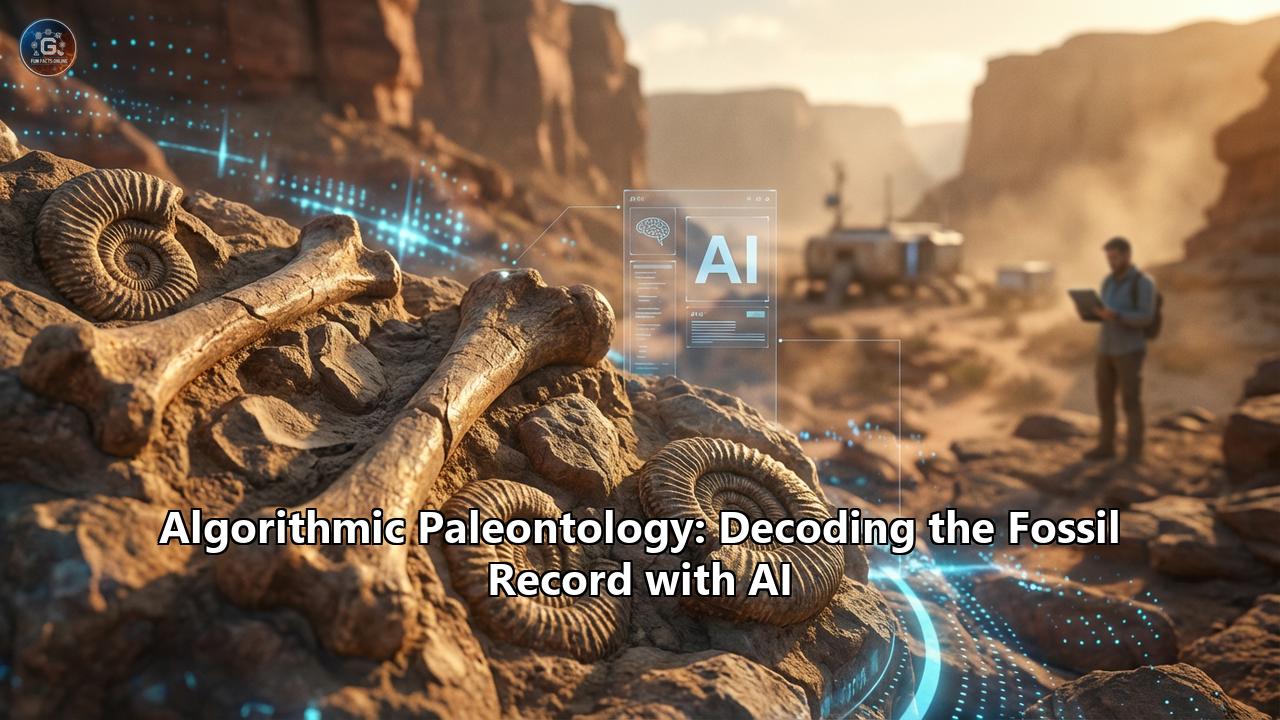
The winds of the Gobi Desert have not changed in eighty million years. They still scour the sandstone cliffs, whittling away the rock to reveal the dragons hidden within. For centuries, the tools of the paleontologist were as constant as those winds: the rock hammer, the chisel, the brush, and the patient, sun-baked eye of the human observer. It was a discipline defined by dust and grit, by the tactile connection between the living and the long-dead.
But today, a new wind is blowing through the badlands, and it carries no sand. It hums with the quiet cooling of server farms and the frantic processing of neural networks. The pickaxe is being joined by the pixel; the brush by the byte. We are standing on the precipice of a second Renaissance in the study of deep time, driven not just by the discovery of new fossils, but by a radical new way of seeing the ones we already have.
Welcome to the age of Algorithmic Paleontology.
In this new era, Artificial Intelligence is not merely a tool for sorting data; it is becoming a partner in discovery. From decoding the gait of a Tyrannosaurus rex through evolutionary robotics to predicting the location of hominid fossils using satellite eyes, AI is stripping away the noise of history to reveal the signal of life. This is the story of how algorithms are resurrecting the past, molecule by molecule, bone by bone, and ecosystem by ecosystem.
Part I: The Digital Hammer
Beyond the Visible Spectrum
The journey begins in the laboratory, where the "preparation" of a fossil—the delicate removal of rock (matrix) from bone—has traditionally been a task of agonizing slowness. A single dinosaur skull can take months, sometimes years, of manual labor to expose. One slip of an air-scribe can destroy millions of years of biological data.
Enter Computed Tomography (CT) and AI Segmentation.
Paleontologists have used CT scans for decades to peek inside concretions, but the resulting data is a chaotic cloud of grayscale voxels (3D pixels). Distinguishing a fossilized bone from a rock of identical density is a task that often stumps even the human eye. This is where Deep Learning steps in.
In 2024, researchers Knutsen and Konovalov published a breakthrough study demonstrating how Deep Learning models could automate the segmentation of fossil CT scans. By training a neural network on a mere 2% of a dataset—manually labeled slices of a Triassic reptile—the AI learned to distinguish the subtle textural differences between bone and stone. It then processed the rest of the dataset independently. What would have taken a human technician months of eyestrain was completed by the algorithm in days.
This "Digital Preparation" does more than save time; it saves the fossil. We no longer need to physically break a rock to see what is inside. We can virtually "dissolve" the matrix, rotating the pristine digital bone in 3D space.
The Retro-Deformation Engine
Fossils rarely arrive in perfect condition. They are crushed by geological pressure, sheared by tectonic shifts, or flattened like roadkill. A skull that was once spherical might look like a pancake today.
Restoring these fossils used to be an art form, subject to the sculptor's bias. Now, it is a mathematical operation. Retro-deformation algorithms reverse the geological distortion. By analyzing the symmetry of the skull and the known properties of bone deformation, AI can mathematically "inflate" the crushed fossil back to its original shape.
This was famously applied to the skulls of early hominids and protoceratopsians. In 2021, a team led by Yu et al. used deep neural networks to reconstruct the embryonic skulls of Protoceratops, revealing developmental traits that were invisible in the crushed specimens. The AI acted as a time machine, rewinding the geological clock to the moment before the sediment hardened.
Part II: The Pattern Hunter
The Microfossil Revolution
While dinosaurs capture the headlines, the true narrators of Earth’s history are the microscopic. Foraminifera, radiolarians, and pollen grains—trillions of these tiny fossils build the limestone beneath our feet. They are the primary indicators of ancient climates, ocean temperatures, and oil deposits.
But identifying them is a nightmare. A single teaspoon of ocean sediment might contain thousands of individuals, and distinguishing Globigerina bulloides from Globigerina falconensis requires a microscope and decades of training. There is a global shortage of human taxonomists capable of this work.
AI has become the ultimate taxonomist.
Systems like miCRAD (Microfossil Classification and Rapid Accumulation Device) now utilize Convolutional Neural Networks (CNNs) to identify these microfossils with accuracy rates exceeding 90%. These systems don't just match shapes; they learn the "gestalt" of the species, recognizing subtle variations in shell coiling and pore density that humans might miss.
The Fossil Image Dataset (FID), a massive repository of over 415,000 images, serves as the training ground for these networks. By ingesting this visual library, AI models are learning to classify life across 50 different clades, from the tiniest plankton to the teeth of vertebrates.
The Tooth Detective
Teeth are the most durable parts of the vertebrate skeleton and often the only things that survive. In the absence of a complete skeleton, a single tooth must tell the whole story.
Recent advancements in computer vision have led to automated tooth identification systems. By analyzing the slopes, serrations, and enamel patterns of isolated teeth, AI can determine not just the species, but the diet of the animal. Is this the tooth of a scavenger or a hunter? A browser or a grazer?
In 2025, researchers introduced a pipeline that could classify fossil teeth into herbivorous or carnivorous categories with stunning precision, purely based on geometric morphometrics fed into a machine learning classifier. This allows paleontologists to reconstruct the food web of an ancient ecosystem even when no bones are found.
Part III: The Time Traveler’s Map
Predictive Geospatial Modeling
Where do you dig?
For centuries, this question was answered by intuition, local rumors, and luck. Paleontologists would walk miles of badlands, hoping to spot a glint of enamel in the sun. Today, we look from the sky.
Satellite imagery combined with Neural Networks is revolutionizing prospecting.Fossils are not found randomly; they erode out of specific geological formations, usually sedimentary rocks of a certain age (e.g., the Late Cretaceous) and a certain lithology (sandstones or mudstones). They also need to be in areas with high erosion rates but low vegetation cover.
In the Great Divide Basin of Wyoming, researchers trained an Artificial Neural Network (ANN) to recognize the "spectral signature" of productive fossil sites. The AI analyzed satellite maps, looking for specific combinations of light reflection that indicate the right mix of sandstone and weathering. It flagged specific GPS coordinates as high-probability targets.
When the team went to those coordinates, they found fossils.
This technique was successfully replicated in the dense, difficult terrain of Gorongosa, Mozambique. Unsupervised learning algorithms analyzed satellite data to identify outcrops of the Rift Valley that were previously unknown. The result was the discovery of new fossil sites that filled a crucial gap in the African paleobiogeographic record. The "Ghost in the Machine" is now guiding the boots on the ground.
Part IV: The Reanimated Beast
Paleobionics: When Robots Walk the Earth
Bones are static, but life is kinetic. The greatest challenge in paleontology is understanding how these animals moved. Did T. rex run or power-walk? Did pterosaurs pole-vault into the air or run down a slope?
Traditional biomechanics involved wires and pulleys on museum mounts. Algorithmic Paleontology uses physics engines—the same technology that powers video games—to simulate millions of years of evolution.
The Orobates Project
One of the most spectacular successes in this field is the study of Orobates pabsti, a 300-million-year-old tetrapod that predates the dinosaurs. To understand how this animal walked—a key moment in the transition from water to land—researchers built a robot.
But they didn't just guess the gait. They used a high-performance computer to simulate thousands of potential gaits, scoring them based on energy efficiency and stability. They then matched these simulations against the fossilized footprints (trackways) the animal left behind.
The result was a "digital twin" of the animal's movement, physically enacted by the robot. The robot revealed that Orobates walked with a more advanced, upright gait than previously thought, rewriting the textbook on early tetrapod locomotion. This field, now dubbed Paleobionics, uses AI to "evolve" movement strategies in a virtual environment.
Simulating the Dinosaur
At Yale, researchers have taken this further with dinosaurs. By combining 3D scans of fossil bones with high-speed X-ray video of modern birds (the living descendants of dinosaurs), they created a new animation workflow.
The AI analyzes how the joints of a bird articulate during movement and maps those constraints onto the dinosaur skeleton. It tests millions of poses to find the ones that are anatomically possible—where bones don't clip through each other and ligaments don't snap.
This "Scientific Animation" has challenged the "gut instincts" of artists. It turns out that many popular depictions of dinosaur movement—the crouched, stalking poses of Velociraptors in movies—are biomechanically impossible. The AI shows us a stiffer, more efficient, and perhaps more terrifyingly mechanical mode of locomotion.
Part V: The Molecular Detective
Deep Time Chemistry
Fossils are not just shapes; they are chemical ghosts. For a long time, we believed that organic molecules degraded quickly, vanishing within a few million years. We were wrong.
Paleoproteomics (the study of ancient proteins) and Paleogenomics (ancient DNA) are frontiers exploding with AI potential.AlphaFold and the Extinct Proteome
DeepMind’s AlphaFold changed biology by solving the protein folding problem, predicting the 3D structure of proteins from their amino acid sequences. In paleontology, this has profound implications.
While DNA degrades relatively fast (the oldest is around 2 million years), proteins can last longer. If we can recover fragmentary protein sequences from fossil enamel or eggshell, AlphaFold can help us reconstruct what those proteins looked like and how they functioned.
Researchers are beginning to use these tools to predict the stability of "resurrected" proteins. For example, by inferring the ancestral sequence of a protein like hemoglobin in a mammoth, AI can model its structure to see how it adapted to the cold. We are no longer just guessing that mammoths had cold-adapted blood; we can simulate the molecule and watch it function in a virtual freeze.
The 3.3 Billion-Year-Old Life
In 2025, a team led by the Carnegie Institution for Science used AI to push the record of life back to 3.3 billion years. They analyzed carbon-rich material in ancient rocks using spectroscopy. To the human eye, the data looked like noise.
But a machine learning model, trained on the chemical "fingerprints" of modern biology and meteorites, saw the pattern. It identified the carbon as biogenic—created by life—with 90% accuracy. This wasn't just slime; the AI detected chemical signatures of photosynthesis, suggesting that life was terraforming the planet a billion years earlier than we thought.
Dating the Undatable
Radiocarbon dating stops working after 50,000 years. Dating older human fossils often relies on context (sediment layers), which can be disturbed.
Researchers at Lund University developed TPS (Temporal Population Structure), an AI method that dates ancient human genomes based on their DNA alone. By analyzing the drift and mutation accumulation in thousands of ancient genomes, the AI can pinpoint where a specific individual fits on the timeline. It can date a bone to 10,000 years ago just by reading its genetic code, bypassing the need for carbon dating entirely.
Part VI: The Ecosystem Architect
DeepDive and the Permian Extinction
Paleontology is ultimately the study of loss. The fossil record is a book with most of the pages ripped out. Reconstructing an entire ecosystem from a few bone fragments is a statistical nightmare.
DeepDive is an AI software designed to fill these gaps. It analyzes the "occurrence data"—where and when fossils are found—to reconstruct species richness over time.In a landmark study on the Permian-Triassic extinction (the "Great Dying," 252 million years ago), DeepDive revealed that the recovery of life took millions of years longer than simple counting of fossils suggested. The AI modeled the "ghost lineages"—species that must have existed but left no fossils—providing a harrowing, high-fidelity picture of a planet struggling to breathe.
Reconstructing Greenland’s Lost Jungle
Perhaps the most poetic triumph of Algorithmic Paleontology occurred in northern Greenland. Scientists extracted environmental DNA (eDNA) from 2-million-year-old soil. There were no bones, just microscopic fragments of genetic material bound to clay.
Using high-throughput sequencing and AI matching, they reconstructed a lost world. The barren polar desert of today was once a lush forest of poplar and birch, inhabited by mastodons, reindeer, and horseshoe crabs. The AI matched the fragmented ancient DNA against vast libraries of modern genomes, piecing together the members of this "Kap København" ecosystem.
It revealed a mix of species that have no modern analog—a community of animals living together that do not coexist anywhere on Earth today. The AI showed us that the past was not just a different version of the present; it was a unique ecological experiment.
Part VII: The Digital Twin
The Museum of the Future
The final frontier of Algorithmic Paleontology is not in the ground, but in the cloud. We are building a Digital Twin of Earth’s history.
Museums are digitizing their collections at a breakneck pace. Photogrammetry and laser scanning create millimeter-perfect models of bones. But AI takes this further, creating "semantic" models.
In the "Expedition Voyager" VR experience at Edelman Fossil Park, or the "Zeitreise" at the Städel Museum, AI manages the environment. It isn't just a pre-rendered movie; it is a simulation. The vegetation grows according to climatic models; the dinosaurs flock according to behavioral algorithms.
Google Arts & Culture brought the Giraffatitan of the Berlin Museum to life in VR. The skeleton in the hall is static, but through the lens of AI, visitors see the muscles attach, the skin pigment fill in (based on melanosome analysis), and the animal breathe.
This democratization of data means a student in rural India can study the holotype of Tyrannosaurus rex held in New York, measuring its femur in 3D space with the same precision as a curator.
Part VIII: The Ethical Algorithm
The Bone Rush and Data Sovereignty
With great power comes great responsibility, and Algorithmic Paleontology is not without its shadows.
There is a risk of a "Digital Bone Rush." As AI makes it easier to predict fossil sites, there is a fear that commercial collectors or looters could use these tools to strip-mine heritage sites before scientists can reach them. If a satellite AI can find a dinosaur, so can a poacher.
Furthermore, there is the issue of Data Sovereignty. Much of the world's paleontological wealth lies in the Global South (Africa, South America, Mongolia), while the servers and AI models are often owned by institutions in the Global North.
Indigenous Futurism and ethics scholars are raising the alarm. Who owns the "digital twin" of a fossil found on Indigenous land? If an AI reconstructs the genome of an ancient ancestor, who controls that data?
The "Game of Bones" is shifting to the digital realm. Ethical frameworks are being developed to ensure that "Digital Colonialism" does not replace the physical colonialism of the past. The future of AI in paleontology must involve collaborative, open-source models that empower local communities to be the guardians of their own deep time heritage.
Epilogue: The Future of the Past
We are building a mirror.
As our algorithms grow more sophisticated, the reflection in that mirror becomes sharper. We are moving toward a "Holodeck" of Deep Time—a fully simulated, physics-based, chemically accurate recreation of the Mesozoic Earth.
Imagine an AI that acts as a planetary simulator. You feed it the atmospheric composition of the Jurassic, the continental positions, and the known fossil species. The AI then fills in the gaps, simulating the weather patterns, the migration routes, the plant growth, and the predator-prey dynamics. It predicts where we should find fossils, and we go there to verify the model.
If the fossil fits the prediction, the model is refined. If it doesn't, the model learns.
This is the promise of Algorithmic Paleontology. It is the convergence of the oldest science—the study of the dead—with the newest science—the creation of artificial intelligence. It allows us to do the one thing that physics tells us is impossible: to travel back in time, and walk among the giants.
The dust of millions of years has met the silicon of the future, and together, they are waking the dead.
Reference:
- https://news.ssbcrack.com/ai-and-synthetic-biology-push-boundaries-of-de-extinction-science/
- https://www.youtube.com/watch?v=gg7WjuFs8F4
- https://medium.com/@jrparker07/a-walk-with-dinosaurs-ais-gift-of-prehistoric-virtual-tours-2f374c327ab7
- https://scitechdaily.com/ai-uncovers-hidden-traces-of-life-in-3-3-billion-year-old-rocks/
- https://www.sciencealert.com/scientists-reconstructed-a-2-million-year-old-ecosystem-from-ancient-dna
- https://www.goethe.de/ins/gb/en/kul/mag/20949031.html
- https://www.phocuswire.com/Google-brings-tourist-attraction-to-life-with-virtual-reality-dinosaurs
- https://www.preprints.org/manuscript/202307.1366