
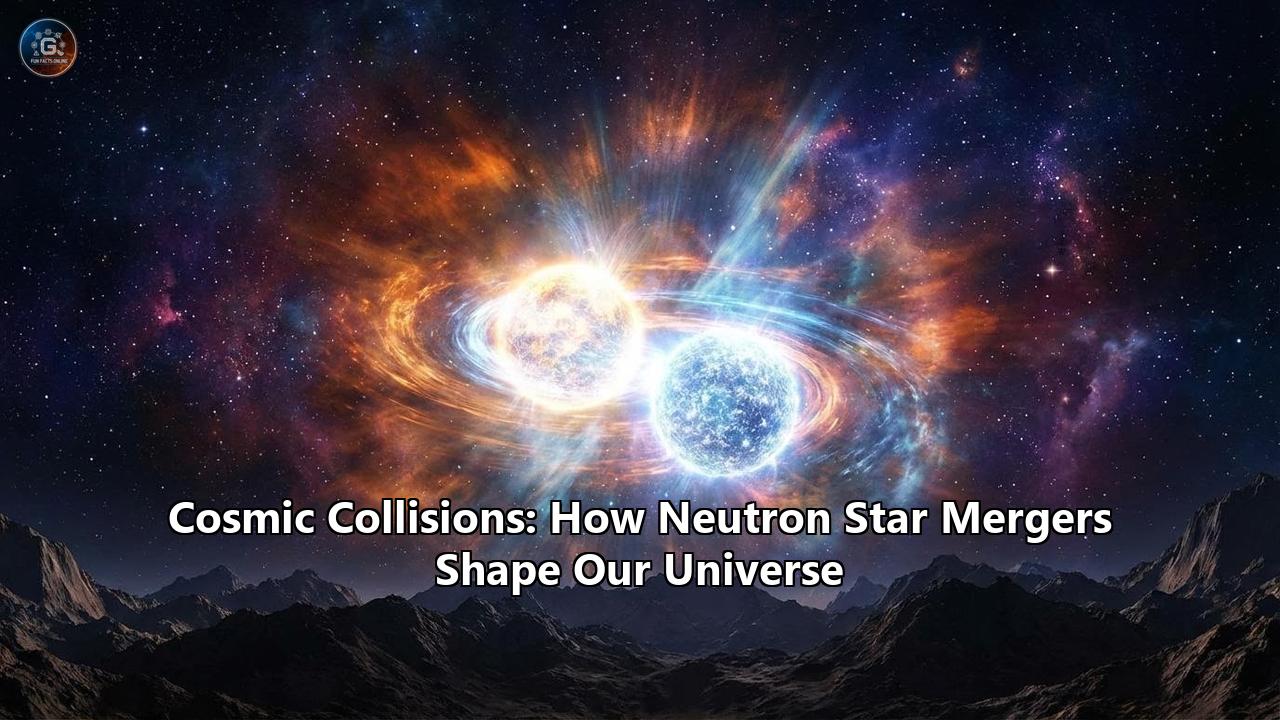
Deep in the silent, freezing expanse of the cosmos, a celestial dance of unimaginable violence is unfolding. Two stellar corpses, each the size of a single terrestrial city but containing more mass than our entire sun, are spiraling toward one another. For billions of years, they have circled in the dark, their orbital energy slowly bleeding away into the very fabric of spacetime. As the distance between them shrinks to a few dozen miles, their orbital speed approaches a fraction of the speed of light. In the final fraction of a second, they do not simply collide; they shatter the cosmic quiet, warping gravity, unleashing jets of high-energy radiation, and forging the heaviest, most precious elements in the universe.
This is a neutron star merger—the universe’s ultimate alchemical forge and one of the most extreme physical events known to modern science.
For decades, the mechanics of these cosmic collisions existed only on the chalkboards of theoretical physicists and in the silicon brains of supercomputers. But in recent years, a profound revolution in astrophysics has allowed us to not only witness these events but to hear them, analyze them, and trace the very origins of the heavy metals that make up our world. To understand how neutron star mergers shape our universe, we must first understand the bizarre nature of the objects themselves, the cataclysmic physics of their collision, and the multi-messenger astronomy that has finally brought them into the light.
The Anatomy of a Stellar Corpse
To appreciate the sheer scale of a neutron star collision, one must grapple with the mind-bending nature of a neutron star. They are the remnants of massive stars—typically those between eight and twenty times the mass of our sun. When such a star exhausts its nuclear fuel, the outward pressure of nuclear fusion ceases, and gravity takes over in a catastrophic instant. The star's core collapses inward, while its outer layers are blasted into space in a brilliant supernova explosion.
What remains is the core. The gravitational crush is so intense that protons and electrons are violently mashed together to form neutrons. The resulting object is supported against further collapse only by "neutron degeneracy pressure," a quantum mechanical phenomenon dictated by the Pauli exclusion principle, which states that no two neutrons can occupy the same quantum state simultaneously.
The physical properties of the resulting neutron star defy terrestrial logic. An entire star is compressed into a sphere merely 12 to 15 miles (20 to 24 kilometers) across. A single teaspoon of neutron star material would weigh roughly a billion tons on Earth—equivalent to the weight of Mount Everest. The gravity at its surface is hundreds of billions of times stronger than Earth’s, meaning that if you were to drop an object from a height of one meter, it would hit the surface at millions of miles per hour.
Structurally, a neutron star is thought to possess a solid, crystalline crust made of iron nuclei squeezed closer together than is possible on Earth. Beneath this crust lies a fluid mantle of neutrons, and deeper still, a region where the nuclear matter is squeezed into bizarre, pasta-like shapes—dubbed "nuclear pasta"—which may be the strongest material in the universe. At the very core, the pressure is so immense that physicists are still unsure of its exact nature; it may contain exotic states of matter, such as hyperons or a quark-gluon plasma.
When two such incomprehensible objects find themselves gravitationally bound in a binary system, the stage is set for a collision that will fundamentally alter their galactic neighborhood.
The Dance of Doom: Inspiral and Gravitational Waves
Neutron stars do not collide by chance. Space is vast, and the odds of two isolated neutron stars randomly bumping into each other are practically zero. Instead, they are born together. Most massive stars exist in binary systems—two stars orbiting a common center of mass. If both stars are massive enough to end their lives as supernovae, and if the binary system somehow survives the violent kick of two separate stellar explosions, they become a binary neutron star system.
According to Albert Einstein’s General Theory of Relativity, accelerating massive objects emit gravitational waves—ripples in the fabric of spacetime itself. As the two neutron stars orbit each other, they churn spacetime, radiating energy away in the form of these invisible waves. This loss of energy causes their orbit to slowly decay.
This inspiral phase lasts for hundreds of millions, or even billions, of years. For most of this time, the stars are millions of miles apart, slowly drawing closer. But as the orbit shrinks, the gravitational wave emission accelerates. In the final minutes, the stars are whipping around each other hundreds of times per second.
Historically, astrophysicists assumed that these extreme stellar pairs would settle into perfectly circular orbits long before their final collision due to the continuous radiating away of orbital eccentricity via gravitational waves. However, the universe constantly defies our expectations. A groundbreaking March 2026 analysis of a gravitational wave event known as GW200105—a collision between a black hole and a neutron star—revealed that the two objects spiraled together on a highly eccentric, oval-shaped orbit right up until the moment of their merger. This extraordinary discovery challenged long-standing models of orbital evolution, suggesting that some extreme binaries are born and merge in highly chaotic, densely populated stellar environments where constant gravitational tug-of-war prevents their orbits from circularizing. Such findings are reshaping our understanding of the dynamics that lead to the final, fatal plunge.
The Cataclysm: Tearing Spacetime Apart
The climax of the inspiral is a violent crescendo that lasts merely milliseconds. As the two stars touch, the immense tidal forces—the difference in gravitational pull across the width of the stars—tear their rigid crusts apart. Material is violently sheared off, forming a swirling, ultra-hot cloud of neutron-rich debris around the merging cores.
At the point of impact, temperatures skyrocket to hundreds of billions of degrees—vastly hotter than the core of our sun. The two objects smash together, creating a singular, hyper-dense mass. The fate of this newly formed remnant depends heavily on the combined mass of the original stars.
If the total mass is low enough, a new, single, incredibly massive neutron star may survive. However, in most observed cases, the combined mass exceeds the theoretical limit that neutron degeneracy pressure can support (the Tolman-Oppenheimer-Volkoff limit). When this happens, the remnant may briefly survive as a "hypermassive neutron star," sustained only by its furious rotation, before inevitably collapsing under its own gravity to form a stellar-mass black hole.
To understand the sheer complexity of these fleeting milliseconds, scientists rely on the world's most powerful supercomputers. In June 2025, an international team led by researchers at the Max Planck Institute for Gravitational Physics completed the longest and most complex simulation of a binary neutron star merger to date. Consuming an astonishing 130 million CPU hours, the simulation modeled 1.5 seconds of real-time physics, incorporating the dizzying effects of general relativity, neutrino radiation, and magnetohydrodynamics. The models revealed in explosive detail how the remnant rapidly collapses into a black hole, while the surrounding disk of matter dramatically amplifies magnetic fields through dynamo effects. These twisting, ultra-powerful magnetic fields act as a cosmic engine, ultimately launching narrow jets of matter and energy perpendicular to the collision at nearly the speed of light.
When these jets punch through the surrounding cloud of debris, they produce a high-energy flash known as a short Gamma-Ray Burst (sGRB). For decades, astronomers observed these fleeting, blinding flashes of gamma rays in the distant universe, suspecting they were the death cries of merging neutron stars. Today, thanks to the marriage of gravitational wave astronomy and traditional observational astronomy, we know this to be true.
The Alchemist’s Forge: Kilonovae and the R-Process
Perhaps the most culturally and chemically significant outcome of a neutron star merger is what happens to the material that doesn't fall into the newly formed black hole. During the violent shearing of the collision, a small fraction of the stars' mass—perhaps just 1% to 5%—is flung outward into space at velocities approaching a third of the speed of light.
This expanding cloud of debris is composed almost entirely of raw neutrons. In the normal universe, free neutrons are unstable; they decay into protons and electrons in about fifteen minutes. But in the ultra-dense, ultra-hot aftermath of a merger, a different kind of nuclear physics takes over: the rapid neutron-capture process, or the r-process.
To understand the r-process, we must look at the periodic table of elements. The Big Bang created only hydrogen, helium, and a tiny trace of lithium. Every element up to iron is forged in the nuclear furnaces of living stars. But iron is the ashes of stellar fusion; fusing iron absorbs energy rather than releasing it. Therefore, the creation of elements heavier than iron requires an explosive input of energy and a massive abundance of neutrons.
In the immediate aftermath of a neutron star merger, seed nuclei (like iron) are bombarded by the dense sea of free neutrons. The nuclei capture neutron after neutron so rapidly that they do not have time to radioactively decay. They swell into massive, highly unstable isotopes. As the debris cloud expands and cools, these bloated nuclei finally undergo beta decay, where some of their extra neutrons turn into protons, transforming them into entirely new, heavy elements.
This cosmic alchemy is responsible for forging roughly half of all the elements in the universe heavier than iron. When you look at a gold ring or a platinum necklace, you are looking at the direct consequence of a neutron star merger. Uranium, thorium, iodine, and rare-earth elements like neodymium (used in the magnets of our smartphones and electric cars) are overwhelmingly produced in these cataclysmic events.
As these newly forged, highly radioactive heavy elements decay, they release an enormous amount of heat. This heat makes the expanding cloud of debris glow intensely in optical and infrared light, creating a temporary astronomical event known as a kilonova. A kilonova can outshine an entire galaxy for a few days, but it fades rapidly, shifting from bright blue to deep red as the cloud expands, cools, and becomes transparent. The discovery and spectroscopic analysis of kilonovae provided the final, smoking-gun proof that neutron star mergers are the universe's primary gold factories.
GW170817: The Event That Changed Astronomy
The theoretical framework of gravitational waves, gamma-ray bursts, and kilonovae existed for years, but it was purely circumstantial until a fateful day in the late summer of 2017.
On August 17, 2017, the Advanced LIGO detectors in the United States and the Virgo detector in Italy registered a faint, oscillating chirp in spacetime. The signal, designated GW170817, lasted for roughly 100 seconds—a clear signature of two neutron stars spiraling inward. Just 1.7 seconds after the gravitational wave signal ended, NASA's Fermi Gamma-ray Space Telescope detected a short burst of gamma rays coming from the same general direction in the sky.
The astronomical community immediately mobilized in an unprecedented global campaign. By triangulating the gravitational wave data, scientists narrowed down the location of the source to a small patch of the southern sky. Within 11 hours, telescopes in Chile detected a bright optical transient—a kilonova—in the outskirts of NGC 4993, a lenticular galaxy located roughly 130 million light-years away.
GW170817 was a watershed moment. It marked the birth of "multi-messenger astronomy," a completely new way of observing the universe. For the first time in human history, scientists observed a cosmic event using both the ripples of gravity and the particles of light.
The scientific yield from this single event was staggering. By studying the light from the kilonova, researchers directly observed the spectroscopic signatures of heavy elements being synthesized in real-time. Later re-analysis of the spectra provided the first direct proof of the creation of strontium, yttrium, lanthanum, and cerium. It is estimated that this single merger produced a total of 16,000 times the mass of the Earth in heavy elements, including about 10 Earth masses of pure gold and platinum.
Furthermore, GW170817 allowed physicists to test the fundamental laws of nature. Because the gravitational waves and the gamma rays arrived across 130 million light-years essentially at the exact same time (separated only by the 1.7-second delay required for the jet to break through the debris), scientists proved that gravitational waves travel at the speed of light, confirming another major prediction of Einstein's general relativity.
The Cosmological Ruler: Measuring the Universe
Beyond alchemy and relativity, neutron star mergers offer a powerful new tool for cosmologists trying to understand the evolution of the universe itself. One of the greatest outstanding mysteries in modern physics is the "Hubble Tension." This tension arises from the fact that different methods of measuring the expansion rate of the universe (the Hubble Constant) yield conflicting results. Measurements based on the cosmic microwave background (the afterglow of the Big Bang) give one value, while measurements based on observing local supernovae give a slightly, but significantly, different value.
Neutron star mergers provide a completely independent way to measure the Hubble Constant by acting as "standard sirens".
When astronomers observe a gravitational wave signal from a merger, the amplitude of the waves directly tells them how far away the collision occurred. This is a pure, absolute distance measurement derived straight from the laws of physics, requiring none of the complex "distance ladder" calibrations used in traditional astronomy. Then, by locating the host galaxy of the merger with traditional telescopes, astronomers can measure its "redshift"—how fast the galaxy is receding from us due to the expansion of the universe.
By combining the absolute distance from the gravitational waves with the receding velocity from the light, scientists can calculate the Hubble Constant. GW170817 provided the first such measurement. While a single event isn't enough to definitively resolve the Hubble Tension, the forthcoming generation of gravitational wave detectors is expected to observe dozens, if not hundreds, of these mergers. By compiling these standard sirens, cosmologists hope to finally nail down the true expansion rate of the cosmos and perhaps uncover new physics driving dark energy.
Galactic Graveyards and Hidden Clues
While NGC 4993 was a relatively standard, older galaxy, the locations where neutron stars merge can be deeply surprising and offer clues into the deep history of the cosmos. For years, astronomers were puzzled by short gamma-ray bursts that appeared to happen in the middle of nowhere, far outside the dense stellar cores where one would expect such extreme binaries to exist.
A striking resolution to this puzzle arrived with the study of a staggering explosion detected in September 2023. Tracked by an array of NASA telescopes—including Chandra, Fermi, and Hubble—the massive blast of radiation, designated GRB 230906A, appeared to originate in seemingly empty space. However, deeper analysis published in March 2026 revealed a magnificent hidden structure: the neutron star merger had occurred inside an unknown "mini-galaxy" that was itself embedded within a colossal, 600,000-light-year-long river of gas and dust—the remnant debris of an ancient collision between much larger galaxies.
This "collision within a collision" proved that the violent galactic mergers of the early universe triggered massive waves of star formation in the tidal tails of gas ripped from the parent galaxies. These rogue stellar nurseries birthed massive stars millions of years ago, which eventually died, became neutron stars, and slowly spiraled together in the dark, isolated depths of intergalactic space. Observations like GRB 230906A remind us that the macroscopic violent history of galaxies is intimately tied to the microscopic nuclear alchemy of the neutron stars they leave behind.
The Future of the Frontier
The study of neutron star mergers is still in its infancy. The gravitational wave detectors LIGO (in the US), Virgo (in Europe), and KAGRA (in Japan) continually undergo upgrades, pushing their sensitivities deeper into the universe. With each observing run, the volume of space they can listen to expands exponentially.
Looking to the future, next-generation observatories promise to turn what is now a trickle of discoveries into a flood. Ground-based projects currently in development, such as the Einstein Telescope in Europe and the Cosmic Explorer in the United States, will possess arms tens of kilometers long. These marvels of engineering will be so sensitive that they could theoretically detect every single binary neutron star merger occurring anywhere in the observable universe.
In space, the Laser Interferometer Space Antenna (LISA) will search for lower-frequency gravitational waves, allowing us to map the gravitational landscape of the cosmos with unprecedented clarity.
As the data grows, astrophysicists hope to answer the lingering questions surrounding these cosmic collisions:
- The Equation of State: What exactly is inside a neutron star? By measuring precisely how the stars deform each other gravitationally right before they touch, physicists can finally determine the "equation of state" of ultra-dense matter, revealing whether the cores contain free quarks or other exotic particles.
- The Origin of the Elements: Are neutron star mergers the only source of the r-process in the universe, or do rare types of supernovae (like magneto-rotational supernovae or collapsars) also play a significant role? Studying the chemical signatures preserved in ancient, metal-poor stars continues to hint at additional sources of heavy element enrichment in the early galaxy.
- The Exact Fate of the Remnant: What is the precise mechanism that tips a hypermassive neutron star into black hole collapse, and how does the lifetime of that temporary remnant dictate the power of the resulting kilonova and gamma-ray burst?
The story of neutron star mergers is fundamentally a story about our own origins. We have long known that we are made of "star stuff"—that the calcium in our bones and the iron in our blood were forged in the hearts of dying stars. But the realization that the heavier, rarer elements require a completely different, infinitely more violent mechanism adds a layer of profound poetry to our existence.
Every piece of gold, every ounce of platinum, and every trace of iodine in our bodies is a silent testament to a cosmic collision. These elements were born in the millisecond fury of two city-sized atomic nuclei smashing together at the speed of light, deep in the void of space. By looking up, listening to the ripples of gravity, and watching the skies for the faint red glow of radioactive debris, we are not just studying the deaths of stars; we are reading the dramatic, violent, and beautiful origin story of the very matter that makes up our world.
Reference:
- https://www.sciencedaily.com/releases/2026/03/260311213432.htm
- https://www.birmingham.ac.uk/news/2026/oval-orbit-casts-new-light-on-black-hole-neutron-star-mergers
- https://www.mpg.de/24689430/simulating-how-neutron-stars-collide
- https://arxiv.org/abs/1710.05858
- https://www.frontiersin.org/journals/astronomy-and-space-sciences/articles/10.3389/fspas.2022.994980/full
- https://www.researchgate.net/publication/12776021_r-Process_in_Neutron_Star_Mergers
- https://en.wikipedia.org/wiki/GW170817
- https://arxiv.org/abs/2507.08760
- https://astrobites.org/2017/10/16/multi-messenger-observations-of-a-binary-neutron-star-merger/
- https://www.mdpi.com/2075-4434/13/5/112
- https://www.mdpi.com/2218-1997/8/9/459
- https://www.livescience.com/space/astronomy/a-collision-within-a-collision-neutron-star-merger-hiding-in-mini-galaxy-could-answer-2-big-astrophysics-questions
- https://www.space.com/astronomy/stars/hubble-and-nasa-space-telescopes-track-game-changing-gamma-ray-burst-back-to-neutron-star-collision-in-forbidden-region-of-the-universe