
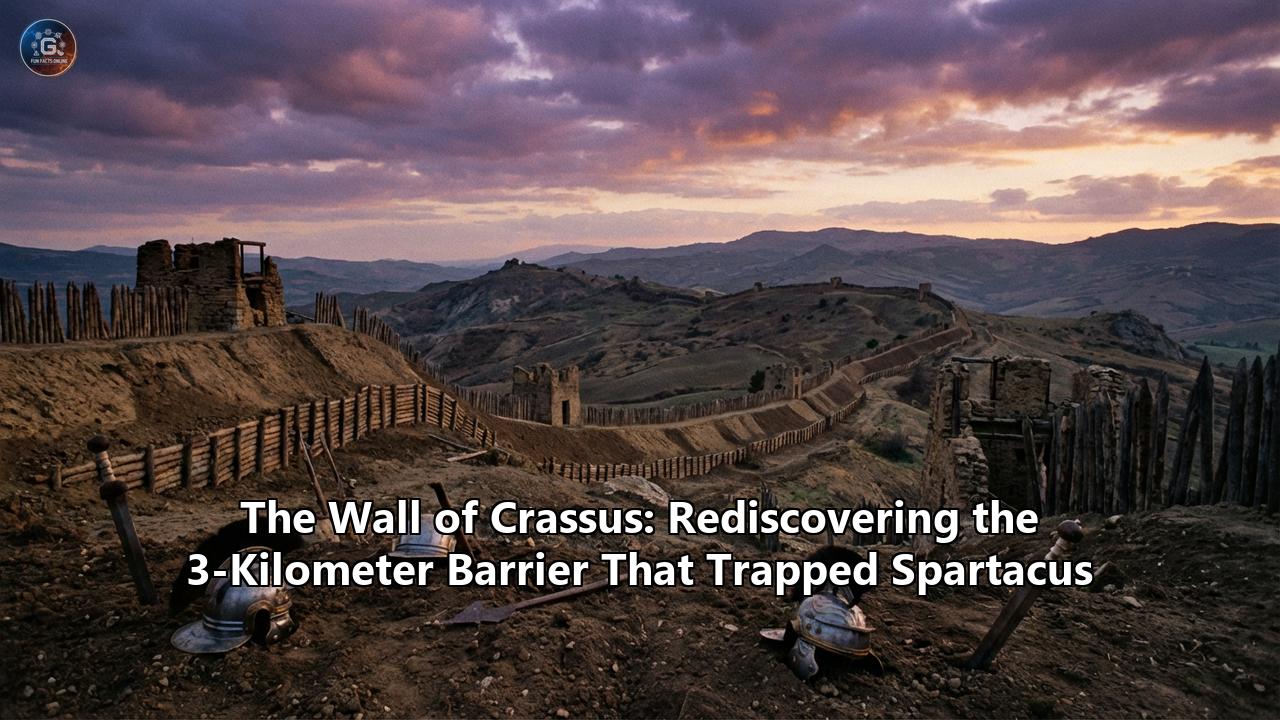
In the dense, shadowed forests of the Dossone della Melia in southern Calabria, a moss-covered spine of stone has lain hidden for two millennia. To the local hikers and mushroom foragers who occasionally stumbled upon it, it was just another old wall—perhaps a boundary marker for a long-forgotten farm, or a ruin left by the Greeks who once colonized this coast. But to the trained eye of history, this unassuming barrier tells a much darker and more dramatic story. It is the physical scar of one of the ancient world’s most desperate struggles: the moment the might of the Roman Republic finally cornered the most famous rebel in history.
This is the Wall of Crassus.
For centuries, historians relied on the dramatic accounts of Plutarch and Appian to understand the climax of the Third Servile War—the gladiator revolt led by Spartacus. They wrote of a massive fortification line, a "wall from sea to sea," built by the ruthless Roman general Marcus Licinius Crassus to bottle up the slave army in the toe of Italy. For just as long, the exact location and nature of this barrier remained a subject of debate and imagination. Now, a groundbreaking archaeological discovery has peeled back the layers of earth and time to reveal the truth. We have found the trap.
Part I: The Ghost in the Forest
The rediscovery of the Wall of Crassus is a testament to the power of modern technology married to old-fashioned curiosity. It did not begin with a grand university expedition, but with a tip-off. A local group of environmentalists in Calabria, passionate about preserving the natural beauty of the Aspromonte mountain range, had long been puzzled by a linear stone structure winding through the woods. It didn't fit the pattern of modern agricultural terraces, nor did it look like the medieval fortifications common in the region.
They contacted Dr. Paolo Visonà, an archaeologist at the University of Kentucky with deep roots in the region. Intrigued, Visonà assembled a team and brought to bear an arsenal of non-invasive technologies: Ground-Penetrating Radar (GPR), LIDAR (Light Detection and Ranging), and magnetometry.
What they found beneath the forest canopy was not merely a wall, but a complex military machine. The LIDAR scans stripped away the vegetation to reveal a distinct L-shaped fortification stretching for approximately 2.7 kilometers (1.7 miles). The GPR looked deeper, identifying the ghost of a deep ditch—a fossa—running parallel to the wall. This was the classic signature of Roman military engineering: the fossa (ditch) and agger (earthen rampart).
But the smoking gun lay in the soil itself. As the team carefully excavated sections of the barrier, they began to find metal. These were not farm tools or coins, but the debris of violence. Broken sword handles, large curved blades, javelin points, and a spearhead were pulled from the earth. The typology of the weapons was unmistakable: they dated to the late Republican period, specifically the first century BCE.
The location, the construction style, and the violent artifacts all pointed to one conclusion. This was the place where Spartacus, trapped and desperate, threw his army against the Roman legions in a bid for freedom.
Part II: The Rise of the Gladiator
To understand the significance of this wall, one must understand the sheer terror that necessitated its construction. By 71 BCE, the name "Spartacus" was not spoken in Rome with the sneering contempt usually reserved for slaves, but with a hushed fear.
The revolt had begun two years earlier, in 73 BCE, with a kitchen knife. Spartacus, a Thracian who had once served as an auxiliary in the Roman army before being enslaved, led a breakout of about 70 gladiators from a training school in Capua. They fought their way out with kitchen utensils before seizing a wagon of gladiator weapons.
Rome initially treated this as a minor police matter. They sent a praetor, Gaius Claudius Glaber, with a hastily assembled militia to deal with the runaways on Mount Vesuvius. Spartacus, displaying the tactical brilliance that would become his hallmark, used vines to rappel down a sheer cliff face and flank the Romans, annihilating them.
This victory was the spark. Thousands of slaves—shepherds, agricultural laborers, and house servants—flocked to Spartacus's banner. The "army" grew to 70,000, then perhaps 100,000 strong. They didn't just defeat Roman patrols; they crushed consular legions. They roamed the Italian peninsula at will, sacking cities and defeating every commander the Senate threw at them.
By 72 BCE, the Roman Republic faced a crisis. Their best generals, Pompey and Lucullus, were away fighting wars in Spain and the East. The heartland of Italy was being ravaged by an enemy that grew stronger with every victory. The Senate turned to the only man who had the wealth to raise an army and the ambition to accept a command that others feared: Marcus Licinius Crassus.
Part III: The Richest Man in Rome
Crassus was a man defined by a chip on his shoulder. Though he was the wealthiest man in Rome—owning silver mines, vast estates, and even a fire brigade that bought burning houses at a pittance—he lacked the military glory of his rival, Pompey the Great. Crassus viewed the war against Spartacus not just as a duty, but as a necessary stepping stone to political dominance.
He took command with a terrifying seriousness. When one of his lieutenants, Mummius, disobeyed orders and engaged Spartacus in open battle—resulting in a cowardly rout—Crassus revived an ancient and brutal punishment: decimation. He took the 500 soldiers who had led the flight, divided them into groups of ten, and forced them to draw lots. The loser in each group was beaten to death by his nine comrades.
The message was clear: Crassus’s soldiers should fear their general more than they feared the enemy. Discipline was restored instantly. The legions that marched south under Crassus were a different beast—grim, silent, and relentlessly professional.
Crassus chased Spartacus down the length of Italy. The rebel leader had initially marched north toward the Alps, presumably to escape into Gaul or Thrace. But for reasons historians still debate—perhaps pressure from his followers who wanted to keep looting, or a belief that they could conquer Rome itself—he turned back south.
It was a fatal mistake. Crassus herded them inexorably toward the "toe" of the Italian boot: the region of Bruttium (modern Calabria). Spartacus had a new plan: he would cross the Strait of Messina to Sicily. The island had a history of massive slave revolts; if he could land there, he could reignite the fires of rebellion and perhaps hold the island as a kingdom of the free.
He negotiated with Cilician pirates to ferry his army across the strait. Spartacus paid them, likely with the plunder of two years of raiding. But the pirates, perhaps bribed by the Roman governor of Sicily or simply treacherous by nature, took the gold and sailed away.
Spartacus was stranded. He was at the very tip of Italy, with the sea at his back and the hostile Aspromonte mountains ahead. And marching toward him was Crassus with eight legions—nearly 40,000 heavy infantry.
Part IV: The Engineering of Entrapment
Crassus arrived and assessed the geography. He realized he didn't need to fight a risky pitched battle against desperate men. He just needed to keep them where they were. Winter was approaching. The rebels had thousands of mouths to feed and no supply lines. If he could lock the door to the peninsula, hunger would do the work of swords.
Plutarch describes the scale of Crassus's ambition:
"Crassus now came up, and observing that the nature of the place suggested what must be done, he determined to build a wall across the isthmus, thereby at once keeping his soldiers from idleness, and his enemies from provisions."
The Greek historian claims the wall ran "from sea to sea," a distance of 300 stadia (roughly 55 kilometers or 35 miles). For years, scholars puzzled over this. Building a continuous stone wall of that length in the rugged terrain of Calabria in a matter of weeks seemed impossible, even for Romans.
The discovery in the Dossone della Melia forest clarifies the reality. The 2.7-kilometer section found by Dr. Visonà’s team was likely the "keystone" of the blockade. The "isthmus" Plutarch refers to is not a flat neck of land but a rugged contraction of the peninsula. The Dossone della Melia is a high plateau that serves as the only viable pass through the spine of the Aspromonte mountains. By fortifying this strategic corridor and linking it with natural barriers—sheer cliffs, deep ravines, and dense forests—Crassus effectively created a continuous line of containment.
The engineering was textbook Roman siegecraft.
- The Fossa (Ditch): First, the legionaries dug a massive trench. Plutarch says it was 15 feet wide and 15 feet deep. The archaeological evidence confirms a deep, V-shaped ditch running parallel to the wall. This was the first line of defense, designed to break the momentum of a charge and trap attackers in a kill zone.
- The Agger (Rampart): The earth dug from the ditch was piled up on the Roman side to create a raised embankment. This gave the legionaries the high ground, allowing them to rain pila (javelins) down on anyone attempting to cross the ditch.
- The Vallum (Wall): On top of the embankment, or reinforcing it, was the stone wall itself. The section found in the forest was built of dry stone, a "cyclopean" effort constructed quickly but robustly. In some sections, it may have been topped with a wooden palisade.
This was not a border wall; it was a prison war. It faced inward, toward the toe of the boot. Crassus posted sentries along its length, with camps at regular intervals. He effectively turned the entire region of Reggio Calabria into a massive concentration camp.
Part V: The Winter Siege
Inside the trap, conditions deteriorated rapidly. The rebel army, numbering tens of thousands of men, women, and children, quickly stripped the countryside bare. There was no food. The winter storms of the Aspromonte are fierce, with biting winds and snow accumulating on the high ground.
Spartacus tested the line. He sent skirmishers to probe for weaknesses, but the wall was solid, and the Roman discipline held. The rebels were reduced to eating their pack animals, and eventually, desperation set in.
Crassus, meanwhile, was growing anxious. News had arrived from Rome that Pompey had returned from Spain and was marching south with his legions. If Pompey arrived before Spartacus was defeated, the triumph would be shared, or worse, stolen. Crassus needed the end to come now.
Spartacus, realizing that time was his enemy as much as the Romans were, decided on a gamble. He could not defend against starvation. He had to break out.
Part VI: The Storm and the Breach
The breakthrough happened on a night of "wintry storm," according to Plutarch. A blizzard or heavy snow masked the movement of the rebel army.
Spartacus chose a specific point along the wall—perhaps the very section discovered by the archaeologists in the Dossone della Melia. The archaeological evidence here tells a chaotic story. The weapon finds are concentrated in a specific area, suggesting a focused, intense assault rather than a general battle along the whole line.
The tactic Spartacus used was horrific and ingenious. The ditch was too deep to cross and too wide to jump. To bridge it, the rebels threw in everything they had. They tossed in bundles of wood, branches, and earth. But that wasn't enough. Historical accounts, echoed by the grim legends of the war, suggest they filled the ditch with the carcasses of their dead horses and cattle. Some sources even whisper that the bodies of dead prisoners or slain rebels were used to create a bridge of flesh over which the living could charge.
The discovery of the broken weapons paints a vivid picture of what happened next.
- Javelin Points: The Romans would have unleashed a volley of heavy pila as the rebels scrambled across the filled ditch. These weapons were designed to punch through shields and armor, bending on impact so they couldn't be thrown back.
- Curved Blades: Iron blades found at the site likely belonged to the rebels—perhaps modified agricultural scythes or sica blades (a curved Thracian dagger) favored by gladiators.
- Sword Handles: The presence of broken handles suggests hand-to-hand combat so fierce that weapons snapped.
The rebels swarmed up the agger, clawing at the stone wall. In the darkness and the driving snow, the Roman line buckled. A third of Spartacus’s army managed to cross the barrier before the alarm could be fully raised and reinforcements brought to bear.
Spartacus had escaped the cage.
Part VII: The End of the War
The breakout was a tactical success but a strategic failure. Spartacus was free of the wall, but his army was divided and weakened. The rebels who had failed to cross were easily mopped up by Crassus's legions.
Spartacus fled north, toward the mountains of Lucania (modern-day Basilicata). But he was no longer running toward freedom; he was running to find a battlefield where he could die on his own terms. The psychological toll of the siege and the breakout had fractured the rebel leadership. A large contingent of Gauls and Germans split off from the main body, perhaps arguing over the route, and were promptly slaughtered by Crassus.
The final act took place near the headwaters of the Silarus River. Spartacus, realizing he could not outrun Crassus and with Pompey closing in from the north, turned his army around to face his pursuer.
It was a battle of annihilation. Spartacus, dismounting his horse to fight on foot with his men, tried to cut his way directly to Crassus. He killed two centurions but was eventually surrounded and cut down. His body was never identified—he was hacked to pieces in the crush of the melee.
The aftermath was one of the cruelest spectacles in Roman history. Crassus captured 6,000 survivors. To ensure that no slave would ever again dream of rebellion, he had them crucified along the Appian Way. For 200 kilometers, from Capua to Rome, a dying man hung every forty yards.
Part VIII: The Legacy of the Wall
The Wall of Crassus faded from memory. The stones were scavenged by local farmers to build sheep pens or terrace walls. The ditch filled with silt and leaves. The forest reclaimed the battlefield.
For 2,000 years, the "wall from sea to sea" was just a line in a history book, a detail that might have been exaggerated by ancient writers to make Crassus look more impressive.
The rediscovery changes that. It validates the ancient texts in a profound way. Plutarch wasn't inventing a myth; he was describing a massive military engineering project that actually existed. The 2.7-kilometer section in the Dossone della Melia confirms that Crassus did indeed try to "cork the bottle" of Italy.
Dr. Visonà's team has done more than map a wall; they have located a moment of terrifying human drama. Standing in that forest today, looking at the mossy stones and the subtle depression of the ditch, one can almost hear the wind howling through the trees, the shouts of officers in Latin, the screams of the rebels in a dozen tongues, and the clash of iron on iron.
This wall is a monument to the lengths an empire will go to maintain control, and the desperate fury of those who would burn the world to be free. Spartacus lost, and his army was destroyed. But the fact that the Roman Republic had to build a Great Wall in the middle of Italy just to stop him proves that for a brief, shining moment, the gladiator made Rome tremble.
Sources & Further Reading:- Plutarch, Life of Crassus
- Appian, Civil Wars
- Archaeological Institute of America Reports (2024)
- Dr. Paolo Visonà, University of Kentucky Research Findings
Reference:
- https://www.smithsonianmag.com/smart-news/archaeologists-discover-the-roman-wall-spartacus-broke-through-with-his-rebel-army-180984738/
- https://www.stone-ideas.com/107984/stone-wall-rome-against-spartacus-rebels/
- https://archaeologymag.com/2024/07/roman-wall-and-site-of-clash-with-spartacus/
- https://www.lavanguardia.com/mediterranean/20240712/9801029/site-epic-battle-spartacus-discovered-forest-italy-slave-rome-empire-calabria-gladiator.html
- https://penelope.uchicago.edu/Thayer/E/Roman/Texts/Plutarch/Lives/Crassus.html
- https://en.wikipedia.org/wiki/Marcus_Licinius_Crassus
- https://www.storiespreschool.com/third_servile_war4.html
- https://www.britannica.com/event/Gladiatorial-War
- https://www.reddit.com/r/history/comments/1dszur5/wall_built_to_contain_spartacus_discovered/
- https://www.reddit.com/r/AskHistorians/comments/ru9oyx/if_spartacus_objective_during_the_third_servile/
- https://www.miamiherald.com/news/nation-world/world/article290340549.html
- https://www.storiespreschool.com/third_servile_war2.html
- https://archaeology.org/news/2024/07/18/roman-fortification-wall-identified-in-southern-italy/
- https://www.warhistoryonline.com/news/spartacus-marcus-licinius-crassus-wall-discovery.html
- https://www.sci.news/archaeology/spartacus-wall-13239.html