
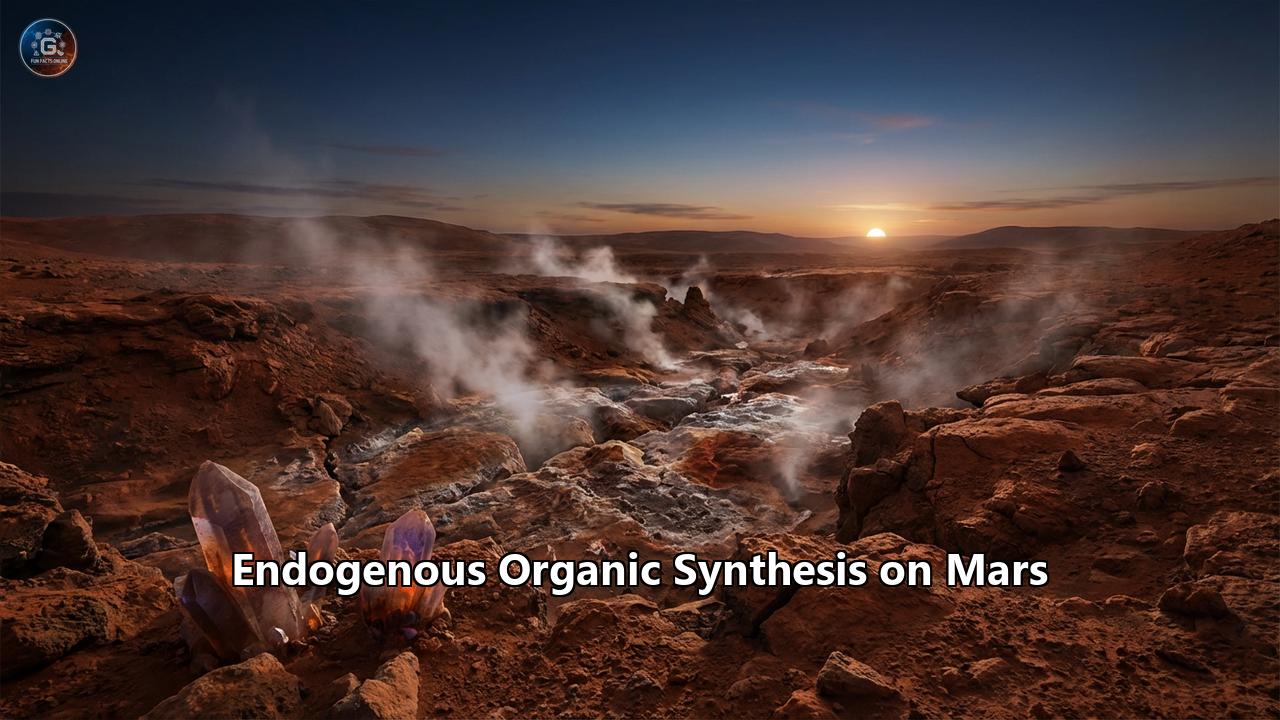
Abstract: The Awakening of a Silent World
For decades, the prevailing narrative of Mars was one of a geologically dead, frozen wasteland—a fossil of a planet whose dynamic history ended billions of years ago. The search for organic molecules, the carbon-based architecture of life, was viewed primarily through the lens of biology: either we would find the remnants of ancient microbes, or we would find a sterile regolith devoid of complexity. This binary view, however, has been shattered.
As of early 2026, a revolution in planetary science is unfolding. Discoveries from the Curiosity and Perseverance rovers, combined with advanced analysis of Martian meteorites, have revealed a stunning truth: Mars is a chemically active world. It possesses an "endogenous" organic engine—a suite of geologic and electrochemical processes that generate complex organic matter without the need for biology. From the depths of ancient mudstones in Gale Crater to the olivine-rich fractures of Nili Fossae, the Red Planet is synthesizing the building blocks of life on a massive scale.
This article explores the cutting-edge science of endogenous organic synthesis on Mars. We will descend into the molecular machinery of the Martian crust, explore the "battery" hypothesis that turns rocks into fuel cells, examine the specific molecules recently discovered, and discuss what this means for the search for life. If Mars can build the components of biology on its own, the line between "rock" and "life" becomes blurrier than ever before.
Part I: The Paradigm Shift – From Viking to Perseverance
The Ghost of Viking: A False Negative
To understand the significance of today's findings, we must look back to 1976. The Viking landers, NASA’s first biological explorers, scooped up Martian soil and heated it, looking for the tell-tale vapors of organic compounds. The Gas Chromatograph-Mass Spectrometer (GC-MS) returned a shocking result: nothing. Aside from a few cleaning solvents from Earth, the Martian surface appeared utterly devoid of organic carbon.
For forty years, this result cast a long shadow. It suggested Mars was not just dead, but chemically hostile, perhaps sterilized by a super-oxidizing surface. It wasn't until the 2008 Phoenix lander discovered perchlorates—highly reactive salts—in the Martian soil that the puzzle pieces fit together. We realized that the Viking landers hadn't found a lack of organics; they had accidentally destroyed them. When Viking heated the soil, the perchlorates became aggressive oxidizers, incinerating any organic matter present and turning it into carbon dioxide and chlorobenzene. The organics were there; we just burned them before we could see them.
Curiosity’s Redemption and the Rise of SAM
The landing of the Curiosity rover in Gale Crater changed everything. Equipped with the Sample Analysis at Mars (SAM) suite, Curiosity was designed to sniff out the molecules Viking missed. In 2018, the team announced the discovery of thiophenes—sulfur-bearing organic rings—and benzene derivatives in 3.5-billion-year-old mudstone.
But the real breakthrough has come in the last few years. Re-analysis of data using "wet chemistry" techniques (which protect organics from perchlorates) and new sampling from the sulfate-bearing unit has unveiled a treasure trove. In early 2025, scientists confirmed the presence of long-chain alkanes—decane, undecane, and dodecane. These are not just simple methane puffs; these are complex, chemically stable hydrocarbons that look suspiciously like the fragments of fatty acids, the structural components of cell membranes.
Perseverance and the Delta
Simultaneously, the Perseverance rover in Jezero Crater has been using its SHERLOC instrument to map organic fluorescence directly on rock faces. Unlike Curiosity, which grinds rock to powder, Perseverance sees the context. It has found organics sandwiched between sulfate minerals, effectively "canned" and preserved for billions of years. The detection of aromatic rings in the Máaz and Séítah formations proves that organic synthesis was not a fluke event but a widespread planetary phenomenon.
Part II: The Engine Room – Mechanisms of Abiotic Synthesis
If these molecules aren't coming from life, where are they coming from? The answer lies in the rocks themselves. Mars is effectively a giant chemical factory, driven by heat, water, and the inherent energy of its minerals.
1. The Martian Battery: Electrochemical Reduction
One of the most exciting recent hypotheses, solidified by research in late 2024 and 2025, is the concept of the "Martian Battery." This theory proposes that the interface between igneous rocks and salty brines creates natural electrochemical cells.
- The Components: Mars is rich in spinel-group minerals (like magnetite) and sulfides (like pyrite). When these conductive minerals come into contact with a saline electrolyte (brine), they create a galvanic potential—essentially a battery.
- The Reaction: This natural voltage is sufficient to drive the electrochemical reduction of dissolved CO2. The carbon dioxide in the brine is stripped of its oxygen and bonded with hydrogen protons from the water.
- The Output: The result is a suite of organic molecules, ranging from simple formate to complex hydrocarbons.
This mechanism is revolutionary because it doesn't require extreme heat or pressure. It can happen in cold, dark, subsurface aquifers. It implies that wherever there is wet rock on Mars, there is likely organic synthesis. The "battery" is always running, slowly trickle-charging the Martian crust with organic carbon.
2. Serpentinization: The Hydrogen Factory
Serpentinization is the classic engine of abiotic chemistry, well-known from Earth's hydrothermal vents. It occurs when water interacts with ultramafic rocks (rich in olivine and pyroxene), turning them into serpentine minerals.
- The Chemical Magic: This reaction is exothermic (releases heat) and produces massive amounts of hydrogen gas ($H_2$).
- Fischer-Tropsch Type (FTT) Synthesis: The liberated hydrogen doesn't just float away. In the presence of iron or magnetite catalysts, it reacts with CO2 to form methane ($CH_4$) and longer hydrocarbon chains.
- Martian Relevance: Large regions of Mars, such as Nili Fossae, are massive exposures of olivine. We now believe these regions were once giant reactors, pumping out hydrocarbons during the Noachian period when liquid water was abundant. The discovery of associated carbonates and phyllosilicates in Nili Fossae is the "smoking gun" of this process.
3. The Nitrogen Link: A Haber-Bosch Process on Mars?
A major hurdle for abiotic theories was nitrogen. Life needs nitrogen, but atmospheric $N_2$ is inert and hard to break. However, recent analysis of the ALH 84001 meteorite and data from Curiosity has found nitrogen-bearing organics (nitriles and nitrates).
New models suggest that the same iron-rich catalysts driving FTT synthesis can also drive a natural Haber-Bosch process. Under the right hydrothermal conditions, $N_2$ and $H_2$ can be catalyzed into ammonia ($NH_3$), which then reacts with organics to form amino acid precursors. The detection of these nitrogenated compounds proves that Mars wasn't just making oil; it was making the specific amino-scaffolding required for pre-biotic chemistry.
Part III: The Molecular Menagerie
What exactly have we found? The chemical inventory of Mars is more diverse than we dared to imagine.
The Long-Chain Alkanes (C10–C12)
The 2025 confirmation of decane, undecane, and dodecane in the Cumberland mudstone is perhaps the most tantalizing discovery. On Earth, these specific chain lengths are often associated with the breakdown of biological lipids (fats). Finding them on Mars forces us to ask:
- Option A: Are they "geolipids"—abiotic mimics formed by polymerization on mineral surfaces?
- Option B: Are they the fossilized remains of ancient cellular membranes?
Current consensus leans toward Option A, specifically a process called surface-mediated polymerization, where mineral grains act as templates, lining up carbon atoms into orderly chains. However, the sheer abundance of these molecules (estimated at hundreds of parts per million before radiation degradation) pushes the limits of known abiotic models.
Thiophenes: The Survivors
Thiophenes are ring-shaped molecules containing sulfur. They are incredibly stable and resistant to radiation. Their discovery is significant because sulfur is a "cross-linking" agent. In vulcanized rubber, sulfur bridges make the material durable. On Mars, sulfurization likely preserved organic matter, locking it into large, tough macromolecules (kerogen) that could survive billions of years of cosmic ray bombardment.
Macromolecular Carbon (MMC)
This is the "dark matter" of Martian organic chemistry—large, complex, insoluble networks of carbon found in Martian meteorites like Tissint. MMC is not a single molecule but a disordered mesh. Its structure resembles terrestrial coal or kerogen. Isotopic analysis of MMC often shows a depletion in Carbon-13, a signature that on Earth is often associated with life. However, on Mars, processes like atmospheric photolysis and escape can also fractionate isotopes, making this a tricky signal to interpret.
Part IV: Locations of Interest – The Geography of Synthesis
Mars is not uniform. Specific environments acted as "kitchens" for this chemistry.
Gale Crater: The Ancient Lakebed
Gale Crater was once a long-lived lake. The sediments here—the mudstones of Yellowknife Bay—are the premier archive of Martian history. The recent discovery of siderite (iron carbonate) here is crucial. Siderite forms only in high-CO2, low-oxygen environments. Its presence confirms that early Mars had a thick atmosphere and an active carbon cycle, trapping atmospheric CO2 into rock, where it could then be reduced to organics.
Jezero Crater: The Delta and the Ring
Perseverance is exploring a delta where a river once flowed into a crater lake. The "Margin Unit" here is rich in carbonates and silica. Silica is excellent at preserving organics (think of fossils on Earth). The finding of diverse organic signals in the Séítah formation—an igneous cumulate rock—is fascinating because it represents a magmatic source of organics. These aren't lake sediments; they are rocks formed from cooling magma that trapped organics synthesized in the high-temperature depths.Nili Fossae: The Hydrothermal Reactor
Though no rover is currently there, Nili Fossae remains the holy grail for abiotic synthesis. It is the largest exposure of olivine on the planet. The interaction of this olivine with water would have generated massive amounts of hydrogen and heat. If there is a place on Mars where the "soup of life" was cooked, it is likely here. Future sample return missions or human explorers will almost certainly target these green, olivine-rich plains.
Part V: Comparative Planetology – Mars in Context
Mars is not alone in its organic richness. To understand it, we must look at its siblings.
- Mars vs. Earth: On Earth, plate tectonics and voracious biology recycle carbon rapidly. We have very little record of abiotic synthesis because life eats it. Mars, lacking tectonics and (macroscopic) biology, is a museum. It preserves the prebiotic chemistry that Earth has long since erased. Studying Mars is studying the "prologue" to life on Earth.
- Mars vs. Europa/Enceladus: The icy moons of Jupiter and Saturn have subsurface oceans. Cassini detected heavy organic molecules in the plumes of Enceladus. The mechanism there—hydrothermal vents at the ocean floor—is chemically identical to the serpentinization proposed for the Martian subsurface. Mars is essentially a "fossilized Enceladus"—a place where the ocean dried up, leaving the hydrothermal vents exposed for us to study without drilling through 20 kilometers of ice.
- Mars vs. Titan: Titan is an organic wonderland, but its chemistry is atmospheric, driven by sunlight turning methane into rain. Mars has this (photolysis), but its primary engine is subsurface and geochemical. Mars is a rock-chemistry world; Titan is a sky-chemistry world.
Part VI: The Future – Decoding the Message
We are standing at a precipice. The question is no longer "Are there organic molecules on Mars?" but "What is their history?"
ExoMars Rosalind Franklin: The Deep Drill
The European Space Agency’s Rosalind Franklin rover (scheduled for launch around 2028) will do what Curiosity and Perseverance cannot: drill deep. Its 2-meter drill will retrieve samples from below the "radiation zone." The surface of Mars is bathed in ionizing radiation that chops up long organic chains. By going deep, we hope to find pristine, unaltered molecules—perhaps even fragile biomarkers like amino acids that surface radiation would have destroyed. Its MOMA instrument is specifically tuned to separate chiral molecules (left-handed vs. right-handed), a key test for biological origin.
Mars Sample Return (MSR)
Ultimately, robots can only do so much. The Mars Sample Return campaign, currently in its planning and architectural phases, aims to bring the cores collected by Perseverance back to Earth. In terrestrial labs, we can measure isotopic ratios with extreme precision. We can look for the specific "clumping" of isotopes that biology produces. We can sequence the carbon chains to see if they follow the "rule of two" (biology prefers even-numbered carbon chains) or the random distribution of abiotic chemistry.
Conclusion: The Living Rock
Endogenous organic synthesis on Mars forces us to rethink the definition of a "living" planet. Mars may not have biological life (that we know of yet), but it has a metabolism. It breathes carbon dioxide, drinks water, and uses the energy of its rocks to build complex structures.
This "geochemical life" is likely the default state of rocky planets in the habitable zone. Before DNA, before cells, there was the battery of the rock. Mars offers us a frozen snapshot of that pivotal moment in cosmic history—the moment when a planet starts to wake up and build the ladder toward life. Whether that ladder was ever climbed remains the ultimate question, but we now know that the rungs are there, built by the planet itself, waiting in the red dust.
Detailed Exploration of Key Concepts
1. The "Battery" Hypothesis: A Technical Deep Dive
The "Martian Battery" concept, formally known as electrochemical reduction, relies on the presence of semi-conducting minerals. On Earth, we see this in deep-sea hydrothermal vents, but on Mars, it can happen in "cryo-brines"—salty water pockets that remain liquid well below freezing.
- Anode: The mineral phase (e.g., magnetite) gets oxidized.
- Cathode: The dissolved CO2 gets reduced.
- The Circuit: The brine acts as the electrolyte.
Recent lab simulations imitating Martian conditions (high CO2, perchlorate-rich brines, basaltic rock) have successfully synthesized formate, acetate, and pyruvate—key precursors to the Krebs cycle (the energy cycle of cells). This suggests that the energy currency of biology (metabolism) might have preceded the informational currency (genetics). Mars might be filled with "metabolic rocks."
2. Preservation: The Perchlorate Paradox
Perchlorates are a double-edged sword.
- The Destroyer: As seen with Viking, they destroy organics when heated.
- The Preserver: In their natural, cold state, perchlorates are extremely stable. They attract water (deliquescence), creating tiny liquid films around mineral grains even in the arid Martian environment. These brine films might be the "safe havens" where endogenous synthesis occurs and where the resulting molecules are sequestered away from UV radiation.
- The Fix: Future instruments like MOMA on Rosalind Franklin use "flash pyrolysis" and derivatization agents to essentially "disarm" the perchlorates before they can burn the sample, allowing us to see the delicate organics they might be hiding.
3. The Deep Biosphere Potential
The surface of Mars is hostile, but the subsurface is mild. The discovery of radiolysis-driven hydrogen production suggests that the Martian crust is a massive battery for potential deep life.
- Radiolysis: Radioactive elements (Uranium, Thorium, Potassium) in the crust decay, releasing particles that split water molecules in pore spaces.
- The Yield: This produces $H_2$ (food for microbes) and sulfates (oxidizers).
- The implications: Models suggest this process could support a biomass of "chemolythotrophic" bacteria comparable to Earth's deep gold mines. The endogenous organics we find on the surface might just be the "exhaust fumes" seeping up from a thriving, or extinct, deep biosphere.
4. The "Missing" Nitrogen Mystery Solved
For years, the lack of detected nitrogen organics was a problem. Amino acids require amine groups (-NH2). The detection of nitrogen in the ALH 84001 carbonates and the "nitrate" detections by Curiosity changed the game.
- Abiotic Fixation: Lightning in the ancient Martian atmosphere and catalytic reduction on iron minerals are now seen as the primary sources.
- Significance: This completes the "habitable triad": Carbon (from CO2), Hydrogen (from water/serpentinization), and Nitrogen (from nitrates). Mars had all the ingredients. The endogenous synthesis wasn't just making "tar"; it was making "lego blocks" for life.
Final Thoughts: A Universe of Organics
The findings on Mars have cosmic implications. If a cold, irradiated, tectonically quiet planet like Mars can synthesize fatty acids and aromatic rings, then the universe must be awash in organic matter. It suggests that the "hard step" in the origin of life is not the creation of the building blocks, but their assembly into a self-replicating system. Mars has shown us that the hardware store is open; we just need to find out if anyone ever came to build the house.
As we look toward the return of samples in the 2030s, we are not just analyzing rocks. We are analyzing the frozen potential of a planet that tried, and perhaps succeeded, in starting the greatest experiment in the universe.
(End of Article)Reference:
- https://www.sci.news/space/nitrogen-bearing-organics-martian-meteorite-alh-84001-08383.html
- https://en.wikipedia.org/wiki/Nili_Fossae
- https://sciworthy.com/mars-could-host-a-deep-underground-biosphere/
- https://www.livescience.com/mars-meteorite-evidence-water-rock-interactions
- https://www.nasaspaceflight.com/2024/10/martian-subsurface-pools/