
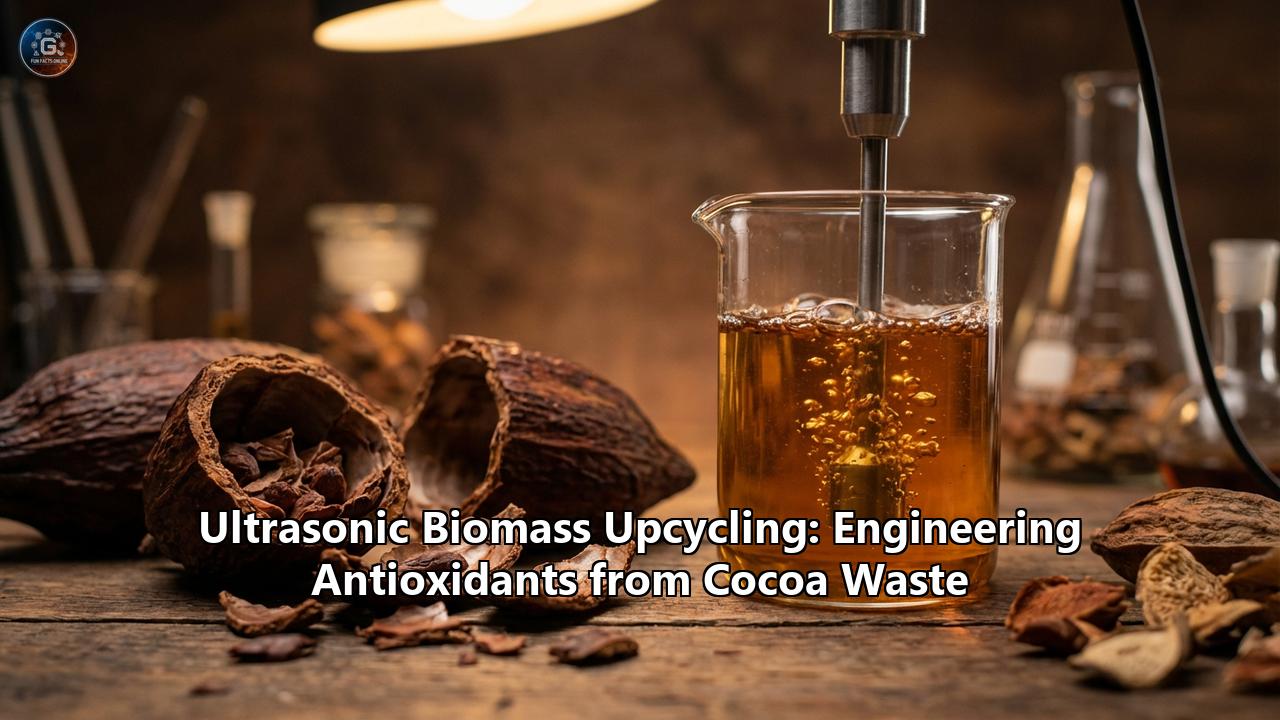
When you snap off a square of your favorite dark chocolate, you are participating in a global ritual of indulgence. Yet, behind the luxurious melt and complex flavor profile lies a staggering agricultural reality: the chocolate industry generates millions of tons of biological waste every single year. For every cocoa bean harvested, fermented, and roasted to perfection, a vast majority of the cacao fruit—up to 80%—is left behind. Cocoa pod husks, bean shells, and sweet mucilage have traditionally been viewed as useless byproducts, left to rot in agricultural fields or relegated to compost heaps.
But what if this mountain of waste is actually a mountain of unmined gold?
Enter ultrasonic biomass upcycling, a revolutionary green technology that is entirely reframing how we handle agricultural waste. By utilizing high-power sound waves, scientists and engineers are now able to crack open the cellular fortresses of cocoa waste to extract high-value, incredibly potent antioxidants. This process not only solves a massive environmental waste issue but also yields premium bioactive compounds destined for the pharmaceutical, cosmetic, and functional food industries.
Here is a deep dive into the fascinating world of ultrasonic biomass upcycling, the science of acoustic cavitation, and how researchers are turning discarded cocoa shells into cutting-edge superfoods—including a groundbreaking "chocolate honey" crafted without a single drop of synthetic chemicals.
The Hidden Treasure Inside Cocoa Waste
To understand the magnitude of this technological breakthrough, we must first look at the anatomy of the Theobroma cacao tree's fruit. The cocoa beans used for chocolate production represent roughly a mere 20% to 25% of the total weight of the cocoa pod. The remaining 75% to 80% consists of the cocoa pod husk (the thick outer shell), the cocoa bean shell (the thin papery layer encasing the bean), and the pulp.
Historically, this residual biomass was considered a nuisance. When left to decompose in fields, rotting cocoa husks can become a breeding ground for black pod rot and other fungal diseases, threatening future harvests. Disposing of it requires labor and capital, posing an economic burden on farmers.
However, modern biochemical profiling has revealed that these discarded components are astonishingly rich in phytochemicals. Cocoa pod husks and bean shells contain massive reserves of polyphenols, flavonoids (such as catechins and epicatechins), methylxanthines (including the stimulant alkaloids theobromine and caffeine), clovamide, and valuable dietary fibers like pectin.
Polyphenols, in particular, are potent antioxidants. They are known to be highly effective at neutralizing free radicals—unstable molecules that cause cellular damage, oxidative stress, and contribute to aging and chronic diseases. In fact, plant-derived polyphenols can be up to 100 times more effective than Vitamin C at neutralizing these harmful molecules. The challenge, historically, has not been finding these antioxidants, but rather extracting them efficiently, profitably, and sustainably.
The Problem with Traditional Extraction
For decades, the extraction of bioactive compounds relied on traditional methods such as maceration or Soxhlet extraction. These legacy methods suffer from severe drawbacks. They typically require immense volumes of harsh, often toxic, petrochemical solvents (like methanol or hexane). Furthermore, they are notoriously slow, sometimes taking days to yield results. Even worse, traditional techniques frequently rely on prolonged exposure to high heat to separate the compounds from the biomass matrix. Because many antioxidants and polyphenols are highly heat-sensitive, boiling them for hours degrades their molecular structure, drastically reducing the quality and potency of the final extract.
This is where green extraction technologies come into play, and none have proven quite as promising, scalable, and efficient as Ultrasound-Assisted Extraction (UAE).
The Science of Sonication: How Ultrasound-Assisted Extraction Works
To visualize ultrasound-assisted extraction, you must imagine a microscopic demolition crew operating at the speed of sound.
UAE utilizes high-frequency sound waves—typically ranging from 20 kHz to 100 kHz, which is just above the threshold of human hearing—transmitted directly into a liquid solvent containing the milled cocoa waste. When these intense ultrasonic waves propagate through the liquid medium, they create alternating cycles of high pressure (compression) and low pressure (rarefaction).
During the low-pressure cycle, the ultrasonic waves create microscopic vacuum bubbles in the liquid. These bubbles grow over several acoustic cycles until they reach a critical mass where they can no longer absorb energy. At this point, during a high-pressure cycle, the bubbles violently implode. This phenomenon is known as acoustic cavitation.
The collapse of these cavitation bubbles is dramatic. On a microscopic scale, the implosion generates extreme, localized hotspots with temperatures that can temporarily reach thousands of degrees Celsius, accompanied by shockwaves and high-velocity liquid jets (traveling at hundreds of kilometers per hour).
When these micro-jets strike the surface of the suspended cocoa biomass, a sequence of highly destructive (yet precisely controlled) physical events occurs:
- Erosion and Fragmentation: The shockwaves physically break down the tough lignocellulosic structure of the cocoa pod husks and bean shells, dramatically reducing particle size and increasing the surface area exposed to the solvent.
- Sonoporation: The acoustic energy punches microscopic holes into the rigid plant cell walls, compromising the cellular fortress that holds the target antioxidants.
- Enhanced Mass Transfer: The intense localized turbulence forces the solvent deep into the biological material, washing out the intracellular compounds—like polyphenols, lipids, and theobromine—and dragging them into the surrounding liquid matrix at unprecedented speeds.
The result? What used to take 24 hours in a heated maceration vat can now be accomplished in a matter of minutes, at vastly lower macro-temperatures, preventing the thermal degradation of the delicate antioxidants. Ultrasound gives significantly higher yields, creates a more potent extract, and radically reduces the energy and time required.
A Masterclass in Green Chemistry: The "Chocolate Honey" Breakthrough
Perhaps the most exciting application of ultrasonic cocoa waste upcycling recently emerged from the State University of Campinas (UNICAMP) in São Paulo, Brazil. In a breakthrough study featured on the cover of ACS Sustainable Chemistry & Engineering, a team of researchers led by Dr. Felipe Sanchez Bragagnolo devised a way to use ultrasound to extract cocoa antioxidants without utilizing any synthetic chemical solvents.
Instead of ethanol or acetone, the researchers turned to a miraculous, natural liquid: honey produced by native Brazilian stingless bees.
Honey is naturally slightly acidic and possesses its own water content, making it an intriguing, naturally occurring solvent. The researchers placed milled cocoa bean shells—the papery waste from chocolate manufacturing—directly into the native bee honey. They then submerged an ultrasonic titanium probe (which looks somewhat like a high-tech metal pen) into the mixture.
As the ultrasound waves pulsed through the honey, acoustic cavitation went to work. The microbubbles burst against the cocoa shells, ripping open the cellular matrices and releasing a flood of caffeine, theobromine, and antioxidant-rich phenolic compounds directly into the honey.
The resulting product is nothing short of revolutionary: a functional, naturally sweet "chocolate honey." It requires no added sugars or artificial flavorings, yet boasts a rich chocolate taste derived entirely from upcycled waste. More importantly, it is a nutritional powerhouse, loaded with cardiovascular-supporting stimulants and anti-inflammatory compounds.
This study also highlighted a serendipitous secondary benefit of the ultrasonic process. Native stingless bee honey generally has a higher water content than standard European honeybee honey, meaning it is prone to fermentation and normally requires pasteurization or strict refrigeration to maintain its shelf life. The UNICAMP researchers hypothesized that the intense physical forces of the ultrasonic cavitation simultaneously disrupt the cell walls of native bacteria and yeast present in the raw honey. Therefore, the ultrasound not only extracts the cocoa antioxidants but acts as a cold-pasteurization technique, naturally extending the shelf life of the honey without boiling away its beneficial enzymes.
Deep Eutectic Solvents and Industrial Economics
While edible solvents like honey are perfect for direct-to-consumer functional foods, the industrial upcycling of cocoa pod husks for cosmetics and pharmaceuticals requires larger-scale solvent systems. Here, ultrasound is being paired with another green chemistry marvel: Natural Deep Eutectic Solvents (NADES).
NADES are a new generation of green solvents made from naturally occurring, biodegradable compounds like plant sugars, organic acids, and amino acids. When mixed at specific ratios, these solid compounds form a liquid mixture with a surprisingly low melting point. A recent study evaluating the extraction of bioactive compounds from cocoa pod husks in Southern Vietnam paired UAE with NADES. The researchers found that optimizing the ultrasound process (at a mild 50 °C for 40 minutes) maximized the extraction of flavonoids, hydroxycinnamates, and flavan-3-ols. The resulting antioxidant capacity of the extract was immense, proving that highly toxic petrochemicals are no longer required to achieve pharmaceutical-grade purity and yield.
Beyond the environmental benefits, the economics of ultrasonic extraction are incredibly compelling. Research investigating the economic potential of polyphenol extraction from cocoa pod husks using UAE found that the financial returns significantly outperformed older methods. By optimizing the sonication time to just 60 minutes using simple distilled water as a solvent, researchers achieved a massive phenolic content yield. From an economic perspective, factoring in the low cost of the waste material, reduced energy usage, and high market value of antioxidant extracts, the ultrasonic process generated an estimated profit margin of over IDR 539,683 (roughly $34 USD) per kilogram of processed extract.
For the global agricultural sector, this is a paradigm shift. Ultrasonic extraction equipment features linear scalability. This means that the exact same acoustic cavitation principles that work in a 500-milliliter laboratory beaker can be perfectly replicated in 1000-liter commercial flow-through sonication reactors. High-performance ultrasonic extractors allow continuous, rapid, and reproducible processing with relatively low operating costs. This creates an incredibly lucrative secondary revenue stream for cocoa producers who can now sell their waste to extraction facilities, or process it themselves.
Measuring Sustainability: The Path2Green Metric
With the rise of "greenwashing" in the corporate world, it is vital to rigorously quantify exactly how sustainable these new technologies are. To address this, scientists have developed a new evaluation framework called Path2Green.
Path2Green introduces 12 distinct principles of green extraction, assessing the environmental impact of biomass valorization from the very origin of the material to the end-use of the product. It measures factors like energy consumption, transport, the toxicity of the solvents used, waste generation, and biodiversity preservation.
When researchers applied the Path2Green sustainability metric to different methods of cocoa waste valorization, ultrasound-assisted extraction performed exceptionally well. Because it utilizes a renewable agricultural byproduct (preventing it from rotting and emitting greenhouse gases like methane), relies on low heat (conserving energy), drastically reduces processing time, and functions perfectly with green or edible solvents (like honey or water), the entire lifecycle of the extraction pushes into a highly positive sustainability index. It perfectly closes the loop of the circular economy.
Future Horizons: From Waste to Wellness
The implications of ultrasonic biomass upcycling extend far beyond cocoa waste. The technology is rapidly becoming the gold standard for "biorefinery" applications worldwide. If ultrasound can successfully strip precious antioxidants from the tough, woody fibers of a discarded cocoa pod, it can be applied to nearly any agricultural byproduct—from grape pomace in the wine industry to coffee silverskins, citrus peels, and olive mill waste.
For the cocoa industry specifically, the extracts generated through ultrasound are already finding their way into high-end applications:
- Cosmetics and Skincare: The polyphenols extracted from cocoa bean shells are powerful anti-aging ingredients. They protect human skin against UV-induced oxidative stress, promote collagen retention, and reduce inflammation.
- Nutraceuticals: Purified theobromine and clovamide extracts are packaged as dietary supplements designed to support cardiovascular health, improve blood flow, and provide jitter-free energy alternatives to synthetic caffeine.
- Active Food Packaging: Interestingly, the antioxidant-rich extracts and the residual pectin from cocoa husks can be spun into biodegradable, edible bioplastics used to wrap perishable foods, actively preventing food spoilage while replacing petroleum-based plastics.
The Dawn of a Circular Food Tech Revolution
The journey of the cocoa bean has always been one of transformation—from a bitter, raw seed to the globally beloved luxury of chocolate. Now, through the ingenuity of ultrasonic engineering and green chemistry, we are extending that transformation to the 80% of the plant we used to throw away.
Ultrasonic biomass upcycling represents a profound shift in how we view the natural world. It proves that waste is merely a resource in the wrong place, waiting for the right technology to unlock it. By harnessing the invisible, violent power of sound waves, we are not just cleaning up agricultural pollution; we are engineering potent antioxidants, creating novel superfoods like chocolate-infused native honey, and forging a highly profitable, deeply sustainable circular economy. The next time you enjoy a piece of chocolate, consider the incredible unseen potential left behind in the field—and the sound waves that are silently turning that waste into the medicine, cosmetics, and superfoods of tomorrow.
Reference:
- https://www.researchgate.net/publication/343807431_Optimization_of_ultrasound_assisted_extraction_of_polyphenols_in_cocoa_beans
- https://pubs.acs.org/doi/10.1021/acssuschemeng.5c04842
- https://www.researchgate.net/publication/394491231_Cocoa_waste_valorization_a_review_and_sustainability_analysis_of_green_technologies
- https://www.semanticscholar.org/paper/Path2Green%3A-introducing-12-green-extraction-and-a-Mesquita-Contieri/e90ee57a0263ced626c6b7579e2be7c3880e250c
- https://news.ssbcrack.com/brazilian-researchers-develop-edible-cocoa-honey-blend-to-reduce-food-waste-and-enhance-nutrition/
- https://pmc.ncbi.nlm.nih.gov/articles/PMC11318242/
- https://www.earth.com/news/scientists-created-chocolate-flavored-honey-with-no-added-sugar/