
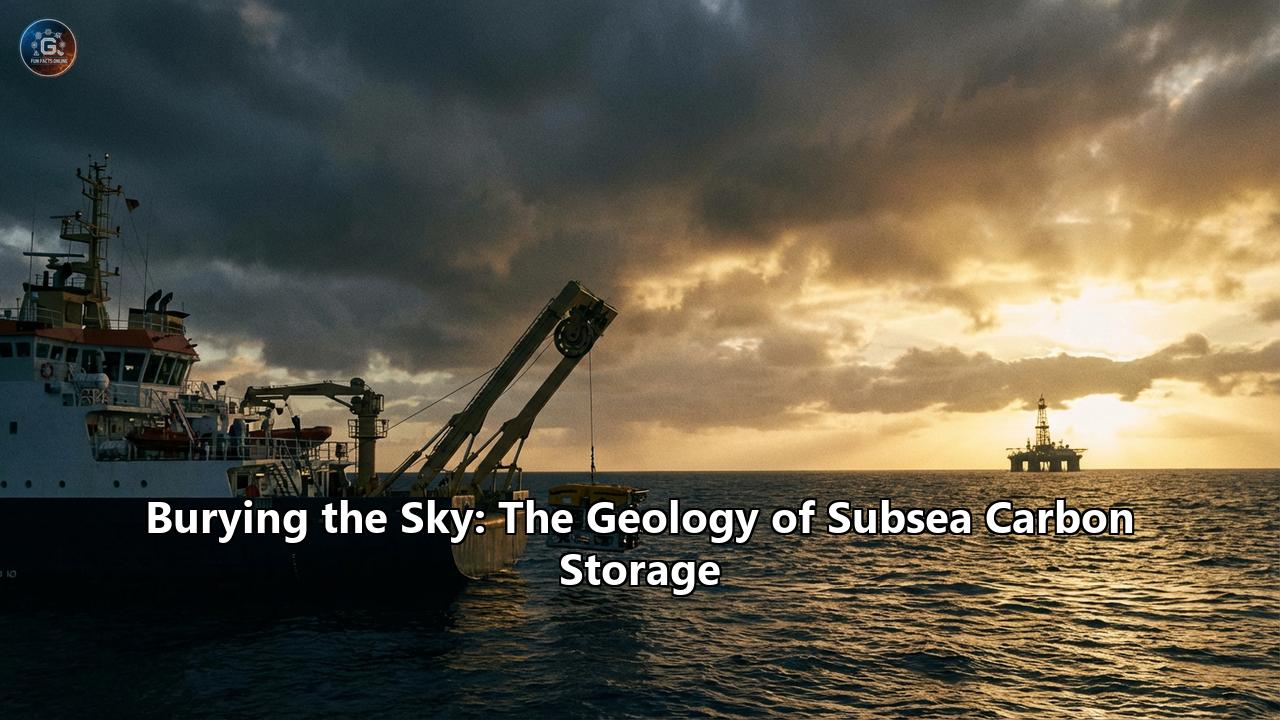
The ocean floor, a realm of eternal darkness and crushing pressure, has long been the final frontier for human exploration. Yet, in the race to avert climate catastrophe, it is poised to become humanity’s most vital vault. As atmospheric carbon dioxide concentrations breach historic thresholds, the solution may lie not in the skies above, but deep within the geology of the seabed below.
Part I: The Blue Frontier – Why Go Subsea?
For decades, the concept of Carbon Capture and Storage (CCS) has been technically feasible but economically elusive. Onshore storage often faces fierce public opposition—the "Not In My Backyard" (NIMBY) phenomenon—and competes for land use. Subsea storage flips this dynamic. By leveraging the vast, unpopulated expanses of the continental shelves, we can access geological formations of immense capacity, far removed from human settlements.
But the allure of subsea storage is not merely about avoiding neighbors. It is about geology and physics. The offshore environment offers two distinct advantages: scale and safety. The world’s continental shelves are thick with sedimentary basins—the same formations that trapped oil and gas for millions of years are now being repurposed to imprison the carbon released by burning them. Furthermore, the sheer weight of the ocean provides a "hydrostatic head," an immense column of water pressure that acts as a secondary seal, ensuring that even if CO2 were to escape the rock, it would face significant physical barriers to reaching the atmosphere.
Part II: The Geological Vault
To understand how we bury the sky, we must first understand the "storage complex." We are not simply pumping gas into a hollow cave. We are injecting it into microscopic pore spaces within solid rock, much like water soaking into a rigid sponge.
1. The Reservoirs: Sandstone and Carbonate
The ideal storage medium is highly porous and permeable sedimentary rock, typically sandstone. These formations, often found 800 to 3,000 meters below the seabed, act as the container.
- Depleted Oil & Gas Fields: These are the "low-hanging fruit." We know they can hold fluids because they held hydrocarbons for eons. The infrastructure (platforms, pipelines) often already exists, though it may need retrofitting for the corrosive nature of CO2.
- Saline Aquifers: These vast underground lakes of unusable saltwater offer the greatest potential volume. Unlike oil fields, they are not confined to narrow traps, extending for hundreds of kilometers. The CO2 is injected into the brine, where it begins a complex geochemical dance.
2. The Caprock: The Ultimate Seal
Above the reservoir must lie a "caprock"—a dense, impermeable layer of shale, clay, or salt. This is the lid of the jar. Without a verified, continuous caprock, injection cannot proceed. In the North Sea, for instance, kilometers-thick layers of plastic clays seal the reservoirs, having successfully trapped natural gas since the Jurassic period.
Part III: The Physics of Eternally Trapping Carbon
Once injected, CO2 doesn't just sit there. It undergoes a metamorphosis driven by four distinct trapping mechanisms that increase security over time.
- Structural Trapping (Immediate): When CO2 is injected, it is in a "supercritical" state—dense like a liquid but viscous like a gas. Being lighter than the saline water, it floats upward. Structural trapping occurs when this buoyant plume hits the impermeable caprock and physically pools there, unable to rise further.
- Residual Trapping (Decades): As the CO2 plume migrates through the microscopic pores of the rock, it displaces the brine. When the injection stops and the plume tail passes, capillary forces snap off tiny droplets of CO2, trapping them in the pore throats. The CO2 becomes stuck, like water in a sponge that cannot be squeezed out.
- Solubility Trapping (Centuries): Over time, the interface between the CO2 and the brine allows the gas to dissolve into the water, creating carbonic acid (sparkling water). This CO2-saturated water is slightly denser than the surrounding brine, causing it to sink. This creates a convection current that churns the reservoir, accelerating further dissolution. Once dissolved, the CO2 can no longer float to the surface.
- Mineral Trapping (Millennia): The final and most permanent phase. The carbonic acid reacts with the minerals in the host rock (such as calcium or magnesium silicates) to precipitate solid carbonate minerals. The CO2 literally turns into stone (calcite, magnesite), permanently fusing with the geology of the Earth.
Part IV: Engineering the Abyss – The Infrastructure
Building a subsea CCS network requires a symphony of extreme engineering, operating at pressures of 200+ bar and temperatures near freezing.
The Transport Network: Pipelines vs. Ships
For short distances, high-pressure pipelines are efficient. They must be designed to resist "running ductile fracture"—a catastrophic zipper-like burst caused by the rapid decompression of CO2. However, for longer distances or smaller volumes, the "ship-to-shore" model is gaining dominance. Specialized carriers, similar to LPG tankers but kept at different pressures (typically 15-19 bar and -26°C), transport liquid CO2 to offshore receiving terminals.
The Subsea Temple
On the seabed, the infrastructure resembles a standard oil extraction site, but in reverse.
- The Subsea Tree: A massive assembly of valves sitting on the wellhead. Unlike production trees designed to let pressure out, injection trees must withstand the thermal shock of cold liquid CO2 entering a hot reservoir.
- The Wellbore: The injection well is lined with specialized cement and steel casings resistant to carbonic acid corrosion. Smart wells are equipped with fiber-optic sensors (Distributed Acoustic Sensing) to listen for leaks or rock fracturing in real-time.
Part V: Global Hotspots and Major Projects
The world is waking up to the subsea potential, with the North Sea currently acting as the Silicon Valley of offshore CCS.
- Norway (Northern Lights): The undisputed leader. Building on 25 years of data from the Sleipner field (where 1 million tons of CO2 have been injected annually since 1996), the Northern Lights project is the world’s first open-source CO2 transport and storage network. It accepts carbon shipped from across Europe to be buried 2,600 meters below the seabed.
- The Netherlands (Porthos & Aramis): Utilizing depleted gas fields in the Dutch North Sea to store emissions from the Port of Rotterdam.
- Asia-Pacific: A sleeping giant. Malaysia and Indonesia are exploring CCS hubs to decarbonize their gas exports. Japan, lacking domestic storage, is pioneering the concept of "transboundary CCS," planning to ship its emissions to storage sites in Southeast Asia and Australia.
- United States (Gulf of Mexico): With a vast existing pipeline network and porous geology, the Texas-Louisiana offshore corridor holds storage potential in the hundreds of gigatons, enough to sequester U.S. industrial emissions for decades.
Part VI: The Risks and the "Uncalculated" Variables
No technological intervention is without risk. Critics point to the "untested" scale of proposed operations.
- Induced Seismicity: Injecting fluids raises pressure underground. If this pressure lubricates an existing fault line, it can trigger earthquakes. Careful site selection and pressure management are critical to avoiding the fate of projects halted by induced tremors.
- Leakage Pathways: The greatest risk is not the geology, but human legacy. The North Sea is punctured by thousands of old oil wells, many abandoned decades ago with standards lower than today’s. These "zombie wells" could act as chimneys for injected CO2 to escape.
- The Brine Displacement Problem: You cannot fill a full cup. Injecting CO2 pushes existing brine out. If not managed, this hyper-saline water could migrate into freshwater aquifers or impact the seabed environment.
Part VII: The Legal Architecture – The London Protocol
Legally, burying waste at sea was banned by the London Convention. However, a landmark amendment to the London Protocol (Article 6) created an exemption specifically for CO2 streams intended for sequestration. This legal tweak legalized the industry. Furthermore, a 2019 resolution allowed for the provisional application of cross-border CO2 transport, enabling landlocked nations (like Switzerland) to export their carbon to nations with storage assets (like Norway), effectively creating a global currency of carbon storage.
Conclusion: A Necessary Geology
"Burying the Sky" is not a panacea. It does not excuse the continued reckless burning of fossil fuels. However, the International Energy Agency (IEA) and the IPCC agree: there is no realistic path to Net Zero without CCS. Hard-to-abate sectors like cement, steel, and chemical production have few other options.
By turning the seabed into a vault, we are closing the loop on the industrial revolution—returning the carbon we excavated from the earth back to the geologic deep, buying humanity the most precious resource of all: time. The geology is ready; the question remains whether our engineering and political will can match the scale of the crisis.
Reference:
- https://www.mdpi.com/2071-1050/17/20/9250
- https://isomase.org/OCAri/Book/Introduction%20to%20Subsea%20Tree/Introduction%20to%20Subsea%20Tree.pdf
- http://pdf.wri.org/css_06_12_08_london_protocol.pdf
- https://pub.norden.org/temanord2023-521/2-international-and-eu-law.html
- https://voelkerrechtsblog.org/carbon-capture-storage-and-removal/
- https://www.demoupcarma.ethz.ch/export/sites/demoupcarma/.galleries/documents/ACCSESS_Deliverable_9.2_IndustryBrief_LF_VB_MM.pdf_2063069299.pdf
- https://www.iea.org/commentaries/is-carbon-capture-too-expensive