
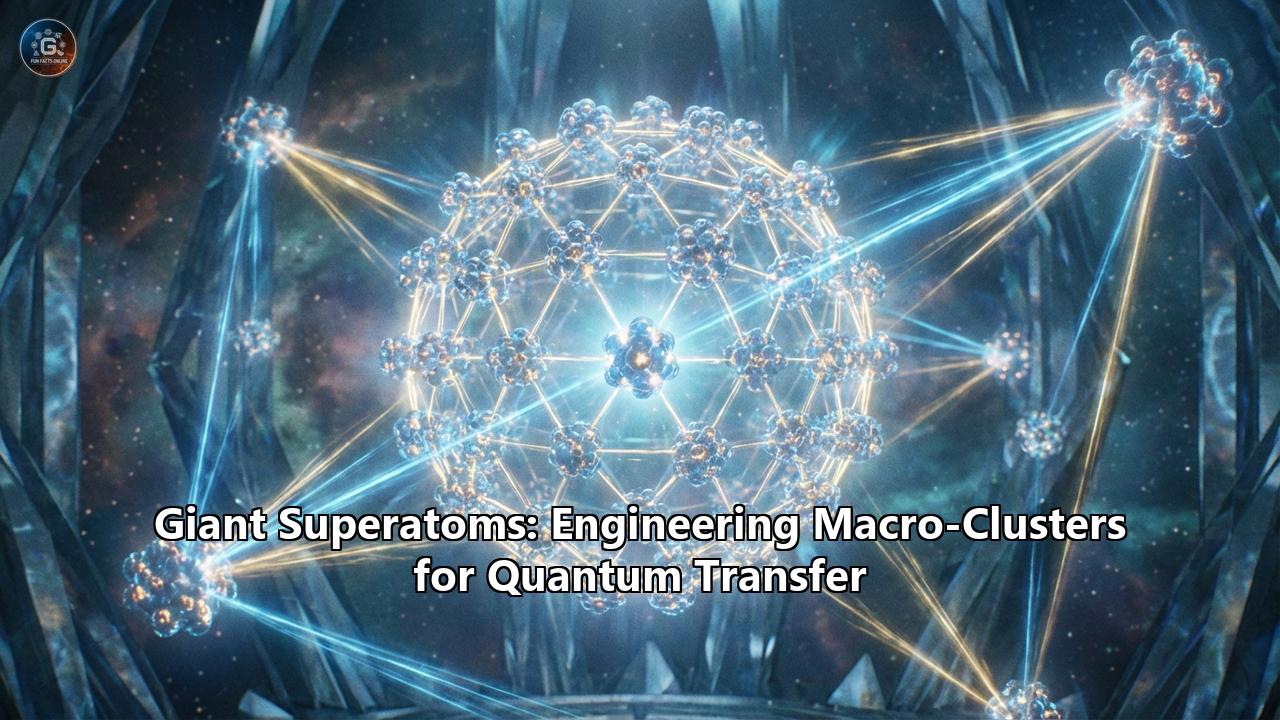
For a century, the quantum world was strictly a microscopic domain. Quantum mechanics was the physics of the invisible—the electron, the photon, the isolated atom. To see quantum effects, one had to squint through the mathematical lens of the sub-atomic. But a revolution is quietly dismantling this scale barrier. We are entering the era of Giant Superatoms and Macro-Clusters, a new class of engineered matter where thousands, sometimes billions, of atoms are coerced into acting as a single, coherent quantum entity.
These are not merely "large groups of atoms." They are engineered singularities. Whether created through the freezing of Rydberg gases, the precise lithography of superconducting circuits, or the chemical synthesis of "designer" molecular crystals, these giant superatoms are breaking the rules of size. They bridge the chasm between the fragile quantum bit (qubit) and the macroscopic world we inhabit. And their most promising application is not just calculation, but Quantum Transfer—the ability to transport quantum information, energy, and entanglement across vast distances with unprecedented fidelity.
This article delves into the engineering of these macro-clusters, exploring how we build them, how they work, and why they hold the key to the future of the quantum internet.
Part I: The Anatomy of a Giant Superatom
To understand how to engineer a giant superatom, one must first understand the principle of collective excitation. In a standard material, atoms act like a disorganized crowd; if you shout at them (hit them with a laser), they all react individually. In a giant superatom, the crowd is disciplined into a single chorus.
1. The Rydberg Superatom: The Gaseous Giant
The most ethereal of these giants is the Rydberg Superatom. Here, scientists trap a cloud of ordinary atoms (like Rubidium) and cool them to near absolute zero. Using a laser, they excite one electron in the cloud to a high-energy "Rydberg state."
Because this electron orbits so far from its nucleus, the atom effectively inflates to thousands of times its normal size. But the magic happens due to the Rydberg Blockade. The inflated atom interacts so strongly with its neighbors that it prevents them from being excited. The result? A cloud of thousands of atoms can only support one excitation at a time. The entire cloud shares this single excited state, behaving mathematically and physically as one giant atom with a single, collective "super-electron."
- Engineering Challenge: The primary challenge is maintaining the "frozen" state of the gas. If the atoms move too much, the collective hallucination breaks.
- Quantum Transfer Utility: These are perfect "quantum repeaters." They can catch a photon (light particle), store its information in the collective cloud spin, and then release it on command. Because the cloud is large, it interacts with light much more efficiently than a single atom ever could.
2. The Artificial Giant: Superconducting Circuits
While Rydberg atoms are ghostly clouds, Superconducting Giant Atoms are man-made chips. These are macroscopic electrical circuits, visible to the naked eye, printed on silicon wafers. They function as "artificial atoms" because their energy levels are quantized just like a natural atom.
The breakthrough in this field is "non-local coupling." In nature, an atom is small and interacts with light at a single point. In these engineered circuits, the "giant atom" is coupled to a waveguide (a transmission line for light) at multiple distant points. This allows the atom to "self-interfere." It can emit a photon at point A and re-absorb it at point B, or cancel out its own emission entirely.
- Engineering Feature: Engineers can tune the size of the atom relative to the wavelength of the signals it processes. This allows for "decoherence-free subspaces"—modes where the atom holds onto quantum information without leaking it to the environment.
3. The Chemical Giant: Superatomic Crystals
The third pillar is the Chemical Superatom. These are stable clusters of specific elements—like Aluminum-13 ($Al_{13}$) or Gold nanoclusters—that mimic the valence electron shell of a completely different element. For example, $Al_{13}$ behaves chemically like a halogen (like Chlorine).
Recent advancements have moved from isolated clusters to Macro-Clusters or Superatomic Crystals. By stacking these clusters into a lattice (like bricks in a wall), scientists create materials where electrons delocalize not just over one cluster, but over the entire crystal structure.
- The Material Advantage: Unlike the fragile Rydberg gas or the cryogenic circuit, these are solid-state materials that can potentially operate at higher temperatures. They offer a pathway to "spin-liquid" states, where magnetic information can flow through the material like a fluid, perfect for transferring quantum data.
Part II: Engineering Mechanisms for Quantum Transfer
The "Holy Grail" of this technology is moving quantum information from point A to point B without losing the delicate "phase" that makes it quantum. Giant superatoms offer unique solutions to this problem.
The Super-Radiant Highway
One of the most exotic properties of macro-clusters is Superradiance. When a giant superatom decays (releases energy), it doesn't just glow; it bursts. The collective nature of the atoms means they emit light with an intensity proportional to the square of the number of atoms ($N^2$).
For quantum transfer, we can engineer the inverse: Subradiance. By arranging the geometry of the superatom, we can trap the photon inside the collective state, preventing it from escaping. The superatom becomes a "dark state" battery, holding the quantum information indefinitely until a control signal tells it to transfer the data to the next node.
Waveguide QED: The Quantum Wire
In superconducting giant atoms, transfer is achieved through Waveguide Quantum Electrodynamics (wQED). Because the giant atom touches the waveguide at multiple points, we can engineer it to emit photons only in one direction. This "chiral" emission is crucial. In a classical wire, signals bounce back and forth, causing noise. In a chiral giant atom setup, the quantum signal flows like water in a pipe—one way, smooth, and lossless.
Magnonics: The Spin Wave
In solid-state superatomic crystals, transfer doesn't necessarily require moving electrons or photons. Instead, we use Magnons—waves of magnetic spin. Imagine a stadium wave performed by the electrons in a crystal. The electrons stay put, but the "wave" of information travels across the material.
Giant superatoms can be engineered to have "topological" protection, meaning these spin waves are robust against impurities in the crystal. The information surfs on the magnetic structure of the macro-cluster, arriving at the destination intact.
Part III: The Macro-Cluster Fabrication Frontier
How do we actually build these things? The engineering is a mix of brute force physics and delicate chemistry.
- Optical Tweezers & Lattices:
For Rydberg superatoms, engineers use intersecting laser beams to create an "egg carton" made of light (an optical lattice). They drop atoms into the slots of this carton. The challenge is "filling factor"—ensuring every slot has exactly one atom to maintain the perfect density for collective behavior.
- Lithographic Stitching:
For superconducting giants, the fabrication uses standard semiconductor techniques but with a twist. The "atom" might be millimeters long, winding across the chip like a snake. The precision required is in the "Josephson Junctions"—thin insulating barriers that give the circuit its quantum non-linearity. A variation of a few nanometers in thickness can ruin the "giant" effect.
- Colloidal Self-Assembly:
For chemical superatoms, the engineering is "bottom-up." Chemists design "ligands"—organic molecules that act as a glue or spacer between the metal clusters. By changing the length of these ligands, they can control the distance between superatoms, tuning the speed at which quantum information can "tunnel" from one cluster to the next.
Part IV: Applications Beyond Computation
While building a quantum computer is the obvious goal, giant superatoms enable technologies that are perhaps even more transformative.
- Quantum Batteries:
Because of the superradiance effect, a giant superatom could theoretically charge up slowly (absorbing energy photon by photon) and then release it all in a nanosecond burst of coherent energy. This isn't a chemical battery; it's a quantum phase battery.
- The Quantum Internet:
Current quantum networks struggle because optical fibers absorb photons. We need "repeaters" to boost the signal. A chain of Giant Superatoms could act as these repeaters, catching a fading photon, restoring its quantum coherence, and firing it to the next node.
- Gravity Sensors:
Large quantum objects are incredibly sensitive to gravity. A "Macro-Cluster" put into a superposition of being in two places at once would feel the tug of gravity differently on each part of its wave function. This could lead to sensors capable of detecting underground oil deposits or magma flows by their gravitational density alone.
Conclusion: The Era of the Giant
We are witnessing a phase shift in physics. We are moving from the study of nature's atoms to the architecture of our own. Giant Superatoms represent a victory of engineering over the chaotic tendency of the macroscopic world. By forcing billions of atoms to hold hands and act as one, we are creating the nodes, the wires, and the storage devices for a future where information is not digital, but quantum. The macro-cluster is no longer a contradiction in terms; it is the building block of the next century.
Reference:
- https://www.britannica.com/science/cluster/Comparison-with-other-forms-of-matter
- https://www.youtube.com/watch?v=a_w6AGe_fIo
- https://www.youtube.com/watch?v=mvlY8pIBQNk
- https://en.wikipedia.org/wiki/Macroscopic_quantum_phenomena
- https://scitechdaily.com/gold-nanoclusters-could-supercharge-quantum-computers/
- https://news.mit.edu/2020/giant-atoms-quantum-processing-communication-0729
- https://scholar.xjtu.edu.cn:443/en/publications/tunable-chiral-bound-states-with-giant-atoms/
- https://arxiv.org/abs/1901.00289
- https://thequantuminsider.com/2025/04/13/scientists-observe-exotic-quantum-phase-once-thought-impossible/