
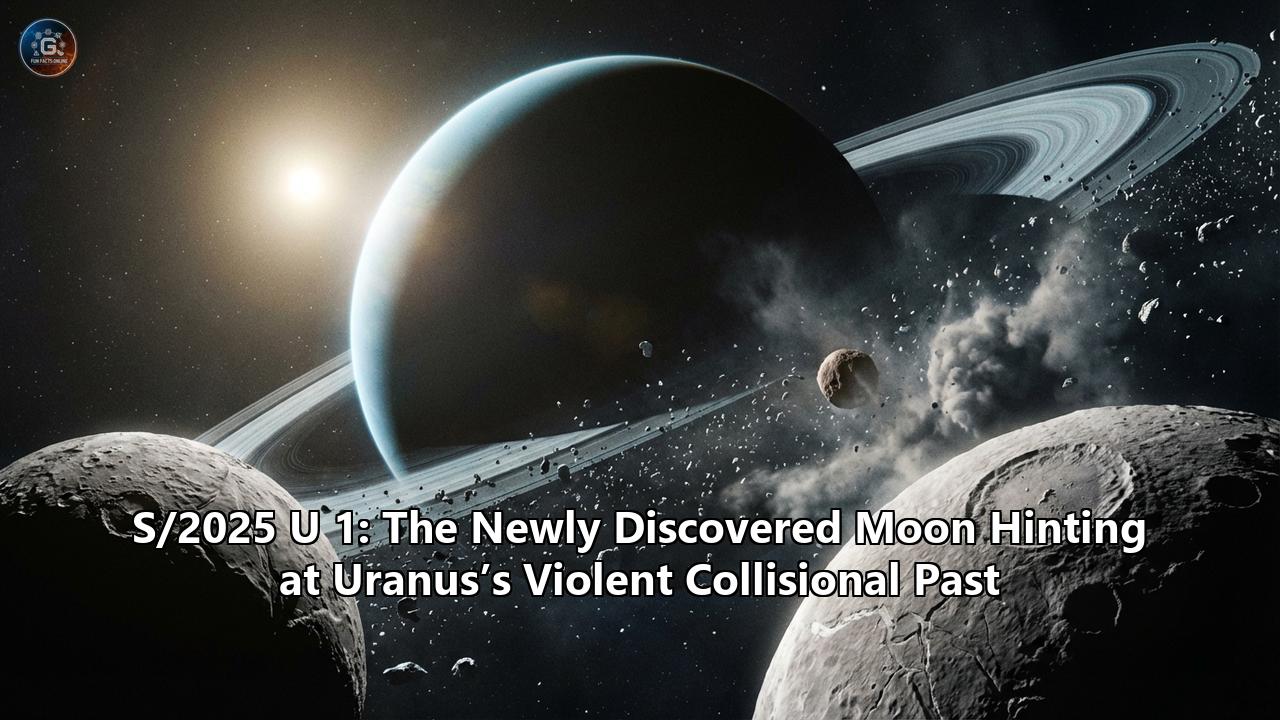
In the quiet, frozen reaches of the outer Solar System, where the Sun is little more than a piercingly bright star, the ice giant Uranus spins like a toppled top. For billions of years, this bizarre world has guarded its secrets behind a veil of aquamarine haze and darker, charcoal-colored rings. But in August 2025, the silence was broken. A new ghost was found haunting the machine of the Uranian system—a tiny, shattered fragment of a violent history that has finally stepped out of the shadows.
This is the story of S/2025 U 1, the moon that shouldn’t have been there, and the cataclysmic past it has returned to tell us about.
Chapter 1: The Ghost in the Ring
The discovery of a new moon in the modern era is usually a matter of staring at a single pixel until it moves. But the unveiling of S/2025 U 1 was something different; it was a triumph of technology over the tyranny of distance.
For nearly four decades, our understanding of the inner Uranian system was frozen in 1986. That was the year NASA’s Voyager 2 spacecraft executed its daring flyby, whipping past the planet at over 60,000 kilometers per hour. In those frantic few hours, Voyager revealed a crowded, chaotic family of small inner moons—Puck, Belinda, Cordelia, Ophelia—huddled together near the planet’s rings. But Voyager’s cameras, 1970s technology hurtling through radiation belts, had limits. It missed things.
It missed S/2025 U 1.
The revelation came on August 19, 2025, when a team of astronomers led by Dr. Maryame El Moutamid of the Southwest Research Institute (SwRI) announced the impossible. Hidden in the glare of Uranus, nestled in the terrifyingly narrow gap between the moons Ophelia and Bianca, was a rock. It was small—barely 10 kilometers (6 miles) wide—and charcoal-black, reflecting almost no light.
It hadn't been found by a probe, but by the golden eye of humanity stationed a million miles from Earth: the James Webb Space Telescope (JWST).
“We were looking at the rings,” Dr. El Moutamid later explained. “We were trying to understand the dust distribution. But when we processed the 40-minute exposure images from the Near-Infrared Camera (NIRCam), there was a dot. A dot that didn't match the stars. A dot that was orbiting.”
The discovery was monumental. It was the first time a moon had been discovered around Uranus by a space telescope since Voyager. It wasn't just a new name on a list; it was a "fossil," a survivor from a chaotic era that reshaped the entire solar system.
Chapter 2: The Victim of a Cosmic Hit-and-Run
To understand why S/2025 U 1 is so important, we must look at the planet it orbits. Uranus is the Solar System’s most battered victim.
Every other planet spins like a top on a table—upright, with a slight tilt. Uranus spins on its side, rolling around the Sun like a ball. Its north pole points at the Sun for 42 years, then plunges into darkness for the next 42. Its rings are vertical. Its moons orbit like the hands of a clock on a wall, rather than a plate on a table.
This unique configuration is the "smoking gun" of a violent collisional past.
Planetary scientists now believe that roughly 4 billion years ago, shortly after Uranus formed, it was stalked by a protoplanet roughly the size of Earth (or perhaps two times larger). In a cataclysm of unimaginable scale, this impactor slammed into the young ice giant.
The energy released was sufficient to vaporize rock and ice instantly. The impact didn't just tip the planet over; it likely pulverized the impactor and stripped away part of Uranus’s outer envelope. The result was a super-heated disk of vapor, dust, and molten rock that encircled the tipped planet.
It was from this hellish disk of debris that the current Uranian moons formed. Unlike Jupiter’s moons, which likely formed from a peaceful distinct nebula, Uranus’s moons are children of violence—born from the wreckage of a planetary collision.
S/2025 U 1 is a piece of that shrapnel.
Chapter 3: The "Impossible" Orbit
When the orbital parameters of S/2025 U 1 were calculated, astronomers were baffled.
The moon orbits at a distance of approximately 56,250 kilometers from the planet's center. This places it deep within the "danger zone" of the Uranian system. It sits precariously between Ophelia (the shepherd moon of the Epsilon ring) and Bianca.
This region is what dynamicists call "packed." The inner moons of Uranus are packed so tightly that their gravitational fields are constantly jostling one another. It is a chaotic dance. If you were to nudge one moon just slightly, the entire system could destabilize, leading to collisions.
In the 1990s, theorists predicted that the inner moons of Uranus are "collisionally evolved." This means they aren't permanent. Over millions of years, they crash into each other, shatter into rings, and then re-accrete into new moons. It is a cycle of death and rebirth.
S/2025 U 1 is likely a product of this cycle. Its small size (10 km) suggests it might be a fragment from a previous collision between Ophelia and Bianca, or perhaps a "rubble pile"—a loose collection of boulders held together by weak gravity, masquerading as a solid moon.
Its presence hints that the "violent past" isn't just ancient history—it is ongoing. The Uranian inner system is a grinder, and S/2025 U 1 is the grit currently passing through the mill.
Chapter 4: Why We Missed It
How did Voyager 2 miss a 10-kilometer moon?
The answer lies in the nature of the Uranian environment. The inner moons of Uranus are covered in a dark, carbon-rich material, likely radiation-processed organic compounds (tholins). They are darker than asphalt. S/2025 U 1 has an albedo (reflectivity) of roughly 0.04 to 0.07. It absorbs 93% of the sunlight that hits it.
When Voyager flew by, it was moving fast and taking short exposures to avoid motion blur. A tiny, black rock against the blackness of space, orbiting next to the bright glare of the planet, was simply invisible to the 1980s vidicon cameras.
It took the James Webb Space Telescope, observing in the infrared, to see it. In infrared light, the thermal glow of the moon and its contrast against the cold background made it pop out. The discovery required a technique called "shift-and-stack," where multiple images are digitally shifted to track the expected motion of a moon, causing the static stars to streak while the moving moon becomes a solid point of light.
Chapter 5: A Clue to the Rings
The location of S/2025 U 1 offers a tantalizing clue about the rings of Uranus.
Uranus has a complex system of dark, narrow rings. For decades, scientists have suspected that there are "shepherd moons" keeping these rings in place, preventing them from spreading out and dissipating. Ophelia and Cordelia shepherd the bright Epsilon ring, but other rings seemed to lack guardians.
S/2025 U 1 orbits just outside the inner ring system. While it is too small to be a major shepherd, its gravity undoubtedly creates "wakes" or ripples in the dust. It may be responsible for maintaining the sharp edges of the fainter, dusty rings that Voyager saw but couldn't resolve.
Furthermore, the moon itself might be a source of the rings. Micrometeoroids from deep space constantly bombard these small moons. Because S/2025 U 1 has such low gravity (you could jump off it and escape into space), any dust kicked up by these impacts doesn't fall back down. instead, it drifts off to join the rings. S/2025 U 1 is essentially bleeding dust into the Uranian system, feeding the very shroud that hides it.
Chapter 6: The Name Game
Following the delightful tradition started by John Herschel, moons of Uranus are not named after Greek or Roman gods, but after characters from the works of William Shakespeare and Alexander Pope.
While the provisional designation is S/2025 U 1, the astronomical community is already buzzing with potential names. The moon sits between Ophelia (from Hamlet) and Bianca (from The Taming of the Shrew / Othello).
Likely candidates will be minor servants or spirits, fitting for such a small world. Moth (a fairy from A Midsummer Night's Dream) or Cobweb are popular theories, given the moon's tiny, gossamer nature and its connection to the "web" of rings.
Chapter 7: The Future of Ice Giant Exploration
The discovery of S/2025 U 1 has reignited the call for a return to Uranus. The Uranus Orbiter and Probe (UOP), a mission prioritized by the planetary science Decadal Survey, is currently being planned for a launch in the early 2030s.
This mission wouldn't just fly by; it would park in orbit. It would be able to map S/2025 U 1 in high resolution. We could see its surface—is it a cratered monolith? A jagged shard? Or a porous fluff-ball?
Studying S/2025 U 1 up close would act as a time machine. By sampling its surface composition, we could determine if it is made of the same material as the impactor that tipped Uranus over. It could be a piece of the alien world that died to make Uranus what it is today.
Conclusion: The Violent Beauty
The discovery of S/2025 U 1 is a reminder that the Solar System is not a finished painting; it is a movie that is still playing.
Uranus, with its sideways spin and its shattered moon system, is a monument to cosmic violence. It teaches us that planets are not static. They can be knocked over, their moons can be pulverized, and from the dust, new worlds can emerge.
S/2025 U 1 is a tiny, black dot in a vast, cold dark. But in that dot lies the story of a collision that shook a world to its core. It is a humble survivor, orbiting silently in the wreckage, waiting for us to come back and listen to its story.
Reference:
- https://www.youtube.com/watch?v=iOGWXYLD_3Q
- https://skyandtelescope.org/astronomy-news/jwst-discovers-new-moon-of-uranus/
- https://www.jpost.com/science/article-864864
- https://esawebb.org/images/uranus-moon-S2025U1/
- https://timesofindia.indiatimes.com/science/nasas-james-webb-telescope-discovers-a-new-moon-around-uranus/articleshow/123501757.cms
- https://en.wikipedia.org/wiki/S/2025_U_1
- https://www.youtube.com/watch?v=Frs5KtkvZyM