
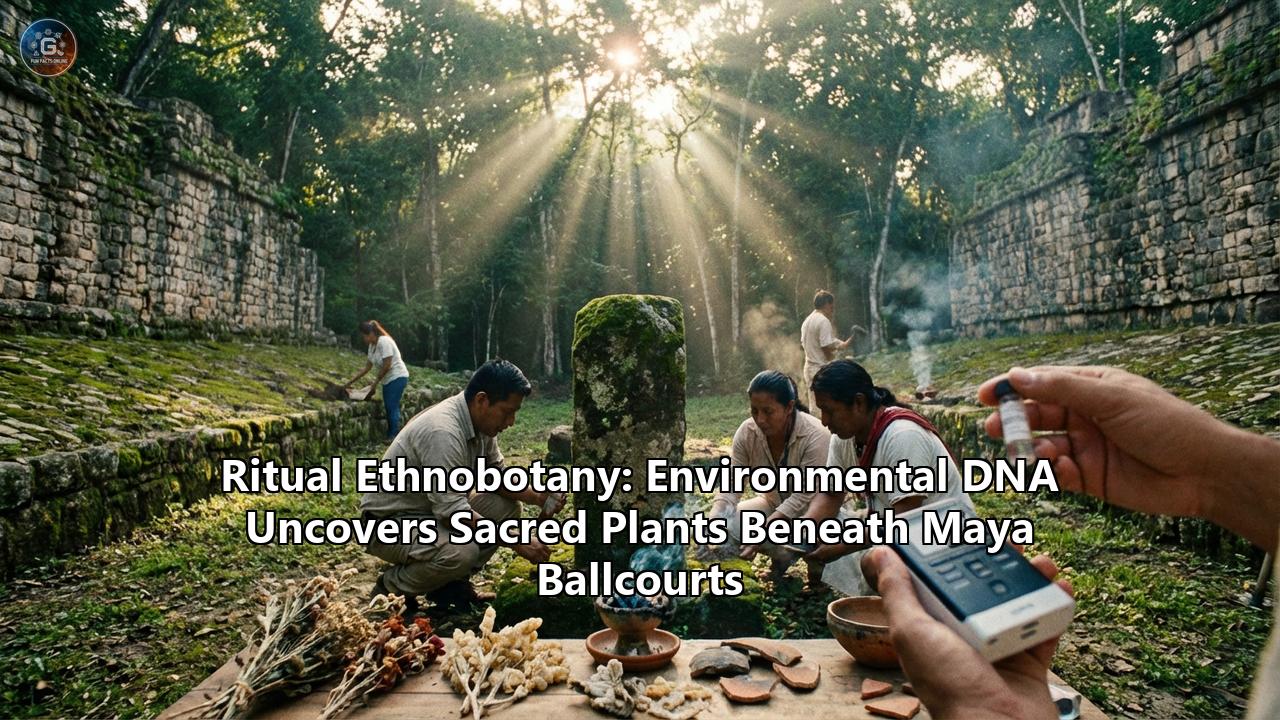
In the dense, humid jungles of Campeche, Mexico, the roots of the forest run deep, intertwining with the limestone bones of a civilization that once ruled the canopy. For over a millennium, the ancient Maya city of Yaxnohcah lay silent, its secrets swallowed by the neotropical earth. Archaeologists have long walked these grounds, mapping the sprawling plazas and towering temples, but the most profound story wasn't written in stone or painted on ceramics. It was invisible, trapped in the very dirt beneath their boots.
In a groundbreaking fusion of archaeology and cutting-edge genetics, a team of researchers has recently unlocked a 2,000-year-old mystery. Beneath the heavy stone floor of a ceremonial ballcourt, they discovered not gold, nor jade, but something far more ephemeral and spiritually potent: the genetic signature of a sacred ritual bundle. Using environmental DNA (eDNA), scientists have identified a precise collection of hallucinogenic and medicinal plants—sealed into the earth as a living prayer to "ensoul" the sacred ground.
This discovery does more than identify ancient flora; it opens a portal into the Maya mind, revealing the complex interplay between botany, belief, and the built environment. It challenges our understanding of the famous Maya ballgame, transforming it from a mere sport into a solemn engagement with the divine, literally grounded in the chemistry of altered states.
I. The Silent Witness: The Ballcourt at Yaxnohcah
To understand the magnitude of this find, one must first understand the stage upon which it was set. Yaxnohcah was a major urban center, a nexus of power and trade that thrived from the Preclassic to the Classic period. Like all great Maya cities, it possessed a heart—a ceremonial center where the membrane between the human world and the spirit world was believed to be thinnest.
Central to this spiritual architecture was the ballcourt.
More Than a Game
Modern eyes often view the Maya ballgame (Pitz or Pok-a-tok) through the lens of modern sports—a mix of soccer and basketball played with a heavy rubber ball. But to the Maya, the ballcourt was a liminal space, a crack in the earth that served as a portal to Xibalba, the Underworld. The game was a reenactment of the cosmic struggle between the Hero Twins and the Lords of Death, a ritual necessary to ensure the rising of the sun and the bringing of rain.
The construction of such a space was not a matter of simple engineering; it was a metaphysical operation. You could not simply pile stone upon stone and expect the gods to attend. The ground had to be sanctified. The space had to be "fixed."
The Excavation
Between 2016 and 2022, a team led by researchers from the University of Cincinnati, Mexico’s National Institute of Anthropology and History (INAH), and other institutions focused their attention on the Helena complex at Yaxnohcah. They were excavating a plaza floor constructed during the Late Preclassic period, roughly around 80 CE.
While excavating a section of the ballcourt, they noticed something unusual: a dark, organic-rich stain in the soil, sealed beneath the limestone pavement. In traditional archaeology, such a stain might be noted as "organic matter" and largely ignored, as the tropical climate of the Maya Lowlands is notoriously aggressive. The humidity and acidic soil usually destroy plant fibers, wood, and textiles within decades, let alone millennia. Physically, the plants were gone.
But the ghosts of their cells remained.
II. The Science of Shadows: Environmental DNA
The breakthrough at Yaxnohcah was made possible not by trowels and brushes, but by the revolution of environmental DNA (eDNA). This technology has transformed forensics and ecology, and it is now rewriting the rulebook of archaeology.
How It Works
Every living organism sheds DNA into its environment. Animals shed skin cells and hair; plants shed pollen, leaves, and root cells. This genetic material settles into the soil, binding to clay particles which can, under the right conditions, preserve the sequence of life long after the organism has decayed.
At Yaxnohcah, the researchers didn't need the plants themselves. They collected small samples of the dark sediment, treating them with a preservative called RNAlater to prevent DNA degradation during transport. Back in the laboratory, they used specific genetic probes designed to latch onto plant DNA.
By sequencing the fragmented genetic codes found in that pinch of soil and comparing them to the massive GenBank database, they could identify the specific species that had decayed there 2,000 years ago. The results were not a random assortment of jungle weeds. They were a "smoking gun" of intentional ritual behavior.
III. The Sacred Botanicals: A Pharmacopeia of the Gods
The eDNA analysis revealed four distinct species of plants clustered together in that single ritual deposit. In the wild, these plants occupy different ecological niches and would rarely be found growing intimately intertwined. Their presence together indicates they were gathered, bundled, and buried with intent.
Each plant carries a deep cultural and chemical significance.
1. Ipomoea corymbosa (Xtabentún): The Visionary Vine
The most sensational find in the bundle was Ipomoea corymbosa, known to the Maya as xtabentún. This is a species of morning glory, a delicate vine with white, bell-shaped flowers.
- The Chemistry: The seeds of this plant contain ergine (LSA), a psychoactive alkaloid chemical structurally similar to LSD. When ingested, it produces vivid hallucinations, auditory distortions, and a trance-like state.
- The Ritual: In Maya shamanism, communication with the divine often required an altered state of consciousness. Priests did not just pray to the gods; they visited them. Xtabentún was a vehicle for this travel. It allowed the shaman to step outside of time and negotiate with the forces of the universe. Its presence beneath the ballcourt suggests that the space was consecrated to facilitate a connection with the Otherworld.
2. Capsicum sp. (Chili Pepper): The Healer and Protector
To the modern palate, chili peppers are a culinary staple. To the ancient Maya, they were powerful medicine and spiritual armor.
- The Chemistry: Chilies contain capsaicin, a compound that releases endorphins and acts as a pain reliever.
- The Ritual: In the context of the bundle, the chili was likely not food. In Maya ethnomedicine, chilies are associated with warding off illness and evil winds. They are "hot" in the humoral sense, capable of burning away negativity. Placing them in the foundation of the ballcourt may have been a protective measure, a spiritual antiseptic to keep malevolent spirits from interfering with the games or to protect the players who engaged in the dangerous sport.
3. Hampea trilobata (Jool): The Wrapper
The third plant identified was Hampea trilobata, a tree known locally as jool.
- The Utility: This tree is deeply woven into Maya material culture. Its bark fibers are strong and were used to make twine and baskets. Its large leaves were traditionally used to wrap food or ceremonial offerings—much like a tamale wrapper.
- The Significance: The presence of jool DNA suggests the mechanism of the deposit. The hallucinogens and medicines were likely not thrown loosely into the pit; they were carefully wrapped in a jool leaf bundle or placed in a basket woven from its bark. This reinforces the idea of a "medicine bundle," a self-contained spiritual offering.
4. Oxandra lanceolata (Lancewood/Chilcahuite): The Bloodletter
The final component was Oxandra lanceolata, a tree with oily leaves and dense wood.
- The Chemistry: The leaves act as a vasodilator and anesthetic.
- The Symbolism: The wood of this tree was prized for making spears and lances. In the context of a ballcourt—a place of symbolic combat and occasional sacrifice—the presence of "spear wood" is potent. Furthermore, its anesthetic properties might link it to bloodletting rituals. Maya elites frequently pierced their tongues, ears, or genitals to offer blood to the gods. An anesthetic plant would be a logical companion to the obsidian lancet.
IV. The "Ensouling" of the Earth
Why bury this specific cocktail of plants beneath a ballcourt? The answer lies in the Maya concept of the animate universe.
For the Maya, buildings were not inanimate objects. A temple, a house, or a ballcourt was a living entity with a soul. However, this soul was not automatic; it had to be activated. When a new structure was built or expanded, it underwent a "fix earth" ritual.
This is similar to the christening of a ship or the laying of a cornerstone, but with higher stakes. The ritual bundle found at Yaxnohcah was likely an offering to the Lords of the Underworld, a payment for the privilege of building on their domain.
By planting hallucinogens (the bridge to the spirit world), protective chilies, and ceremonial wrappings, the Maya were "feeding" the building. They were imbuing the ballcourt with the power to function as a sacred space. They were turning a stone floor into a battery of spiritual energy.
V. A New Era for Archaeology
The Yaxnohcah discovery is a watershed moment. For decades, archaeologists have been limited to what they can see: stone, ceramic, obsidian, and bone. The "soft" history of the Maya—their textiles, their food, their medicines, and their wooden tools—has largely rotted away, leaving gaps in our understanding that were filled with guesswork.
The successful extraction of plant DNA from tropical soils proves that the organic history of the Maya is not lost; it is merely hidden.
- Invisible Markets: We can now potentially sample soil from ancient plazas to see exactly what vegetables, fruits, and herbs were being sold.
- Garden Cities: We can test the soil of ancient terraces to understand agricultural strategies that sustained millions of people.
- The Shaman’s Toolkit: We can identify the specific ingredients of ritual intoxicants, confirming ethnohistoric accounts that were previously dismissed as Spanish exaggerations.
VI. Echoes from the Underworld
When the Maya players of Yaxnohcah stepped onto that court 2,000 years ago, the rubber ball bouncing against the stone walls echoed the movement of the stars. They played on top of a secret. Beneath their feet, encased in the earth, was a bundle of morning glory and chili, a silent prayer ensuring that the portal remained open, that the gods were listening, and that the sun would rise again.
Today, the stone rings of the ballcourt may be broken and the players long gone, but thanks to the molecular memory of the soil, the prayer still speaks. It reminds us that for the Maya, the physical and the spiritual were inextricably bound, woven together like the fibers of the jool tree, rooted in a land that remembers everything.
Reference:
- https://www.sciencedaily.com/releases/2024/04/240426165137.htm
- https://www.smithsonianmag.com/smart-news/ancient-maya-ballers-blessed-their-court-with-a-bundle-of-ritual-plants-180984295/
- https://archaeologymag.com/2024/04/ancient-maya-ballcourts-reveal-ritual-offerings/
- https://archaeology.org/issues/september-october-2024/collection/maya-power-plants/ancient-dna-revolution/
- https://www.labrujulaverde.com/en/2024/04/maya-blessed-their-ball-fields-by-depositing-hallucinogenic-plants-and-chili-peppers-under-them/
- https://www.uc.edu/news/articles/2024/08/uc-archaeologist-uses-edna-to-unlock-secrets-of-ancient-mayan-civilizations.html
- https://pmc.ncbi.nlm.nih.gov/articles/PMC11051596/
- https://www.popsci.com/science/mayan-ballcourts-sacred-plants/
- https://scitechdaily.com/ancient-maya-rituals-discovered-beneath-mexicos-ballcourts/
- https://www.uc.edu/news/articles/2024/05/news-media-highlights-uc-discovery-of-ceremonial-rituals-at-ancient-maya-ballcourt-in-mexico.html
- https://www.uc.edu/news/articles/2024/04/uc-researchers-find-evidence-of-ceremonial-offerings-in-mexico.html
- https://www.newsweek.com/ancient-maya-ballcourt-may-been-blessed-hallucinogenic-find-hints-1895322