
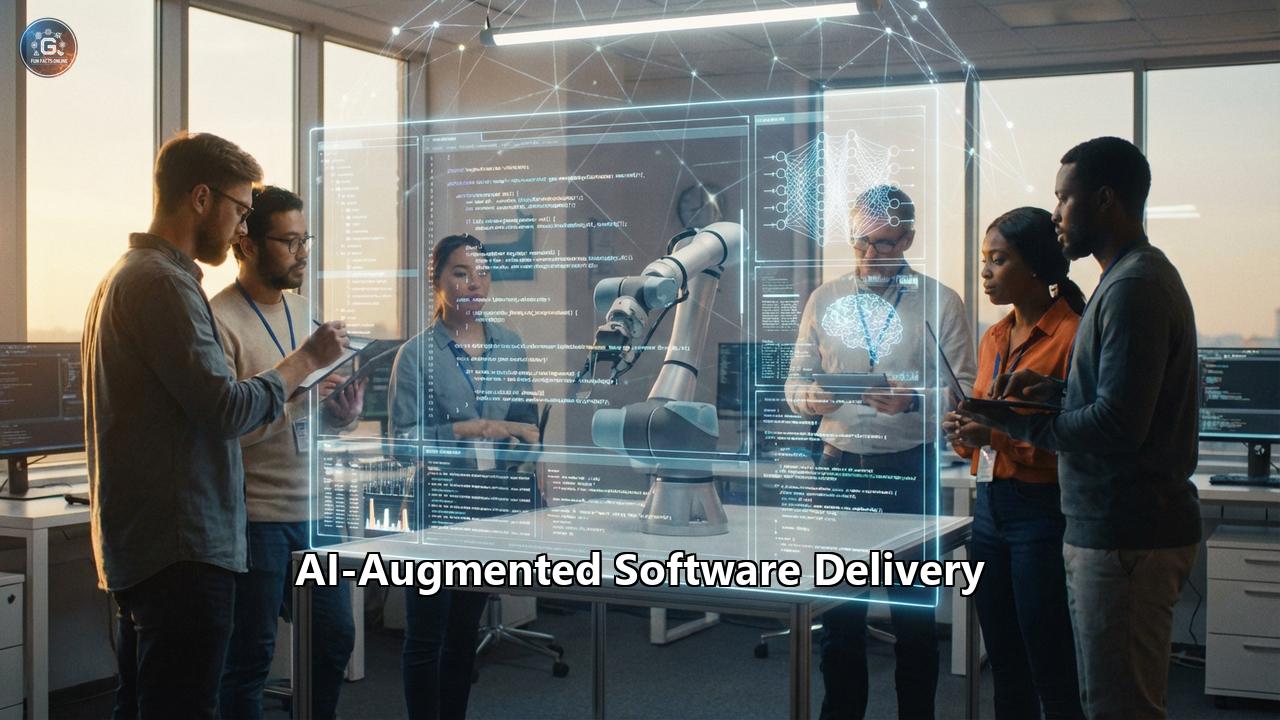
The software development industry is currently navigating its most significant inflection point since the advent of the internet. We have moved past the hype cycle of "will AI replace us?" and landed firmly in the era of AI-Augmented Software Delivery. This is no longer about simple automation or smarter autocomplete; it is about a fundamental restructuring of the Software Development Life Cycle (SDLC) where artificial intelligence acts as a force multiplier, a guardian of quality, and, increasingly, an autonomous agent of change.
In 2026, the question for engineering leaders is no longer if they should adopt AI, but how to weave it into the very fabric of their delivery pipelines without unravelling the security and culture that hold their teams together. This comprehensive guide explores the landscape of AI-augmented delivery, from the rise of "Context Engineering" to the deployment of autonomous agents, offering a roadmap for organizations ready to evolve.
Part 1: The Paradigm Shift – From Automation to Augmentation
To understand where we are going, we must distinguish between the automation of the past and the augmentation of the present.
Traditional DevOps was built on deterministic automation. If Event A happens, trigger Script B. It was rigid, rule-based, and fragile. If a UI button moved five pixels to the right, the Selenium script failed. If a server log threw an unknown error code, the pipeline halted until a human intervened.
AI-Augmented Software Delivery is probabilistic and adaptive. It doesn't just follow rules; it understands intent.- Old World: A script runs a test suite. If it fails, it sends an email.
- New World: An AI agent runs the test suite. If it fails, it analyzes the stack trace, correlates it with recent code commits, identifies the likely culprit, generates a fix, runs the test again to verify the fix, and then alerts the human developer with a solution ready to merge.
This shift changes the primary constraint of software delivery from human typing speed to human verification speed. We are transitioning from a world where code is scarce and expensive to one where code is abundant and cheap, but trust is at a premium.
The Three Pillars of Augmentation
- Predictive, Not Just Reactive: Traditional monitoring tells you the server is down. AI-augmented delivery tells you the server will go down in 20 minutes because of a memory leak introduced in the last deployment, and it auto-scales the infrastructure to compensate while rolling back the bad commit.
- Context-Aware: Generic AI tools (like a basic ChatGPT interface) are useful but limited. The real power lies in tools that understand your specific codebase, your architectural patterns, your variable naming conventions, and your business logic.
- Agentic Workflows: We are moving from "Chat with your Code" to "Agents acting on your Code." These are autonomous loops where AI plans, executes, and critiques its own work before presenting it to you.
Part 2: The New AI-Augmented SDLC
The linear waterfall model died years ago, but even the Agile/DevOps loops are being reshaped. Let’s walk through the new lifecycle, phase by phase.
Phase 1: Planning and Requirements (The "Shift Left" of Intelligence)
The biggest source of waste in software isn't buggy code; it's building the wrong thing. AI is intervening before a single line of code is written.
- Requirement Analysis & Refinement: In 2026, Product Managers rarely write Jira tickets in isolation. They draft a rough intent, and an AI analyst reviews it against the existing codebase and historical documentation. The AI might flag: "This requirement contradicts the security policy defined in Q3 2024" or "This feature looks similar to the 'User Roles' module we built last year; should we extend that instead?"
- Dynamic PRD Generation: Instead of static Product Requirement Documents (PRDs), teams act out scenarios with AI personas. A developer can simulate a user interaction with a "Virtual Customer" agent to uncover edge cases that would normally only be found in production.
Phase 2: Design and Architecture
- Text-to-Architecture: Architects now use generative design tools to visualize system interactions. A prompt like "Design a scalable event-driven architecture for a payment gateway handling 10k TPS" yields a detailed diagram (e.g., in Mermaid.js or wildly editable formats) complete with recommended AWS/Azure services, potential bottlenecks, and cost estimates.
- Legacy Modernization: One of the most potent uses is "explaining" the unexplainable. AI tools ingest millions of lines of COBOL or legacy Java, map the dependencies, and suggest a microservices decomposition plan, effectively de-risking modernization projects that have been stalled for a decade.
Phase 3: Coding (The Era of the "10x" Developer?)
This is the most visible change. Tools like GitHub Copilot, Cursor, and Tabnine have become non-negotiable.
- Context Engineering: The skill of the modern developer is not memorizing syntax, but Context Engineering. This involves curating the "context window" of the AI—feeding it the right interface definitions, database schemas, and design patterns so it generates code that actually compiles and runs.
- Boilerplate is Dead: Writing CRUD (Create, Read, Update, Delete) APIs, unit test skeletons, and data mapping layers is now instant. Developers spend their energy on the "business core"—the unique logic that differentiates the product.
- The "Junior" Paradox: A senior developer with AI is a superhero. A junior developer with AI is a risk. Without the "grunt work" to learn from, juniors may struggle to build the mental models needed to debug complex systems. We will discuss this "Experience Starvation" later.
Phase 4: Testing (Self-Healing and Visual AI)
- Visual AI: Tools like Applitools have revolutionized UI testing. Instead of checking if a specific CSS class exists, Visual AI looks at the page like a human does. It ignores minor rendering differences (like a 1px shift due to browser version) but catches "meaningful" breaks (like a buy button overlapping text).
- Self-Healing Scripts: In the past, if a developer changed a button ID from submit-btn to confirm-purchase, the test failed. AI-augmented test runners detect this change: "I can't find submit-btn, but I see confirm-purchase in the same location with the same behavior. I will update the test script automatically."
- Test Case Generation: You paste a user story; the AI generates the Gherkin syntax (Given/When/Then), the step definitions, and the negative test cases you forgot to think about.
Phase 5: Deployment and Ops (AIOps)
- Predictive Scaling: AIOps platforms like Dynatrace and Datadog ingest petabytes of operational data. They don't just alert on high CPU; they correlate it with business metrics. "Checkout latency is up 200ms, which correlates with a 5% drop in conversion. The root cause is likely the database locking issue introduced in release v2.4. Recommendations: Revert or apply this specific index."
- Security Fabric (DevSecOps): Tools like Snyk using DeepCode AI scan code not just for known CVEs, but for logic flows that look vulnerable. They can auto-fix vulnerabilities, creating a Pull Request that patches a security hole before the security team even sees the alert.
Part 3: Real-World Case Studies
Theory is fine, but who is actually doing this?
1. GitLab & NatWest: The Enterprise Scale
The Challenge: UK banking giant NatWest needed to modernize software delivery while adhering to strict financial regulations. The Solution: By adopting GitLab Duo (an AI suite), they integrated AI directly into their workflows. The Result: The bank didn't just "write code faster." They used AI for automated compliance checks and test generation. GitLab's research indicates that such AI-enhanced innovation could unlock billions in economic value by saving developers hundreds of hours on "toil"—non-creative, repetitive tasks. NatWest publicly highlighted how this deepened trust in their engineering rigor rather than diluting it.2. WalkMe & Applitools: The Visual Quality Guardrail
The Challenge: WalkMe, a digital adoption platform, supports thousands of website overlays. Testing their product across every browser and device combination manually was impossible. The Solution: They implemented Applitools' Visual AI. The Result: The team saved 2 months of man-hours per release cycle. They increased test coverage from 3 browsers to 10 browsers without adding headcount. The AI caught "visual regressions"—bugs where the code works, but the UI looks broken—that no standard automation could ever find.3. Snyk: Security at the Speed of AI
The Challenge: As developers used AI to write code faster, they were also introducing vulnerabilities faster. Traditional security scans took too long to run in the CI pipeline. The Solution: Snyk’s DeepCode AI, which combines symbolic AI (high precision) with generative AI (flexibility), provided real-time fixes. The Result: Companies using this "AI Security Fabric" reported a 75% faster remediation time for issues found during development. Instead of a security ticket sitting in a backlog for weeks, the AI suggested a fix that the developer could accept in seconds.Part 4: The Tooling Landscape of 2026
The market has consolidated into a few key categories.
The "Co-Pilots" (Coding Assistants)
- GitHub Copilot: The market leader. In 2026, it is no longer just a text predictor. It has "Workspace" awareness, meaning it can refactor code across multiple files and understand dependencies.
- Cursor: An AI-native code editor (a fork of VS Code) that allows for "Composer" mode, where you can write a spec and the editor writes the files, runs the terminal commands, and fixes its own errors.
- Tabnine: The privacy-focused choice. Preferred by enterprises that need to run models locally or in VPCs without sending code to public LLM providers.
The "Guardians" (Quality & Security)
- Applitools / Percy: For Visual AI.
- Snyk / SonarQube AI: For code quality and security. They now have "AI Gatekeepers" that block PRs that look generated but unverified.
The "Operators" (AIOps)
- Dynatrace Davis: A "causal" AI engine. Unlike generative models that guess, Davis uses deterministic AI to map the topology of your system, offering precise root cause analysis.
- PagerDuty Process Automation: Uses AI to group thousands of alerts into a single "Incident" and suggests remediation runbooks.
Part 5: The Human Element – Skills for the Augmented Age
The most dangerous myth is that AI makes software engineering "easy." It makes syntax easy, but it makes system design harder.
The Rise of "Context Engineering"
Prompt engineering (the art of talking to a chatbot) is dead. It has been replaced by Context Engineering. This is the architectural skill of designing the information flow that feeds the AI.
- A Context Engineer decides: What documents does the AI need to see? How do we index our codebase so the RAG (Retrieval-Augmented Generation) system retrieves the right snippet? How do we sanitize data so the AI doesn't leak PII?
The "Verification" Bottleneck
In 2026, a developer spends 20% of their time writing code and 80% of their time acting as a Lead Reviewer for the AI.
- Trust Deficit: A study by Sonar in 2025 showed that while 42% of code is AI-assisted, 96% of developers don't fully trust it. This "trust deficit" creates a new kind of mental fatigue. Reviewing code is often harder than writing it, especially when the code looks plausible but contains subtle logic errors.
The Junior Developer Crisis
Organizations are facing a "Senior-Only" problem. Because AI can do the work of a junior dev (writing boilerplate, basic functions), companies are hiring fewer juniors. But if you don't hire juniors, you never get seniors.
- The Solution: Progressive companies are turning juniors into "AI Operators." Their job is to orchestrate the AI agents, verify the output, and focus intensely on learning architecture and business logic earlier in their careers.
Part 6: Governance and the "Traffic Light" Policy
Shadow AI (developers pasting proprietary code into public chatbots) is the #1 security risk. You cannot ban AI, so you must govern it. The industry standard for 2026 is the Traffic Light Protocol:
| Level | Color | Allowed Tools | Data Rules |
| :--- | :--- | :--- | :--- |
| Green | Approved | Enterprise Copilot, Self-Hosted LLMs | Safe for Proprietary Code. Zero-retention agreements are signed. |
| Yellow | Caution | Public Chatbots (e.g., Free ChatGPT) | NO CODE. General logic questions only. No PII, no company names, no API keys. |
| Red | Banned | Unknown / Unvetted Plugins | strictly prohibited. These often scrape data or introduce supply chain attacks. |
Key Policy Rule: The Human in the Loop Mandate. A human must review and sign off on every line of AI-generated code. "The AI wrote it" is not a valid defense for a production outage.Part 7: Future Outlook (2026-2030)
As we look toward the end of the decade, three trends will dominate:
- Agentic Workflows: We will move from "Human-in-the-loop" to "Human-on-the-loop." Agents will have permission to create a branch, write the code, write the test, deploy to a staging environment, and then ping the human: "I have built feature X. It is live on Staging. Here is the link. Approve for Production?"
- Self-Writing Software: Applications that self-optimize. An e-commerce site might detect that a specific SQL query is slow, and the application itself will rewrite the query, test the optimization, and hot-swap the code without a deployment window.
- The Rise of the "Software Naturalist": Developers will become more like biologists, observing complex, evolving AI ecosystems, pruning them, and guiding them, rather than acting as the bricklayers of the past.
Conclusion
AI-Augmented Software Delivery is not a tool you buy; it is a way of working. It offers the promise of releasing software at the speed of thought, but it demands a higher caliber of engineering discipline to manage the chaos. The teams that thrive in 2026 will not be the ones who code the fastest, but the ones who curate context the best, govern their agents the wisest, and never lose sight of the fact that software is ultimately built for humans, by humans—even if the heavy lifting is done by machines.
Deep Dive: The AI-Augmented Software Development Life Cycle (SDLC)
To fully appreciate the transformation, we must dissect the SDLC phase by phase. The traditional distinct stages of "Plan -> Build -> Test -> Deploy" are blurring into a continuous, AI-mediated loop.
1. Planning & Analysis: The End of Ambiguity
In the traditional waterfall or even Agile models, requirement gathering was a game of "telephone." Business stakeholders described a need, a product manager wrote it down (often missing nuance), and developers interpreted it (often incorrectly).
The AI Advantage: Requirements as CodeIn an AI-augmented workflow, requirements are treated as executable specifications from day one.
- Ambiguity Detection: Before a developer ever sees a Jira ticket, an AI agent parses the user story. It checks for:
Completeness: "You mentioned a 'User Profile' page, but didn't specify error states for image uploads."
Contradiction: "This requirement for 2FA conflicts with the 'One-Click Login' requirement in Epic B."
Contextual Relevance: "We already have a UserAuth service. Should this feature leverage that?"
- Synthetic User Personas: AI can simulate stakeholders. A developer can ask a "Virtual CMO" agent, "Does this UI flow align with our Q3 branding guidelines?" and get immediate feedback based on the ingested brand rulebook.
2. Architecture & Design: Generative Systems
Architecture has long been the stronghold of the "Senior Principal Engineer"—a role requiring deep experience. AI is democratizing this by acting as an infinite library of patterns.
- Pattern Matching at Scale: An architect can describe a system constraints: "I need a system that handles 50,000 concurrent websocket connections, stores chat logs for 5 years for compliance, and has a latency under 100ms globally." The AI can propose three distinct architectures (e.g., Elixir/Phoenix vs. Go/Redis vs. Node/Kafka), complete with pros, cons, and estimated AWS monthly bills for each.
- Infrastructure as Code (IaC) Generation: Once an architecture is selected, the AI generates the Terraform or Pulumi scripts to spin it up. It doesn't just write generic code; it writes code compliant with your company's specific security policies (e.g., "All S3 buckets must be encrypted with KMS").
3. Development: The "Centaur" Programmer
The term "Centaur" (half human, half horse) is often used to describe the chess players who combine human intuition with computer calculation. 2026 developers are Centaurs.
- The "Blank Page" Problem is Solved: No developer starts with an empty file. They start with a comment describing the intent, and the AI scaffolds the entire module.
- Cognitive Offloading: Developers no longer memorize standard libraries. They don't need to know the exact syntax for a Python datetime conversion; they just type // convert string to epoch and verify the result. This frees up mental RAM for higher-order logic.
- Refactoring Agents: Technical debt is the silent killer of software. Agentic AI can now run in the background, identifying "smelly" code (long functions, duplicated logic) and opening Pull Requests to refactor them. The human's job is simply to review and merge.
A junior developer can now generate a complex React component in seconds. But if it contains a re-rendering bug that only shows up under heavy load, do they have the expertise to spot it? This is the central tension of AI coding: Ease of generation > Ease of understanding.
4. Testing: From "Checking" to "Exploring"
Testing is where AI provides perhaps its highest ROI.
- Unit Test Generation: AI tools can read a function and generate 100% code coverage unit tests, including edge cases (null inputs, massive integers) that humans often skip.
- Self-Healing Selenium: We discussed this earlier, but its impact cannot be overstated. The #1 reason teams abandon UI automation is "brittleness." AI heals this brittleness, making automation sustainable.
- Visual Regression: Tools like Applitools allow for "Semantic Visual Testing." It understands that a dynamic ad banner changing is not a bug, but the footer disappearing is.
- Exploratory Testing Bots: AI agents can "crawl" an application like a chaotic user, trying to break flows. They might try clicking "Back" during a payment transaction or double-submitting a form—finding race conditions that scripted tests miss.
5. Security (DevSecOps): The AI Shield
Security can no longer be a "gate" at the end. It must be a continuous fabric.
- Supply Chain Analysis: AI monitors your npm or pip dependencies. If a maintainer's account is compromised (a common attack vector), the AI agent detects the anomaly in the package's behavior (e.g., "Why is this logging library suddenly trying to open a network socket?") and blocks the upgrade.
- Secrets Detection: Hardcoded API keys are a classic error. AI scanners understand the entropy of strings and the context ("This variable is named stripe_key") to catch secrets before they are committed to git.
- Vulnerability Explanation: When a vulnerability is found, the AI doesn't just link to a CVE database. It explains the exploit in the context of your code: "This SQL injection is possible because you are concatenating user input in line 42 of login.js. Here is the sanitized version using parameterized queries."
6. Operations & Observability: AIOps
When code hits production, reality hits hard.
- Noise Reduction: A typical outage generates thousands of alerts. AIOps tools cluster these. Instead of 500 emails saying "CPU High," you get one Slack notification: "Database Cluster A is overloaded due to a deadlock. This is affecting Service B and Service C."
- Predictive Maintenance: "Disk usage is growing at 5% per hour. At this rate, the server will crash at 3:00 AM. I can provision a larger volume now. Approve?"
- Incident Post-Mortems: After an incident, AI parses the chat logs (Slack/Teams), the system logs, and the timeline of events to draft the "Root Cause Analysis" (RCA) document, saving engineers hours of paperwork.
The Human Impact: Roles, Skills, and Culture
Technological change is fast; cultural change is slow. The successful implementation of AI-augmented delivery relies 10% on tools and 90% on people.
The Evolution of the Developer Role
| Era | Primary constraint | Key Skill |
| :--- | :--- | :--- |
| 2000s | Access to knowledge | Memorization / Books / Docs |
| 2010s | Typing / Boilerplate | Google / StackOverflow |
| 2020s | Complexity | System Integration |
| 2026+ | Trust / Context | AI Orchestration / Verification |
New Skills for 2026
- AI Literacy & Skepticism: Knowing how LLMs work (tokens, temperature, hallucinations) is crucial. Developers must be professional skeptics, assuming the AI is "confidently wrong" until proven otherwise.
- Context Curation: The ability to assemble the right data to feed the AI. This is like being a librarian for a super-genius who knows everything but has amnesia.
- Code Review Proficiency: Reading code is harder than writing it. As AI writes more, humans read more. Skills in quick, accurate code auditing are becoming highly reinforced.
- System Thinking: With the "how" of coding becoming easier, the value shifts to the "what" and "why." Understanding distributed systems, eventual consistency, and business domains is where the human value add resides.
The Junior Developer Bottleneck
We must address the elephant in the room. If AI does the "easy" work, how do juniors learn?
- The "Apprenticeship" Model: Companies must deliberately create "safe fail" zones. Juniors should be encouraged to write code without AI for training purposes, or use AI as a tutor ("Explain line 42 to me") rather than a doer.
- Pair Programming with AI: Juniors can use AI as a "Senior Partner," asking it to critique their code before a human sees it. This creates a psychological safety net, allowing them to learn faster without fear of judgment.
Strategy & Governance: How to Implement
Implementing AI-augmented delivery without a strategy is a recipe for "Shadow AI" and chaos.
The "Engineering Foundations First" Rule
Do not add AI to a broken process.If your testing is manual, your deployments are flaky, and your documentation is outdated, AI will just help you create bad code faster.
- Fix your CI/CD first.
- Standardize your linter rules.
- Clean your documentation.
- Then add AI to accelerate this clean engine.
The Governance Framework
- Data Privacy is Paramount: Never send core IP or customer PII to a public model. Use enterprise tiers (like Azure OpenAI or AWS Bedrock) that guarantee zero retention.
- Attribution & Licensing: Be wary of "Copyleft" code. If an AI generates code that resembles a GPL-licensed library, you could legally taint your codebase. Tools like Snyk and Black Duck now have "AI Attribution" scanners to mitigate this.
- The "Human Liability" Clause: Company policy must state clearly: The developer who commits the code is responsible for it.* You cannot blame the bot during the post-mortem.
Conclusion: The Augmented Future
We are building the future of software with tools that feel like magic, but require the discipline of science. AI-Augmented Software Delivery is a journey from being "coders" to being "architects of intelligence."
The software engineers of 2026 are not being replaced; they are being promoted. They are moving up the stack, away from the syntax and the semicolons, and towards the systems, the solutions, and the strategy.
The companies that succeed will be those that recognize AI not as a way to cut costs, but as a way to expand capability—to build better, safer, and more ambitious software than we ever thought possible.
Welcome to the age of the Augmented Engineer.
Reference:
- https://medium.com/@shreesonavane97/how-ai-is-quietly-changing-software-development-in-2026-real-examples-d1ce65fc1b8c
- https://medium.com/startup-insider-edge/how-senior-developers-use-ai-very-differently-from-juniors-what-you-should-do-in-2026-05c9bb3c279a
- https://www.cio.com/article/4132224/ai-is-redefining-entry-level-tech-roles-heres-what-cios-need-to-change-now.html
- https://medium.com/algomart/prompt-engineering-vs-context-engineering-a-shift-i-wish-someone-had-explained-to-me-earlier-0a73cfeca49f
- https://pub.towardsai.net/context-engineering-is-the-new-prompt-engineering-11a22053c1f6
- https://medium.com/coding-nexus/how-i-actually-build-software-with-ai-in-2026-86d074203baf
- https://www.index.dev/blog/will-ai-replace-software-developer-jobs
- https://medium.com/@sohitmishra/ai-career-growth-for-developers-what-actually-matters-in-2026-b70e4c39592a
- https://paulawity.com/ai-skills-every-developer-should-learn-in-2026
- https://github.blog/ai-and-ml/automate-repository-tasks-with-github-agentic-workflows/
- https://aimultiple.com/agentic-ai
- https://www.youtube.com/watch?v=aOe8GMQ16bs
- https://www.epicai.pro/7-developer-skills-you-ll-need-in-2026-tl8fc
- https://apyhub.com/blog/top-developer-skills-to-learn-2026
- https://armsofold.co.uk/ai-replacing-developers
- https://www.coursereport.com/blog/7-skills-you-need-to-become-an-ai-engineer-in-2026