
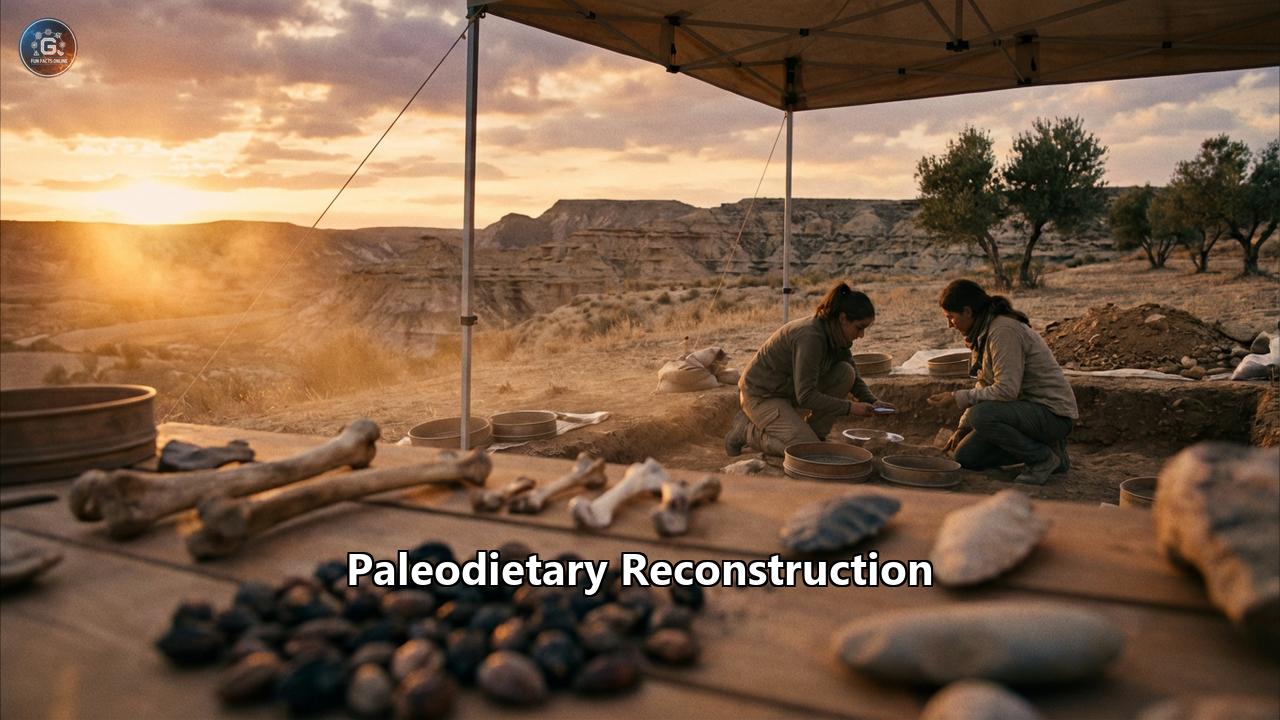
Introduction: The Ghost of a Last Meal
High in the Ötztal Alps, over 5,000 years ago, a man sat down for what would be his final meal. He was tired, likely hunted, and resting at an altitude that would make modern hikers winded. From his pouch, he pulled strips of dried meat and a few handfuls of grain. He didn't know that millenia later, scientists would analyze the very atoms of this meal to reconstruct not just his final moments, but the entire world he lived in.
This man, known to the world as Ötzi the Iceman, has become the most famous patient in the field of paleodietary reconstruction. When researchers peered into his stomach using advanced tomography and molecular analysis, they didn't just find food; they found a story. They found ibex and red deer meat, ancient einkorn wheat, and traces of toxic bracken fern. They found that his diet was a staggering 50% fat—a caloric necessity for surviving in a frozen, alpine landscape.
Paleodietary reconstruction is the scientific discipline that allows us to time travel through our stomachs. It is not merely a list of ingredients; it is the study of human adaptation, social hierarchy, migration, and the very evolution of our species. By analyzing chemical signatures in bone collagen, microscopic scratches on tooth enamel, and invisible fats trapped in pottery shards, archaeologists are rewriting history. They are debunking modern fads like the "Paleo Diet," revealing the gritty reality of cannibalism, and showing us that "you are what you eat" is a truth that echoes across thousands of years.
Part I: The Science of Survival (Methods & Techniques)
To reconstruct a diet that disappeared thousands of years ago, archaeologists rely on a toolkit that borrows heavily from chemistry, biology, and geology. These methods act as distinct lenses, each revealing a different layer of the past.
1. Stable Isotope Analysis: The Atomic Signature
The backbone of modern paleodietary studies is the principle of isotopic fractionation. The old adage "you are what you eat" is chemically literal. The tissues of your body are built from the nutrients you consume, and those nutrients carry specific atomic weights—isotopes—derived from the environment.
- Carbon ($^{13}C/^{12}C$): This is the primary plant tracker. Plants photosynthesize in different ways (C3 vs. C4 pathways).
C3 Plants: Wheat, barley, rice, fruits, and nuts (temperate climates). They have lower $\delta^{13}C$ values.
C4 Plants: Maize (corn), millet, sorghum, and sugarcane (tropical/arid climates). They have higher $\delta^{13}C$ values.
By measuring carbon isotopes in bone collagen, we can tell if a population was eating wheat or corn. It also helps distinguish between terrestrial and marine diets, as marine organisms are enriched in $^{13}C$.
- Nitrogen ($^{15}N/^{14}N$): The trophic level tracker. With every step up the food chain, nitrogen-15 concentrates in the body.
Vegans: Low $\delta^{15}N$.
Omnivores: Moderate $\delta^{15}N$.
Carnivores: High $\delta^{15}N$.
Marine Hunters: Extremely high $\delta^{15}N$ (because aquatic food chains are longer).
This method was key in discovering that Neanderthals were top-level carnivores, often occupying a trophic position higher than hyenas.
2. Dental Microwear Texture Analysis (DMTA)
If isotopes are the chemistry of diet, microwear is the physics. The food we chew leaves microscopic traces on our teeth—pits, scratches, and gouges.
- Hard objects like nuts, seeds, and bone create complex, pitted surfaces.
- Tough foods like fibrous leaves and meat create long, parallel scratches.
- By using 3D confocal microscopy, researchers map these "landscapes" on tooth enamel. This tells us about the physical properties of the food eaten in the last few weeks of life. It’s how we know that Paranthropus boisei, once nicknamed "Nutcracker Man" because of his massive jaws, was actually eating mostly soft grasses, not hard nuts.
3. Organic Residue Analysis (ORA)
Ceramic pots are the Tupperware of antiquity. Even after thousands of years, unglazed pottery retains "chemical ghosts"—lipids (fats) trapped in the porous clay matrix.
- Using gas chromatography-mass spectrometry (GC-MS), scientists can extract these fats and identify them.
- Dairy fats have a distinct isotopic signature compared to adipose fats (meat). This technique has been revolutionary in mapping the spread of dairying (milk consumption) across Neolithic Europe and the Indus Valley.
4. Paleoproteomics and Ancient DNA
The cutting edge. While DNA degrades relatively quickly, proteins are more robust. Paleoproteomics analyzes ancient proteins (like those in dental calculus or bone) to identify specific species consumed.
- Dental Calculus (Plaque): The plaque on your teeth mineralizes into "tartar" or calculus, trapping bacteria, starch grains, and food proteins. It is a fossilized mouth-swab. Analysis of Neanderthal calculus has revealed they ate woolly rhinoceros and wild mushrooms, and even used natural aspirin (poplar bark).
Part II: The Hunter-Gatherer Menu (Paleolithic Reality vs. Myth)
The "Paleo Diet" Myth
Modern culture is obsessed with the "Paleolithic Diet"—a regimen of high meat, no grains, and no processed sugars. While the "no processed sugar" part is accurate, the archaeological record shatters the rest of the fantasy.
- Carbohydrates were Key: Recent studies of starch grains trapped in dental calculus show that Paleolithic humans were eating wild oats, tubers, and legumes long before agriculture.
- Diversity is the Rule: There was no single Paleo diet. The Inuit ancestor ate almost 100% meat and fat; the Hadza ancestor ate predominantly tubers and honey. The "natural" human diet is defined by flexibility, not a specific food list.
Case Study: The Dark Side of the Menu – Cannibalism at Gran Dolina
One of the most chilling chapters in dietary history comes from the Gran Dolina cave in the Sierra de Atapuerca, Spain. Here, in layers dating back 850,000 years, archaeologists found the remains of Homo antecessor.
- The Evidence: Among the animal bones (deer, bison) were human bones. Crucially, the human bones bore the exact same butchery marks as the animals: skinning marks, defleshing cuts, and marrow extraction fractures (where bones are cracked open).
- The Victims: Many were children and adolescents. A recently analyzed cervical vertebra of a 2-4 year old child showed clear cut marks indicating decapitation.
- The Verdict: This was "gastronomic cannibalism"—eating humans for nutrition rather than ritual. It suggests that for early hominins, other humans were simply another source of meat in a resource-competitive environment.
Part III: The Agricultural Revolution – The Maize Explosion
The shift from hunting and gathering to farming (the Neolithic Transition) was the biggest dietary change in human history. It brought stability, but it also brought malnutrition, cavities, and a drop in height.
Case Study: Cahokia and the Corn Mothers
Cahokia, located near modern-day St. Louis, was the largest pre-Columbian city north of Mexico, booming around AD 1050. Its rise is inextricably linked to one plant: Maize (Corn).- Isotopic Evidence: Because maize is a C4 plant and the native vegetation of the Mississippi Valley is C3, maize leaves a screamingly loud signal in the carbon isotopes of human bone.
- The Findings: Before AD 900, the isotopic signature of the region's inhabitants is typical of a mixed diet (nuts, seeds, venison). Suddenly, between AD 900 and 1000, there is a massive spike in $\delta^{13}C$.
- The Impact: This indicates a rapid, almost abrupt adoption of maize agriculture. This "corn explosion" fueled the population boom that built the massive mounds of Cahokia. However, it came at a cost. Skeletons from this period show increased porotic hyperostosis (a sign of iron-deficiency anemia) and dental caries (cavities) caused by the high-sugar, starchy corn diet. The "Corn Mothers" fed the city, but they also plagued its health.
Part IV: Diet, Class, and Identity in Complex Societies
As societies became more complex, diet became a marker of status. "Tell me what you eat, and I will tell you who you are" applies perfectly to the archaeological record.
Case Study: The Vegetarian Gladiators of Ephesus
Popular culture depicts Roman gladiators as hulking, meat-eating beasts. But isotopic analysis of bones from a gladiator cemetery in Ephesus (Turkey) tells a different story.
- The "Barley Men": The bones revealed high strontium levels and low nitrogen values compared to the general population. This profile indicates a diet heavy in plants and very low in animal protein.
- The Ash Tonic: Historical texts referred to gladiators as hordearii ("barley eaters"). The high strontium/calcium ratios in their bones confirm they consumed a special "ash drink"—a concoction of charred plant ash and vinegar. This was essentially a prehistoric calcium supplement, crucial for healing bone fractures sustained in the arena. They were fueled by carbs and ash, not steak.
Case Study: King Richard III – A Diet Fit for a King
When the skeleton of King Richard III was discovered under a parking lot in Leicester in 2012, it offered a rare opportunity to track the diet of a specific historical figure over his lifetime.
- Multi-Tissue Analysis: Scientists analyzed three different tissues:
Teeth: Formed in childhood (locked-in signal).
Femur: Remodels slowly (average of the last 10–15 years).
Ribs: Remodels quickly (average of the last 2–3 years of life).
- The Royal Shift: His teeth showed a standard high-status diet. But his ribs—reflecting his short reign as King—showed a massive jump in $\delta^{15}N$ and oxygen isotopes.
- The Menu: The nitrogen spike indicates a huge increase in "luxury proteins"—freshwater fish (pike, eel), game birds (swan, heron, crane), and potentially marine mammals. The oxygen shift is attributed to a significant increase in wine consumption (which has a different water source than local English rainwater). Richard literally drank and feasted his way through his kingship.
Case Study: The Mary Rose – Diversity on Deck
The sinking of Henry VIII’s flagship, the Mary Rose, in 1545 preserved a "time capsule" of Tudor naval life.
- Isotopes of Origin: Analysis of oxygen and sulphur isotopes in the crew's teeth revealed that not all of them were English. Some had isotopic signatures consistent with warmer, southern climates—likely Southern Europe or North Africa.
- The Naval Diet: Nitrogen analysis showed the crew had a diet surprisingly high in terrestrial protein. This aligns with naval records of rations: salted beef, pork, and ship's biscuits. Despite being surrounded by the sea, they weren't eating much fish—fish was for fast days and the poor; beef was the fuel of the navy.
Part V: Surviving the Edge – The Greenland Vikings
For decades, historians believed the Norse settlements in Greenland (AD 985–1450) collapsed because the stubborn Vikings refused to adapt to the climate, clinging to European farming instead of adopting Inuit hunting tactics. Isotope analysis has debunked this "failure to adapt" myth.
- The Shift: Early Viking settlers had diets that were 80% terrestrial (beef, dairy, sheep).
- The Adaptation: As the climate cooled (the Little Ice Age), isotopic analysis of later skeletons shows a dramatic shift. By the end of the settlement period, their diet was up to 80% marine.
- The Reality: They did adapt. They became seal hunters. The "marine reservoir effect" (where marine carbon makes dates look older) had initially confused radiocarbon dating, making researchers think they died out earlier or didn't eat fish. Correcting for this showed they survived for centuries by gorging on seal meat. Their eventual disappearance wasn't a failure of diet, but likely a collapse of the ivory trade and social isolation.
Part VI: The Future of the Past
The field is currently undergoing a "molecular revolution," moving beyond bulk carbon and nitrogen into uncharted territories.
1. Zinc Isotopes ($\delta^{66}Zn$)
Nitrogen isotopes are great for trophic level but are easily ruined by diagenesis (decay) in old fossils. Zinc isotopes in tooth enamel are the new game-changer.
- Zinc is robust and preserves for millions of years.
- Zinc levels decrease as you go up the food chain. This method recently confirmed the carnivorous diet of megalodon sharks and is now being applied to early hominins to settle debates about scavenging vs. hunting.
2. Magnesium Isotopes ($\delta^{26}Mg$)
Magnesium offers a new way to look at "dietary structure." It helps distinguish between plant sources and tracks physiological stress. Recent studies suggest it can act as a proxy for the structural complexity of the diet (whole plants vs. processed).
3. Calcium Isotopes ($\delta^{44}Ca$) – The Weaning Tracker
Calcium isotopes are revolutionizing the study of childhood. Breast milk has a distinct calcium isotope signature. By microsampling the enamel of baby teeth (which grow in layers like tree rings), scientists can pinpoint the exact month a child stopped breastfeeding. This "weaning age" is a critical demographic variable, linked to fertility rates and population growth in ancient societies.
Conclusion: The Story in the Bone
Paleodietary reconstruction has transformed archaeology from a discipline of objects (pottery, arrowheads) to a discipline of biology. It has humanized the past. We now know that the "mighty" gladiator ate beans to survive, that the "primitive" hunter-gatherer understood the medicinal value of plants, and that the "stubborn" Viking was actually a flexible survivor.
Every bone, every tooth, and every potsherd is a biological archive. As technology advances—moving into single-amino acid analysis and deep proteomic sequencing—we will likely uncover even more intimate details. We may soon know not just what* they ate, but how they seasoned it, how they cooked it, and perhaps, via the microbiome, how it made them feel. The menu of the past is open; we are just learning how to read it.
Reference:
- https://pmc.ncbi.nlm.nih.gov/articles/PMC9543897/
- https://www.researchgate.net/publication/352104607_Zinc_isotopes_from_archaeological_bones_provide_reliable_tropic_level_information_for_marine_mammals
- https://academic.oup.com/bioscience/article/72/7/618/6590448
- https://www.ncbi.nlm.nih.gov/books/NBK482457/
- https://zoe.com/learn/paleo-diet-versus-ancient-humans-diet
- https://www.nationalgeographic.com/science/article/850000-year-old-child-neck-bone-and-cannibalism
- http://comunicacio.iphes.cat/eng/news/new/879.htm
- https://www.livescience.com/archaeology/human-evolution/ancient-human-relative-cannibalized-toddlers-850-000-year-old-neck-bone-reveals
- https://archaeologymag.com/2025/07/decapitation-of-a-child-850000-years-ago-atapuerca/
- https://allthatsinteresting.com/atapuerca-spain-homo-antecessor-cannibalism
- https://conf.goldschmidt.info/goldschmidt/2022/meetingapp.cgi/Paper/12650
- https://www.frontiersin.org/journals/earth-science/articles/10.3389/feart.2022.1056881/full
- https://www.pnas.org/doi/10.1073/pnas.1704412114