
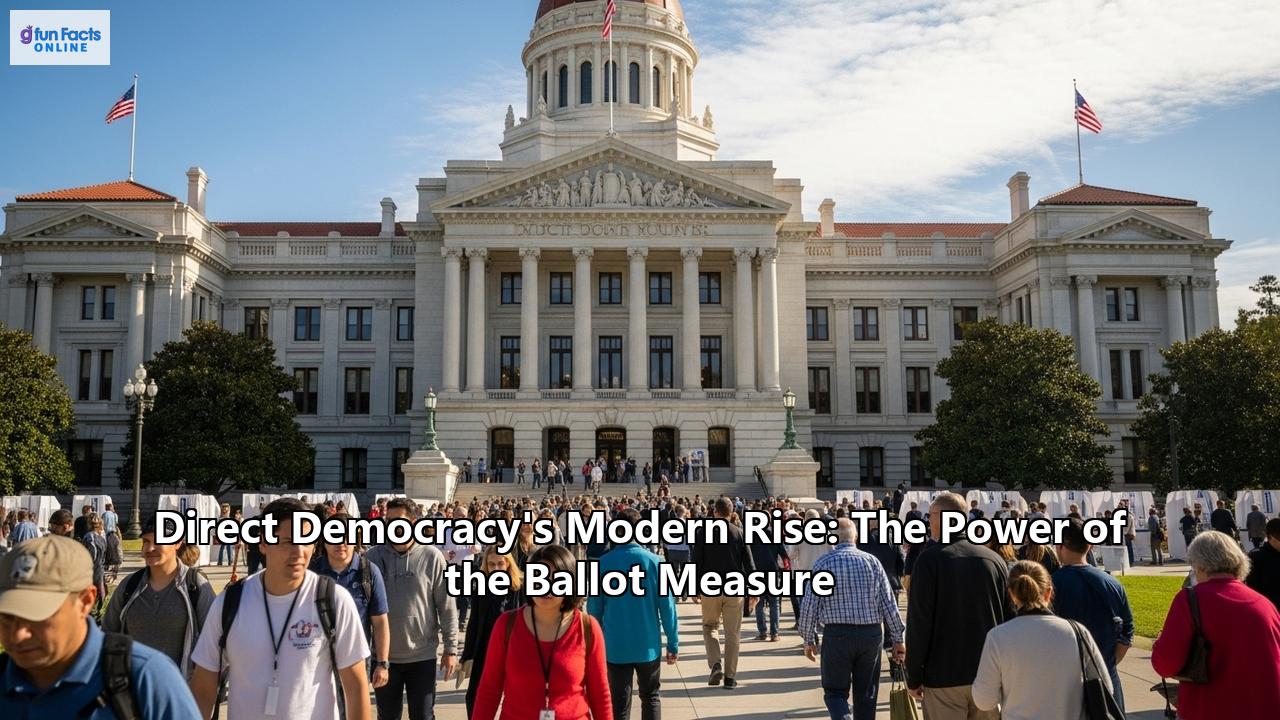
In an era of shifting political landscapes and evolving civic engagement, direct democracy is experiencing a modern renaissance, with the ballot measure emerging as a powerful tool for citizen-led change. This resurgence signifies a growing desire among citizens to have a more direct say in the laws and policies that shape their lives, moving beyond the traditional confines of representative democracy.
The Essence of Direct Democracy
Direct democracy, in its purest form, is a system where citizens vote directly on laws and policies rather than electing representatives to make decisions on their behalf. This model of governance, with roots stretching back to ancient Athens, is often lauded as the truest form of democracy. The core principle is to cut out the "middlemen" and empower the populace to be the ultimate arbiters of their own governance.
In the modern world, pure direct democracy is impractical for large nations. Instead, a hybrid model known as semi-direct democracy has become the most common form. This system combines the tenets of direct and representative democracy, where citizens elect officials for day-to-day governance but retain the power to vote on significant issues through mechanisms like referendums, initiatives, and recalls.
The Engine of Direct Democracy: Ballot Measures
At the heart of modern direct democracy are ballot measures, also known as propositions. These are laws, issues, or questions placed on a ballot for voters to approve or reject. This process allows citizens to take an active role in policymaking, essentially becoming lawmakers themselves.
The modern ballot measure system in the United States has its origins in the Progressive Era of the late 19th and early 20th centuries. Reformers sought to curb the power of political parties and influential "bosses," leading to the adoption of initiatives and referendums in numerous state constitutions, particularly in the Western states. South Dakota was the first to adopt such a process in 1898, followed by Utah in 1900 and Oregon in 1902.
Since then, the use of ballot measures has seen a significant resurgence. Since 1980, there have been over 900 statewide ballot measures in the U.S., with thousands more at the local level. Currently, 38 states permit some form of direct democracy, and 24 states, along with the District of Columbia, allow for citizen-initiated measures.
There are several types of ballot measures:
- Initiatives: These allow citizens to propose legislation or constitutional amendments by gathering a required number of signatures from registered voters. The initiative can be "direct," where the proposal goes straight to the ballot, or "indirect," where it is first submitted to the legislature. Eighteen states allow for initiated constitutional amendments, and 21 permit initiated state statutes.
- Referendums: This mechanism allows citizens to vote on laws already passed by the legislature. The "veto referendum" or "popular referendum" enables voters to repeal existing legislation. This form of direct democracy is available in 23 states.
- Legislative Referrals: In this case, the legislature places a proposed law or constitutional amendment on the ballot for voter approval. This is a common practice, with 49 states utilizing this process for constitutional amendments.
The Allure of Direct Democracy: A Double-Edged Sword
The growing popularity of ballot measures stems from a number of perceived benefits:
- Increased Transparency and Accountability: Direct democracy promotes transparency by bringing policy debates into the public sphere, reducing the potential for "backroom deals." It also holds elected officials more accountable, as citizens can directly challenge or bypass their decisions. The mere threat of a citizen initiative can incentivize politicians to be more responsive to public preferences.
- Greater Citizen Engagement: Knowing their vote can directly impact policy encourages greater participation in the political process and fosters a sense of community. This direct involvement can lead to a more informed and engaged citizenry.
- Overcoming Political Gridlock: In situations where partisan politics lead to legislative stalemates, ballot measures can provide a path forward on critical issues. They allow citizens to unbundle complex issues and vote on them individually, breaking through political logjams.
- Protecting Against the "Tyranny of the Majority": While some fear that direct democracy could lead to the oppression of minority groups, others argue that it can actually protect them. In a representative system, powerful minority interests can sometimes hold sway over the majority. Direct democracy, in theory, gives power back to the broader population.
However, direct democracy is not without its critics and potential pitfalls:
- The Influence of Money and Special Interests: While intended to empower ordinary citizens, ballot measure campaigns can be incredibly expensive, often funded by wealthy individuals and special interest groups. This can lead to a situation where the process is hijacked to serve narrow agendas rather than the public good. For instance, from 2000 to 2020 in California, spending on ballot measure campaigns reached a staggering $4.2 billion.
- The Challenge of an Informed Electorate: For direct democracy to function effectively, voters must be well-informed about the complex issues they are deciding on. In a world of busy schedules and information overload, ensuring a well-educated electorate can be a significant challenge.
- The Risk of "Tyranny of the Majority": A frequently cited concern is that a majority of voters could pass laws that infringe upon the rights of minority groups. This highlights the need for strong constitutional protections to safeguard against such outcomes.
- The Potential for Poorly Drafted Laws: Critics argue that complex policy issues are often better handled by legislators who have the time and resources to deliberate and craft nuanced laws. Ballot measures, sometimes written by activists or special interests, can lead to unintended consequences.
The Digital Age and the Future of Direct Democracy
The rise of the internet and social media is profoundly impacting the landscape of direct democracy. Technology offers unprecedented opportunities to enhance citizen participation:
- Increased Accessibility: Online platforms and mobile applications can make it easier for people to engage in the political process, regardless of their location or physical abilities. This could lead to a more inclusive and representative democracy. Digital petitions and online town halls are just a few examples of how technology can democratize participation.
- Facilitating Mobilization: Social media has become a powerful tool for political mobilization, allowing grassroots campaigns to organize and reach a wide audience at a relatively low cost.
However, the digital age also presents new challenges:
- The Spread of Disinformation: The same technologies that facilitate engagement can also be used to spread false or misleading information, potentially manipulating public opinion and undermining informed decision-making.
- The Digital Divide: Unequal access to technology and digital literacy can create new forms of inequality, potentially marginalizing those who are not digitally savvy.
- The Power of Big Tech: There are growing concerns about the immense power of large technology companies and their potential to influence democratic processes. The algorithms that curate our online experiences can shape our perceptions and, ultimately, our political choices.
Landmark Ballot Measures and Their Impact
Throughout modern history, ballot measures have been at the forefront of significant social and political change:
- Taxpayer Revolts: California's Proposition 13 in 1978, which capped property taxes, sparked a nationwide "taxpayer revolt" and led to similar measures in other states.
- Term Limits: A 1990 ballot measure in California, Colorado, and Oklahoma imposing term limits on state lawmakers helped ignite a national movement for such reforms.
- Social Issues: Ballot measures have played a pivotal role in debates over contentious social issues.
Marijuana Legalization: The journey toward marijuana legalization began with ballot measures, starting with California's Proposition 19 in 1972. Colorado and Washington's successful legalization measures in 2012 were a major turning point.
Same-Sex Marriage: Between 1998 and 2012, voters in 30 states approved measures banning same-sex marriage. The tide has since turned, and in 2024, California voters will have the opportunity to repeal the ban they approved in 2008.
Abortion Rights: In 1970, three years before the landmark Roe v. Wade decision, voters in Washington state legalized abortion through a referendum. In more recent times, following the overturning of Roe v. Wade*, ballot measures have become a key battleground for reproductive rights. For example, in 2024, Missouri voters approved an amendment to allow abortion up to 24 weeks.
The Ongoing Battle for Direct Democracy
The increasing use and impact of ballot measures have not gone unnoticed by those in power. In some states, there have been efforts to make the initiative process more difficult. For example, in August 2023, the Ohio legislature attempted to raise the threshold for passing ballot measures from a simple majority to a 60% supermajority, a move that was ultimately rejected by voters. Similarly, in Utah, after the state's Supreme Court upheld a citizen-led initiative, the legislature put forth a measure to grant themselves the power to amend or repeal such initiatives.
These moves are indicative of a larger struggle over the balance of power between representative government and direct citizen participation. Proponents of a stronger direct democracy argue that in an era of hyper-partisanship and gerrymandering, ballot measures are often the last line of defense for ensuring that the will of the majority is heard.
Conclusion: The Enduring Power of the People
The modern rise of direct democracy through the ballot measure is a testament to the enduring desire of people to have a direct hand in their own governance. While not a panacea for all the challenges facing modern democracies, it offers a vital mechanism for citizen empowerment, policy innovation, and holding the powerful to account. As technology continues to evolve and political landscapes shift, the role of direct democracy is likely to become even more central to the ongoing experiment of self-government. The power of the ballot measure is, ultimately, the power of the people to shape their own destiny.
Reference:
- https://www.liberties.eu/en/stories/direct-democracy/43941
- https://www.scribd.com/document/701049188/19-Advantages-and-Disadvantages-of-Direct-Democracy
- https://open-research-europe.ec.europa.eu/articles/5-171
- https://getrevising.co.uk/grids/advantages-and-disadvantages-of-direct-democracy
- https://www.britannica.com/topic/direct-democracy
- https://journals.openedition.org/transatlantica/5279
- https://ballotpedia.org/Ballot_measure
- https://socialsciences.uoregon.edu/news/why-ballot-measures-are-booming-some-states
- https://en.wikipedia.org/wiki/Initiatives_and_referendums_in_the_United_States
- https://ballotpedia.org/History_of_ballot_measures_to_establish_initiative_and_referendum_processes
- https://feps-europe.eu/empirical-effects-of-direct-democracy/
- https://www.motherjones.com/politics/2024/09/ballot-measures-democracys-last-line-of-defense-ohio-arizona-utah-abortion-gerrymandering/
- https://effectivegov.uchicago.edu/primers/direct-democracy-and-ballot-measures
- https://citizensnotpoliticians.org/why-ballot-measures-are-democracys-last-line-of-defense/
- https://www.numberanalytics.com/blog/future-direct-democracy-digital-age
- https://www.oecd.org/en/blogs/2024/09/breaking-new-ground-enhancing-citizen-participation-in-democracys-digital-age.html
- https://www.europarl.europa.eu/RegData/etudes/BRIE/2020/646161/EPRS_BRI(2020)646161_EN.pdf646161_EN.pdf)
- https://www.elon.edu/u/imagining/surveys/future-of-democracy-2020/credit/
- https://www.pewresearch.org/internet/2020/02/21/concerns-about-democracy-in-the-digital-age/
- https://www.pbs.org/wnet/preserving-democracy/2024/03/21/ballot-measures-an-important-form-of-direct-democracy/