
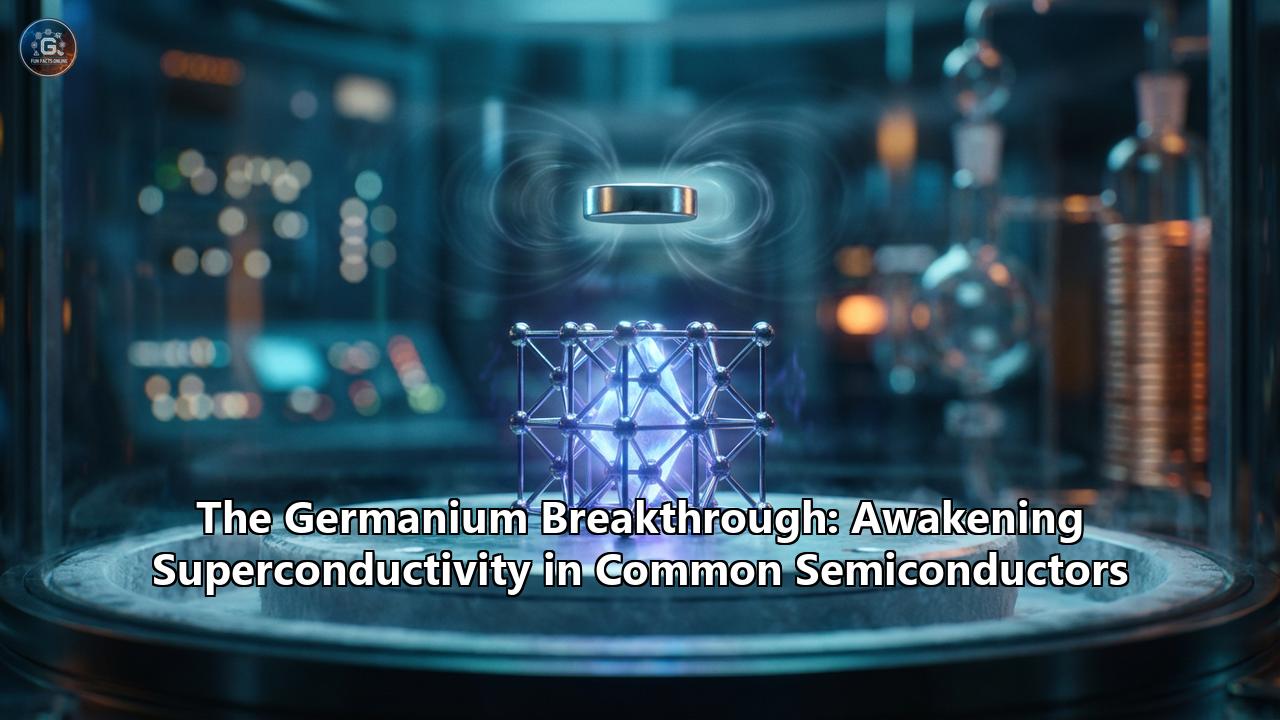
The silence in the laboratory was not the absence of sound, but the hush of anticipation. For sixty years, physicists had been chasing a ghost: a material that could speak the language of logic like a semiconductor and the language of infinity like a superconductor. They were two different worlds—one resistant, switching, and calculating; the other flowing, eternal, and perfectly efficient. To combine them was to dream of a computer that could think without heat, a quantum machine that could be built on a factory line.
For decades, silicon was the king, and germanium was the forgotten ancestor—the element that started the transistor revolution only to be cast aside. But in late 2025, the ancestor awoke.
In a breakthrough that has sent shockwaves from the cleanrooms of Silicon Valley to the theoretical physics departments of Europe, researchers have successfully turned germanium—the very material that gave birth to the electronics age—into a superconductor. This is not just a new material; it is a new state of matter for the backbone of modern technology. It is the "Germanium Breakthrough."
Introduction: The Impossible Marriage
To understand the magnitude of this discovery, we must first understand the "Berlin Wall" that has existed in materials science.
On one side, we have semiconductors. Silicon and germanium are the bricks of the digital age. They are useful precisely because they represent a struggle. Electrons moving through them encounter resistance; they can be stopped, started, and steered. This ability to switch current on and off is what makes zeros and ones. It is the logic of computation.
On the other side, we have superconductors. These are materials—usually metals like aluminum or niobium—that, when cooled to extreme temperatures, undergo a magical transformation. Resistance vanishes. Electrons pair up into "Cooper pairs" and flow endlessly without losing a single atom of energy. If you start a current in a superconducting loop, it will flow forever, potentially outlasting the universe itself.
For half a century, scientists have dreamed of a "superconducting semiconductor." Such a material would be the Holy Grail of electronics. It would allow us to create Josephson junctions—the heart of quantum computers—out of a single block of material. It would eliminate the chaotic, messy interfaces where metal meets silicon, which currently cause signal loss and heat. It would allow for "gatemon" qubits that are fast, tunable, and scalable.
But nature had a rule: You can have logic, or you can have flow. You cannot have both.
Doping a semiconductor (adding impurities to change its conductivity) usually destroys the delicate crystal lattice required for superconductivity. Push it too hard, and the crystal shatters or turns into a disordered glass.
In October 2025, a team led by physicists at New York University (NYU) and the University of Queensland defied nature. They didn't just find a new superconductor; they forced germanium to become one. They achieved the "impossible marriage."
The Breakthrough: Anatomy of a Discovery
The discovery, published in the prestigious journal Nature Nanotechnology, was not a result of stumbling upon a new rock in a mine. It was a feat of atomic engineering.
The team, spearheaded by Professor Javad Shabani at NYU, focused on germanium. Germanium is a Group IV element on the periodic table, sitting right below silicon. It has a similar diamond-like crystal structure. To make it superconduct, the theory was simple: flood it with "holes."
In semiconductor physics, a "hole" is the absence of an electron. It acts like a positive charge carrier. If you could pack enough holes into germanium, it should, theoretically, transition into a metallic state and then, at low temperatures, become a superconductor.
The problem was the "pack." To achieve this state, you need to replace germanium atoms with gallium atoms. Gallium has one fewer electron than germanium, so every substitution creates a hole. But gallium atoms are smaller and softer. Past attempts to force gallium into germanium resulted in the crystal structure collapsing. It was like trying to build a brick wall where every eighth brick is made of marshmallow; the wall eventually crumbles.
The Secret Weapon: Molecular Beam Epitaxy (MBE)The breakthrough came from a technique known as Molecular Beam Epitaxy (MBE). Imagine a spray-painting machine, but one that sprays individual atoms in a vacuum so perfect it mimics deep space.
The researchers didn't just mix gallium and germanium in a pot. They grew the crystal layer by atomic layer. By carefully controlling the temperature and the flux of atoms, they managed to trick the germanium lattice. They substituted one out of every eight germanium atoms with gallium.
This is an insanely high doping concentration—far beyond what is used in standard electronics (which might be one in a million). Under normal circumstances, the germanium would reject the gallium, pushing it out into clumps. But the MBE process "froze" the atoms in place before they could rebel.
The result was a thin film of "Super-Germanium" (Ge:Ga).
When they cooled this film down, they watched the resistance. It dropped. And dropped. And then, at roughly 3.5 Kelvin (-453°F), it flatlined. Zero.
The germanium was no longer a semiconductor. It was a superconductor.
Why Germanium? The Return of the King
To appreciate why this specific material matters, we have to look at history.
In 1947, at Bell Labs, John Bardeen, Walter Brattain, and William Shockley built the world's first transistor. It was a clunky, spider-like device. And it was made of germanium.
For the first decade of the computer age, germanium was the king. But it had a fatal flaw: it was unstable at high temperatures (it leaked electricity) and it didn't form a good natural insulator. Silicon, on the other hand, formed silicon dioxide—a perfect natural insulator. By the 1960s, silicon had taken over, and germanium was relegated to niche applications like fiber optics and night-vision lenses.
But germanium never truly went away. It is inherently faster than silicon. Electrons (and holes) move through germanium with much higher mobility. In recent years, as we hit the physical limits of silicon, chipmakers like TSMC and Intel have begun mixing germanium back into their chips to boost speed.
Now, with the discovery of superconductivity, germanium has an advantage that silicon cannot match. Silicon acts as an insulator for superconductors; it kills the quantum state. Germanium, however, can now be the superconductor.
This means we can manufacture quantum chips using the same machines, the same factories, and the same supply chains that we already use for our laptops and phones. We don't need to invent a new industry; we just need to retune the old one.
The Science Under the Hood: Cooper Pairs in a Semiconductor
Let’s dive deep into the physics of what is actually happening inside this "Super-Germanium."
1. The Cooper Pair MechanismIn a standard superconductor (like lead or mercury), electrons move through a lattice of positive ions. As an electron moves, it attracts the positive ions slightly toward it. This distortion creates a region of higher positive charge, which attracts a second electron. These two electrons, which normally repel each other, become bound together in a "Cooper pair."
Cooper pairs are bosons. Unlike individual electrons (fermions), which cannot occupy the same quantum state, bosons can all pile into the same state. They move as a coherent wave, slipping through the lattice without colliding with anything. No collisions means no resistance.
2. The Gallium FactorIn the NYU experiment, the gallium atoms play a dual role. First, they provide the charge carriers (the holes) necessary to conduct electricity. Second, they modify the vibration of the crystal lattice (the phonons).
The high concentration of gallium creates a "strain" in the crystal. The atoms are packed tighter and under tension. This strain modifies the "band structure"—the energy landscape that electrons inhabit. It pushes the "Fermi level" (the energy level of the most energetic electrons) into a zone where superconductivity is favored.
3. The "Hard" GapOne of the most crucial findings of the paper was the nature of the superconducting gap. In quantum mechanics, the "gap" is the energy required to break a Cooper pair. A "soft" gap means there are still some rogue electrons leaking through, causing errors (decoherence). A "hard" gap means the protection is total.
The Super-Germanium showed an incredibly hard gap. This is vital for quantum computing. It means that the quantum information stored in this material is protected from the noise of the outside world.
The "Holy Grail": Integrated Quantum Circuits
Why is the tech world hyperventilating about this? The answer lies in two words: Scalable Quantum.
Current quantum computers, like Google’s Sycamore or IBM’s Eagle, are marvels of engineering, but they are Frankenstein monsters. They are made of aluminum superconductors sitting on top of silicon wafers, connected by complex wiring.
- The Problem: The interface between the aluminum (superconductor) and the silicon (semiconductor) is "dirty." The atoms don't align. This mismatch creates microscopic defects that act as "traps" for energy. These traps cause the qubits to lose their memory (decoherence) in microseconds.
- The Solution: With superconducting germanium, there is no mismatch. You can take a wafer of germanium, dope one region to be a semiconductor (for control), and dope the next region to be a superconductor (for the qubit). The interface is seamless. The atoms are perfectly aligned because it is the same crystal.
This allows for the creation of Gatemons (gate-tunable transmons). These are qubits that can be controlled by a simple voltage (like a transistor) rather than bulky magnetic fields.
Imagine a chip that looks like a standard Intel processor.- Layer 1: Germanium semiconductor transistors for control logic.
- Layer 2: Germanium superconducting qubits for calculation.
- Layer 3: Germanium superconducting interconnects for zero-loss data transfer.
All made of the same material. All made in the same fab. This is the path to a quantum computer with millions of qubits, rather than just hundreds.
Applications Beyond Quantum: The "Super-Semi" Era
While quantum computing is the headline act, the implications of superconducting germanium ripple out into other fields.
1. Cryogenic Electronics (Cold CMOS)Space is cold. Deep space is really cold. Current electronics used in satellites and rovers are designed to work at room temperature and have to be heated up to survive in space, which wastes precious battery power.
With superconducting germanium, we could build electronics designed to work at 3 Kelvin. These chips would have zero resistance, generating no heat and consuming negligible power. This could revolutionize deep-space probes, allowing them to process massive amounts of data without draining their nuclear batteries.
2. Ultra-Sensitive SensorsSuperconductors are used to make SQUIDs (Superconducting Quantum Interference Devices), the most sensitive magnetic sensors in the world. They are used in MRI machines and to detect gravitational waves.
Currently, making SQUIDs is a complex, multi-material process. Making them out of germanium would make them cheaper and smaller. We could see "MRI on a chip" technology, or brain scanners that fit in a helmet rather than a room.
3. Terahertz ComputingThe frequency at which a computer runs (its clock speed) is limited by heat. If you run a silicon chip too fast, it melts. Superconductors generate no heat. A hybrid germanium chip could potentially run at speeds in the Terahertz range—thousands of times faster than today's 5GHz processors.
The Challenges: It’s Not All Zero Resistance
As with any breakthrough, we must temper the hype with reality. There are significant hurdles to clearing before we see Super-Germanium in our iPhones.
1. The Temperature Barrier3.5 Kelvin is cold. Very cold. It is close to absolute zero (-273.15°C). To reach these temperatures, you need bulky dilution refrigerators that use expensive Helium-3 and Helium-4 isotopes.
While this is fine for a quantum computer (which sits in a fridge anyway), it is a dealbreaker for consumer electronics. You won't have a superconducting phone in your pocket anytime soon. The hope, however, is that understanding the mechanism in germanium could lead to "high-temperature" variants—perhaps working at liquid nitrogen temperatures (77 K), which are much easier to maintain.
2. The Manufacturing CostMolecular Beam Epitaxy (MBE) is slow. It is a research tool, not a mass-production tool. It takes hours to grow a wafer that a commercial fab produces in seconds.
To make this commercially viable, engineers need to figure out how to achieve this high gallium doping using standard industrial processes like Chemical Vapor Deposition (CVD) or Ion Implantation. If they can’t, this will remain a niche technology for high-end quantum computers only.
3. Strain ManagementThe crystal lattice of Super-Germanium is under immense strain. If you make the film too thick, it snaps and reverts to a non-superconducting state. This limits the technology to very thin films (2D layers). Engineers must learn how to build 3D structures without losing the magic.
The Future Landscape: A New "Silicon" Valley?
The "Germanium Breakthrough" arrives at a fascinating time. The semiconductor industry is currently in a state of flux. Moore's Law is dead or dying. We can't make silicon transistors much smaller without quantum tunneling ruining the logic.
The industry is looking for "More than Moore"—technologies that add value not by shrinking, but by adding new physics.
Superconducting germanium fits perfectly into this narrative. It offers a way to integrate the next generation of computing (quantum) with the current generation (classical).
The 2030 Roadmap:- 2026-2027: Optimization. Researchers will race to raise the critical temperature and improve the "critical current" (how much power it can handle).
- 2028: The first "All-Germanium" Qubit. A demonstration of a qubit with record-breaking coherence times, made entirely of Ge:Ga.
- 2030: Integration. A hybrid chip containing classical logic and quantum qubits, manufactured in a pilot foundry.
Conclusion: Awakening the Giant
For sixty years, germanium was the "Sleeping Beauty" of the electronics world. It was beautiful, potent, but slumbering in the shadow of its sister, silicon.
With the application of advanced atomic spray-painting and the precise injection of gallium, the sleeper has awoken. It has woken up not just as a semiconductor, but as a superconductor.
This discovery forces us to rewrite the textbooks. The line between "semiconductor" and "superconductor" has been erased. In its place is a continuum—a single material that can be tuned to resist, to switch, or to flow forever.
We are standing on the precipice of the Hybrid Era. An era where our chips don't just compute; they cooperate with the quantum nature of the universe. And it turns out, the key to the future was hiding in the very first transistor we ever built.
The Germanium Breakthrough is not just about a new material. It is about the realization that the materials we thought we knew still have secrets—secrets that could power the next hundred years of human innovation.
Reference:
- https://www.techno-science.net/en/news/major-breakthrough-germanium-used-everywhere-in-electronics-becomes-superconducting-N27838.html
- https://www.science.gov/topicpages/r/radiopharmaceutical+production+facility
- https://www.science.gov/topicpages/t/three-year+field+experiment
- https://markets.financialcontent.com/wral/article/tokenring-2025-10-30-germaniums-quantum-leap-a-superconducting-breakthrough-reshapes-the-future-of-computing-and-ai
- https://www.science.gov/topicpages/r/radiopharmaceutical+production+centres.html
- https://medium.com/technicity/scientists-create-first-superconducting-semiconductor-a-breakthrough-in-germanium-engineering-0545b021c657
- https://news.ssbcrack.com/scientists-develop-superconducting-germanium-paving-the-way-for-advanced-quantum-devices-and-energy-efficient-technologies/
- https://www.sciencedaily.com/releases/2025/10/251030075105.htm
- https://www.nyu.edu/about/news-publications/news/2025/october/scientists-create-new-type-of-semiconductor-that-holds-supercond.html
- https://semiwiki.com/forum/threads/super-conduction-with-germanium-a-breakthrough.23932/
- https://markets.financialcontent.com/stocks/article/tokenring-2025-10-30-germaniums-quantum-leap-a-superconducting-breakthrough-reshapes-the-future-of-computing-and-ai
- https://www.livescience.com/technology/computing/new-semiconductor-could-allow-classical-and-quantum-computing-on-the-same-chip-thanks-to-superconductivity-breakthrough