
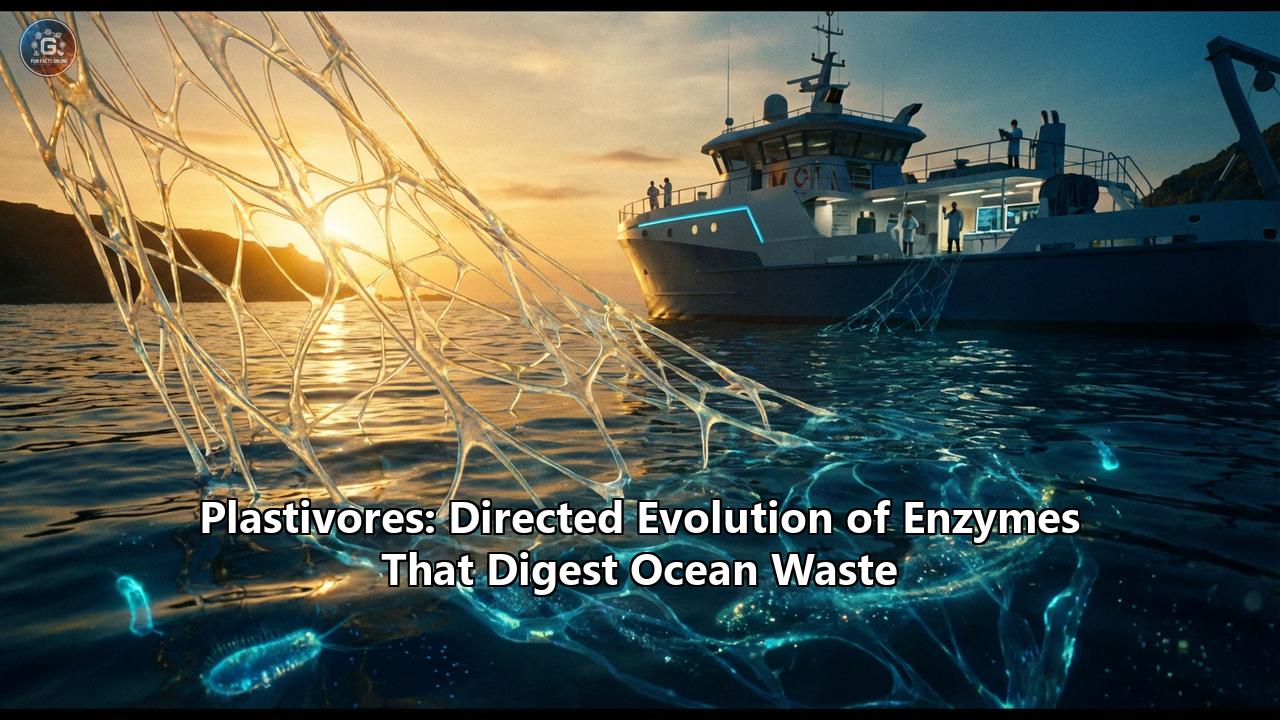
The dawn of the Plastivore Age was not marked by a single thunderclap, but by a microscopic crunch—the sound of a carbon bond snapping within the gut of a bacterium that had no business eating a PET bottle. For decades, humanity had looked to the stars or to massive feats of engineering to solve its planetary crises. We built leviathan machines to skim the ocean surface and engineered chemical plants to melt down our mistakes. But while we were looking up and out, nature was looking down and in, evolving a silent, invisible army in the muck of landfills and the gloom of the ocean floor.
We are now standing at the precipice of a biological revolution that promises to undo one of the most durable errors of the industrial age: the invention of "indestructible" plastic. This is the story of Plastivores—the organisms that eat what we thought could not be eaten—and the scientists who are hacking the very code of life to turn these microscopic scavengers into planetary healers. From the serendipitous discovery of a plastic-eating bug in a Japanese recycling yard to the AI-driven design of "super-enzymes" capable of digesting a sneaker in an afternoon, this is the comprehensive chronicle of how directed evolution is rewriting the future of ocean waste.
Part I: The Accidental Feast
To understand the magnitude of the solution, one must appreciate the intractability of the problem. Plastics are polymers—long, repeating chains of molecules that are incredibly stable. Nature loves to break things down; a fallen leaf is disassembled by fungi and bacteria in weeks. But synthetic plastics like polyethylene terephthalate (PET) were designed to resist this very process. Their chemical bonds are alien to the natural world, a language that no enzyme had learned to speak. Or so we thought.
The Sakai Discovery
The paradigm shifted in 2016. In the shadow of a plastic recycling facility in Sakai City, Japan, a team of researchers led by Kohei Oda was sifting through sediment contaminated with PET debris. They were hunting for the biological equivalent of a unicorn. What they found was Ideonella sakaiensis 201-F6.
This bacterium wasn't just tolerating the plastic; it was eating it. It had evolved a pair of enzymes—molecular scissors—that allowed it to use PET as its sole energy source. The first enzyme, which the scientists aptly named PETase, latched onto the smooth, crystalline surface of the plastic and snipped the long polymer chains into shorter chunks called mono(2-hydroxyethyl) terephthalic acid, or MHET. The bacterium then absorbed these chunks and used a second enzyme, MHETase, to chop them down further into ethylene glycol and terephthalic acid—basic building blocks that the cell could digest.
It was a revelation. Evolution, usually a process measured in eons, had essentially sprinted. PET had only existed in mass quantities for about 70 years. In that blink of geological time, Ideonella sakaiensis had engineered a completely new metabolic pathway to exploit a man-made niche.
The Enzymatic Key
The discovery of PETase was the spark, but the enzyme itself was far from a flamethrower. In its natural state, it was slow. It worked best at mild temperatures and struggled with the highly crystalline, durable plastics used in bottles. A single bacterial colony might take weeks to degrade a thin film of plastic—a pace far too leisurely to combat the millions of tons of waste entering the oceans annually.
But the blueprint was there. The protein structure of PETase revealed a "cleft"—a groove where the plastic polymer fit like a key in a lock. The problem was that the lock was a bit too tight and the key a bit too jagged. This is where human ingenuity stepped in, not to replace nature, but to turbocharge it.
Part II: Directed Evolution – Speed-Running Nature
If natural evolution is a blind watchmaker, directed evolution is a watchmaker with a cheat code. Pioneered by Nobel laureate Frances Arnold, directed evolution is a method of protein engineering that mimics natural selection but accelerates it by orders of magnitude.
The Process of acceleration
The concept is elegantly simple in theory but ferociously complex in execution. Scientists take the gene that codes for an enzyme like PETase and introduce random mutations—errors in the genetic code. They might create thousands, or even millions, of slightly different versions of the enzyme.
These mutant enzymes are then screened. Which one works slightly faster? Which one survives at a higher temperature? The vast majority are useless, broken by the mutations. But a tiny fraction—perhaps one in a thousand—shows a slight improvement. That winner is selected, and the process is repeated. Mutation, screening, selection. Rinse and repeat.
In the hands of researchers at institutions like the University of Portsmouth and the U.S. National Renewable Energy Laboratory (NREL), PETase was subjected to this evolutionary boot camp. They weren't just looking for speed; they were looking for robustness.
The Birth of FAST-PETase
One of the crowning achievements of this approach came from the University of Texas at Austin, where a team utilized artificial intelligence to guide the evolution. They didn't just throw darts at the genetic board; they used a machine learning model to predict which mutations would stabilize the enzyme's structure.
The result was FAST-PETase (Functional, Active, Stable, and Tolerant PETase). Unlike its wild cousin, which fell apart at temperatures above 30°C, FAST-PETase could operate at 50°C. This was crucial. Plastics act like glass; at higher temperatures, their tight molecular chains relax and become "rubbery," making them much easier for enzymes to attack. A heat-tolerant enzyme could dig into the plastic structure much more aggressively.
FAST-PETase could degrade a plastic tray in days, sometimes hours. It was a proof of concept that moved the technology from "biological curiosity" to "industrial potential."
Part III: The Plastivore Zoo – Beyond Bacteria
While Ideonella hogged the spotlight, it wasn't the only creature discovering that plastic could be dinner. A diverse "zoo" of plastivores was emerging from the most unexpected corners of the globe.
The Fungus that Breathes No Air
Deep in the Amazon rainforest, researchers discovered a fungus named Pestalotiopsis microspora. Its talent? It could devour polyurethane—the spongy material used in furniture and insulation—and it could do so anaerobically (without oxygen). This is a game-changer for landfills, which are essentially oxygen-free tombs where waste usually sits mummified for centuries. A fungus that can thrive in the suffocating depths of a landfill and eat the insulation buried there represents a new frontier in waste management.
The Moth that Chews Through Bags
Perhaps the most visceral example of a plastivore comes from the humble wax worm, the larva of the greater wax moth (Galleria mellonella). Beekeepers have long hated these pests because they infest hives and eat the beeswax. But chemically, beeswax is a complex soup of hydrocarbons—structurally very similar to polyethylene, the plastic used in grocery bags.
In a classic moment of scientific serendipity, Federica Bertocchini, a molecular biologist and amateur beekeeper, removed some infesting worms from her hives and placed them in a plastic shopping bag. An hour later, the bag was riddled with holes. The worms weren't just chewing their way out; they were chemically degrading the plastic.
Subsequent research identified two enzymes in the worm's saliva—named "Demetra" and "Ceres" after agricultural goddesses—that could oxidize and break down polyethylene at room temperature. Unlike bacteria that might need days, the wax worm saliva acted within hours. This suggested that insect "spit" might hold the key to degrading the tougher, high-density plastics that bacterial enzymes struggled with.
The Mealworm Gut
Similarly, the yellow mealworm (Tenebrio molitor) was found to possess a gut microbiome capable of processing polystyrene (Styrofoam). When fed a diet of nothing but Styrofoam blocks, these larvae survived and even gained weight. The bacteria in their gut shattered the polystyrene polymers into simpler monomers, which the worms then metabolized. It was a perfect symbiotic disassembly line.
Part IV: The Ocean Challenge – The Saltwater Barrier
Applying these miracles on land is one thing; applying them in the ocean is a challenge of a different magnitude. The ocean is cold, salty, and vastly diluted. An enzyme that works beautifully in a warm, concentrated bioreactor would likely wash away or denature instantly in the North Atlantic.
The "White Tide" and the Urgency
The urgency of the ocean problem was underscored by the "White Tide" events of the mid-2020s, where millions of plastic pellets (nurdles) washed up on European coastlines following shipping accidents. These pellets, too small to be mechanically cleaned effectively, embedded themselves in the sand and seaweed, entering the food chain at the microscopic level. The public outcry demanded a solution that didn't involve sieving the entire ocean.
Engineering for the Deep
Enter Vibrio natriegens. Known to microbiologists as the "lab rat of the sea" because of its incredibly fast reproduction rate, this marine bacterium thrives in saltwater. In late 2023 and continuing into 2025, researchers at North Carolina State University and other hubs began genetically engineering V. natriegens to carry the PETase genes.
The goal was to create a "salt-compatible" plastivore. By splicing the plastic-eating machinery of Ideonella into the hull of a marine survivor like Vibrio, scientists created an organism that could theoretically survive and function in seawater.
The M5 Motif: Nature catches up
But perhaps the most humbling discovery came in late 2025, when a global survey of ocean DNA revealed the "M5 motif." Researchers analyzing metagenomic data from deep-sea samples found that ocean bacteria were already evolving. They identified a specific structural feature (the M5 motif) in natural enzymes that indicated an adaptation to degrade PET.
Nature, in the cold, high-pressure dark of the deep ocean, was evolving its own solution. These wild enzymes were slower than their lab-grown cousins, but they were robust, adapted to the specific salinity and pressure of the deep sea. This discovery validated the concept: plastic was becoming a carbon source, a new rung on the marine food ladder.
Part V: The Industrial Revolution – Closing the Loop
While we dream of cleaning the oceans, the most immediate impact of plastivore technology is happening on dry land, in the birth of the "Infinite Recycling" industry.
The False Promise of Mechanical Recycling
Traditional recycling is a downward spiral. When you melt a plastic bottle to make a new one, the polymer chains degrade. The plastic gets weaker, yellower, and less useful. After one or two cycles, it can no longer be a bottle; it becomes a carpet or a park bench, and eventually, it hits the landfill. It is a delay, not a solution.
The Enzymatic Circular Economy
Enzymatic recycling changes the physics of the loop. Companies like Carbios in France and Samsara Eco in Australia are building industrial bioreactors that use enzymes to deconstruct plastic completely.
Imagine a giant steel vat filled with shredded polyester t-shirts, murky water, and a few kilograms of engineered enzyme. Over 24 hours, the enzyme acts like a molecular demolition crew. It takes the complex, mixed-up plastic of the t-shirts (often dyed, dirty, or blended with cotton) and strips the plastic down to its monomers—the pure chemical bricks.
The cotton is left behind as sludge (potential biofuel), while the plastic monomers are purified. These monomers are chemically identical to those derived from petroleum. You can use them to build a brand-new, crystal-clear plastic bottle that is indistinguishable from a virgin one. And you can do it again, and again, infinitely.
The Economics of 2027
By 2025, pilot plants were already proving the technology. Projections for 2027 and 2028 suggest that enzymatic recycling will reach "cost parity" with virgin plastic. This is the tipping point. Once it is cheaper—or even just competitively priced—to grow plastic from enzymes than to drill it from the ground, the petroleum tap begins to close.
This method also slashes energy costs. Melting plastic requires high heat (energy); enzymes work at 60-70°C. The carbon footprint of an enzymatic recycling plant is estimated to be nearly 50% lower than that of producing virgin PET.
Part VI: The Ethics and Ecology of Release
If we have the bugs, why not just dump them in the Great Pacific Garbage Patch and let them feast? This question leads us into the murky waters of bioethics and ecology.
The Andromeda Strain Scenario
The scientific consensus is currently a firm "No" to uncontrolled release. The ocean is a chaotic, interconnected system. If we release a genetically modified "super-bacterium" designed to eat plastic voraciously, we cannot predict where it will stop.
Could it evolve to eat other polymers? Could it disrupt the microbiome of plankton? Could it degrade the plastic coatings on underwater internet cables or the hulls of boats? The risk of "biological escape" is non-zero. Once a self-replicating organism is in the ocean, you cannot recall it.
The Carbon Sink Dilemma
There is also a chemical reality to consider. Plastic is solid carbon. If bacteria eat it, they metabolize it and release the byproduct: Carbon Dioxide. Rapidly converting the millions of tons of ocean plastic into CO2 would release a pulse of greenhouse gas. While arguably better than microplastics choking fish, it is trading one pollution for another.
The UN High Seas Treaty
The ratification of the UN High Seas Treaty (BBNJ Agreement), set to enter into force in 2026, adds a legal layer. This treaty governs the biodiversity of international waters. Releasing a GMO into the high seas would require unprecedented international environmental impact assessments. It effectively puts a moratorium on "geo-engineering" the ocean with bacteria until we can prove—beyond a shadow of a doubt—that it is safe.
Part VII: Future Horizons – The Symbiotic Earth
So, where do we go from here? The future of plastivores is likely a hybrid one.
Autonomous Bioreactors
Instead of dumping bacteria into the sea, we will likely bring the sea to the bacteria. Engineers are designing autonomous, solar-powered "bio-barges." These vessels would roam the gyres, collecting plastic debris on conveyor belts. Inside the ship, in contained, temperature-controlled vats, the directed-evolution enzymes would digest the plastic. The safe byproducts (biomass) could even fuel the ship, while the valuable monomers are stored for collection. This keeps the GMOs contained while cleaning the environment.
Home Bioreactors
Startups are even eyeing the domestic market. Imagine a kitchen appliance, the size of a dishwasher, where you toss your packaging. Inside, a capsule of enzymes breaks it down into a safe liquid that can be poured down the drain (biodegradable) or a solid brick of monomers that you sell back to the company.
New Materials
Ultimately, the directed evolution of plastivores is teaching us how to design better plastics. We are now engineering plastics specifically to be eaten by these enzymes. Imagine a "triggerable" plastic—durable on the shelf, but the moment it hits seawater or is sprayed with a specific enzyme, it unzips instantly.
Conclusion
The era of the Plastivore is a testament to the resilience of life and the audacity of human science. We created a monster—a material that lasts forever—and now we are training nature's smallest hunters to tame it.
It is not a magic wand. It will not absolve us of the need to reduce consumption. But it offers a glimpse of a circular future, where waste is not an endpoint, but a beginning. In the saliva of a worm and the gene-edited heart of a bacterium, we have found the tools to undo the damage of the past century, one molecule at a time. The plastic age is ending; the enzymatic age has begun.
Reference:
- https://eurofish.dk/can-plastic-eating-bacteria-offer-a-viable-solution-to-the-problem-of-oceanic-waste/
- https://micronanoeducation.org/journal/volume-3-issue-2/potential-of-tenebrio-molitor-and-zophobas-morio-in-plastic-degradation-mechanisms-microorganisms-and-enzymes/
- https://www.theguardian.com/environment/2023/sep/28/plastic-eating-bacteria-enzyme-recycling-waste
- https://thisisbeirut.com.lb/articles/1321923/pestalotiopsis-microspora-the-fungus-that-eats-plastic
- https://www.mix-up.eu/blog/detail/waxworm-saliva-rapidly-degrades-plastic-bags
- https://recyclinginternational.com/commodities/plastics-recycling/ai-designed-enzymes-drive-plastics-recycling-start-up/59978/
- https://sterlingplasticsinc.com/insights/enzymatic-recycling-is-changing-the-future-of-plastic-recycling/
- https://earth.org/historic-un-led-high-seas-treaty-to-take-effect-in-2026-as-ratification-threshold-cleared/
- https://www.ungeneva.org/en/news-media/news/2025/09/110787/un-high-seas-treaty-clears-ratification-threshold-enter-force
- https://2021-2025.state.gov/high-seas-treaty-frequently-asked-questions/
- https://oceans-and-fisheries.ec.europa.eu/news/high-seas-treaty-enters-force-milestone-ocean-conservation-2026-01-16_en
- https://www.unep.org/news-and-stories/story/what-international-agreement-protect-high-seas-and-why-it-important
- https://www.forbes.com/sites/amyfeldman/2024/05/03/this-startups-ai-designs-enzymes-that-can-eat-plastic-waste/
- https://sifted.eu/articles/epoch-biodesign-enzyme-plastic-waste