
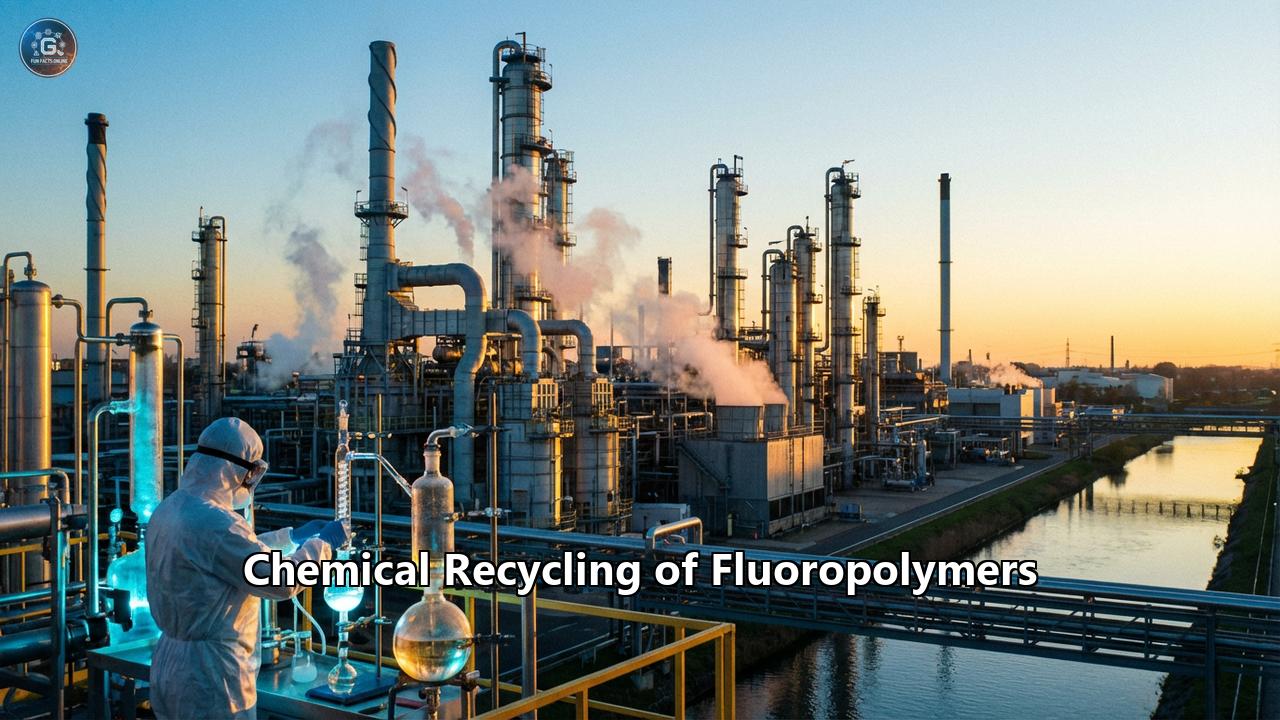
In the pantheon of modern materials, few substances occupy a position as contradictory as fluoropolymers. They are the chemical world's paradox: indispensable yet persistent, life-saving yet potentially environmentally burdensome. From the non-stick coating on a frying pan to the critical membranes in hydrogen fuel cells, fluoropolymers like PTFE (Polytetrafluoroethylene), PVDF (Polyvinylidene Fluoride), and FEP (Fluorinated Ethylene Propylene) are the silent backbones of modern industry.
Their defining characteristic—the carbon-fluorine (C-F) bond—is the strongest single bond in organic chemistry. It renders them virtually immune to heat, acid, solvents, and time itself. But this invincibility creates a massive downstream problem. When a fluoropolymer product reaches the end of its life, it does not degrade. It persists. In an era where "PFAS" (per- and polyfluoroalkyl substances) has become a household term synonymous with "forever chemicals," the pressure to find a sustainable end-of-life solution for these materials is no longer just an environmental wish; it is an existential imperative for the industry.
Enter chemical recycling. Unlike mechanical recycling, which often results in a degraded product ("downcycling"), chemical recycling promises the alchemist’s dream: breaking down these complex, indestructible chains back into their pristine atomic building blocks. It offers a path to a true circular economy where the "forever" nature of fluorine is harnessed within a closed loop, rather than left to linger in a landfill.
This comprehensive guide explores the cutting-edge science, the economic battlegrounds, and the technological frontiers of chemically recycling fluoropolymers.
Part 1: The Science of Stability (and How to Break It)
To understand the challenge of recycling fluoropolymers, one must first appreciate the fortress of their molecular structure. The backbone of a polymer like PTFE consists of a carbon chain completely sheathed in fluorine atoms. The fluorine atoms are large and electronegative, hugging the carbon tightly and repelling almost everything else. This "fluorine shield" is why eggs don't stick to the pan and why acids don't eat through the pipe.
The Mechanical Limit
Traditional recycling—mechanical recycling—involves chopping up plastic, melting it, and reforming it. This works reasonably well for simple plastics like PET bottles. However, for fluoropolymers, this is often a dead end.
- Degradation: Many fluoropolymers, especially PTFE, have such high melt viscosities that they don't truly "flow." Remolding them often requires sintering (pressing powder together), and using recycled powder results in a material with significantly lower tensile strength and fatigue resistance.
- Purity: High-value applications (semiconductors, aerospace) demand 99.999% purity. Mechanically recycled material invariably carries contaminants, relegating it to low-tier uses like park benches or basic fillers.
The Chemical Solution
Chemical recycling bypasses these physical limitations by attacking the C-F bond directly. The goal is to revert the polymer to its monomer (the single lego brick) or to its mineral state (the raw rock).
Part 2: The Technologies of Deconstruction
There is no single "chemical recycling" machine. Instead, there is a spectrum of technologies, ranging from the brutal to the elegant, designed to dismantle these molecules.
1. Thermal Depolymerization (Pyrolysis)
This is currently the most mature technology. Pyrolysis involves heating the fluoropolymer in an oxygen-free environment to temperatures between 500°C and 800°C.
- The Process: Inside a specialized reactor (often a rotary kiln or fluidized bed), the heat causes the long polymer chains to "unzip."
- The Prize: The primary output is the original monomer. For PTFE, this yields TFE (Tetrafluoroethylene) gas.
- The Challenge: TFE is explosive and toxic. Handling it requires extreme safety protocols. Furthermore, the process can generate toxic byproducts like PFIB (Perfluoroisobutene) if the temperature isn't perfectly controlled.
- The Yield: Advanced pyrolysis systems can recover up to 90-95% of the monomer, which can then be purified and repolymerized into "virgin-quality" PTFE.
2. Mineralization (The "Reset Button")
While depolymerization seeks to recover the monomer, mineralization seeks to recover the element. This is gaining traction as the ultimate solution to the PFAS concern because it completely destroys the organic structure.
- The Concept: The polymer is broken down into inorganic fluoride salts, such as Calcium Fluoride (CaF2), which is chemically identical to Fluorspar—the mined mineral used to make fluoropolymers in the first place.
- The Method: Techniques involve treating the waste with molten alkalis (like Sodium Hydroxide) or using subcritical water oxidation.
- Why it Matters: This method is "feedstock agnostic." It doesn't care if the waste is PTFE, FEP, or a mix of contaminated fluoropolymers. It converts everything back to the foundational mineral, closing the loop at the mine level rather than the factory level.
3. Supercritical Fluid Depolymerization
A more modern approach uses supercritical fluids (substances heated and pressurized until they act like both a liquid and a gas) to dissolve and break down the polymer.
- Supercritical Water: At high pressures, water becomes a highly aggressive solvent that can snip polymer chains. This method is often cleaner than pyrolysis and can be tuned to produce specific chemical outputs.
Part 3: The "Forever Chemical" Context
The drive for chemical recycling is inextricably linked to the global regulatory crackdown on PFAS.
- The "Low Concern" Debate: The industry argues that fluoropolymers are "Polymers of Low Concern" (PLC) because they are too large to cross biological membranes (unlike their toxic, small-molecule cousins like PFOA).
- The Waste Problem: However, even if the polymer is safe during use, its manufacture and disposal are under the microscope. Incinerating fluoropolymers at standard municipal waste temperatures is dangerous; it can release Hydrogen Fluoride (HF) and other potent greenhouse gases.
- The Regulatory Guillotine: The European Union's proposed PFAS restrictions and the US EPA's tightening grip are forcing manufacturers to prove that they can manage the entire lifecycle. Chemical recycling is the industry's best defense—it proves that these materials can be managed responsibly without leaking into the environment.
Part 4: Commercial Frontiers and Key Players
The transition from lab-scale chemistry to industrial reality is happening now, driven by heavyweights and agile startups.
1. 3M & Dyneon (The Pilot Pioneers)Before announcing their exit from the PFAS market (a move driven by liability management), 3M's subsidiary Dyneon built the world's first pilot plant for the up-cycling of fully fluorinated polymers in Germany. They demonstrated that 500 tons of PTFE waste could be converted back into TFE monomer annually, proving the technical viability of the "unzipping" process.
2. Chemours (The Circularity Strategists)As a spinoff of DuPont and a Titan in the industry, Chemours has launched major initiatives like "Remove2Reclaim." They are not just looking at pure PTFE but are tackling the harder problem: recovering fluoropolymers from complex composites (like extracting TiO2 and polymers from mixed plastics). Their focus is on decoupling growth from resource consumption, moving toward a model where F-gases and polymers are reclaimed and re-processed.
3. AGC Chemicals (The Clean Tech Angle)AGC (Asahi Glass Co.) is attacking the problem from two ends. First, they are developing "surfactant-free" polymerization technologies to eliminate the use of PFAS processing aids (the "soap" used to make the plastic). Second, they are promoting products like "F-Clean" ETFE films for greenhouses which are designed to be fully recyclable. Their strategy highlights a crucial point: Design for Recyclability is just as important as the recycling process itself.
4. The Specialized RecyclersCompanies like Heroflon (Italy) and others have long specialized in mechanical recycling (reprocessing scrap into micropowders). However, the shift is now toward feedstock recycling. Startups and established waste management firms are partnering to build the high-temperature reactors necessary to handle fluoropolymers safely.
Part 5: The Economic Equation
The biggest hurdle to chemical recycling is not chemistry; it is economics.
- The Virgin Price Trap: In recent years, a boom in petrochemical capacity (particularly in China and the US) has driven down the price of virgin monomers. When it is cheaper to pump oil and mine fluorspar than to collect, sort, and pyrolyze waste, recycling struggles.
- The "Green Premium": However, high-end industries (Automotive, Aerospace, Semiconductor) are increasingly willing to pay a premium for "Certified Circular" materials to meet their own sustainability goals (Scope 3 emissions).
- The Cost of Liability: As landfilling becomes expensive (due to hazardous waste classifications) and incineration becomes strictly regulated, the "cost of disposal" is rising. This changes the equation. If paying to recycle is cheaper than paying for a hazardous waste lawsuit, companies will recycle.
Part 6: Future Outlook – The Closed Loop Fluorine Economy
The future of fluoropolymers lies in a "Closed Loop Fluorine Economy." In this vision, fluorine is treated not as a consumable, but as a borrowed element.
- Extraction: Fluorspar is mined.
- Creation: Fluoropolymers are synthesized for critical applications (EV batteries, medical implants, 5G towers).
- Collection: End-of-life products are meticulously collected.
- Reversion: Chemical recycling converts them back to monomers or mineralization converts them back to CaF2.
- Rebirth: The material enters the cycle again.
We can expect to see "Take-Back Programs" becoming standard for industrial users of fluoropolymers. Just as you return a toner cartridge, semiconductor fabs will return their used PFA tubing to the manufacturer.
We will see the rise of "Digital Product Passports"—digital tags that track the exact chemical composition of a fluoropolymer part throughout its life, ensuring it ends up in the right recycling stream.
Conclusion:Chemical recycling of fluoropolymers is complex, energy-intensive, and chemically aggressive. Yet, it is achievable. It represents the only viable path to keeping these essential materials in our economy while keeping them out of our environment. As technology matures and regulatory pressure mounts, the indestructible nature of fluoropolymers will transform from a liability into an asset—a material that, once made, never truly needs to be thrown away.
Reference:
- https://www.chemours.com/en/chemistry-in-action/critical-chemistries/responsible-manufacturing
- https://jiuanchemical.com/unlocking-the-sustainability-potential-recycling-polyvinylidene-difluoride-pvdf/
- https://www.ellenmacarthurfoundation.org/circular-examples/keeping-the-molecules-and-materials-in-use-solvay
- https://www.solvay.com/en/article/rhodianyl-pioneering-polymer-circular-economy
- https://www.solvay.com/en/sustainability/planet-progress/more-circularity
- https://www.agc-asiapacific.com/sustainability/circular-economy/
- https://www.reecycle.app/post/recycled-vs-new-the-struggle-of-matching-prices
- https://plasticsrecycling.org/wp-content/uploads/2024/08/APR-Recycled-vs-Virgin-LCA-May2020.pdf
- https://www.echemi.com/cms/10500.html
- https://www.lelezard.com/en/news-22036983.html