
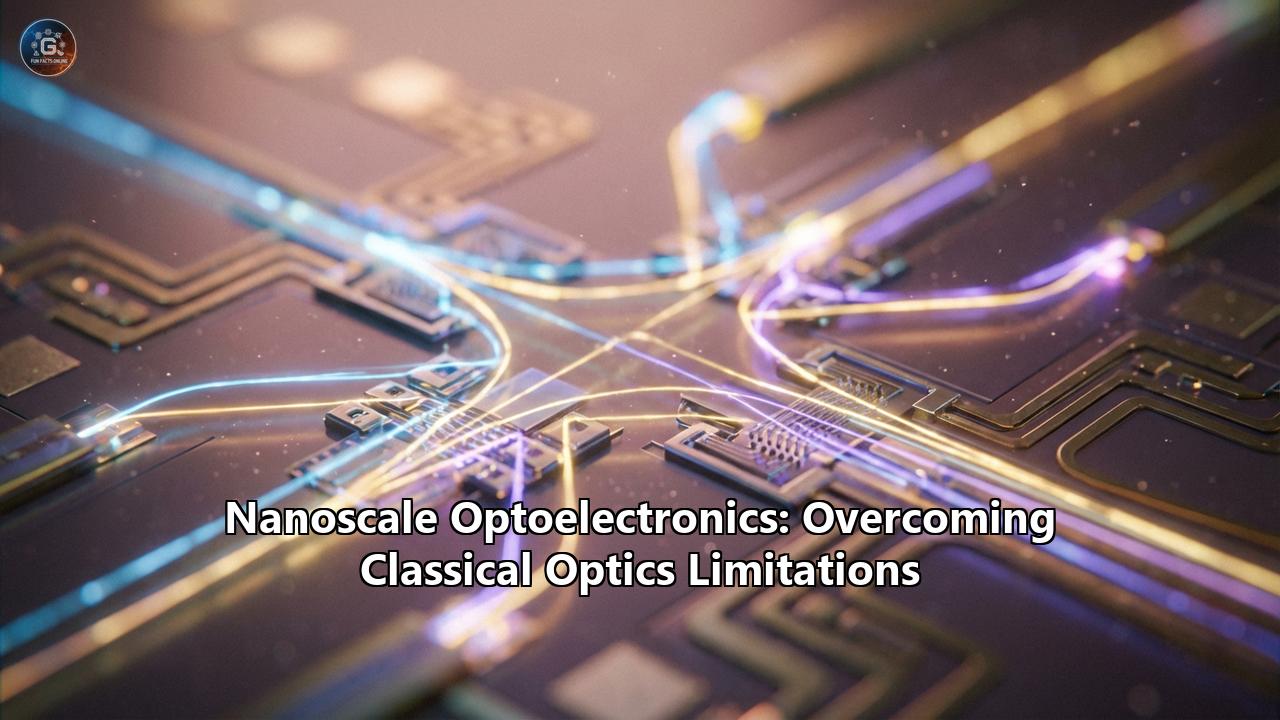
The digital age is running headlong into a fundamental physical wall. For over half a century, the relentless drumbeat of Moore’s Law has dictated that the number of transistors on a microchip doubles roughly every two years, shrinking electronic components to near-atomic dimensions. Today, the transistors powering our smartphones, data centers, and artificial intelligence networks are measured in single nanometers. Electrons, the workhorses of classical computing, are perfectly suited for these microscopic realms because they are tiny and easily manipulated. However, relying on electrons to transmit data comes with an inescapable toll: resistance, latency, and massive heat generation. As our demand for data transmission surges exponentially, the copper wires connecting these billions of nanoscale transistors have become the ultimate bottleneck.
The obvious solution is light. Photons—the fundamental particles of light—travel at the ultimate speed limit of the universe, carry immense amounts of data without interfering with one another, and generate virtually no heat. Fiber-optic cables have already revolutionized global telecommunications, crisscrossing oceans to transmit terabits of data per second. Yet, when we attempt to bring the power of light down to the computer chip, we collide with a rigid barrier dictated by the laws of classical physics: the diffraction limit.
A visible light photon has a wavelength ranging from roughly 400 to 700 nanometers. According to classical optics, light cannot be focused or confined to a space smaller than approximately half its wavelength. This means that traditional optical components—lenses, waveguides, and optical fibers—are monstrously large compared to modern nanoscale electronics. You simply cannot squeeze a 500-nanometer light wave into a 5-nanometer electronic circuit using classical optical techniques. The size mismatch is akin to trying to thread a thick maritime mooring rope through the eye of a microscopic needle.
This fundamental incompatibility between the size of light and the size of modern electronics is the driving force behind one of the most exciting and transformative fields in modern physics: nanoscale optoelectronics. By harnessing exotic quantum phenomena, novel nanomaterials, and revolutionary new device architectures, scientists are finally breaking the ironclad laws of classical optics. The result is a paradigm shift that promises to merge the unmatched speed of photonics with the ultra-compact scale of electronics, paving the way for everything from next-generation quantum computers to atomic-resolution biological sensors.
The Ironclad Laws of Classical Optics
To understand the magnitude of the breakthroughs in nanoscale optoelectronics, one must first understand the invisible cage that has trapped optical physics for over a century. In 1873, the German physicist Ernst Abbe mathematically defined the diffraction limit of light. Abbe discovered that when light passes through a circular aperture, it diffracts, creating a blurring effect. Because of this wave nature, even a theoretically perfect lens cannot focus light to an infinitely small point.
The Abbe diffraction limit (and the closely related Rayleigh criterion) states that the maximum spatial resolution of an optical system is fundamentally restricted to roughly half the wavelength of the light being used divided by the numerical aperture of the lens. For visible light, this sets a hard floor of about 200 to 250 nanometers. Anything smaller than this dimension simply cannot be resolved, manipulated, or confined by standard optical means.
For decades, this limitation was accepted as an immutable law of nature. It defined the boundaries of microscopy, photolithography, and optical computing. If you wanted to build an optical waveguide to channel light on a microchip, that waveguide had to be hundreds of nanometers thick. When engineers tried to make the waveguides smaller, the light would simply refuse to be confined, leaking out into the surrounding materials.
Thus, a cruel dichotomy emerged: electronics could be miniaturized to the atomic scale but suffered from resistance and heat; photonics offered limitless bandwidth and cold operation but was cursed with a massive physical footprint. To bridge this gap, science had to find a way to decouple the physical size of an optical mode from the free-space wavelength of its photons. The solution did not lie in refining classical lenses, but in forcing light to interact with matter in entirely new ways.
Plasmonics: Forging the Bridge Between Light and Matter
The key to overcoming the diffraction limit lies in a subfield of nanophotonics known as plasmonics. Plasmonics relies on the interaction between electromagnetic waves (light) and the free electrons present in metals, such as gold, silver, and aluminum.
When a photon strikes the interface between a metal and a dielectric (like glass or air) under the right conditions, its energy couples with the sea of free electrons on the metal's surface. This coupling creates a new, hybrid quasiparticle known as a surface plasmon polariton (SPP). Unlike a free-flying photon, an SPP is a wave of electron density oscillating in perfect synchrony with the electromagnetic field.
The magic of surface plasmons lies in their wavelength. Because the optical energy is physically bound to the mass of the oscillating electrons, the momentum of the system increases, and the effective wavelength of the light is drastically compressed. Through plasmonics, a photon with a free-space wavelength of 800 nanometers can be squeezed into a surface plasmon mode that is just 10 or 20 nanometers across. The diffraction limit is thus spectacularly bypassed. Light is no longer treated as a purely electromagnetic wave; it becomes a mechanical-electrical-optical hybrid that can be corralled into nanoscale dimensions.
Plasmonics manifests in two primary forms:
- Surface Plasmon Polaritons (SPPs): These are propagating waves that travel along flat metal surfaces or metal nanowires. They act as ultra-compact optical cables, guiding light around sharp nanoscale bends that would be completely impossible for traditional fiber optics.
- Localized Surface Plasmons (LSPs): When light strikes a metallic nanoparticle (rather than a flat surface), the entire electron cloud of the nanoparticle oscillates in place. This creates a highly localized, intensely amplified electromagnetic field around the particle. The resonance frequency of an LSP can be precisely tuned by changing the size, shape, and material of the nanoparticle, a property that is heavily exploited in modern sensing and energy-harvesting applications.
However, manipulating light at such extreme proximities eventually leads to another boundary: the quantum limit. Recent pioneering research into "tunnelling plasmonics" has revealed that when two metallic nanostructures are brought within sub-nanometer distances of each other, classical electromagnetic theories break down. At these atomic-scale gaps, quantum tunnelling of electrons occurs across the cavity, establishing an ultimate quantum limit for plasmonic field confinement. This profound discovery fundamentally rewrites our understanding of non-local transport and dictates the future engineering of molecular-scale optoelectronics.
The SPASER: Lasers Shrink to the Nanoscale
One of the greatest triumphs of nanoscale optoelectronics is the invention and realization of the SPASER (Surface Plasmon Amplification by Stimulated Emission of Radiation). Proposed theoretically in 2003 and first realized experimentally in 2009, the SPASER is the nanoscale equivalent of a laser.
Conventional lasers, regardless of how small they are manufactured, are bound by classical optics. A traditional laser requires an optical cavity (a set of mirrors) to bounce light back and forth, amplifying it through a gain medium. Because this cavity must be at least half a wavelength long to support a standing wave of light, traditional lasers can never be smaller than the diffraction limit.
The SPASER discards the photonic cavity entirely. Instead of amplifying propagating photons, a SPASER amplifies localized surface plasmons. In a typical SPASER architecture, a metallic nanoparticle (the plasmonic resonator) is surrounded by a gain medium, such as highly fluorescent dye molecules, quantum dots, or perovskites. When the gain medium is excited by an external energy source, it transfers its energy non-radiatively directly to the surface plasmons of the metal nanoparticle. This initiates a chain reaction of stimulated emission of surface plasmons—a massive, coherent oscillation of electrons locked in a space just a few tens of nanometers across.
Over the past decade, the evolution of SPASERs and plasmonic nanolasers has been breathtaking. Modern advancements have achieved dynamic modulation, room-temperature operation, electrical injection, and incredibly low lasing thresholds. The true power of the SPASER lies in its ability to generate intensely strong, coherent optical fields in sub-wavelength volumes, allowing them to interface directly with nanoscale electronic components.
Recent breakthroughs have dramatically expanded the utility of SPASERs beyond fundamental physics into realms like bioengineering and energy generation. For instance, researchers have engineered biocompatible SPASER nanoparticles that act as super-bright, water-soluble nanoprobes for biological imaging. Emitting light with a spectral width over 30 times narrower and an intensity over 100 times brighter than traditional quantum dots, these SPASERs can generate stimulated emission directly inside living cells. Furthermore, their ultra-narrow emission linewidths and small size (often under 50 nanometers) have made them perfect candidates for stimulated emission depletion (STED) nanoscopy, achieving sub-75 nm spatial resolution and paving the way for unprecedented observation of cellular mechanics.
In the realm of energy, SPASER-based nanostructures are breaking new ground in near-field enhancement. Theoretical investigations have shown that the energy transfer dynamics within optimally designed SPASER systems could achieve energy conversion efficiencies up to 80%, highlighting their immense potential not just as light sources, but as nano-sources of highly localized energy for advanced harvesting applications.
Single-Molecule Optoelectronics: The Ultimate Limit of Control
As we push beyond the nanoscale, optoelectronics is entering the domain of individual atoms and molecules. The ultimate dream of molecular electronics is to use single molecules as functional electronic or photonic components—switches, routers, or memory cells. However, achieving precise control over photoreactions at the atomic level has historically been an insurmountable challenge.
In a landmark 2024 breakthrough, scientists from the Fritz Haber Institute successfully demonstrated atomic-precision control of plasmon-induced single-molecule switching. Traditional applications of localized surface plasmons (LSPs) were largely limited to purely metallic structures. However, researchers successfully extended LSP functionality to metal-semiconductor nanojunctions. By utilizing a plasmon-resonant tip within a low-temperature scanning tunneling microscope, they were able to induce the reversible breaking and forming of specific chemical bonds between a single organic molecule and a silicon surface.
Through extreme confinement of the electromagnetic field, the optical switching rate could be tuned simply by shifting the scanning tip by distances as unimaginably small as 0.01 nanometers. Furthermore, the team demonstrated that the optoelectronic function could be chemically tailored; swapping a single oxygen atom for a nitrogen atom inside the molecule entirely inhibited the photoswitching. This level of sub-nanometer, atomic-precision chemical tailoring provides a versatile new platform for designing next-generation nano-optoelectronics, sensors, and photovoltaic cells from the literal bottom up.
Architecting the Void: Metamaterials and Photonic Crystals
While plasmonics provides a way to compress light, other branches of nanoscale optoelectronics focus on sculpting the space through which light travels. Metamaterials and photonic crystals are engineered structures designed to manipulate light in ways that no naturally occurring material can.
Photonic Crystals are the optical equivalents of semiconductors. In a semiconductor crystal, the periodic arrangement of atoms dictates the flow of electrons, creating an "electronic bandgap"—a range of energies that electrons are forbidden to possess. This is the underlying physics of all computer chips. Photonic crystals replicate this concept for light. By creating periodic nanostructures—such as a lattice of microscopic holes etched into a slab of silicon—engineers can create a "photonic bandgap." Light of a specific wavelength cannot propagate through the crystal and is perfectly reflected. By introducing an intentional "defect" into this perfect lattice (such as leaving out a single hole), light can be permanently trapped in a nanoscale cavity with a remarkably high quality (Q) factor, bouncing back and forth millions of times before decaying. These defect cavities are crucial for building highly sensitive optical modulators and quantum logic gates. Metamaterials take this structural engineering a step further. While photonic crystals manipulate light through diffraction via structures sized at roughly half the wavelength of light, metamaterials are composed of artificial "meta-atoms" that are significantly smaller than the wavelength of the light they are meant to control. Because these structures are so sub-wavelength, the incoming light perceives them as a homogeneous, continuous material.By designing the exact geometry of these nanoscale metallic and dielectric components, scientists can tune the material's electric permittivity and magnetic permeability to virtually any value. This has led to the creation of metamaterials with a negative refractive index—a property absent in the natural universe. When light enters a negative-index metamaterial, it bends in the "wrong" direction. This unnatural bending is the core mechanism behind concepts like the "invisibility cloak," which smoothly bends light waves around an object to render it optically transparent, and the "superlens," a flat lens capable of focusing light well beyond the Abbe diffraction limit to image viruses and DNA strands using visible light.
The Miracle Materials of the Nanoscale
Classical optoelectronics relied heavily on bulk semiconductors like silicon, gallium arsenide, and indium phosphide. However, overcoming classical limitations requires materials with extraordinary light-matter interaction capabilities. The rise of nanoscale optoelectronics is inextricably linked to the discovery and integration of novel, low-dimensional materials.
Two-Dimensional (2D) Materials:The isolation of graphene—a single layer of carbon atoms arranged in a hexagonal lattice—ignited an explosion of interest in 2D materials. Graphene possesses an astonishingly high electron mobility and interacts with light over an incredibly broad spectrum, from ultraviolet to the terahertz range. Despite being only one atom thick, a sheet of graphene absorbs 2.3% of incident visible light. When integrated with nanophotonic waveguides, graphene acts as an ultra-fast, broad-bandwidth optical modulator, translating electrical data into optical pulses at staggering speeds.
However, graphene lacks a bandgap, making it difficult to use as a light-emitting source. This limitation led to the exploration of Transition Metal Dichalcogenides (TMDCs), such as molybdenum disulfide (MoS2) and tungsten diselenide (WSe2). TMDCs are essentially 2D semiconductors. At the monolayer limit, they exhibit a direct bandgap, allowing them to emit light with remarkably high efficiency. When coupled with plasmonic nanoantennas or photonic crystal cavities, TMDC monolayers serve as incredibly compact sources for on-chip lasers and single-photon emitters.
Recent expansions into 2D heterostructures have even bridged the notorious terahertz (THz) gap. In 2025, researchers demonstrated the extreme confinement of long-wavelength THz light to the nanoscale using hafnium dichalcogenides. By exploiting phonon polaritons—quasiparticles formed by the coupling of photons with the vibrating atomic lattice of the crystal—scientists managed to shrink THz light down to dimensions previously thought impossible. This breakthrough opens the door to ultra-compact THz resonators, high-speed optoelectronic integration, and advanced environmental sensing devices.
Perovskites:Halide perovskites have emerged as a disruptive force in optoelectronics. Best known for driving the efficiency of solar cells to record highs in mere years, their tunable bandgaps, high defect tolerance, and excellent luminescent quantum yields make them exceptional gain materials for nanoscale lasers. Perovskite nanowires and quantum dots can be easily synthesized from solution at low temperatures, making them far cheaper to manufacture than traditionally grown epitaxial semiconductor crystals. When hybridized with plasmonic substrates, perovskites can achieve ultra-low threshold lasing at room temperature, a critical requirement for practical deployment in optical microchips.
Quantum Dots (QDs) and Core-Shell Structures:Quantum dots are semiconductor nanocrystals whose optical properties are dictated entirely by quantum confinement. Because their size is smaller than the exciton Bohr radius, tuning the physical diameter of a quantum dot precisely changes the color of light it emits or absorbs. The development of complex core-shell architectures—such as a semiconductor core encased in a metallic shell—has provided new avenues to manipulate non-linear optics and plasmonic photonics simultaneously. These hybrid structures allow for exquisite tuning of the localized surface plasmon resonance, drastically enhancing their utility in high-efficiency LEDs, photodetectors, and single-photon sources.
Transformative Applications: Rewiring the Digital World
The convergence of these materials and physical principles is moving nanoscale optoelectronics out of the laboratory and into technologies that will define the 21st century.
On-Chip Interconnects and Next-Generation Computing:The immediate commercial driver for nanoscale optoelectronics is the data center crisis. Currently, different processing units within a server rack, or even different cores on a single chip, communicate via copper interconnects. At high gigahertz frequencies, copper behaves terribly—it acts as an antenna, radiating energy, causing crosstalk, and generating massive amounts of heat. Data centers currently consume vast percentages of global electricity, much of it simply to cool the servers.
Nanoscale optoelectronics replaces these copper wires with silicon photonic waveguides integrated directly alongside CMOS electronic transistors. Microscopic ring resonators, powered by plasmonic modulators, translate electronic data into multiplexed beams of light. This data is routed across the chip at light speed and read by nanoscale germanium or graphene photodetectors. Because light signals do not interfere with one another, hundreds of data streams of different colors can be simultaneously sent down a single waveguide (wavelength-division multiplexing). This promises chips that process information thousands of times faster than today's processors, with a fraction of the energy consumption.
Neuromorphic Nanophotonics:As artificial intelligence models grow exponentially, traditional Von Neumann computing architectures are struggling to keep up. Nanoscale optoelectronics is giving rise to optical neuromorphic computing—hardware that mimics the neural structure of the human brain using light. By using networks of interacting nanophotonic phase-change materials and micro-ring resonators, chips can perform the complex matrix-vector multiplications required for AI inference optically, continuously, and at the speed of light. This could eventually lead to AI processors that are vastly superior to current GPUs in both latency and power efficiency.
Biophotonics and Medical Diagnostics:In the realm of biology, the diffraction limit has long frustrated scientists attempting to observe the nanoscale machinery of living cells in real time. Nanoscale optoelectronics is shattering these barriers. Using localized surface plasmon resonance, plasmonic nanoparticles act as ultra-sensitive biosensors. When a specific biomolecule—such as a cancer biomarker or a viral protein—binds to the surface of the nanoparticle, the local refractive index changes, causing a measurable shift in the color of the scattered light. This enables the real-time, label-free detection of diseases at the single-molecule level.
Furthermore, SPASER nanoprobes and advanced biophotonic integration are paving the way for revolutionary treatments. Because metallic nanoparticles exhibit strong photothermal properties, they can be functionalized with antibodies to target specific cancer cells. Once attached, near-infrared laser light (which harmlessly passes through human tissue) is applied. The nanoscale optoelectronic properties of the particles convert this optical energy entirely into localized heat, destroying the tumor from the inside without harming surrounding healthy tissue. This integration of cellular nanotechnology, super-resolution imaging, and target-specific organoid manipulation is set to transform the entire landscape of personalized medicine.
Quantum Optoelectronics and Secure Communication:At the very frontier of physics lies the quantum realm, and nanoscale optoelectronics is essential for realizing quantum networks. Quantum communication relies on the generation, manipulation, and detection of individual photons. Traditional light sources emit a statistical shower of photons, but quantum cryptography (like Quantum Key Distribution) requires reliable single-photon emitters. Defect centers in nanodiamonds, isolated TMDC molecules, and specially engineered plasmonic cavities provide the strict isolation necessary to emit exactly one photon at a time. By coupling these single emitters to nanoscale optical waveguides, scientists are laying the hardware foundation for an unhackable, global quantum internet.
The Fabrication Frontier: Building the Impossible
Realizing the potential of nanoscale optoelectronics is an immense manufacturing challenge. The devices require patterning materials with sub-nanometer precision, far beyond the capabilities of standard photolithography used in today’s foundries.
Currently, top-down fabrication techniques like Electron Beam Lithography (EBL) and Focused Ion Beam (FIB) milling are utilized to etch complex geometries into metals and semiconductors. While these techniques offer phenomenal precision, they are slow, sequential, and difficult to scale to mass production.
Consequently, there is a massive push toward bottom-up fabrication via self-assembly. Using the principles of nanochemistry, scientists can synthesize highly specific, complex optical superstructures by exploiting the chemical affinities of nanoparticles. For instance, colloidal systems exhibiting unique collective behaviors can drive anisotropic building blocks to self-assemble into complex plasmonic architectures. DNA origami is another striking example, where engineered DNA strands act as a programmable scaffold to position individual fluorescent molecules, gold nanoparticles, and quantum dots with angstrom-level accuracy.
Another persistent hurdle in plasmonics is ohmic loss. The very free electrons that give plasmons their unique capabilities also cause the waves to decay rapidly into heat via electrical resistance. To overcome these losses, modern research heavily focuses on hybridizing plasmonic systems with powerful optical gain media, essentially creating internal amplifiers that pump energy back into the plasmonic mode faster than it can dissipate. Additionally, the field is exploring alternative plasmonic materials, such as transition metal nitrides (like titanium nitride) and transparent conducting oxides, which offer lower losses and better CMOS compatibility than gold or silver.
Forging the Future of Light
Nanoscale optoelectronics is not merely an incremental technological step; it is a fundamental shift in our mastery over the physical world. By bending, squeezing, and amplifying light at dimensions smaller than a virus, we are systematically overcoming the classical optics limitations that have bound scientific progress for over a century.
From the atomic-precision control of single-molecule reactions deep within metal-semiconductor junctions to the realization of highly efficient SPASERs mapping the interior of living cells, the control of light at the nanoscale is an ongoing triumph of human ingenuity. We have moved from manipulating massive beams of light through glass lenses to orchestrating the quantum mechanical dance of photons and electrons in artificial atoms.
As fabrication techniques scale and these components transition from isolated laboratory curiosities to fully integrated architectures, the implications will ripple through every facet of civilization. Data centers will run cold, transmitting astronomical volumes of data on threads of pure light. Biologists will observe the intricate mechanics of diseases unfolding at the molecular level in real-time. Quantum processors will utilize individual photons to unravel chemical mysteries that are physically impossible for classical computers to solve.
The diffraction limit, once considered an insurmountable wall erected by the universe, has been reduced to a mere engineering challenge. In the ultimate convergence of electronics and photonics, the speed of light has finally found a home at the scale of the atom, promising a future illuminated by the sheer, unbounded potential of nanoscale optoelectronics.
Reference:
- https://pmc.ncbi.nlm.nih.gov/articles/PMC11501162/
- https://iris.cnr.it/retrieve/a867c96a-c14f-458b-8e5c-29ecc6291b77/prod_328860-doc_188868.pdf
- https://www.mdpi.com/2304-6732/12/2/123
- https://www.np.phy.cam.ac.uk/wp-content/uploads/sites/50/2024/06/nature12-quantumplasmonics.pdf
- https://www.light-am.com/article/pdf/preview/xjzz-2020-9-882.pdf
- https://www.researchgate.net/publication/397014516_Advance_and_Future_of_Spaser_Nanoprobes_From_Fundamental_Research_to_Practical_Applications
- https://www.fhi.mpg.de/1597005/2024-08-13-Single-Molecule-Optoelectronics
- https://www.nanotech-now.com/news.cgi?story_id=57502
- https://www.fhi.mpg.de/2127607/2025-09-16-Shrinking-Terahertz-Light-to-Nanoscale
- https://fiveable.me/introduction-nanotechnology/unit-11
- https://www.researchgate.net/publication/46379407_Plasmonics_An_Emerging_Field_Fostered_by_Nano_Letters
- https://iconnference.com/symposium-2026/nanobiotechnology/