
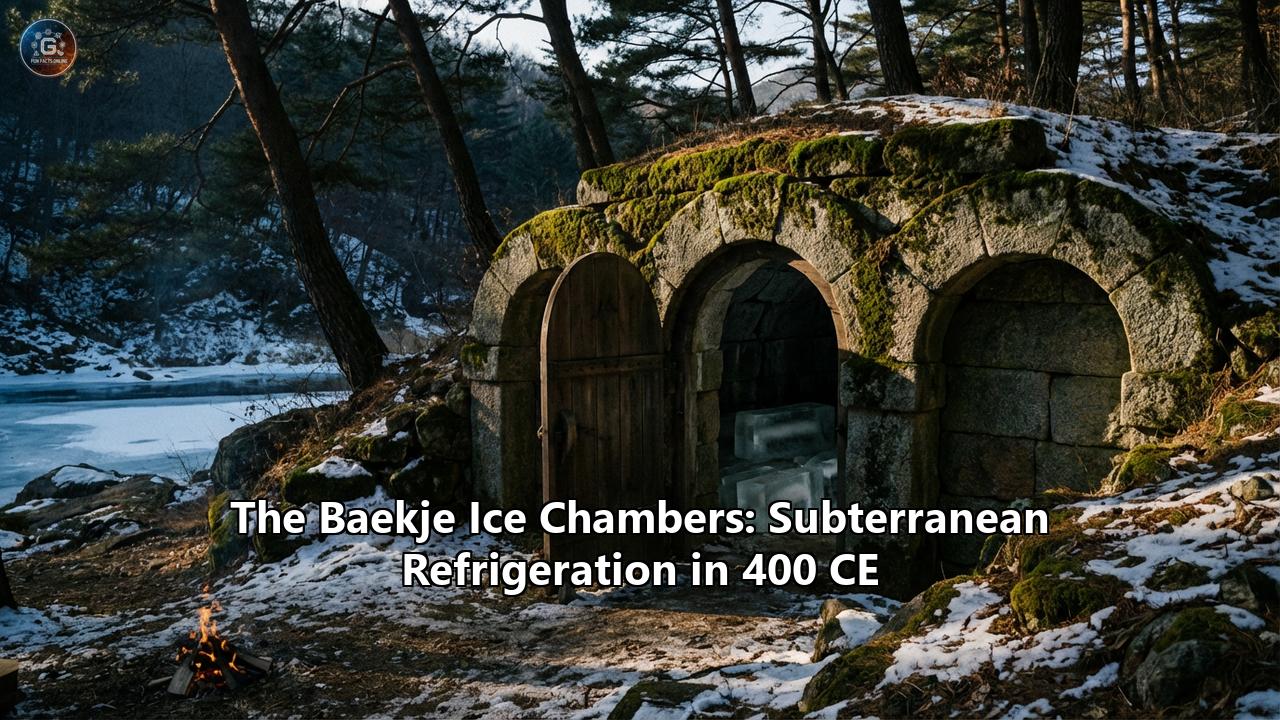
Imagine the stifling, heavy humidity of July on the Korean Peninsula. The air is thick, the sun is unrelenting, and the landscape hums with the drone of cicadas. In the year 400 CE, escaping this oppressive summer heat was largely impossible for the common populace of the Baekje Kingdom. Yet, deep within the royal palace walls, the king and his highest-ranking retainers were experiencing the impossible: the sharp, biting chill of winter. Servants would emerge from heavily guarded subterranean vaults bearing pristine blocks of ice, using them to chill fine wines, preserve delicate meats, and cool the ambient air of the royal chambers. In an era long before mechanical refrigeration, this was not merely a culinary luxury; it was a god-like display of absolute power.
The story of the Baekje ice chambers—known historically as bingo (氷庫) or ice warehouses—is a fascinating intersection of environmental engineering, immense labor mobilization, and ancient spirituality. While the world often looks to the grand monuments of Rome or the sweeping yakhchals of Persia for early examples of temperature control, the subterranean refrigeration techniques perfected by the Baekje kingdom around 400 CE represent one of the most sophisticated feats of ancient East Asian engineering. Recent archaeological breakthroughs have peeled back the earth to reveal precisely how these ancient Korean engineers defied the seasons, managing to keep winter trapped in a box even through the hottest days of summer.
The Kingdom of Baekje in 400 CE: An Era of Expansion and Innovation
To understand the sheer magnitude of subterranean refrigeration in 400 CE, one must first understand the world of Baekje. As one of the Three Kingdoms of Korea—sharing the peninsula with Goguryeo to the north and Silla to the east—Baekje was a maritime powerhouse and a beacon of cultural refinement. Around the turn of the 5th century, the kingdom was experiencing a dynamic period of conflict, territorial shifting, and profound cultural development. The capital was firmly established at Hanseong (modern-day Seoul), situated strategically along the Han River.
In this era, Baekje was highly stratified. The king held near-divine status, supported by a complex aristocracy. Controlling the environment was a definitive way to visually and physically demonstrate this unassailable hierarchy. Harvesting ice required no magic, but it did require something equally potent: absolute command over thousands of human lives and a deep, empirical understanding of thermodynamics.
During the freezing winters, the Han River would turn into a thick sheet of solid ice. The royal court dispatched armies of laborers onto the perilous, frozen waters. Armed with iron tools, chisels, and wooden mallets, these workers cut massive, uniform blocks of ice. This harvest had to be perfectly timed—too early, and the ice would be too thin to survive the summer; too late, and the spring thaw would make the river too dangerous to traverse. Once cut, the heavy blocks were hauled onto wooden sleds, pulled by oxen and men up into the hills, and packed tightly into the subterranean bingo.
While the concept of storing winter ice for summer use took root in the Hanseong period around 400 CE, the most breathtaking physical evidence of this technology was recently unearthed further south, providing a perfect anatomical blueprint of how these ancient freezers operated.
The Architectural Blueprint: Engineering the Cold
For decades, historians knew through ancient texts that ice storage was a vital part of early Korean dynasties, but the exact mechanical realities of the Baekje bingo remained shrouded in mystery. That changed dramatically during the 17th archaeological excavation survey of the Busosanseong Fortress, a UNESCO World Heritage site located in Buyeo, South Chungcheong Province. As the royal citadel during Baekje’s later Sabi period (538–660 CE), Busosanseong yielded the first-ever discovered Baekje-era ice storage facility, shedding light on the technological lineage that dates back to the 400 CE era.
The structure uncovered by the National Research Institute of Cultural Heritage (NRICH) is a masterclass in ancient thermodynamics. The bingo measures approximately 7 meters from east to west and 8 meters from north to south, descending 2.5 meters deep into the earth. The exterior shape is roughly rectangular, but the interior features a meticulously carved U-shape.
Why build underground? The Baekje engineers understood the principle of thermal mass. While the surface temperature in Korea fluctuates wildly—from freezing blizzards in January to 35°C (95°F) heatwaves in August—the temperature of the bedrock just a few meters below ground remains remarkably stable, hovering around 10°C to 15°C (50°F to 59°F) year-round. By carving the bingo directly into this bedrock, the engineers utilized the earth itself as a massive, natural insulator.
However, digging a hole is not enough to keep ice frozen for six months. The Baekje architects implemented several brilliant structural adaptations. They reinforced the southern wall with sturdy stone blocks. Because the southern side of a hill or structure in the Northern Hemisphere receives the most direct solar radiation, the southern wall of the chamber would naturally be the warmest. Adding a thick layer of stone not only reduced the interior space to pack the ice more tightly but also provided a critical secondary layer of thermal insulation against the sun's ambient heat.
The most dangerous enemy of stored ice is not warm air, but water. Water has a much higher thermal conductivity than air. If ice sits in a puddle of its own meltwater, the rate of melting accelerates exponentially, causing a catastrophic chain reaction that can destroy an entire vault of ice in days. To combat this, the Baekje engineers designed an ingenious drainage system. At the very center of the bingo floor, they excavated a specialized pit—measuring roughly 230 cm long, 130 cm wide, and 50 cm deep—lined with stone slabs and filled on one side with broken stones. This acted as an ancient sump pump. As the outermost layers of ice inevitably began to sweat and melt, the water trickled down through the insulated packing materials, funneled into the central pit, and drained safely away from the remaining ice block.
The Insulation Layer: The Science of Straw and Sawdust
While the bedrock provided the baseline temperature and the drainage pit removed the threat of thermal conductivity, the ice still needed a physical barrier against the air. Though organic materials naturally decay and vanish from the archaeological record, historical analogs from the era tell us exactly how the Baekje managed this.
Once the ice blocks were lowered into the U-shaped bedrock chamber, they were packed tightly together to reduce the surface area exposed to the air. The less surface area, the slower the melt. Between the blocks, and packed densely against the stone walls and the ceiling, the laborers stuffed massive quantities of rice straw, pine boughs, reed mats, and sawdust.
Rice straw is highly porous, trapping millions of tiny pockets of air. Because stagnant air is a notoriously poor conductor of heat, a thick layer of straw creates an exceptional R-value (the measure of thermal resistance). Furthermore, as the top layer of ice very slowly melted, the resulting cold water would dampen the inner layers of straw. As warm summer air occasionally seeped into the chamber, it would hit the damp straw and cause microscopic evaporation. Evaporation is an endothermic process—it absorbs heat. Therefore, the very act of the ice slowly melting helped to continuously refrigerate the micro-environment within the chamber, maintaining a stable temperature just above freezing point.
Rituals, Earth Deities, and the Wu Zhu Coins
In the world of 400 CE, engineering was not a secular pursuit; it was deeply intertwined with spirituality, cosmology, and the appeasement of the divine. Manipulating the seasons—forcing winter to survive into summer—was viewed as a disruption of the natural order. To achieve this without angering the gods required elaborate rituals.
During the excavation of the Baekje bingo, archaeologists discovered an extraordinary artifact that perfectly encapsulates this worldview. Buried near the ice storage facility was a beautifully preserved earthenware jar, identified as a jijingu. This small, short-necked jar, adorned with a round lid and a bead-shaped handle, was not left by accident. It was a ritual offering deliberately interred into the soil before the construction of the ice chamber even began.
The purpose of a jijingu was to appease the local land deities, asking for their permission to carve into the earth and praying for the structural safety and success of the facility. But the true marvel lay inside the jar. When archaeologists carefully opened it, they found five bronze Chinese Wu Zhu coins.
Also known as wushu coins, these currencies were first minted by the Han Dynasty in 118 BCE and remained in broad circulation across East Asia for nearly 750 years. In ancient East Asian cosmology, coins were not merely money; they were powerful symbols of prosperity, human civilization, and divine protection. The placement of exactly five coins is also highly significant, likely tying into the East Asian philosophical concept of the Wuxing (the Five Elements: wood, fire, earth, metal, and water). To store frozen water in the earth required a harmonic balance of these elements. By burying the jijingu and the Wu Zhu coins, the Baekje elite were spiritually anchoring their technological marvel, ensuring that the heavy stone blocks would not collapse and that the precious ice would not prematurely melt.
This ritual deposit marks the first time such an offering has been directly linked to an ice storage facility in Korean history, proving that the bingo was considered a sacred and highly important architectural endeavor, blending practical engineering with mystical reverence.
The Currency of Power: Why Ice Mattered
To the modern mind, accustomed to pressing a button on a refrigerator door to receive crushed ice, it is easy to understate the absolute luxury of ice in the ancient world. In 400 CE, ice was a currency of ultimate power.
According to the National Research Institute of Cultural Heritage, these long-term ice storage facilities were "hierarchical spaces that could only have been built and operated by a strong royal authority and state". Ice was the physical manifestation of the king's reach. It proved that the monarch commanded enough labor to cut the ice, enough oxen to transport it, enough engineers to build the vaults, and enough guards to protect it year-round.
The practical applications were vast. First and foremost, ice was used to preserve perishable items. The Baekje court enjoyed a highly sophisticated diet. The storage of premium meats, fresh fish from the Yellow Sea, and exotic fruits required stringent temperature control. Beyond food, ice was a critical component of ancient medicine. Medicinal herbs and concoctions that would normally spoil in the summer humidity could be kept potent and fresh for the royal apothecaries.
But perhaps the most profound use of the ice was performative. During the grueling heat of summer, the Baekje king would host elaborate banquets for foreign emissaries from Japan, Silla, or China. In a pavilion overlooking the river, as sweat beaded on the brows of the guests, servants would serve chilled fruit, cold soups, and wine cooled with pure, crystalline ice. To hand a guest a freezing cup of wine in the middle of a sweltering July was an intimidating flex of diplomatic and economic power. It whispered a clear message: The King of Baekje controls the very seasons.
Furthermore, ice was used as a political tool. The king would distribute small blocks of ice to favored ministers, generals, and scholars as a royal reward during the hottest months. To receive ice from the king was one of the highest honors a Baekje official could achieve, a temporary and highly perishable gift that required immediate enjoyment and cemented unwavering loyalty.
A Global Brotherhood of Cold: Baekje in the World Context
The Baekje mastery of subterranean refrigeration around 400 CE places them in a prestigious, global fraternity of ancient engineers. Across the ancient world, various empires were battling the heat with their own unique adaptations to their specific geographies.
In the sprawling deserts of Persia, engineers constructed the massive yakhchals—giant, above-ground, dome-shaped evaporative coolers made of specialized mortar called sarooj. These relied heavily on wind catchers (badgirs) and overnight freezing in the arid desert to create and store ice.
In Rome, emperors like Nero famously commanded armies of slaves to sprint down from the Apennine Mountains carrying snow, which was packed tightly into straw-lined pits to create a slushy ice for chilling aristocratic wines.
In China, the imperial lingyin (ice pits) of the Zhou and Han dynasties relied on massive, deep trenches dug into the loess soil, insulated heavily with vegetation.
The Baekje bingo shared the fundamental principles of insulation and thermal mass with these global counterparts, but it was uniquely tailored to the rugged, mountainous geology of the Korean Peninsula. Unlike the deep loess of China or the dry deserts of Persia, Korea features tough, granite-heavy bedrock and a highly humid summer monsoon season. The Baekje adaptation of carving U-shaped chambers directly into the unforgiving bedrock, combined with the advanced stone-lined drainage sumps to battle the intense humidity and meltwater, represents an incredible regional evolution of thermal engineering.
The Legacy of the Baekje Ice Chambers
The brilliant subterranean freezers developed by the Baekje kingdom did not die when the kingdom eventually fell to the allied forces of Silla and Tang China in 660 CE. Instead, the technological foundation laid in 400 CE and perfected through the Sabi period became a vital piece of the peninsula's architectural DNA.
When the Silla kingdom unified the Korean Peninsula, they adopted and expanded upon the Baekje ice storage techniques. This tradition evolved further during the subsequent Goryeo and Joseon dynasties. By the Joseon era, the ancient bingo evolved into the majestic Seokbinggo (stone ice houses)—magnificent, vaulted stone cellars with aerodynamic ventilation shafts that can still be seen today in cities like Gyeongju and Andong. While these later stone structures are visually breathtaking, they owe their fundamental engineering principles—bedrock thermal mass, stone insulation, and central drainage—directly to the brilliant minds of the Baekje architects.
Furthermore, this ancient capacity for refrigeration permanently altered the trajectory of Korean culinary history. The availability of ice and deep cold storage allowed for the early development of uniquely Korean dishes. The nation’s famous love for cold summer dishes—such as naengmyeon (icy cold buckwheat noodles)—traces its philosophical roots back to the royal courts that first learned to preserve winter for the summer table. The complex fermentation of early kimchi and soy pastes also relied on a deep understanding of ambient temperature control, a science mastered by the same minds that built the bingo.
Unearthing the Freeze
Today, as you stand near the excavated U-shaped bedrock of the Busosanseong Fortress, it is easy to mistake it for just another ancient foundation. But to look at the Baekje ice chamber is to look at a monument of human defiance.
In 400 CE, the Baekje people looked at the brutal, suffocating heat of the summer and decided they would simply not accept it. Through backbreaking labor on frozen rivers, an intuitive genius for thermodynamics, and a deep spiritual reverence for the earth, they carved a space where time and temperature stood still. The discovery of the bingo and its protective jijingu jar of coins bridges the gap between the mystical and the mechanical. It reminds us that long before electricity, freon, or motorized compressors, ancient civilizations were already bending the forces of nature to their will—one carefully insulated, perfectly drained block of ice at a time.
Reference:
- https://arkeonews.net/1400-year-old-ice-storage-unearthed-at-baekje-fortress-reveals-ancient-korean-engineering/
- https://www.zmescience.com/science/archaeologists-uncovered-a-1400-year-old-freezer-hidden-beneath-a-korean-fortress/
- https://www.popsci.com/science/ancient-freezer-south-korea/
- https://archaeologymag.com/2025/10/1400-year-old-ice-storage-unearthed-in-south-korea/
- https://archaeology.org/news/2025/10/15/baekje-kingdom-ice-house-found-in-south-korea/
- https://cm.asiae.co.kr/en/article/2025101309293660300
- https://www.quora.com/Why-does-South-Korea-always-steal-some-culture-from-America
- https://www.scribd.com/document/517978633/UKS11-Korean-Cuisine-Eng