
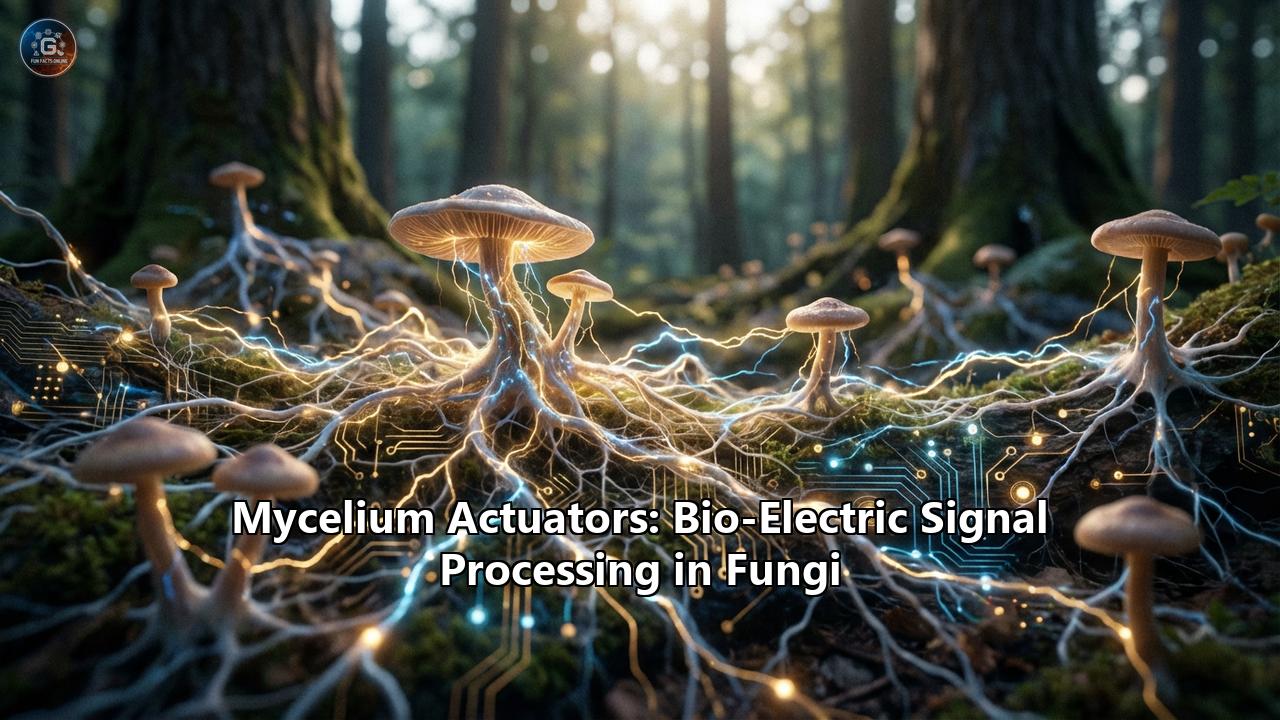
The forest floor is not merely a graveyard of fallen trees and decaying leaves; it is a motherboard. Beneath the damp soil, an ancient, sprawling internet of biological fiber pulses with information. For decades, we walked over it, assuming it was silent. We were wrong.
Recent breakthroughs in bio-cybernetics have unveiled that fungi are not just passive decomposers but active signal processors. They hum with electrical spikes, trade information through ion channels, and possess a "language" of voltage that we are only just beginning to decode. Now, engineers are plugging into this network, not to harvest mushrooms, but to build brains. Welcome to the dawn of Mycelium Actuators—where biology meets robotics, and the circuit board is grown, not soldered.
Part I: The Hidden Circuitry of Nature
1.1 The Fungal Connectome
To understand how a mushroom can drive a robot, one must first understand the mycelium—the vegetative part of a fungus, consisting of a mass of branching, thread-like hyphae. If you were to zoom in on a single hypha, you wouldn't just see a cell; you would see a pressurized, water-filled tube capable of exerting immense hydraulic force, wrapped in a sensitive membrane that tastes, feels, and "thinks" in ions.
In a single teaspoon of healthy soil, there can be miles of these hyphae. They form a mycorrhizal network, often dubbed the "Wood Wide Web," connecting trees and plants, redistributing nutrients, and warning of pests. But beyond this chemical exchange lies a faster, more immediate mode of communication: electricity.
In 1995, Swedish researchers led by Stefan Olsson inserted microelectrodes into the mycelium of Armillaria bulbosa and Pleurotus ostreatus (the Oyster mushroom). They watched in stunned silence as the needle on their chart recorder flicked. The fungi were firing action potentials—rapid changes in voltage across their cell membranes, strikingly similar to the nerve impulses that allow you to read this sentence.
1.2 The Ion Dance: Calcium, Potassium, and Turgor
In animal neurons, an action potential is a cascade of sodium and potassium ions rushing in and out of the cell. Fungi, having diverged from animals over a billion years ago, evolved a parallel solution.
The fungal "nerve impulse" is primarily driven by calcium (Ca²⁺) and proton (H⁺) gradients, alongside potassium.
- The Trigger: When a hypha encounters a stimulus—a heavy metal, a sudden temperature drop, or a mechanical weight—mechanosensitive ion channels pop open.
- The Channels: Research has identified channels like MsL10 (MscS-like), which responds to membrane tension (touch/pressure), and Yvc1, a vacuolar channel homologous to the TRP (Transient Receptor Potential) channels found in human sensory neurons.
- The Spike: As ions flood the cell, the membrane depolarizes. This electrical wave travels along the hyphae. It is slower than a human nerve signal—moving at millimeters per second rather than meters—but it is relentless and robust.
This electrical activity is intimately tied to turgor pressure. Fungi are hydraulic machines. They grow by pumping ions into their tips, drawing water in by osmosis, and pressurizing the cell to over 100 atmospheres—enough to crack pavement. The electrical signal is the command; the turgor pressure is the muscle.
Part II: The Cyborg Fungus
2.1 The Cornell Breakthrough: A Robot Controlled by a Mushroom
In late 2024, a team at Cornell University led by Anand Mishra and Rob Shepherd shattered the barrier between mycology and robotics. They didn't just study the signals; they harnessed them.
The team cultivated Pleurotus eryngii (King Oyster mushroom) directly into the hardware of a bio-hybrid robot. They built an electrical interface that could read the fungus's natural spikes.
- The Setup: The mycelium was grown in a small chamber with electrodes. This "brain" was mounted on two different robotic bodies: a soft, five-legged, spider-like bot and a four-wheeled rover.
- The Experiment: When the researchers shone UV light on the fungus, it reacted. Fungi generally dislike strong light; it signals exposure and potential drying. The mycelium fired a train of high-frequency spikes.
- The Actuation: The robot's computer interface translated these biological spikes into digital commands. The "spider" bot kicked its legs, scuttling away from the light. The rover rolled forward.
This was not a pre-programmed response. The robot was not "simulating" a reaction. The fungus felt the light, and the fungus drove the robot. It was a true bio-cybernetic loop: biological sensing $\rightarrow$ electrical processing $\rightarrow$ mechanical actuation.
2.2 Why Fungi? The Case for Wetware
Why replace a silicon chip with a mushroom? A standard microcontroller is faster, cheaper, and doesn't rot. However, biological systems offer advantages that silicon cannot match:
- Extreme Sensitivity: Fungi can detect minute chemical changes in soil—toxins, pathogens, nutrient gradients—that would require thousands of dollars in synthetic sensors to replicate.
- Self-Repair: If you crack a silicon chip, it’s garbage. If you cut a mycelial network, it heals itself, re-routing connections and regrowing lost tissue.
- Energy Efficiency: A fungal computer runs on oatmeal and woodchips, not lithium and coal.
- Resilience: Pleurotus can survive in high salinity, radiation (some fungi grow inside the Chernobyl reactor), and extreme cold. A bio-hybrid robot could be dropped into a toxic waste spill or a radioactive zone, survive, and report back data until it eventually biodegrades into compost.
Part III: Decoding the "Fungal Language"
3.1 The 50-Word Vocabulary
Professor Andrew Adamatzky at the University of the West of England (UWE) Bristol has taken the electrical analysis a step further. He treats fungal spike trains not just as noise, but as a language.
In a landmark study, Adamatzky recorded the electrical activity of four species: Ghost Fungi (Omphalotus nidiformis), Enoki (Flammulina velutipes), Split Gill (Schizophyllum commune), and Cordyceps (Cordyceps militaris). He found that the spikes often clustered into "trains."
- Syntax: The duration and interval of these spike trains were consistent. When he applied linguistic analysis—the same math used to study human languages—he found striking similarities.
- The Lexicon: The fungi seemed to have a vocabulary of up to 50 distinct "words" (spike patterns).
- The Speaker: Schizophyllum commune (Split Gill) was the most loquacious, generating the most complex sentences.
Adamatzky theorizes these signals are used to coordinate the colony. "I found food here," "Damage detected in sector 7," or "Prepare for sporulation."
3.2 The Skeptics' View: Is it Just Noise?
Not everyone is convinced. Mycologist Dan Bebber and others argue that comparing these spikes to human "language" is anthropomorphic. They suggest the signals could be:
- Housekeeping: Rhythmic pulses related to nutrient transport, like a heartbeat or peristalsis.
- Propagation Artifacts: The electrical shadow of cell growth (tip extension) rather than intentional communication.
The debate is fierce, but for engineers, the meaning matters less than the consistency. If a specific toxin always triggers "Word #4," we can program a robot to recognize "Word #4" as a danger alarm, regardless of whether the fungus "meant" to say it.
Part IV: Material Actuators — When the Fungus is the Muscle
While the Cornell robots used the fungus as a brain to drive electric motors, a parallel field of research asks: Can the fungus be the muscle?
4.1 Hygroscopic Actuation
Dead fungal tissue, much like wood, is hygroscopic—it absorbs moisture from the air. This property can be engineered.
- The Mechanism: By layering aligned mycelium fibers (or wood veneers bound by mycelium) with materials that don't swell, researchers create bilayers. When humidity rises, the mycelium layer expands, forcing the material to bend.
- Zero-Energy Motors: These actuators need no battery. They move purely based on the daily cycle of dawn (damp) and noon (dry).
- Applications: Imagine "living" architecture—windows that automatically close when it rains, or solar panels that track the sun using moisture gradients, all built from fungal composites.
4.2 Hydraulic Power: The Hyphal Ram
Living hyphae can exert pressures of 4–8 MPa (roughly 580–1100 psi). This is comparable to the pressure in a commercial pressure washer.
- Soft Robotics: Researchers are exploring "growth-driven actuation." Instead of a motor spinning a wheel, a fungal robot could function like a plant root, hydraulically forcing its way through rubble.
- The Challenge: Speed. Fungal growth is slow. However, "rapid turgor loss" (the mechanism some plants use to snap their leaves) is also present in fungi (e.g., shooting spores). Harnessing this explosive release of pressure could create fast-twitch fungal muscles.
Part V: The Future — Fungal Computing and Living Starships
5.1 The Fungal Motherboard
We are moving toward Fungal Integrated Circuits (FICs).
- Logic Gates: We can already make fungal logic gates. By crossing two streams of mycelium, we can create AND/OR/NOT gates based on whether the electrical spikes propagate or block each other.
- Memory: Fungi show "memristive" behavior. If you stimulate a pathway repeatedly, the conductivity changes. The fungus "learns" the path, physically reinforcing the connection. This is the hardware of a neural network, growing in real-time.
5.2 Space Exploration: The Ultimate Payload
NASA is interested. Sending electronics to Mars is heavy and expensive. Sending a spore print is nearly weightless.
- Myco-Architecture: On Mars, astronauts could feed local regolith and waste to fungal spores. The mycelium would bind the dust into bricks (actuation via growth), while the living network within the walls acts as a sensor array to detect structural breaches or radiation leaks.
- Self-Assembling Rovers: A "seed" robot containing the basic mechanical skeleton and a dormant fungal culture could be dropped on a planet. Upon landing, it adds water. The brain grows, the sensors activate, and the rover wakes up.
Part VI: A Bio-Hacker’s Guide to Mycelium Electronics
For the brave makers and citizen scientists, the barrier to entry is surprisingly low. You don't need a university lab to listen to mushrooms.
The "Myco-Synth" Setup:- The Subject: Pleurotus ostreatus (Oyster) is the lab rat of the fungal world. Tough, fast-growing, and electrically active. Buy a grow kit online.
- The Probes: Use fine silver wire or acupuncture needles. Sterilize them with a flame.
- The Amplifier: Fungal signals are weak (microvolts). You need a high-impedance instrumentation amplifier. The HX711 (commonly used for digital scales) is a popular hack, but a dedicated EMG/ECG sensor board (like the MyoWare or SpikerBox) works better for capturing dynamic spikes.
- The Interface: Connect the amplifier output to an Arduino or ESP32.
- The Code: Write a simple loop to plot the voltage. You will see noise (60Hz hum), but if you shield your mushroom (a Faraday cage made of chicken wire helps), you might just see the slow, rolling waves of the "Spike Trains."
Part VII: Ethical Frontiers
If a mushroom can drive a robot, react to pain stimuli, and process information, is it sentient?
Most scientists say no—at least, not in the way we are. It is intelligence without consciousness, processing without feeling. But as we integrate these systems into our technology, the line blurs.
- The "Slave" Problem: If we build a computer made of living brain tissue (even fungal), and we force it to calculate, is that ethical?
- The Internet of Living Things: We are entering an era where our devices are not just "smart" but "alive." Your house might have a fungal immune system. Your car might heal its own scratches.
The Mycelium Actuator is more than a novelty; it is a paradigm shift. It challenges our definition of the machine. It suggests that the most advanced technology of the future will not be mined from the earth, but grown from it.
As we plug our wires into the soil, we are finally joining the conversation that has been happening beneath our feet for 400 million years. The question is: Are we ready for what they have to say?
Reference:
- https://www.youtube.com/watch?v=7DrqU558peE
- https://medium.com/@francesco.cozzolino/do-mushrooms-communicate-a-concise-scientific-look-at-fungal-signalling-e9cae5f918ef
- https://royalsocietypublishing.org/rsos/article/9/4/211926/96736/Language-of-fungi-derived-from-their-electrical
- https://www.youtube.com/watch?v=zPmXmGa4e7A
- https://www.discovermagazine.com/if-fungi-could-talk-study-suggests-fungi-could-communicate-in-structure-43541
- https://blogs.uwe.ac.uk/research-external-engagement/uwe-bristol-academic-researches-the-language-of-fungi-derived-from-their-electrical-spiking-activity/
- https://www.theguardian.com/science/2022/apr/06/fungi-electrical-impulses-human-language-study
- https://thescikuproject.com/2025/03/28/language-of-fungi/
- https://www.sciencealert.com/fungi-communicate-with-patterns-that-look-uncannily-like-our-own-speech
- https://www.digitalisventures.com/blog/notes-on-engineering-health-july-2024-notes-on-unconventional-computing