
For centuries, humanity’s quest to understand the universe has been inextricably linked to the size of our mirrors. From the moment Galileo first pointed a rudimentary curved glass lens toward the night sky in the 17th century, the evolution of astronomy has been driven by a simple, unyielding rule: to see deeper into the cosmos and resolve finer details, you must build a larger telescope. We have progressed from small, handheld tubes to colossal terrestrial observatories and space-based marvels like the Hubble and James Webb Space Telescopes. Yet, despite these engineering triumphs, we are rapidly approaching a fundamental physical barrier.
The laws of classical optics dictate that no matter how perfectly a telescope is constructed, its resolving power is absolutely constrained by the "diffraction limit". When light from a distant star or galaxy passes through a telescope's circular aperture, it behaves as a wave, diffracting and spreading out to create a central blur surrounded by concentric ripples, known as the Airy disk. If two celestial objects—say, a distant star and its orbiting exoplanet—are too close together in the sky, their Airy disks merge, rendering them indistinguishable. The only traditional way to overcome this diffraction limit is to increase the diameter of the telescope's aperture. But constructing single optical mirrors larger than a few tens of meters becomes structurally, financially, and practically impossible.
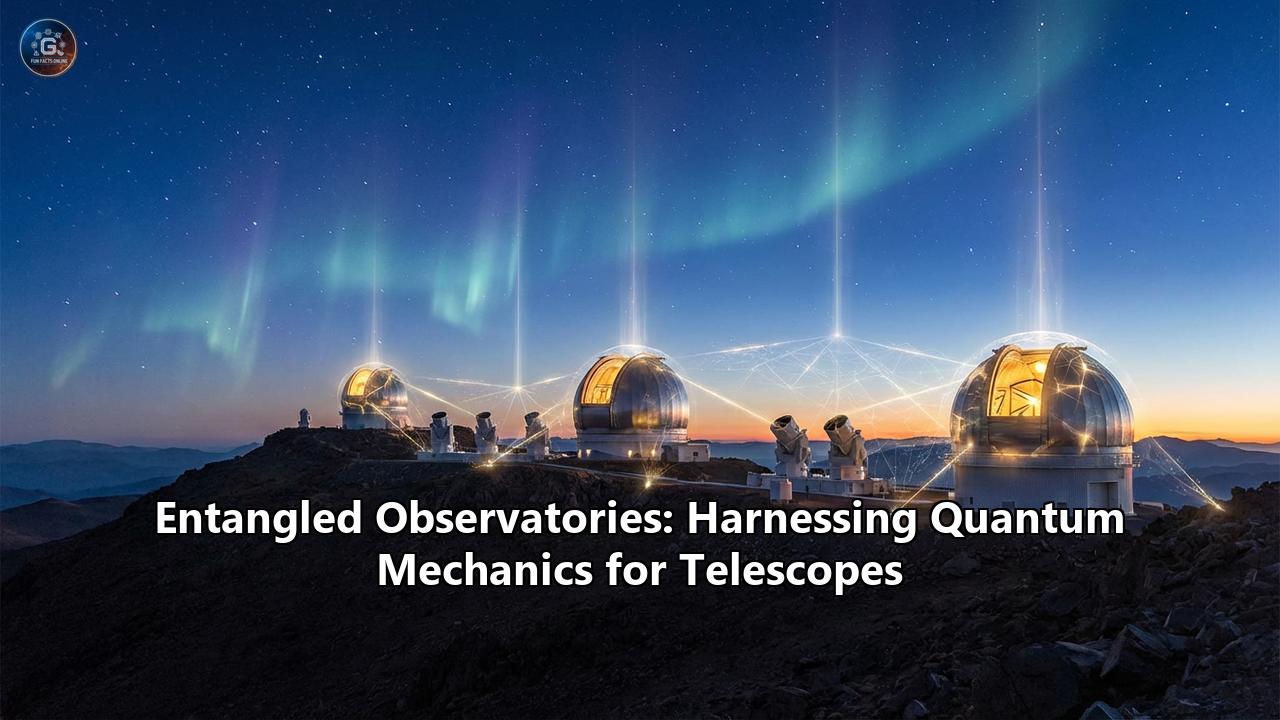
Enter the era of "Entangled Observatories." Astronomers and quantum physicists are currently joining forces to shatter the classical diffraction limit, proposing a revolutionary paradigm shift: harnessing the mind-bending principles of quantum mechanics—specifically, quantum entanglement—to network distant telescopes. By treating light not just as a classical wave, but as a quantum state, researchers are laying the groundwork for virtual, Earth-sized optical telescopes. This quantum-assisted approach promises to revolutionize astronomy, allowing us to capture ultra-high-resolution images of exoplanetary surfaces, peer into the glowing event horizons of supermassive black holes at visible wavelengths, and observe the universe with unprecedented, microscopic clarity.
The Wall of Classical Interferometry
To understand why quantum mechanics is required to build the next generation of telescopes, we must first understand the triumphs and limitations of classical interferometry. Astronomers have long known that you do not necessarily need one giant, continuous mirror to achieve high resolution. Instead, you can use a technique called "long-baseline interferometry". By taking two or more telescopes separated by a vast distance (the "baseline") and combining the light they collect from the same target, you can simulate a single virtual telescope with a diameter equal to the distance between them.
This technique has been spectacularly successful in the realm of radio astronomy. The Event Horizon Telescope (EHT), which captured the historic first images of the supermassive black holes at the centers of the M87 galaxy and our own Milky Way, is an Earth-sized radio interferometer. Because radio waves have very long wavelengths and low frequencies, we can easily use electronic atomic clocks to record the precise time (the phase and amplitude) that each radio wave hits each telescope dish. These vast amounts of data are digitized, stored on hard drives, and later synchronized and combined in a supercomputer to form an image.
However, translating this success to optical (visible and near-infrared) wavelengths is a technological nightmare. Visible light oscillates at hundreds of terahertz—trillions of cycles per second. No existing electronic clock can tick fast enough to record the phase of optical light waves. Therefore, to achieve optical interferometry, the light beams themselves must be physically transported from each telescope to a central combining station.
Currently, this is done using complex systems of mirrors, vacuum tubes, or fiber-optic cables, known as optical delay lines, which must be stabilized to within a fraction of a light's wavelength. If a mirror vibrates by even a nanometer, the interference pattern is destroyed. Furthermore, as the baseline increases, optical fibers absorb the precious, faint starlight; after a few hundred kilometers, almost all the astronomical photons are lost to the glass. Consequently, classical optical interferometers are strictly limited to baselines of a few hundred meters, severely restricting their resolving power.
The Quantum Leap: Entanglement as a Virtual Lens
If we cannot physically transport the starlight, how can we combine it? The answer lies in the bizarre quantum phenomenon that Albert Einstein famously derided as "spooky action at a distance": quantum entanglement.
Entanglement occurs when two or more particles become inextricably linked, sharing the exact same quantum state regardless of the physical distance separating them. If you measure the property of one entangled particle, the state of its partner is instantly determined, defying classical intuition. While classical interferometry requires physical optical links to combine light, quantum astronomy proposes using pre-distributed pairs of entangled photons to share information between distant observatories without ever bringing the starlight beams together physically.
The foundational blueprint for this concept was proposed in 2012 by researchers Daniel Gottesman, Thomas Jennewein, and Sarah Croke (often referred to as the GJC protocol). They envisioned a scenario where a quantum repeater network sits between two distant optical telescopes. Instead of piping the astronomical photons toward each other, the network generates a pair of entangled photons and sends one to Telescope A and the other to Telescope B.
When a photon from a distant star arrives at Telescope A, it is made to interact locally with Telescope A's half of the entangled pair. Through a process involving a Bell-state measurement, the state of the starlight is essentially "teleported" or correlated into the quantum network. Because the two network photons are entangled, the phase information of the starlight hitting Telescope A can be compared with the starlight hitting Telescope B. The genius of the GJC protocol is that the starlight itself never has to travel through the lossy, noisy miles of optical fiber between the observatories. Even if the entangled photons sent by the quantum repeater are lost in the fiber, it doesn't matter—you simply generate another pair. You only perform the measurement when both the starlight and the entangled network photon are successfully present. This effectively bypasses the photon-loss barrier that plagues classical optical interferometers, allowing for arbitrarily long baselines—even the size of planet Earth.
Modern Breakthroughs and the Quantum Fisher Information Limit
Since the seminal GJC proposal, the intersection of quantum information science and astronomy has exploded into a highly active field of theoretical and experimental research. The goal is not merely to overcome photon loss but to extract the maximum possible information from the universe, pushing up against the absolute limits defined by quantum mechanics itself.
In a landmark 2026 study, a team of researchers from the University of Arizona, the University of Maryland, and NASA's Goddard Space Flight Center, led by Dr. Saikat Guha, pushed the theoretical boundaries of the quantum telescope even further. They recognized that traditional optical resolution is constrained by the Rayleigh criterion, but treating starlight strictly as a quantum object opens up new mathematical tools, such as the Quantum Fisher Information limit.
According to this 2026 framework, "quantum mechanics allows for two distant parties to share entanglement—a form of correlation that is stronger than any probabilistic correlation allowed by physics". The team developed a technique utilizing spatial mode sorting and pre-distributed entanglement stored in quantum memories at each telescope. By sorting the spatial modes of the light before detection, and correlating them using the entangled memories, the telescopes can achieve a single-bit post-processed outcome that extracts the exact angle of arrival of the starlight. This technique completely eliminates the need to physically combine the beams, mimicking a telescope the size of the baseline with astonishing fidelity and reaching the ultimate precision limits mandated by the laws of physics.
Other teams have focused on continuous-variable entanglement and intensity interferometry. In 2023, researchers from Brookhaven National Laboratory (BNL) and Stony Brook University, supported by physicist Stephen Vintskevich, proposed a two-photon interferometry scheme borrowing heavily from the Hanbury Brown-Twiss (HBT) effect. The classical HBT effect measures the correlation of photon intensities (photon bunching) rather than direct phase amplitudes. The BNL-led team realized that by using a source of entangled photons to correlate photon counts at two different stations, they could measure the opening angle between two stars while entirely removing the crippling problem of photon phase stability that hinders classical optical VLBI. As BNL scientist Andrei Nomerotski noted, the second star in their observation can even be viewed as a source of coherent photons for the first star, elegantly linking intensity interferometry to the original Gottesman-Jennewein-Croke proposal.
The Core Technologies of an Entangled Observatory
Transitioning these breathtaking theoretical frameworks from chalkboards to operational observatories requires a monumental leap in quantum engineering. A global quantum telescope network relies on a symphony of cutting-edge technologies, many of which are currently in their infancy but rapidly maturing.
1. Quantum Memories: Catching a Star's Whisper
At the heart of a quantum telescope is the need to briefly pause the universe. Astronomical photons are incredibly faint; a telescope might only receive a single photon from a distant exoplanet every few minutes. When that photon arrives, it must be stored perfectly intact until an entangled network photon arrives to interact with it. Classical data storage measures the light, destroying its delicate quantum phase. Quantum memories, however, utilize non-destructive write and read processes to absorb the photon's exact quantum state into an atomic or solid-state system.
Recently, massive strides have been made using Silicon-Vacancy (SiV) centers in diamond nano-cavities. In September 2025, researchers demonstrated an entanglement-assisted non-local optical interferometer using exactly this technology. By storing light in the electron spin states of the diamond SiV centers, the team successfully performed remote phase sensing across a fiber link baseline of 1.55 kilometers. This proof-of-concept experiment integrated remote quantum entanglement, photon mode erasure (which hides the "which-path" information of the incoming light to preserve interference), and non-local photon heralding. It stands as one of the first physical demonstrations that linking telescopes via quantum memories is an achievable reality.
2. The Quantum Internet and Repeaters
To build an Earth-sized telescope, entangled photons must be distributed across oceans and continents. Because standard optical fibers absorb photons, and quantum states cannot be cloned or amplified (due to the no-cloning theorem of quantum mechanics), scientists must build "quantum repeaters". These devices perform entanglement swapping, allowing short-distance entanglement to be stitched together into long-distance entanglement. Recent breakthroughs published in Nature have already demonstrated the transmission of entangled photons over 1,200 kilometers using satellite-to-ground links and fiber networks, proving the feasibility of the infrastructure needed for global astronomical networks.
3. Astrophotonics and Photonic Circuits
Managing the delicate interference of quantum states at the telescope focal plane requires immense precision. Standard bulk optics (glass lenses and mirrors) are often too bulky and prone to thermal noise. Enter "astrophotonics," the integration of microscopic photonic circuits tailored for astrophysics. Modern prototypes propose channeling the starlight directly into on-chip waveguides where quantum interference can be controlled at the nanometer scale. These circuits align with the goals of maintaining enhanced stability and reducing network failure during quantum data encoding. By centralizing the quantum interference on an astrophotonic chip, telescopes become incredibly robust against the environmental vibrations that currently plague classical interferometers.
A Cosmic Symphony: Entanglement and the Stars
The poetic irony of quantum telescopes is that they use the smallest, most localized physical theories (quantum mechanics) to study the largest, most distant objects in the universe (astrophysics). This profound intersection was beautifully highlighted by the 2022 experiments led by Nobel laureate Anton Zeilinger at the William Herschel Telescope (WHT) and the Telescopio Nazionale Galileo (TNG) in the Canary Islands.
Zeilinger's team utilized the light from distant quasars—galaxies powered by supermassive black holes located 8 to 12 billion light-years away—to control a quantum entanglement experiment on Earth. The quasar light dictated which measurements were performed on pairs of entangled photons generated in a mobile laboratory. The fluctuations of the ancient light ensured that the measurement decisions were made completely independently, proving that quantum entanglement is an inherent property of the universe, untouched by any hidden local variables. While this experiment was a test of fundamental physics rather than an imaging protocol, it vividly demonstrated that astronomical observatories and quantum entanglement laboratories are destined to merge.
The Future Cosmos: What Will We See?
If humanity successfully constructs a global network of Entangled Observatories, the resulting "quantum telescope" will achieve angular resolution orders of magnitude beyond anything currently possible. The scientific yield would fundamentally alter our understanding of the cosmos.
Mapping the Surfaces of Exoplanets:Currently, even our most powerful telescopes see exoplanets as mere dips in starlight or, at best, a single, blurred pixel of light. A quantum telescope with an Earth-sized baseline operating at visible and near-infrared wavelengths could resolve the surfaces of planets orbiting nearby stars. We could directly image the continents, oceans, and massive weather systems of alien worlds, searching for the atmospheric signatures of life, such as seasonal greening or atmospheric biosignatures, with our own eyes.
Zooming in on Black Hole Event Horizons:The EHT gave us our first blurry, donut-shaped glimpse of a black hole's shadow in the radio spectrum. A quantum optical interferometer could pierce much closer to the event horizon. Because optical wavelengths are thousands of times shorter than radio waves, an optical baseline of the same size yields thousands of times more resolution. We could image the razor-thin "photon ring" surrounding the black hole, capturing the intricate dynamics of the accretion disk and testing the predictions of Albert Einstein's General Relativity in the most extreme gravity environments imaginable.
Stellar Astrophysics in High Definition:Stars are currently treated mostly as point sources. With quantum-assisted interferometry, we could map the surfaces of stars across the galaxy. We could watch convection cells boiling on the surface of red giants, observe the violent magnetic snapping of starspots and flares on nearby dwarfs, and measure the precise diameters and shapes of rapidly rotating stars.
Precision Cosmology and Dark Energy:The improved signal-to-noise ratio and unprecedented resolution offered by quantum telescopy would allow for ultra-precise tracking of celestial motions. By observing the relativistic orbital precession of stars around the galactic center or measuring the exact distances and expansions of distant galaxies, we could place the tightest constraints yet on the nature of dark matter and the mysterious dark energy driving the accelerated expansion of the universe.
The Challenges Ahead
Despite the intoxicating potential of Entangled Observatories, immense hurdles remain. The primary challenge is the "photon occupancy" of astronomical sources. Starlight is not a controlled laser beam; it is a chaotic, thermal source of light with extremely low photon flux. A single spatial mode of starlight may contain a photon only a tiny fraction of the time. When operating a quantum telescope, researchers must account for the partial distinguishability between the pristine, perfectly defined entangled photons generated on the ground and the chaotic, altered photons arriving from space.
Furthermore, as the starlight descends through Earth's atmosphere, atmospheric turbulence scrambles its phase and spatial modes. Quantum telescopes will require ultra-advanced adaptive optics—deformable mirrors operating at thousands of hertz—to correct this atmospheric distortion before the starlight can enter the quantum memory and successfully interfere with the network's entangled photons.
Finally, the generation and maintenance of complex quantum states, such as Gottesman-Kitaev-Preskill (GKP) states or multi-partite entangled states, require incredibly low-noise environments. Research by the Brookhaven National Laboratory's Computing and Data Sciences team has heavily focused on the classification and stabilization of multipartite entanglement entropy. Using advanced techniques like convex optimization and quantum error correction, scientists are actively working on how to protect the fragile entangled states from decoherence as they traverse the global network. Without robust quantum error correction, the virtual mirror will crack under the pressure of terrestrial noise.
A New Lens on Reality
We are standing on the precipice of a new era in astronomy. The telescope of the future will not be defined merely by the curvature of its glass or the mass of its steel frame, but by the ethereal, mathematical perfection of quantum correlation. By replacing physical optical links with quantum entanglement, we are untethering our vision from the constraints of classical engineering and tapping directly into the fundamental fabric of reality.
Entangled Observatories promise to turn the entire planet into a single, unblinking eye. Through the marriage of quantum mechanics and astrophysics, the blurry, unresolved mysteries of the night sky will eventually snap into breathtaking focus, forever changing our place among the stars. The quantum revolution in astronomy has begun, and the universe is ready for its close-up.
Reference:
- https://www.azoquantum.com/Article.aspx?ArticleID=520
- https://www.universetoday.com/articles/are-we-entering-the-era-of-quantum-telescopes
- https://dailygalaxy.com/2026/02/clarity-space-observations-quantum-tech/
- https://eprints.whiterose.ac.uk/id/eprint/236008/1/APX11_2597311%20%28Huang%29.pdf
- https://www.youtube.com/watch?v=EAZO10WgKZI
- https://eprints.whiterose.ac.uk/id/eprint/225582/1/PhysRevA.111.043701.pdf
- https://www.quantastro.bnl.gov/references/quantum-assisted-approach
- https://www.ing.iac.es/PR/press/quantum2.html
- https://www.inverse.com/science/quantum-telescopes
- https://arxiv.org/html/2501.16670v1
- https://www.researchgate.net/publication/395418592_Entanglement_Assisted_Non-local_Optical_Interferometry_in_a_Quantum_Network
- https://quantumzeitgeist.com/quantum-network-entanglement-demonstrates-assisted-non-local-optical-interferometry-low-light/
- https://andovertechreview.com/2025/12/01/assessing-quantum-interferometry-to-enhance-telescopic-efficiency-a-phy440-astronomy-research-project/
- https://www.bnl.gov/compsci/quantum/quantum-telescope.php
- https://arxiv.org/html/2412.16571v1
- https://preprints.opticaopen.org/articles/preprint/Generation_of_optical_Gottesman-Kitaev-Preskill_states_with_cavity_QED/21871584
- https://arxiv.org/abs/2110.05315