
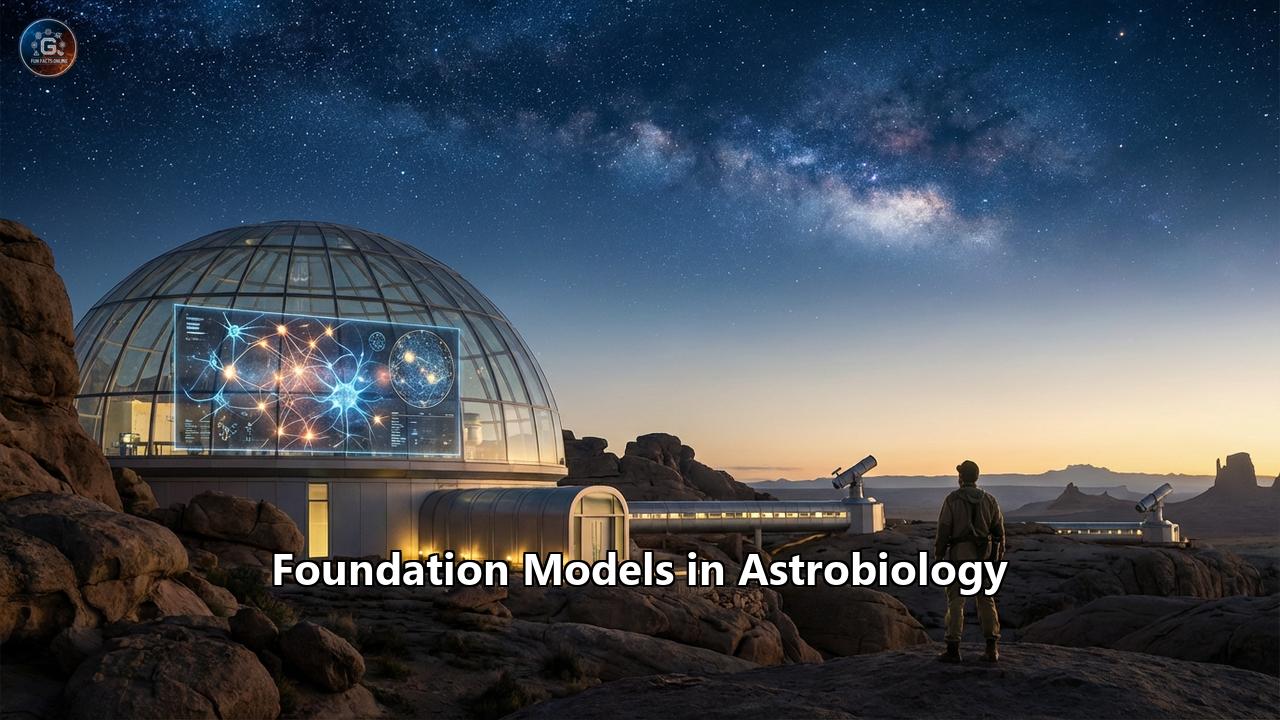
The year 2026 marks a pivotal turning point in the human quest to answer our oldest question: Are we alone? While telescopes like the James Webb Space Telescope (JWST) and the ground-based giants continue to peer deeper into the cosmos, the most profound revolution in astrobiology is not happening on a launchpad or a mountaintop. It is happening in server farms, where a new class of artificial intelligence—Foundation Models (FMs)—is fundamentally reshaping how we search for life beyond Earth.
For decades, astrobiology was a field defined by data scarcity. We had one data point for life (Earth) and a universe of silence. Today, we face the opposite problem: a deluge of data so complex and voluminous that human cognition alone can no longer parse it. From the spectral fingerprints of distant exoplanet atmospheres to the terabytes of radio signals filtering through the Allen Telescope Array, the sheer scale of information requires a new kind of observer. Enter the "Silicon Astrobiologist"—multimodal, pre-trained, and capable of synthesizing knowledge across the physics, chemistry, and biology of a thousand worlds.
The Paradigm Shift: From Machine Learning to Foundation Models
To understand the magnitude of this shift, we must distinguish between the "traditional" machine learning (ML) of the early 2020s and the Foundation Models of 2025-2026. Traditional ML in astrobiology was often task-specific: a model trained solely to detect craters on Mars could not identify a biosignature in a gas plume. It was a specialist, brilliant but narrow.
Foundation Models are different. Trained on vast, diverse datasets—ranging from millions of scientific papers to petabytes of spectral data and planetary imagery—these models build a generalized understanding of the "rules" of nature. They can transfer learning from one domain to another. A model that understands the chemical grammar of terrestrial geology can, with minimal fine-tuning, learn to distinguish between a biological methane signature and a volcanic one on K2-18b.
The watershed moment arrived in February 2025, when NASA Ames Research Center and the SETI Institute hosted the inaugural Foundation Models for Astrobiology Workshop. The consensus from that gathering, solidified by the release of the "Paper I" white paper in late 2025, was clear: the future of life detection is AI-driven, multimodal, and autonomous.
The Text-Based Synthesizers: INDUS and AB-Chat
Astrobiology is inherently interdisciplinary. To evaluate a single potential biosignature, a researcher must synthesize knowledge from stellar astrophysics (the star's UV output), planetary science (atmospheric dynamics), geology (volcanic outgassing), and biology (metabolic byproducts). No single human expert holds deep expertise in all these fields.
This is where text-centric Foundation Models like INDUS and the proposed AB-Chat (AstroBiology-Chat) have become indispensable. Built upon architectures similar to the commercial LLMs of the early 2020s but trained on curated scientific corpora (NASA technical reports, ArXiv preprints, and peer-reviewed journals), these models act as omniscient research assistants.
INDUS, developed largely by NASA researchers, has demonstrated an uncanny ability to "connect the dots." In recent trials, when fed conflicting papers on the phosphine detection in Venus’s atmosphere, INDUS was able to highlight subtle discrepancies in the calibration methods of different instruments—a nuance that had escaped human meta-analysis for months. AB-Chat, a concept gaining traction in 2026, takes this a step further. It is designed not just to retrieve information but to generate hypotheses. By ingesting the entire corpus of prebiotic chemistry literature, AB-Chat can suggest novel reaction pathways for the origin of life that have never been tested in a lab, effectively guiding the hands of experimentalists toward high-probability discoveries.The Digital Eye: Multimodal Detection and LifeTracer
While text models synthesize theory, the heavy lifting of detection falls to multimodal models capable of "seeing" and "smelling" the universe.
One of the most exciting breakthroughs of late 2025 is LifeTracer, a machine learning framework designed to analyze mass spectrometry data. In the past, distinguishing between complex organic molecules created by life (biotic) and those created by space chemistry (abiotic) was a slow, manual process prone to debate. LifeTracer changes the game. Trained on thousands of samples—from carbonaceous meteorites to terrestrial fossils—it has learned the subtle "chemical texture" of life.
In blind tests, LifeTracer achieved over 87% accuracy in distinguishing meteoritic organic sludge from biological samples. It identified that abiotic samples, formed in the vacuum of space, tend to contain compounds with higher volatility and specific retention times that biotic samples lack. This tool is now being integrated into the analysis pipelines for future sample return missions, potentially acting as the first line of defense in identifying Martian biosignatures.
Simultaneously, models like Morpheus and ExoGAN are revolutionizing exoplanet research. Morpheus, originally an image classifier for galaxies, has been upgraded to handle the deep-infrared data from JWST. Meanwhile, ExoGAN (a Generative Adversarial Network) is used to simulate millions of potential exoplanet atmospheres. By generating synthetic spectra of "living" and "dead" worlds under various stellar conditions, it provides the training data necessary to teach other AIs what to look for. This "dreaming" AI allows researchers to prepare for the detection of biosignatures that we have not yet observed in reality.
Real-Time Technosignatures: The Edge of Discovery
The Search for Extraterrestrial Intelligence (SETI) has always been a "needle in a haystack" problem. The haystack is the entire radio spectrum, and the needle is a transient signal that might last only milliseconds.
In late 2025, the SETI Institute partnered with NVIDIA to deploy the IGX Thor platform at the Allen Telescope Array (ATA). This collaboration represents a move from "post-processing" to "edge computing." deeply integrated into the telescope's hardware.
Previously, terabytes of radio data were recorded and analyzed days or weeks later. If a transient signal—like a Fast Radio Burst (FRB) or a potential technosignature—occurred, it was often too late to verify it. The new AI-driven pipeline processes gigabits of data per second in real-time. It uses a Foundation Model trained on all known forms of radio interference (satellites, cell phones, radar) to filter out human noise instantly.
This system effectively gives the ATA a "reflex." If the AI detects an anomaly that defies known astrophysical or anthropogenic patterns, it can trigger immediate follow-up observations, locking the telescope onto the target before the signal fades. We are no longer just recording the sky; we are actively listening with an intelligent filter.
The "N=1" Problem and the Hallucination Risk
Despite this progress, the integration of Foundation Models into astrobiology faces a unique epistemological hurdle: the "N=1" Problem. We only know of one instance of life: Earth's.
Training an AI to find life based solely on Earth data risks creating a "homocentric" bias. An AI trained on terrestrial biochemistry might stare right at a silicon-based organism or a plasma-based lifeform and classify it as a rock. Conversely, there is the risk of "hallucinating life." Foundation Models, particularly generative ones, are known to find patterns where none exist. In the high-stakes arena of life detection, a "false positive" could trigger a premature announcement of alien life, devastating the field's credibility.
To combat this, researchers are employing Anomaly Detection rather than simple classification. Instead of teaching the AI "this is what life looks like," they teach it "this is what physics looks like." The model learns the baseline of abiotic processes—how rocks erode, how gas clouds cool, how stars shine. Anything that deviates significantly from this thermodynamic baseline is flagged as an "oddball."
This approach aligns with the "agnostic biosignature" framework. We aren't looking for DNA or chlorophyll; we are looking for complexity that entropy cannot explain. We are looking for the statistical shadow of intent.
The Future: The Autonomous Scientist
As we look toward the latter half of the 2020s and into the 2030s, the role of Foundation Models will evolve from tools to partners. NASA's planning for the Habitable Worlds Observatory (HWO), the successor to JWST, already incorporates AI as a core component of the mission architecture.
We are moving toward the concept of the "Autonomous Scientist"—spacecraft equipped with onboard Foundation Models capable of making real-time scientific decisions. Imagine a probe in the oceans of Europa. Communications with Earth take hours. If the probe sees a fleeting plume of hydrothermal vent fluid, it cannot wait for instructions. It must recognize the scientific value of the event, adjust its trajectory, and sample the plume, all on its own.
In 2026, the foundation for this future is being poured. We are building the silicon brains that will one day ride atop our rockets. These models are not just processing data; they are expanding the definition of what is knowable. By synthesizing the scattered knowledge of humanity, they are preparing us to recognize the other, whenever and wherever we finally meet it.
The search for life has transformed. It is no longer just a search for biology; it is a search for information. And in this new era, our most powerful telescope is the neural network.
Reference:
- https://arxiv.org/abs/2510.08636
- https://www.labroots.com/trending/space/24851/searching-biosignatures-mars-planetary-bodies-using-artificial-intelligence-machine-learning-2
- https://www.theregister.com/2022/06/09/ai_jwst_morpheus/
- https://weatheire.com/news/space/2025/10/29/seti-institute-uses-ai-to-speed-search-for-extraterrestrial-life/
- https://www.seti.org/news/seti-institute-accelerates-the-search-for-life-beyond-earth-with-nvidia-igx-thor/
- https://www.seti.org/news/seti-institute-in-the-news-2025-october-roundup/
- https://aibusiness.com/nvidia/nvidia-joins-search-for-extraterrestrial-life
- https://www.imanagerpublications.com/article/21990/
- https://medium.com/ai-simplified-in-plain-english/data-science-revolutionizes-astrobiology-a587b5b5576b