
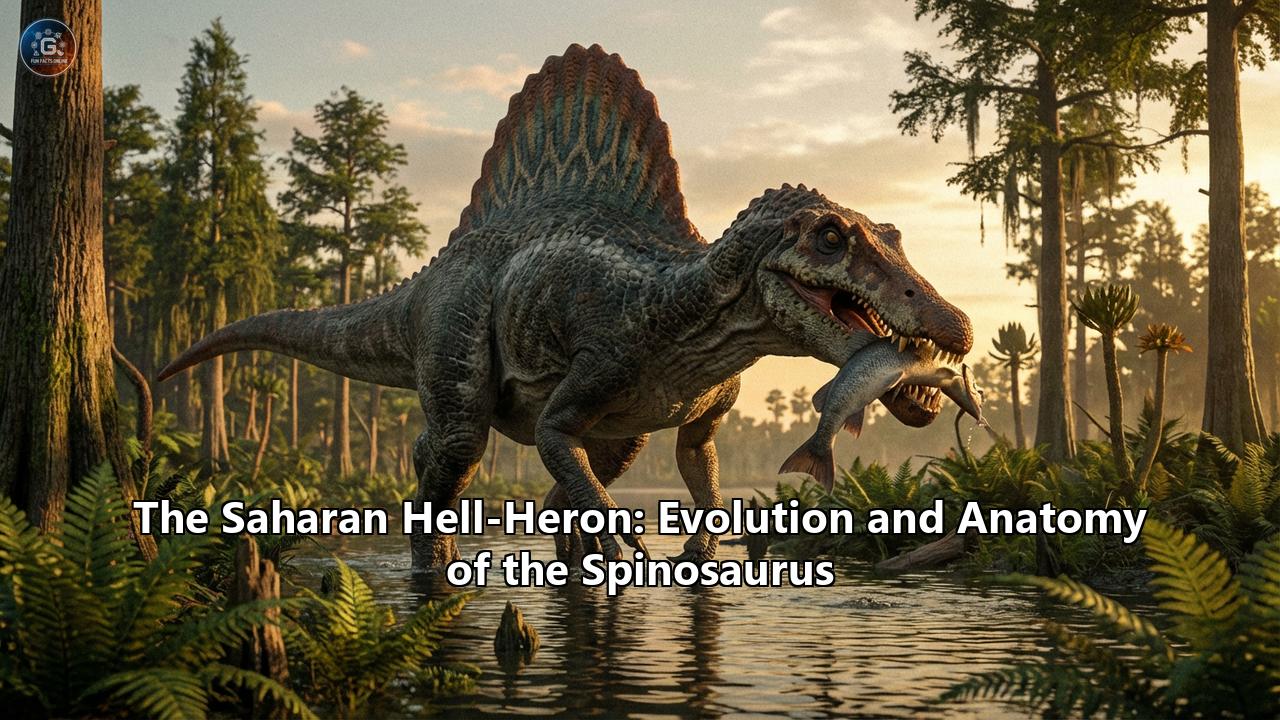
The paleontology of the twenty-first century is being defined not by the tyrant lizards of the land, but by a bizarre, sail-backed enigma that has forced scientists to rewrite the rulebook on dinosaur biology. Picture a predator longer than Tyrannosaurus rex, wielding a skull akin to a gargantuan crocodile, an imposing six-to-seven-foot sail stretching down its spine, and a paddle-like tail. For over a decade, the public imagination and the scientific community have been captivated by the idea that this creature was a fully aquatic river monster—a dinosaurian submarine that actively pursued prey in deep waters.
However, a wealth of recent biomechanical data, intense academic debate, and a stunning 2026 discovery in the Sahara Desert have drastically shifted this paradigm. Today, the leading scientific model paints an even more terrifying, yet ecologically realistic picture. Meet the "Hell Heron"—a towering, bipedal, semi-aquatic wading predator that stalked the ancient river systems of Cretaceous Africa.
To understand the evolution, anatomy, and ecology of Spinosaurus, one must unravel a century of destroyed fossils, bitter scientific rivalries, and the most rigorous anatomical stress-testing ever applied to an extinct animal.
A Tragedy of Ash and Bone: The Lost Holotype
The story of Spinosaurus is as dramatic as the animal itself. The first remains of Spinosaurus aegyptiacus were discovered in the Bahariya Oasis of Egypt in 1912 by Richard Markgraf, a fossil collector working for the aristocratic German paleontologist Ernst Stromer. In 1915, Stromer formally named the creature, recognizing it as a massive, bizarre theropod equipped with strange, conical teeth and towering neural spines. He named it Spinosaurus aegyptiacus—the "Egyptian spine lizard."
Stromer meticulously illustrated and mounted the partial skeleton in the Paleontological Museum in Munich. For decades, it stood as a marvel of the Cretaceous period. But tragedy struck during World War II. In April 1944, Allied bombing raids decimated Munich. Despite Stromer’s desperate pleas to the museum director to move the fossils to a safe location, his requests were ignored. The museum was obliterated, and the only known remains of Spinosaurus were reduced to ash and dust. For over half a century, the beast existed only as a ghost—surviving merely in Stromer’s beautifully detailed, sepia-toned sketches and photographs.
Because the physical evidence was gone, Spinosaurus lingered in scientific obscurity. It was often inaccurately reconstructed in paleontology books as a generic, upright theropod with a T. rex-like head and a random sail slapped onto its back. It wasn't until the late 20th and early 21st centuries that the sands of the Sahara began to yield the secrets of this lost river king once again.
The Evolution of the River Kings: From Europe to Gondwana
To understand how Spinosaurus became the ultimate Hell Heron, we must look at its family tree. The Spinosauridae family did not start out as aquatic giants. The evolutionary story likely begins in the Early Cretaceous period, in what is now Europe, before the supercontinent Gondwana fully broke apart.
In 2021, paleontologists unearthed the remains of two early spinosaurids on the Isle of Wight in England. One of them was aptly named Ceratosuchops inferodios, which translates from Latin and Greek to the "horned, crocodile-faced hell heron". Living about 125 million years ago—roughly 25 million years before Spinosaurus—Ceratosuchops lacked a massive sail but possessed the signature elongated snout and a braincase optimized for snapping up fish along ancient floodplains.
From these European origins, the spinosaurids radiated southward into Africa and South America. They diversified into two main subfamilies: the Baryonychinae (including the British Baryonyx and the African Suchomimus) and the Spinosaurinae (which includes Spinosaurus and its closest relatives). As the millions of years ticked by, the African river systems, particularly the Kem Kem beds of Morocco and the inland floodplains of Niger, provided the perfect selective pressures. The environments were swarming with giant, car-sized coelacanths, massive lungfish, and sawfishes. To exploit this bounty, the spinosaurids evolved increasingly specialized traits, culminating in the capstone of their lineage: Spinosaurus.
Anatomy of a Nightmare: Engineering the Spinosaurus
By the time Spinosaurus aegyptiacus emerged approximately 95 million years ago, it had evolved a suite of anatomical oddities that made it entirely unique among dinosaurs. Spanning up to 40 to 50 feet in length and weighing between 5 to 7 tons, it dwarfed the terrestrial apex predators of its day.
The Piscivorous Skull
The skull of Spinosaurus was built for fishing, not for bone-crushing. While a T. rex had a deep, muscular skull designed to shatter the armor of a Triceratops, the Spinosaurus possessed a long, narrow, tubular snout resembling that of a modern gharial. Its teeth were not serrated steak-knives; they were smooth, subconical, and interdigitating. The lower teeth protruded outward and fit perfectly into gaps between the upper teeth, creating an inescapable "fish-trap" for slippery, thrashing aquatic prey.
Furthermore, the nostrils of Spinosaurus were positioned far back on the skull, near the eyes, allowing the animal to partially submerge its snout in the water while still breathing effortlessly. A network of neurovascular openings at the tip of the snout suggests it possessed highly sensitive pressure receptors, similar to modern crocodiles, allowing it to detect the movements of fish in murky waters without relying on sight.
The Sail
The most iconic feature of Spinosaurus is its sail, supported by neural spines that grew up to 7 feet long. Since Stromer’s discovery, the function of the sail has been hotly debated. Was it a thermoregulatory device to absorb sunlight? Was it a fleshy hump used for storing fat, akin to a camel?
Recent biomechanical models and 3D reconstructions heavily lean toward the sail being a display structure. Just as modern reptiles or birds use crests and vibrant feathers for mating displays or territorial dominance, the sail of Spinosaurus likely served as a massive, pliant billboard. Covered in skin and tightly packed with blood vessels, it would have been highly visible above the water line, allowing individuals to identify each other or intimidate rivals in the dense, crowded mangrove swamps of Cretaceous Africa.
The Paddle-Like Tail
In 2020, a groundbreaking discovery by Dr. Nizar Ibrahim and his team shocked the world: Spinosaurus possessed a massive, flexible, fin-like tail. The neural spines on the tail vertebrae were highly elongated, creating a paddle structure previously unseen in any theropod dinosaur. For proponents of the "aquatic pursuit predator" model, this was the smoking gun. It suggested Spinosaurus used its tail to propel itself through the water, chasing down prey like a giant, reptilian eel.
However, as the scientific method demands, this hypothesis was swiftly put to the test. And the results would ignite the fiercest paleontological debate of the decade.
The Great Aquatic Debate: Submarine vs. Stork
For the past ten years, two competing models of Spinosaurus ecology have battled for dominance. On one side, "Team Submarine" (led by Nizar Ibrahim and Matteo Fabbri) argued that Spinosaurus was a fully aquatic diver, swimming efficiently to hunt prey underwater. On the other side, "Team Stork" (led by Paul Sereno of the University of Chicago and Nathan Myhrvold) championed the "Hell Heron" model, asserting that while Spinosaurus lived around water, it was a shoreline wader entirely incapable of high-speed aquatic pursuit.
The Bone Density War
The battleground eventually shifted to the internal microstructure of the dinosaur's bones. In 2022, Fabbri and his colleagues published a high-profile study in Nature, analyzing the bone density of Spinosaurus and its relatives. They found that Spinosaurus had highly osteosclerotic (dense and compact) bones, lacking the hollow medullary cavities seen in agile terrestrial dinosaurs like T. rex. Fabbri's team argued that this extreme bone density acted as a biological ballast, much like the heavy bones of penguins, manatees, and hippos, allowing the dinosaur to counteract buoyancy and dive deep underwater.
The scientific community was initially captivated. But in science, a hypothesis must withstand the crucible of peer review and replication.
In 2024, Sereno, Myhrvold, and their team published a comprehensive rebuttal in PLOS ONE. They identified severe methodological flaws in the 2022 bone density study, which had relied on a statistical method known as phylogenetic flexible discriminant analysis (pFDA). Sereno's team demonstrated that bone density is not a foolproof proxy for aquatic diving. For example, elephants—which are undeniably non-diving terrestrial animals—have bone densities overlapping with those of Spinosaurus. The dense bones in Spinosaurus were more likely an adaptation to support its massive, 7-ton weight on its relatively short hind limbs, not a ballast for diving.
The Biomechanics of Sinking a Giant
The physical mechanics of the animal further dismantled the submarine hypothesis. In a rigorous 2022 study published in eLife, Sereno's team constructed a CT-based digital flesh model of Spinosaurus aegyptiacus. They added internal air spaces (such as the lungs and air sacs characteristic of theropod dinosaurs) and muscle mass to test its center of gravity and buoyancy.
The results were definitive: Spinosaurus was a terrible swimmer.
Despite its dense leg bones, the sheer volume of its lungs and upper body would have made it incredibly buoyant, requiring enormous and impossible amounts of energy to dive. Furthermore, if it floated on the surface, the giant 7-foot sail would have acted as a massive liability, making the animal top-heavy. In the water, it would have been highly unstable and prone to tipping over, capable of a maximum swimming speed of less than 1 meter per second—far too slow to chase down the agile fish of the Kem Kem river systems.
As Sereno noted, "Why would Spinosaurus retain structures [like a massive sail] that make submerging far more difficult by way of drag?". The evidence pointed overwhelmingly away from the submarine model and toward the bipedal wader. Like a modern heron, Spinosaurus waded into waterways up to six feet deep without floating. With its toes anchored firmly in the river mud, it stood motionless, its jaws poised at the surface. When a giant sawfish swam by, the Hell Heron plunged its scimitar-snout into the water with terrifying speed, clamping its interdigitating teeth around the prey.
The 2026 Discovery: Spinosaurus mirabilis and the Scimitar Crest
Just as the scientific community was settling into the Hell Heron model, the Sahara Desert yielded a discovery that shattered expectations and perfectly validated the wading predator hypothesis. In February 2026, Paul Sereno and his team announced the discovery of an entirely new species: Spinosaurus mirabilis.
The expedition began in 2019, guided by local Tuareg nomads deep into the punishing, isolated interior of the Sahara Desert in Niger, far from any ancient coastal deposits. "I was attracted to the Sahara like a magnet... It's as beautiful as it is daunting," Sereno reflected on the harrowing journey. Digging in the isolated Jenguebi site, powering their 3D laptops via solar panels, the team pieced together three skulls and substantial skeletal remains of this new giant.
Spinosaurus mirabilis lived roughly 95 million years ago and was equally as massive as S. aegyptiacus, reaching 40 feet in length. However, it possessed distinct anatomical differences. It featured longer, more robust hind limbs, a longer snout, and wider-spaced teeth. But its most breathtaking feature was its skull ornamentation: a massive, 20-inch blade-like scimitar crest curving upward from its head.The Inland River Stalker
The discovery of S. mirabilis was the final nail in the coffin for the ocean-going, fully aquatic hypothesis. The fossils were discovered between 500 and 1,000 kilometers inland, completely isolated from ancient coastlines or deep seas. Furthermore, the remains were found alongside the fossils of long-necked, leaf-eating sauropods, painting a picture of a lush, forested inland river ecosystem.
"I envision this dinosaur as a kind of 'hell heron' that had no problem wading on its sturdy legs into two meters of water but probably spent most of its time stalking shallower traps for the many large fish of the day," Sereno explained following the discovery.
The scimitar crest on the skull of S. mirabilis reinforces the behavioral complexity of the Spinosauridae. Covered in keratin and equipped with vascular canals, it was almost certainly brightly colored. Much like the sail on its back, the cranial crest was an extravagant display piece used for territorial signaling or mate attraction, operating above the water line while the animal waded.
The Ecological Niche: Reign of the River Wader
When we synthesize the century of discoveries—from Stromer's lost holotype to the dense bones of the limbs, the paddle tail, and the scimitar crest of Spinosaurus mirabilis—the true nature of the Spinosauridae emerges with crystal clarity.
During the mid-Cretaceous, northern Africa was not a desert. It was an extensive network of tidal flats, mangrove forests, and massive, slow-moving river deltas. This environment was highly competitive, swarming with multiple species of giant terrestrial carnivores like Carcharodontosaurus (a theropod larger than T. rex). To avoid direct competition with these bone-crushing predators, Spinosaurus carved out a highly specialized, untouchable ecological niche.
By adapting to the water's edge, Spinosaurus gained access to an untapped buffet of enormous aquatic prey. It evolved solid, heavy leg bones to act as anchors, allowing it to stand firm against strong river currents without being swept away. Its long, muscular tail—while perhaps capable of gentle side-to-side sweeping to help it navigate shallow waters—was primarily used as a counterbalance and an extension of its visual display.
Standing up to 15 feet tall at the hip, the dinosaur functioned like a terrestrial lighthouse. It inclined its crocodile-like skull downward, its sensitive snout piercing the surface of the water, feeling for the ripples of approaching lungfish. When the strike occurred, it was swift and brutal. The interlocking conical teeth pinned the slippery prey, and the powerful neck muscles pulled the massive fish from the water.
It did not need to swim like a shark or dive like a penguin. As a specialized bipedal wader, the Hell Heron dominated the boundary between land and water, mastering two worlds without fully committing to either.
Epilogue: The Ever-Changing Dinosaur
The evolution of our understanding of Spinosaurus is one of the greatest testaments to the self-correcting nature of paleontology. It has morphed from a generic, upright lizard in the 1920s, to a T. rex-slaying movie monster in the early 2000s, to a swimming submarine in 2014, and finally to the spectacularly bizarre, scimitar-crested Hell Heron we know today.
The recent discovery of Spinosaurus mirabilis in the remote dunes of Niger reminds us that the fossil record still holds unimaginable secrets. There are millions of years of evolutionary history buried beneath the earth, waiting for the right mixture of luck, technology, and perseverance to bring them to light.
Spinosaurus stands as a monument to evolutionary ingenuity. It took the standard bipedal dinosaur blueprint and stretched, warped, and modified it into an unrecognizable masterpiece of biological engineering. While it may not have been the deep-sea leviathan once hypothesized, the reality is far more compelling. The image of a 40-foot, 7-ton predator, adorned with a bright sail and a scimitar crest, standing silently in the mist of a primordial river, is a vision of prehistoric terror and beauty that no work of fiction could ever hope to rival.Reference:
- https://www.livescience.com/crocodile-faced-hell-heron-dinosaur-discovered
- https://www.youtube.com/watch?v=WoeA6xaVdZo
- https://www.sciencenews.org/article/dinosaur-spinosaurus-jurassic-swim
- https://biologicalsciences.uchicago.edu/news/spinosaurus-aquatic-lifestyle
- https://www.gktoday.in/spinosaurus-mirabilis-discovered-in-sahara-desert/
- https://www.natureasia.com/en/nmiddleeast/article/10.1038/nmiddleeast.2022.13
- https://www.cam.ac.uk/research/news/dense-bones-allowed-spinosaurus-to-hunt-underwater
- https://thedebrief.org/scientists-unearth-a-scimitar-crested-hell-heron-during-a-daunting-sahara-desert-expedition/
- https://news.uchicago.edu/story/hell-heron-dinosaur-discovered-central-sahara
- https://elifesciences.org/articles/80092
- https://ancient-life.quora.com/The-controversy-regarding-Spinosaurus-kind-of-continues-This-was-released-a-little-while-back-but-its-now-been-proper
- https://www.labmanager.com/dense-bones-allowed-em-spinosaurus-em-to-hunt-underwater-27797
- https://maxs-blogo-saurus.com/2024/03/07/the-return-of-spinosaurus-new-paper-challenges-subaquatic-foraging-behaviours/
- https://www.sci.news/paleontology/spinosaurus-hunting-12749.html
- https://economictimes.indiatimes.com/news/international/us/hidden-for-millions-of-years-scientists-identify-a-new-dinosaur-species-deep-in-the-sahara/articleshow/128612767.cms?from=mdr