
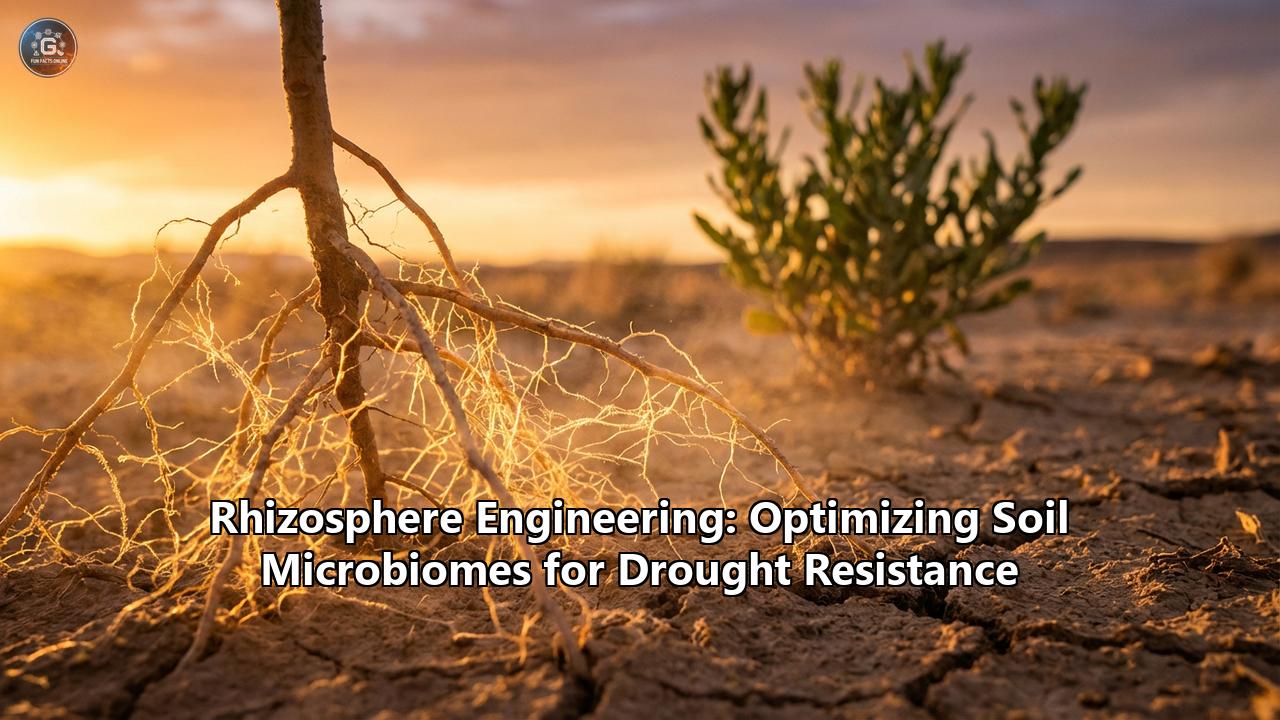
In an era where climate change is rewriting the rules of global agriculture, the silent crisis of water scarcity looms larger than any pest or pathogen. As aquifers deplete and rainfall patterns become increasingly erratic, the scientific community is turning its gaze downward—not just to the roots, but to the microscopic universe that envelops them. This article navigates the cutting-edge discipline of Rhizosphere Engineering, a transformative approach that seeks to redesign the soil microbiome to confer drought resistance to crops. We explore the intricate molecular mechanisms of plant-microbe interactions, from the enzymatic cleavage of stress hormones to the production of bacterial "super-glues" that lock moisture into the soil. We delve into the methodologies of Host-Mediated Microbiome Engineering (HMME) and the construction of Synthetic Microbial Communities (SynComs). Furthermore, we analyze real-world case studies, commercial breakthroughs, and the ethical frontiers of releasing "designer" ecosystems into the wild. This is the story of how humanity is learning to speak the chemical language of the soil to secure the future of food.
1. Introduction: The Hidden Reservoir
The history of agriculture has largely been a history of the visible: the selection of larger seeds, taller stalks, and greener leaves. For ten thousand years, we have bred the plant above the ground, often ignoring the complex life support system below it. The rhizosphere—the narrow zone of soil directly influenced by root secretions and associated soil microorganisms—is arguably the most chemically active and biologically diverse ecosystem on Earth. It is here, in this thin layer of life, that the battle for water is often won or lost.
Drought is a physiological trauma for a plant. It is not merely a lack of water; it is a cascade of cellular failures. Turgor pressure drops, membranes tear, proteins denature, and toxic reactive oxygen species (ROS) flood the cytoplasm. Conventionally, we have addressed this through irrigation and breeding for drought-tolerant genetics. But irrigation is reaching its hydrological limits, and genetic breeding is slowing against the pace of climate change.
Rhizosphere engineering represents a paradigm shift. Instead of asking the plant to survive alone, we are recruiting an army of microscopic allies to fight the battle on its behalf. These allies—Plant Growth-Promoting Rhizobacteria (PGPR) and Arbuscular Mycorrhizal Fungi (AMF)—have evolved over millions of years to help their hosts survive desiccation. They are the original bio-engineers.
Today, we are moving from passive observation to active manipulation. We are no longer just finding beneficial bugs; we are building them. We are engineering "smart soils" where the microbiome is tuned like a Formula One engine, specifically calibrated to retain water, scavenge nutrients, and signal the plant to close its stomata before the first leaf even wilts.
2. The Molecular Machinery of Drought Resistance
To understand how a bacterium can save a corn stalk from withering, we must descend into the molecular trenches. The mechanisms of microbiome-induced drought tolerance are elegant, complex, and highly specific.
2.1. The ACC Deaminase "Stress Buster"
One of the most well-characterized mechanisms involves the modulation of plant stress hormones. When a plant detects water deficit, it produces ethylene. In small amounts, ethylene is a growth regulator; in high concentrations, caused by stress, it is a harbinger of senescence. It triggers leaf drop, stops root growth, and accelerates cell death. It is the plant's way of hitting the panic button.
Enter the bacteria possessing the enzyme 1-aminocyclopropane-1-carboxylate (ACC) deaminase.
The biochemistry is a masterpiece of co-evolution. Ethylene is synthesized in plant tissues from a precursor molecule called ACC. This precursor is water-soluble and is exuded by plant roots into the rhizosphere. Bacteria like Pseudomonas putida or Achromobacter xylosoxidans have evolved to detect this ACC. They absorb it and use the ACC deaminase enzyme to cleave it into ammonia and α-ketobutyrate.
By breaking down the precursor outside the root, the bacteria create a concentration gradient. ACC flows out of the plant root to restore equilibrium, effectively draining the plant's reserves of the stress precursor. The result? The plant cannot produce the massive spike of "stress ethylene" that usually stops growth. The roots keep growing deeper, searching for water, even as the soil dries out. The bacteria get a nitrogen source (ammonia), and the plant gets a lifeline. This interaction is often described as the bacteria "tricking" the plant into thinking it is not under stress.
2.2. Exopolysaccharides: The Soil Hydrogel
If you have ever held a handful of healthy soil, you know it feels different from sterile sand. It is crumbly, yet holds together. This structure is largely due to Exopolysaccharides (EPS)—long-chain sugar polymers secreted by bacteria.
In the context of drought, EPS acts as a biological hydrogel. Strains of Bacillus subtilis and Paenibacillus secrete massive amounts of these hygroscopic (water-attracting) polymers.
- Moisture Sponge: The EPS matrix can hold many times its weight in water, creating a micro-reservoir around the root hairs. When the bulk soil reaches the permanent wilting point, the rhizosphere may still have available water trapped in this bacterial slime.
- Soil Aggregation: EPS acts as a glue, binding soil particles into stable aggregates. These aggregates create porosity, improving water infiltration and reducing evaporation.
- Biofilm Protection: The bacteria form a biofilm over the root surface. This biological plastic wrap reduces water loss from the root itself and maintains the hydraulic continuity between the root and the soil, preventing the dreaded "air gap" that forms when soil shrinks during drying.
2.3. Volatile Organic Compounds (VOCs): Wireless Signaling
Perhaps the most futuristic mechanism is the use of airborne signals. Rhizosphere bacteria release Volatile Organic Compounds (VOCs) such as 2,3-butanediol and acetoin. These molecules can travel through the air pockets in the soil and even diffuse into the atmosphere.
When a plant detects these specific bacterial VOCs, it activates specific signaling pathways (often involving the HKT1 transporter and SOS pathway). This "priming" prepares the plant for drought before it even occurs. It is comparable to a vaccination. The VOCs induce a state of "Induced Systemic Tolerance" (IST).
- Stomatal Regulation: Some VOCs signal the plant to partially close its stomata, conserving water without completely shutting down photosynthesis.
- Root Architecture: VOCs can stimulate lateral root formation, increasing the surface area for water absorption.
2.4. Osmolyte Accumulation: The Anti-Freeze for Drought
To keep water inside a cell when the outside is dry, a plant must lower its osmotic potential. It does this by accumulating "compatible solutes" or osmolytes—molecules that balance the pressure without interfering with cell metabolism.
Microbes accelerate this process. Plants inoculated with specific Azospirillum strains show significantly higher levels of proline, trehalose, and glycine betaine. In some cases, the bacteria produce these osmolytes and secrete them for the plant to take up. In others, they trigger the upregulation of the plant's own osmolyte synthesis genes. Proline, in particular, acts not just as an osmotic balancer but also as a chaperone protein, protecting cellular structures from collapsing under dehydration and scavenging reactive oxygen species.
3. The Engineer's Toolkit: From Discovery to Design
Knowing the mechanisms is one thing; harnessing them is another. The field of Rhizosphere Engineering has moved beyond simple "bioprospecting" (finding good bugs) to sophisticated "synthetic ecology" (building good ecosystems).
3.1. Host-Mediated Microbiome Engineering (HMME)
HMME is a powerful technique that uses the plant as a filter to select the best microbiome. It is essentially "artificial selection" applied to an ecosystem rather than a single organism.
The Protocol:- Selection Round 0: A diverse soil sample (the "inoculum") is collected from a harsh environment, perhaps a desert or a field with a history of drought.
- Stress Test: Plants (e.g., wheat or maize) are grown in this soil and subjected to severe lethal drought.
- Survival of the Fittest: The plants that survive the longest or show the fewest symptoms are identified.
- Transplantation: The rhizosphere soil from these "winner" plants is collected. This soil is now enriched with the microbes that helped those specific plants survive.
- Iteration: This enriched soil is used to inoculate a new generation of seeds. The cycle is repeated 5–10 times.
With each generation, the microbiome becomes more specialized, evolving into a hyper-efficient drought-resistance community. This method bypasses the need to isolate individual species in a petri dish. It respects the complexity of the community, carrying over not just the dominant players but the "helper" species that might be unculturable but essential.
3.2. Synthetic Microbial Communities (SynComs)
While HMME is a "top-down" approach, SynComs are "bottom-up." Here, scientists isolate hundreds of specific bacterial strains, sequence their genomes, and profile their metabolic capabilities.
Using computational modeling and AI, researchers design a "dream team." They might select:
- Strain A for its high ACC deaminase activity.
- Strain B for its massive EPS production.
- Strain C because it produces antifungal compounds to protect Strain A and B.
- Strain D because it can fix nitrogen to support the growth of the others.
These strains are mixed in precise ratios to create a SynCom. The goal is to create a community that is robust, stable, and functionally predictable—something that is notoriously difficult with single-strain inoculants which often die off when introduced to the chaotic environment of real soil.
The "Keystone" Concept: Recent research focuses on identifying "keystone taxa"—microbial species that function like the conductor of an orchestra. They may not be the most abundant, but their presence dictates the structure of the entire community. Engineering the rhizosphere often boils down to successfully establishing just these few keystone species.3.3. Rhizosphere Transplantation
Similar to Fecal Microbiota Transplantation (FMT) in medicine, Rhizosphere Transplantation involves moving the entire microbiome from a healthy, resistant plant to a susceptible one.
In high-value crops like greenhouse tomatoes or medicinal cannabis, this is becoming a viable commercial strategy. Growers can maintain "donor" plants that are verified to have a supreme microbiome. The soil is processed (often via a slurry filtration method to remove pathogens while keeping beneficials) and applied to new seedlings. This "jump-starts" the immune system and stress resilience of the young crop.
4. Case Studies: Success Stories from the Field
The transition from the lab bench to the muddy reality of a farm field is the "Valley of Death" for ag-tech. However, several notable successes prove that rhizosphere engineering is ready for prime time.
4.1. The Wheat Fields of Kansas and Lavie Bio
Lavie Bio, an Israeli ag-biotech company, has been a pioneer in using AI to decipher microbiome functions. Their product, Yalos™ (formerly Thrivus), targets spring wheat, durum, and barley.
In 2023, Lavie Bio released results from extensive field trials across the US wheat belt. The challenge was significant: wheat prices were volatile, and fertilizer costs were skyrocketing. Farmers needed yield stability.
- The Results: In trials covering winter wheat, Yalos demonstrated an average yield increase of 7% to 8%. In specific drought-stressed blocks, the performance gap widened, with treated plants maintaining green leaf area significantly longer than controls.
- The Economics: For a farmer, a 4-bushel-per-acre increase translates directly to profit, often delivering a Return on Investment (ROI) of 3:1 or 4:1. The microbes improved nutrient use efficiency, allowing the crop to do more with less—a critical factor when water is the limiting reagent.
4.2. Corn in the Ukraine: Indigo Ag's Massive Trial
Indigo Ag is one of the "unicorns" of the biologicals world. Their approach involves a massive database of endophytes (microbes that live inside plant tissues).
In a landmark trial partnership with Agroprosperis in Ukraine (one of the world's breadbaskets), Indigo tested their microbial seed treatment, Indigo 30, on corn. The region spans the "Humid Continental" to "Moderate Steppe" climate zones, prone to summer heat waves.
- The Data: Across 50 hectares of side-by-side trials, the microbial treatment delivered an average yield improvement of 425 kg per hectare (approx. 5%). In the highest-performing fields, the uplift was nearly 840 kg/ha (over 7.5%).
- The Mechanism: Agronomists confirmed that the treated corn had significantly denser root masses. The microbes stimulated early root vigor, allowing the plants to tap into subsoil moisture during the critical grain-fill stage when the rains stopped.
4.3. Replacing Nitrogen in the US Corn Belt: Pivot Bio
While primarily marketed for nitrogen fixation, Pivot Bio’s products like PROVEN® 40 and the newer PROVEN® G3 have profound implications for drought resilience.
Synthetic nitrogen fertilizer makes plants "lazy"—they develop shallow root systems because nutrients are abundant at the surface. Pivot Bio’s gene-edited microbes adhere to the root and feed it nitrogen directly.
- Drought Synergy: Because the nitrogen is produced on the root, it is weather-proof. It doesn't need rain to dissolve it and move it to the plant (unlike granular urea), and it doesn't leach away in a flood.
- Field Observations: In 2023 trials, corn treated with Pivot Bio’s microbes showed greater resilience during mid-season dry spells. By reducing the salt index of synthetic fertilizers (which can exacerbate osmotic stress), the microbial nitrogen allowed the plants to maintain turgor pressure better. Reports indicated an 11 bushel/acre advantage in some no-till fields following cereal rye, a scenario notoriously difficult for nitrogen availability.
5. The Commercial Landscape: A Gold Rush in the Soil
The success of these case studies has triggered an investment gold rush. The "Biologicals" market is projected to reach over $25 billion by the end of the decade.
- Indigo Ag: Focuses on "endophytes." Their collection of 30,000+ strains allows them to customize treatments for specific stresses (drought vs. heat vs. nutrient deficiency). Their business model also uniquely connects grain premiums to sustainable practices.
- Pivot Bio: The leader in "synbio" (synthetic biology). They are not just selecting microbes; they are editing the bacterial genome to "re-awaken" nitrogen fixation genes that are normally silenced in the presence of synthetic fertilizers. Their new "dry planter box" formulations for 2026 show the industry moving toward ease-of-use—a major hurdle for farmer adoption.
- Ginkgo Bioworks: The "Intel Inside" of the industry. Ginkgo doesn't sell seeds; they sell the platform to engineer the microbes. Their recent partnership with Bayer (creating a powerhouse formerly known as Joyn Bio) and collaborations with companies like Agricen highlight their role in optimizing the fermentation and manufacturing of these bugs. They are using high-throughput screening to test millions of strain variations.
- AgBiome: Uses a proprietary "GENESIS" platform to sequence and screen microbes. Their patent portfolio (e.g., the "Connate" and "Howler" lines) reveals a strategy of combining biologicals with synthetic chemistry to reduce chemical loads while maintaining efficacy—a "hybrid" approach that appeals to risk-averse farmers.
6. Emerging Technologies: The Frontier of Smart Soils
We are currently in the "Version 1.0" phase of rhizosphere engineering. What does Version 2.0 look like?
6.1. Sentinel Plants and Bio-Sensors
Imagine a plant that can text you when it's thirsty. Scientists are developing "Sentinel Plants" with engineered microbiomes that act as biosensors. These bacteria are designed to fluoresce or produce a specific gas signal when they detect early chemical markers of drought stress in the root zone.
- Drones equipped with hyperspectral cameras could fly over a field, detecting the "SOS signal" from the rhizosphere days before the crop shows visible wilting. This would allow for hyper-precision irrigation, applying water only where the microbiome says it is needed.
6.2. AI and Predictive Microbiomics
The complexity of the soil—with its billions of interacting species—is too great for the human mind to model. AI is stepping in. Companies like Ginkgo Bioworks and start-ups utilizing "Deep Learning" are training models on vast datasets of soil metagenomics.
- The Goal: To predict exactly how a SynCom will behave in a specific soil type with a specific weather forecast. Instead of a "one-size-fits-all" product, a farmer in Nebraska might download a custom microbial recipe for their specific sandy-loam soil and expected July rainfall, which is then printed or fermented on-demand at a local hub.
6.3. CRISPR-Cas9 in the Soil
While controversial, the potential of gene editing in situ is being explored. Researchers are developing "delivery systems" (like bacteriophages) that can inject CRISPR machinery into existing soil bacteria, editing their genomes to enhance EPS production or nitrogen fixation without needing to introduce a new, foreign species. This "gene drive" approach could theoretically upgrade an entire field's microbiome without tilling or replanting.
7. Challenges and Ethical Considerations
Despite the promise, the road ahead is paved with challenges.
7.1. The Consistency Problem: The "Field vs. Lab" gap remains the industry's biggest headache. A microbe that performs miracles in a sterile greenhouse pot often gets outcompeted and eaten within 24 hours in a real field. Native soil microbes are fierce competitors. Solving the "persistence" problem—keeping the engineered microbes alive long enough to do their job—is the primary focus of current R&D. 7.2. Regulatory Purgatory: Is a gene-edited microbe a "fertilizer," a "biostimulant," or a "genetically modified organism" (GMO)? The answer depends on which side of the Atlantic you are on.- USA: Generally more permissive. If the edit mimics a natural mutation (like Pivot Bio's approach), it faces a lighter regulatory path than a transgenic organism.
- EU: Much stricter. The regulatory framework for microbial biostimulants is still evolving, and the label "GMO" can be a commercial death sentence in consumer markets. Companies are navigating this by focusing on "wild-type" selection (HMME) for Europe while reserving gene editing for the Americas.
8. Conclusion: The Second Green Revolution
The First Green Revolution saved a billion lives by altering the plant's genetics and dumping chemicals on the soil. The Second Green Revolution will save the planet by altering the soil's genetics and restoring its biology.
Rhizosphere engineering is not just about keeping corn green during a dry July. It is about fundamentally reimagining agriculture as an ecological partnership. It acknowledges that the plant is not an individual, but a holobiont—a super-organism consisting of the host and its microbiome.
As we stand on the precipice of a hotter, drier world, these invisible engineers offer a tangible hope. They remind us that the solutions to our biggest problems may not lie in looking up at the clouds and praying for rain, but in looking down at the earth and empowering the life within it. By optimizing the rhizosphere, we are not just engineering drought resistance; we are engineering resilience itself.
Reference:
- https://www.frontiersin.org/journals/sustainable-food-systems/articles/10.3389/fsufs.2021.617157/full
- https://www.agriculture.com/pivot-bio-adds-dry-planter-box-options-for-2026-11849697
- https://evogene.com/press_release/lavie-bio-announces-expansion-of-its-bio-inoculant-product-for-spring-wheat-yalos-to-durum-and-barley/
- https://www.global-agriculture.com/global-agriculture/lavie-bio-announces-commercial-expansion-of-yalos-to-winter-wheat/
- https://www.pivotbio.com/
- https://www.prnewswire.com/news-releases/agbiome-secures-patent-protection-for-new-connate-product-line-301085231.html
- https://www.indigoag.com/hubfs/BIO-2022-ProgramGuide_120222.pdf