
The murky waters of Alexandria’s Eastern Harbor have long held the secrets of the Ptolemies, a dynasty that fused Greek intellect with Egyptian grandeur. For centuries, the existence of their legendary "floating palaces"—opulent river barges described by ancient historians—hovered somewhere between historical fact and orientalist fantasy. We had the words of Strabo and the boasts of Callixenus of Rhodes, but we lacked the wood, the nails, and the hull to prove that such decadent vessels truly plied the waters of the Nile Delta.
That changed this week.
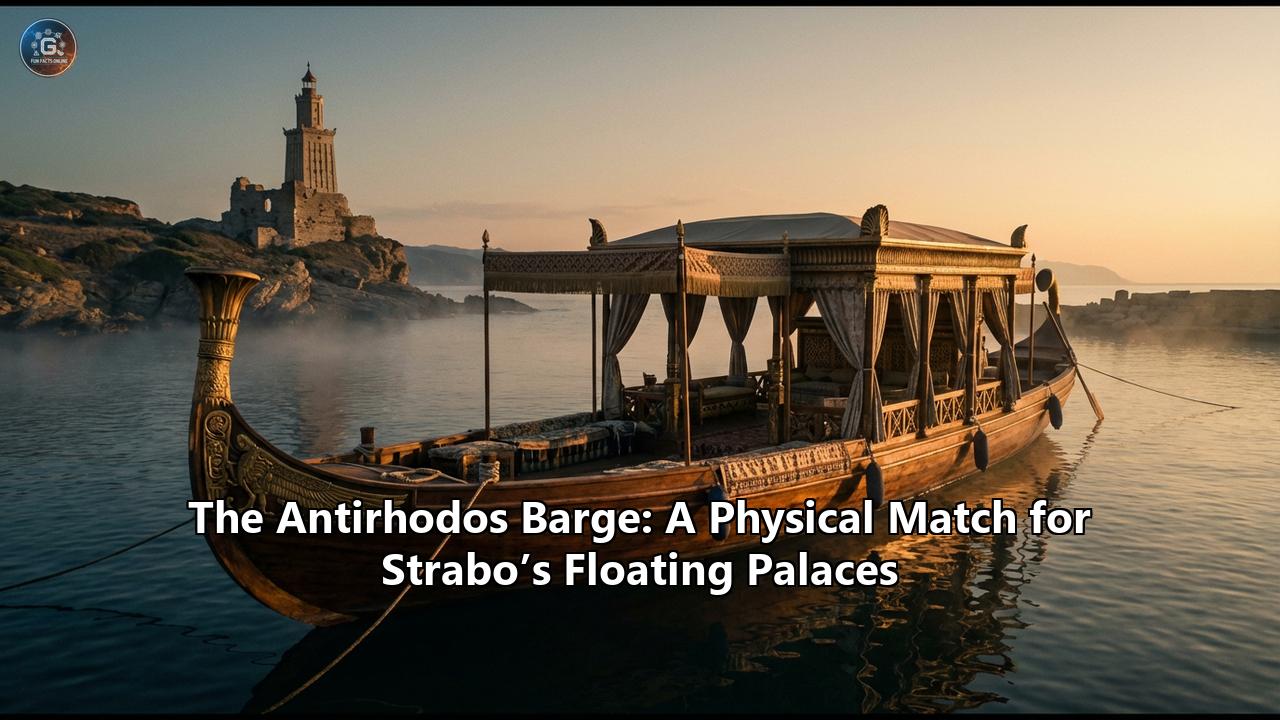
In a discovery that fundamentally alters our understanding of maritime luxury in the ancient world, the European Institute for Underwater Archaeology (IEASM), led by Franck Goddio, has announced the excavation of a remarkably preserved shipwreck off the submerged island of Antirhodos. Preliminary analysis confirms that this vessel is not a warship, nor a merchant freighter, but a thalamagos—a "cabin carrier," a pleasure barge dating to the early Roman period, echoing the precise descriptions left to us by the geographer Strabo over two millennia ago.
This is not merely a shipwreck; it is a time capsule of the transition between Ptolemaic excess and Roman imperial adaptation. It is the physical manifestation of a lifestyle that has captivated the Western imagination since Shakespeare’s Enobarbus described Cleopatra’s barge burning on the water.
The Discovery: A Ghost from the Portus Magnus
The find was made in the Portus Magnus, the Great Harbor of ancient Alexandria, a site that has been under survey by Goddio’s team for decades. The topography of this submerged city is complex; earthquakes and tidal waves in the 4th and 8th centuries AD sent the royal quarters, including the island of Antirhodos, tumbling into the sea.
Buried under meters of protective sediment, the wreck lies just fifty meters from the site of the Temple of Isis. This proximity is the first clue to its identity. The vessel, preserved by the anaerobic conditions of the harbor clay, measures approximately 28 meters in surviving length, with an estimated original length of 35 meters and a beam (width) of 7 meters.
While 35 meters may pale in comparison to modern superyachts, in the context of ancient riverine navigation, this was a significant craft. However, it is not the size that has electrified the archaeological community, but the shape.
The Naval Architecture of Leisure
Unlike sea-going vessels of the period, which featured deep keels and rounded hulls to cut through Mediterranean waves, the Antirhodos barge is emphatically flat-bottomed. The hull features a "hard chine"—a sharp angle where the bottom meets the sides—at the bow, transitioning to a softer, rounded turn at the stern.
This specific architecture tells a story of engineering intent. A flat bottom provides two distinct advantages:
- Shallow Draft: It allows the vessel to navigate the shallow, silt-laden canals that connected Alexandria to the Nile and the sanctuary city of Canopus.
- Stability: It creates a massive, stable platform, minimizing the rolling motion caused by passenger movement. This was a ship designed not for speed, but for stillness—a floating stage for dining, sleeping, and ritual.
The structural timbers are robust, yet they show no evidence of a mast step, indicating the vessel relied entirely on oars or towing. Goddio’s team estimates it would have required twenty to twenty-four rowers to propel the barge, likely slave labor hidden away on a lower level or rowing from outriggers, ensuring the guests on the main deck remained undisturbed by the sweat of propulsion.
Strabo’s Prophecy: The Literary Link
To understand why this rotting wood matters, we must turn to the library of the past. The Greek geographer Strabo visited Egypt around 25 BC, shortly after the fall of Cleopatra and the annexation of Egypt by Rome. In his Geography (Book XVII), he offers a vivid, almost voyeuristic account of the lifestyle along the canal that linked Alexandria to Canopus:
"From Alexandria there is a canal to Canopus... The voyage is full of people who play the flute and dance without restraint, with extreme licentiousness, both men and women, on the boats... They hold feasts in cabin-boats (thalamagoi), in which they enter the thick of the cyami [beans/lotus] and the shade of the leaves."
For centuries, scholars debated the nature of these thalamagoi. Were they small skiffs with awnings? Or were they substantial architectural structures floating on water?
The Antirhodos wreck provides the answer. The beam of 7 meters is exceptionally wide for a ship of this length. This 5:1 ratio is inefficient for speed but perfect for architecture. It confirms that the vessel was built to support a "thalamus"—a large, heavy central pavilion or deckhouse.
The discovery validates Strabo’s eye for detail. This was not a boat you sat in; it was a boat you lived on. The flat hull allowed the ship to glide through the "thick of the cyami," the dense marsh vegetation, without snagging a keel, while the wide deck provided the square footage necessary for the "feasts" and "licentiousness" he described with such Roman puritanism.
The "Thalamagos": Anatomy of a Floating Palace
The term thalamagos literally translates to "room carrier" or "cabin carrier." In the Ptolemaic tradition, these were not merely boats; they were floating extensions of the royal palace.
The Ptolemaic Precedents
The Antirhodos barge is a modest successor to the leviathans of the earlier Ptolemaic era. The most famous of these was the thalamegos of Ptolemy IV Philopator (ruled 221–204 BC), a catamaran monstrosity that was reportedly half a stadium (approx. 90 meters) long. Ancient texts describe it as having:
- A dining hall for twenty couches made of cedar and cypress.
- A sleeping suite for the king and queen.
- A shrine to Aphrodite.
- Columns made of real marble (or high-quality imitation).
While the newly discovered Antirhodos wreck is smaller than Philopator’s giant, it represents the persistence of this distinct naval tradition into the Roman era. It bridges the gap between the Hellenistic mega-barges and the later Roman "Nemi ships" of Emperor Caligula, proving that the technology of luxury barges was a continuous, evolving lineage.
The Roman Adaptation
The graffiti found on the central carling (keelson) of the Antirhodos wreck is written in Greek, the lingua franca of the Eastern Mediterranean, and dates the vessel to the first half of the 1st century AD. This places the ship in the reign of emperors like Tiberius, Caligula, or Claudius.
This timing is crucial. It suggests that even after the fall of Cleopatra, the Roman governors and the surviving Alexandrian elite continued the Ptolemaic tradition of riverine luxury. They adopted the thalamagos lifestyle, cruising the Canopic branch of the Nile, perhaps imitating the very queens they had conquered. The boat is a hybrid artifact: Egyptian environment, Greek language, Roman era.
A Ritual Function? The Navigium Isidis
While the temptation is to view this vessel solely as a "party barge" for drunken revelries, Franck Goddio has proposed a more solemn, yet equally spectacular, possibility.
The ship was found in the shadow of the Temple of Isis. In the 1st century AD, the cult of Isis was exploding in popularity across the Roman world. One of the central festivals of this cult was the Navigium Isidis (The Vessel of Isis), an annual maritime procession that marked the opening of the sailing season.
During this festival, a magnificent, ritually purified ship was launched from the harbor, laden with votive offerings and piloting the "solar barque" of the goddess.
The specific features of the Antirhodos barge align with a ritual function:
- The Wide Deck: Perfect for a procession of priests, musicians, and the display of sacred statuary.
- The Slow Speed: A ritual procession requires a stately, measured pace, achievable only by a barge designed for stability over velocity.
- The Location: Its proximity to the Isis sanctuary suggests it may have been the property of the temple, used to transport the high priesthood or the idol of the goddess herself during the journey to Canopus.
If this theory holds, the "feasts" Strabo described might have been the secular side of a religious coin—the public revelry accompanying a sacred voyage.
The Day the Music Stopped: The Catastrophe of 50 AD
Why did this vessel sink? It does not appear to have been scuttled or slowly abandoned. The timbers are well-preserved, and the context suggests a sudden event.
Archaeologists point to a massive seismic event that struck Alexandria around 50 AD. This earthquake (and likely accompanying tsunami) is believed to be responsible for the destruction of the Temple of Isis on Antirhodos and the initial subsidence of the eastern port.
The scenario is cinematic in its tragedy: The barge, perhaps moored at the temple quay or preparing for a festival, was caught in the violent churning of the harbor waters. The flat-bottomed hull, so stable in calm water, would have been helpless against a tsunami or the liquefaction of the harbor floor. It was swamped, smashed, or simply dragged down as the island itself gave way, settling into the silt that would embrace it for two thousand years.
The Significance of the Find
The discovery of the Antirhodos barge is a milestone in maritime archaeology for three primary reasons:
1. Verification of Textual SourcesArchaeology often struggles to align physical finds with historical texts. Here, the alignment is near-perfect. The hull form explains the "cabin-boat" terminology used by Strabo and Athenaeus. We no longer have to guess how they navigated the shallow lakes and canals; we have the engineering blueprint.
2. Insight into the "Hydro-City"We often think of ancient cities as land masses bordered by water. Alexandria was different; it was a "hydro-city," a Venice of the South, where water was the primary medium of social and royal life. This barge demonstrates that the harbor and canals were not just for transport, but were habitable spaces—extensions of the urban fabric.
3. The Link to CaligulaHistorians have long suspected that Caligula’s famous Nemi ships—the massive floating palaces recovered in Italy in the 1930s—were inspired by his obsession with Egyptian kingship and the Ptolemaic court. The Antirhodos barge provides the "missing link." It shows the type of vessel Caligula would have seen or heard about—the Egyptian prototype that inspired his Roman megalomania.
Conclusion: A Window into the Lost World
As divers continue to document the timbers of the Antirhodos barge, we are granted a rare intimacy with the ancient world. We can imagine the slap of water against the flat hull, the smell of incense drifting from the central pavilion, and the sound of flutes echoing off the stone embankments of the Portus Magnus.
For centuries, the "floating palaces" of Alexandria were dismissed as the exaggerations of poets and the propaganda of kings. Today, resting on the harbor floor, the wood speaks the truth: they were real, they were magnificent, and they were the stage upon which the drama of the ancient world was played out. Strabo did not exaggerate; he merely reported what he saw—a world where luxury knew no boundaries, not even the water's edge.
Reference:
- https://www.franckgoddio.org/shipwreck-k1/
- https://www.labrujulaverde.com/en/2025/12/underwater-discovery-in-alexandria-the-remains-of-a-luxurious-ceremonial-boat-from-the-early-roman-period-emerge/
- https://divemagazine.com/scuba-diving-news/ancient-egyptian-pleasure-barge-discovered-alexandria
- https://www.archaeology.wiki/blog/2025/12/09/alexandria-discovery-of-the-wreck-of-an-ancient-pleasure-boat/
- https://archaeology.org/news/2025/12/09/egyptian-pleasure-boat-discovered-off-alexandrias-coast/
- https://gulfnews.com/world/mena/wreck-of-2000-year-old-leisure-ship-discovered-off-alexandrias-coast-2-1.500374996
- https://archaeologymag.com/2025/12/egyptian-pleasure-barge-unearthed-in-alexandria/
- http://www.thehistoryblog.com/archives/74860
- https://www.discovermagazine.com/a-2-000-year-old-pleasure-barge-resurfaces-in-cleopatra-s-harbor-telling-us-of-life-in-roman-egypt-48377
- https://www.cambridge.org/core/books/abs/ptolemies-the-sea-and-the-nile/hellenistic-royal-barges/CAF05A102A7614DF46DA161A714E178B
- https://en.wikipedia.org/wiki/Thalamegos
- https://www.reddit.com/r/ancientrome/comments/19cx5q8/recreation_of_a_navis_lusoria_used_in_northern/
- https://www.google.com/search?q=time+in+Washington,+DC,+US